

PR Monitoring AI Agent
Workflow-driven AI agent that searches for specific terms, deduplicates results against previously found articles, and emails only new findings with direct links.
Benefits
This agent eliminates the manual monitoring burden entirely and guarantees that no relevant coverage slips through the cracks.
- Zero-effort monitoring: The agent runs on a continuous automated schedule, executing predefined search queries without any manual intervention, ensuring coverage monitoring happens consistently regardless of team bandwidth or vacation schedules
- Intelligent deduplication: Every discovered article is checked against a historical database of previously found results, so team members only receive alerts on genuinely new coverage rather than being flooded with repeat notifications for articles already tracked
- Immediate awareness: New coverage is delivered via email alerts with direct URLs the moment it is discovered, closing the gap between publication and team awareness from days to hours
- Comprehensive keyword coverage: Multiple search queries run in parallel across configurable keyword sets, ensuring that monitoring covers product names, executive mentions, competitor comparisons, industry terms, and any other signals the team needs to track
- Historical coverage database: Every discovered article is stored in a structured dataset, creating a searchable archive of all media coverage over time that supports trend analysis and reporting
- Resource reallocation: By automating the monitoring function entirely, PR team members can redirect the hours previously spent on manual searches toward higher-value activities like relationship building, pitch development, and strategic communications planning
Problem Addressed
Public relations and communications teams at growing organizations face a monitoring challenge that scales faster than their headcount. Every product launch, executive hire, partnership announcement, and industry event creates new keywords to track. Competitors generate coverage that needs to be identified and assessed. Industry publications write about trends where the organization should be mentioned but may not be.
The traditional approach involved team members manually running searches each morning, checking Google Alerts that were inconsistent and incomplete, and maintaining spreadsheets of discovered articles. Coverage was routinely missed. Duplicate articles consumed review time. When a team member was out, monitoring gaps appeared immediately. The organization needed a system that would execute comprehensive searches automatically, recognize articles it had already found, and deliver only net-new coverage to the team without any manual effort.
What the Agent Does
The agent operates as an automated PR monitoring pipeline that continuously discovers, deduplicates, and distributes new media coverage:
- Query execution: The agent runs a configurable set of search queries against news and web sources on a scheduled cadence, pulling fresh results for each predefined keyword combination
- Result extraction: For each search result, the agent extracts the article URL, title, publication source, publication date, and a brief content snippet for context
- Deduplication check: Every extracted URL is compared against the historical dataset of previously discovered articles, and only results that have never been seen before pass through to the alert stage
- Historical dataset update: Newly discovered articles are added to the persistent results dataset, ensuring they will be recognized as duplicates in all future monitoring cycles
- Alert generation: New findings are compiled into a formatted email alert containing the article title, source publication, URL, and relevant snippet for each new result
- Distribution: Alerts are delivered to configurable recipient lists, with the option to route different keyword categories to different team members based on their area of responsibility
Standout Features
- Persistent deduplication memory: The historical results dataset grows with every monitoring cycle, ensuring that the agent's duplicate detection improves over time and never re-alerts on previously discovered coverage regardless of how long ago it was found
- Multi-query orchestration: Multiple independent search queries execute in a single monitoring cycle, covering different keyword combinations, competitors, and topic areas without requiring separate workflows for each
- Configurable scheduling: Monitoring cadence is adjustable from hourly to daily depending on the urgency of the coverage area, with high-priority keywords running more frequently than general brand monitoring
- Source-agnostic discovery: The agent searches across the full web rather than being limited to specific publication databases, catching coverage from niche industry blogs, regional news outlets, and social platforms that traditional monitoring tools miss
- Trend reporting: Beyond individual alerts, the agent generates weekly and monthly coverage summaries showing volume trends, top sources, sentiment patterns, and keyword distribution across all monitored terms
Who This Agent Is For
This agent is built for communications and marketing teams that need comprehensive media monitoring without dedicated monitoring staff or expensive enterprise PR tools.
- PR and communications professionals responsible for tracking media coverage across multiple product lines, executives, and competitive topics
- Marketing leadership who need consistent visibility into brand mentions and industry coverage without depending on manual monitoring processes
- Competitive intelligence teams tracking how competitors are covered in trade publications, analyst reports, and general media
- Executive communications teams monitoring CEO and leadership mentions across news, social, and industry channels
- Agency teams managing media monitoring for multiple clients who need automated, deduplicated alerts at scale
Ideal for: Technology companies, consumer brands, financial services firms, healthcare organizations, and any enterprise where media coverage monitoring is a critical communications function.

Internal Knowledge Chatbot AI Agent
Retrieval-augmented generation chatbot that connects directly to internal knowledge bases, enabling employees to find answers in seconds and reducing support ticket volume across the organization.
Benefits
This agent transforms how employees access institutional knowledge, replacing the friction of searching through documentation or waiting for support responses with instant, conversational answers.
- Reduced support ticket volume: Employees who previously submitted tickets for routine information questions now self-serve through the chatbot, freeing support teams to focus on complex issues that require human expertise
- Seconds instead of hours: Finding an answer that might have required searching through multiple documents, wikis, or knowledge base articles now takes a single conversational query and returns a direct answer
- Consistent answer quality: Every employee receives the same quality of answer regardless of when they ask, how busy the support team is, or whether the subject matter expert is available
- 24/7 availability: The chatbot operates around the clock, supporting employees across all shifts and time zones without staffing constraints that limit traditional support hours
- Knowledge base utilization: Organizations invest significant effort in building knowledge bases that employees rarely use because searching them is too slow. The chatbot transforms that existing investment into active, accessible value
- Onboarding acceleration: New employees can access institutional knowledge conversationally from day one, reducing the ramp time and the burden on colleagues who would otherwise answer the same questions repeatedly
Problem Addressed
A member-owned financial institution had invested in building internal knowledge bases covering policies, procedures, product details, compliance requirements, and operational workflows. The documentation existed. The problem was that employees could not find what they needed when they needed it.
Searching through documentation required knowing which knowledge base to look in, what terminology the documentation used, and having the patience to read through long articles to find the specific paragraph that answered a particular question. Most employees took the faster path: they submitted a support ticket or asked a colleague. This created two problems. First, the support team was overwhelmed with questions that had documented answers, spending time on retrieval rather than resolution. Second, colleagues who became known as subject matter experts found their own productivity disrupted by constant interruptions. The organization had a knowledge problem disguised as a support problem. The knowledge existed. Employees just could not access it efficiently.
What the Agent Does
The agent operates as a retrieval-augmented generation chatbot that bridges the gap between existing knowledge bases and employee questions:
- Knowledge base connection: The chatbot connects directly to the organization's internal knowledge bases, indexing documentation across policies, procedures, product information, compliance requirements, and operational guides
- Natural language query processing: Employees ask questions in plain language without needing to know which knowledge base contains the answer or what specific terminology the documentation uses
- Retrieval-augmented generation: The RAG architecture retrieves the most relevant documentation passages first, then generates answers grounded in that specific content, ensuring responses are based on actual organizational knowledge rather than general AI training data
- Source citation: Every answer includes references to the specific knowledge base articles and sections it drew from, allowing employees to verify the information and read additional context when needed
- Conversational follow-up: Employees can ask follow-up questions to drill deeper into a topic, clarify specific points, or explore related areas without starting a new search from scratch
- Continuous knowledge coverage: As knowledge bases are updated with new policies, procedures, or product information, the chatbot's index refreshes automatically, ensuring answers reflect the most current documentation
Standout Features
- Grounded responses: RAG architecture ensures the chatbot answers from organizational documentation rather than generating plausible-sounding but potentially incorrect responses from general training data
- Cross-knowledge-base search: Employees do not need to know which knowledge base contains their answer. The chatbot searches across all connected sources simultaneously, handling questions that span multiple documentation repositories
- Source transparency: Every response includes citations back to the original documentation, maintaining trust and enabling verification that is critical in compliance-sensitive environments like financial services
- Escalation path: When the chatbot cannot find a confident answer in the knowledge base, it transparently indicates the limitation and offers to create a support ticket, ensuring no question goes completely unanswered
- Usage analytics: The system tracks which questions are asked most frequently and which questions it cannot answer well, providing the knowledge management team with data to improve documentation coverage where it matters most
Who This Agent Is For
This agent is designed for organizations with substantial internal knowledge bases where the investment in documentation is not translating into employee self-service because the search and access experience is too slow.
- Financial institutions where employees need quick access to policy, compliance, and product documentation to serve members effectively
- IT support teams overwhelmed with routine questions that have documented answers buried in knowledge bases employees do not search
- HR departments managing employee questions about benefits, policies, and procedures that are fully documented but poorly accessed
- Operations teams where procedural questions interrupt experienced staff who become informal knowledge sources
- Any organization that has invested in building knowledge bases but finds employees still default to asking colleagues or submitting tickets
Ideal for: Financial institutions, member-owned cooperatives, insurance companies, healthcare organizations, and any enterprise where internal documentation exists but employee access to that knowledge remains a friction point that drives support volume and slows operations.
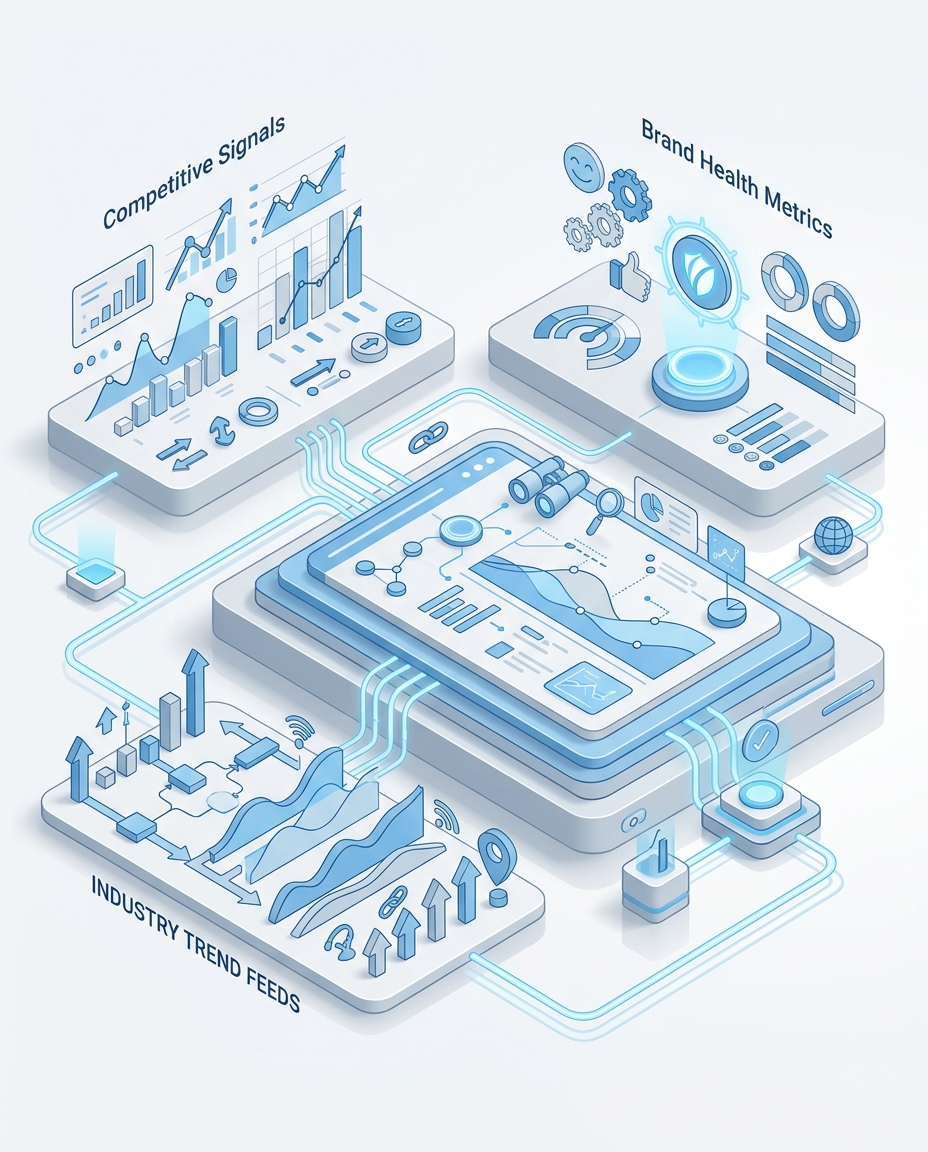
Marketing Intelligence AI Agent
Single-app AI agent monitoring industry updates, brand health, competitive positioning, customer intelligence, and market share through integrated notebook-powered analysis.
Benefits
Marketing teams are drowning in data spread across dozens of tools. This agent surfaces what matters and puts it in one place.
- Single source of truth: Brand health metrics, competitive movements, customer intelligence, industry trends, and market share data are unified in one application instead of scattered across multiple disconnected tools and spreadsheets
- Real-time competitive awareness: The agent continuously monitors competitor activity, product announcements, and positioning changes, ensuring marketing leadership sees competitive shifts as they happen rather than weeks later
- Customer intelligence integration: Internal customer data including closed-loss reasons, NPS trends, and feature requests is surfaced alongside external market data, connecting customer voice to strategic decision-making
- Trend-driven content strategy: Industry trend monitoring identifies emerging topics and shifting priorities before they become mainstream, giving content and product marketing teams a timing advantage
- Executive-ready reporting: All intelligence is pre-formatted for leadership consumption, eliminating the weekly scramble to compile marketing performance and competitive updates from multiple sources
- Reduced tool sprawl: By consolidating intelligence from multiple external sources into automated notebook-powered pipelines, the organization eliminates redundant monitoring subscriptions and manual data collection efforts
Problem Addressed
Marketing organizations at technology companies face an overwhelming intelligence problem. Competitive landscapes shift weekly. Industry analyst reports drop quarterly. Customer feedback arrives daily through support tickets, NPS surveys, and sales call notes. Brand sentiment fluctuates across social channels, review sites, and media coverage. Market share data updates on different cadences from different research providers.
The result is a fragmented intelligence picture where critical signals get buried in noise. A product marketing manager tracking competitive positioning opens one tool. A content strategist monitoring industry trends opens another. A demand gen leader checking brand health opens a third. Nobody has the complete picture, and the act of assembling it manually takes hours every week that could be spent on strategy and execution. When leadership asks for a market intelligence briefing, the team scrambles to compile data from eight different sources into a coherent narrative. The organization needed a single intelligence layer that automatically collects, processes, and presents all marketing-relevant signals in one unified view.
What the Agent Does
The agent operates as a comprehensive marketing intelligence platform powered by automated data collection pipelines and AI-driven analysis:
- Industry monitoring: Automated notebooks continuously scan industry news feeds, analyst publications, and technology trend reports, extracting relevant developments and categorizing them by topic, urgency, and strategic relevance
- Brand health tracking: The agent aggregates brand sentiment data from review platforms, social media mentions, media coverage, and analyst reports into a composite brand health score with trend analysis
- Competitive positioning analysis: Product announcements, pricing changes, messaging shifts, and market movements across competitors are tracked and analyzed, with AI-generated comparison summaries highlighting strategic implications
- Customer intelligence synthesis: Internal data from CRM systems, support platforms, and feedback channels is processed to surface closed-loss patterns, feature demand signals, and customer satisfaction trends
- Market share reporting: Data from research providers and internal pipeline analysis is combined to track market share trends, segment performance, and competitive win/loss ratios over time
- Unified dashboard delivery: All intelligence streams are rendered in a single interactive application that enables drill-down exploration, time-range filtering, and custom view configuration for different stakeholder needs
Standout Features
- Notebook-powered automation: All data collection and processing runs through scheduled computational notebooks, making the intelligence pipeline transparent, version-controlled, and easily extensible when new data sources need to be added
- Cross-signal correlation: The agent identifies connections between different intelligence streams, such as correlating a competitor product launch with a spike in closed-loss mentions of that competitor in the same quarter
- Priority-weighted alerting: Not all intelligence is equally urgent. The agent classifies incoming signals by strategic priority and only escalates items that cross configurable importance thresholds
- Historical trend analysis: Every intelligence metric includes historical context, so users can see whether current readings represent a meaningful shift or normal fluctuation compared to prior periods
- Custom view configuration: Different stakeholders see different intelligence slices. Product marketing gets competitive deep-dives. Demand gen gets brand health and market share. Leadership gets the executive summary with drill-down capability
Who This Agent Is For
This agent is designed for marketing organizations that need to make strategic decisions based on a complete, continuously updated picture of their competitive landscape and market position.
- Marketing leadership who need a unified intelligence briefing instead of manually assembling data from multiple tools before every planning meeting
- Product marketing managers tracking competitive positioning, analyst sentiment, and market messaging trends across their competitive set
- Content strategists monitoring industry trends and customer voice signals to identify high-impact topics and emerging themes
- Demand generation leaders tracking brand health, market share, and campaign performance in the context of competitive activity
- Strategy teams evaluating market dynamics, segment performance, and competitive threats to inform long-range planning
Ideal for: Technology companies, SaaS vendors, financial services firms, healthcare organizations, and any enterprise where marketing strategy depends on continuous competitive and market intelligence.

Implementation Planning AI Agent
AI agent that walks users through their business problems conversationally, then generates full implementation plans complete with business impact, technical requirements, and resourcing needs.
Benefits
This agent converts what is typically a multi-week scoping exercise into a structured, repeatable process that produces deployment-ready implementation plans in minutes.
- Structured problem decomposition: The conversational interface guides users through a systematic problem analysis framework, ensuring that requirements are captured completely rather than surfacing mid-implementation as scope changes
- Platform capability mapping: Each identified business problem is automatically mapped to the specific platform capabilities that address it, eliminating the knowledge gap between what users need and what the technology can deliver
- Quantified business impact: Generated plans include projected business impact estimates based on comparable implementations, giving stakeholders the data they need to prioritize and approve projects
- Technical specification generation: The agent produces detailed technical requirements including data source integrations, transformation logic, security configurations, and infrastructure dependencies
- Resource estimation: Each plan includes staffing recommendations with role types, estimated hours, and skill requirements, enabling project managers to build accurate timelines and budget requests
- Self-service accessibility: Users who lack deep platform expertise can generate high-quality implementation plans independently, reducing the bottleneck on solutions architects and technical consultants
Problem Addressed
Organizations adopting complex analytics and data management platforms face a consistent challenge: translating business problems into concrete implementation plans requires deep platform expertise that most users do not possess. Solutions consultants and architects spend significant time in discovery sessions, manually mapping business requirements to platform capabilities, estimating technical effort, and documenting implementation approaches.
This process was slow, inconsistent, and heavily dependent on individual expertise. Two consultants given the same business problem would produce plans with different structures, different capability recommendations, and different effort estimates. Customers waiting for implementation plans experienced delays that pushed back time-to-value. Internal teams lacked a standardized framework for scoping, leading to projects that were under-specified at kickoff and required expensive mid-flight corrections. The organization needed a system that could encode platform expertise into a repeatable process, producing consistent, comprehensive implementation plans from conversational input.
What the Agent Does
The agent operates as an AI-powered solutions architect that conducts structured discovery and generates complete implementation specifications:
- Conversational discovery: The agent engages users in a guided conversation, asking targeted questions about their business context, current pain points, existing data sources, stakeholder requirements, and success criteria
- Problem classification: User responses are analyzed and classified against a taxonomy of known business problem patterns, enabling the agent to match stated needs against proven solution architectures
- Capability recommendation: For each identified problem, the agent recommends specific platform features, integrations, and configurations, explaining how each capability addresses the stated requirement
- Architecture generation: The agent assembles individual capability recommendations into a coherent implementation architecture, identifying integration points, data flow dependencies, and sequencing requirements
- Impact and effort modeling: Each plan includes projected business impact metrics, estimated implementation effort in hours by role, and a phased delivery timeline with milestone definitions
- Document generation: The complete plan is rendered as a structured document with executive summary, technical specifications, resource requirements, risk factors, and recommended next steps
Standout Features
- Adaptive questioning: The conversational flow adjusts dynamically based on user responses, drilling deeper into areas of complexity while skipping sections that are not relevant to the stated business problem
- Solution template library: The agent draws from a curated library of proven implementation patterns, ensuring that recommendations reflect real-world best practices rather than theoretical configurations
- Dependency-aware sequencing: Generated plans account for technical dependencies between implementation phases, ensuring that foundational components are built before the features that depend on them
- Multi-scenario planning: Users can generate multiple plan variants at different investment levels (minimum viable, recommended, and comprehensive), enabling informed trade-off discussions with stakeholders
- Exportable deliverables: Plans are generated in formats suitable for executive presentations, technical handoff documents, and project management tools, eliminating the need for manual reformatting
Who This Agent Is For
This agent is built for anyone who needs to convert business requirements into structured implementation plans without requiring deep platform architecture expertise.
- Solutions consultants who need to produce consistent, comprehensive implementation plans faster and with less manual effort
- Account executives who want to generate preliminary solution scopes during the sales process to accelerate deal progression
- Customers evaluating platform capabilities who need to see a concrete implementation path for their specific business problems before committing
- Project managers scoping new initiatives who need accurate effort estimates and resource requirements to build realistic timelines
- Technical architects validating that proposed solutions leverage the full range of available platform capabilities
Ideal for: Technology platform vendors, systems integrators, enterprise IT organizations, consulting firms, and any team that repeatedly translates business requirements into technical implementation plans.
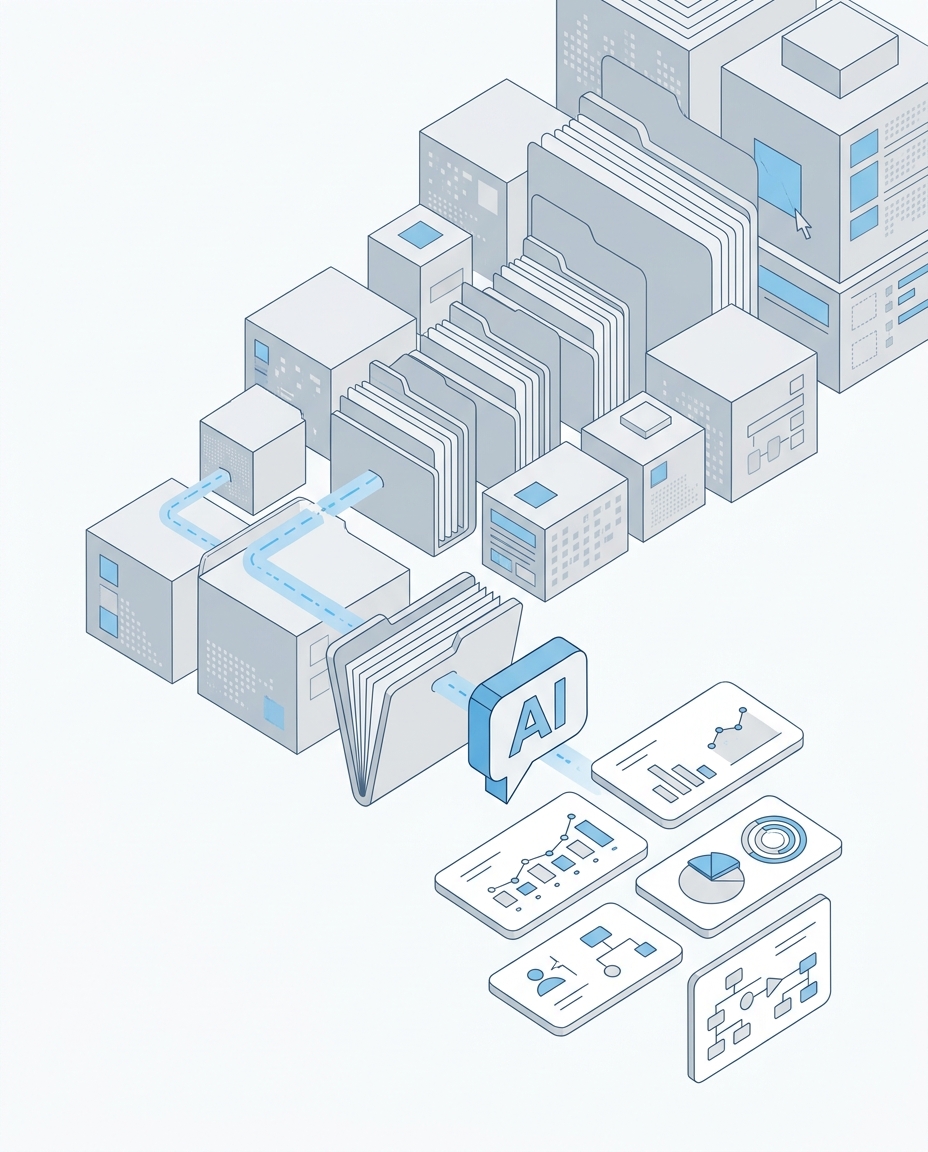
Census Data Chat AI Agent
Conversational AI agent that guides users through complex, deeply nested census datasets via clarifying questions, returning summaries, data tables, and auto-generated visualizations.
Benefits
This agent makes deeply technical, complexly structured public datasets genuinely accessible to people who have important questions but no data engineering skills.
- Democratized data access: Researchers, policymakers, journalists, and citizens can explore complex census data through natural conversation without needing to understand nested data structures, variable codes, or query syntax
- Guided exploration: The agent asks clarifying questions to help users refine vague inquiries into precise data requests, preventing the frustration of getting irrelevant results or no results from poorly formed queries
- Multi-format responses: Answers arrive as summaries, structured data tables, and auto-generated charts, giving users the format most appropriate for their question rather than forcing all answers into a single presentation mode
- Reduced data literacy barrier: Users who previously needed to understand census data structures, geographic hierarchies, and variable naming conventions can now access the same information through plain language questions
- Faster time to insight: Exploration that previously required loading datasets into statistical software, identifying relevant variables, and writing queries now happens in real time through conversation
- Public engagement amplification: By making census data conversationally accessible, the organization fulfills its mission of making public information genuinely public, not just technically available
Problem Addressed
A public policy organization maintains large, complex, publicly available census datasets. The data is deeply nested, inconsistently structured across survey years, and encoded with variable names that require reference documentation to interpret. The organization's mission is to make this data accessible to the public and to researchers studying demographic and economic trends.
In practice, the data was available but not accessible. A researcher wanting to compare educational attainment across counties would need to identify the correct survey tables, understand the geographic hierarchy encoding, locate the right variables across potentially different naming conventions between survey years, and either use statistical software or build custom queries to extract the answer. For the general public, the barrier was even higher. The data existed to inform democratic participation and policy discussion, but only people with data engineering skills could actually use it. The organization needed an interface that could meet users at their level of data literacy and guide them to the answers they were looking for.
What the Agent Does
The agent operates as a multi-agent conversational system that translates natural language questions into structured data exploration:
- Question interpretation: The agent parses user questions to identify the demographic dimensions, geographic scope, time range, and comparison type being requested, mapping colloquial language to census data concepts
- Clarifying dialogue: When a question is ambiguous or underspecified, the agent asks targeted clarifying questions rather than guessing. If a user asks about income, the agent might ask whether they mean household or individual income, and for which geographic area
- Dataset scanning: Multiple agent components scan available datasets to identify which survey tables, years, and variables contain the data needed to answer the query, handling cross-year naming inconsistencies automatically
- Query execution: The agent constructs and executes optimized queries against the census data store, retrieving precisely the data needed rather than returning entire tables for the user to filter manually
- Summary generation: Results are presented first as natural language summaries that answer the user's question directly, with key findings highlighted and context provided for interpretation
- Visualization creation: When appropriate, the agent auto-generates charts, maps, or comparison tables that visualize the data, choosing the visualization type that best matches the nature of the question and the data structure
Standout Features
- Multi-agent architecture: Separate agents handle question interpretation, dataset scanning, query construction, and response generation, allowing each component to specialize in its domain rather than forcing a single model to handle all tasks
- Guided exploration mode: Rather than requiring users to know exactly what they want, the agent supports exploratory conversations where users can progressively refine their questions based on initial results
- Cross-year data normalization: The agent automatically handles variable naming changes, geographic boundary adjustments, and methodology shifts between census survey years, presenting consistent results across time periods
- Adaptive response format: The agent selects the best response format based on the question type, a count question gets a number with context, a comparison gets a table, a geographic question gets a map, and a trend question gets a time series chart
- Public-facing deployment: The agent is designed for embedding on public websites where users range from data scientists to citizens with no technical background, handling the full spectrum of data literacy gracefully
Who This Agent Is For
This agent is built for organizations that maintain complex public datasets and need to make that data genuinely accessible to audiences without data engineering skills.
- Public policy organizations seeking to fulfill open-data missions by making complex datasets conversationally accessible
- Researchers who need to explore census and demographic data quickly without loading datasets into statistical software
- Policy analysts comparing demographic indicators across geographies and time periods for briefing documents and reports
- Journalists investigating demographic trends who need quick, accurate data retrieval to inform reporting
- Government agencies that publish public data and want to increase citizen engagement with that information
Ideal for: Public policy organizations, government data portals, research institutions, civic technology providers, and any entity that maintains complex public datasets and recognizes that data accessibility requires more than just publishing files online.

Data Impact Governance AI Agent
AI-enhanced governance agent that prevents risky changes to critical data systems, summarizes dataflow modifications, and enables natural language exploration of dataset differences.
Benefits
If you manage data pipelines in any production environment, you already know the anxiety of deploying changes to critical dataflows. This agent acts as your always-on safety net.
- Change impact visibility: Every dataflow modification is automatically summarized by AI before it reaches production, giving data engineers a clear, plain-language explanation of what changed and what downstream assets are affected
- Risk prevention at the gate: The governance layer evaluates proposed changes against criticality ratings and dependency chains, flagging high-risk modifications before they can break dashboards, reports, or downstream pipelines
- Faster incident diagnosis: When data issues arise, AI-powered change summaries let engineers quickly identify which recent modification caused the problem without manually diffing dataflow versions
- Natural language data exploration: Non-technical stakeholders can ask plain-language questions about differences between dataset versions, reducing the burden on data teams to investigate and explain every anomaly
- Audit trail automation: Every change, approval, and impact assessment is logged automatically, creating a complete governance record without requiring engineers to maintain manual documentation
- Reduced rollback frequency: By catching risky changes before deployment, the agent significantly reduces the number of emergency rollbacks and the production downtime they cause
Problem Addressed
Data engineering teams operating large-scale analytics environments face a persistent governance challenge: changes to critical data pipelines can have cascading effects that are difficult to predict and expensive to repair. A single modification to a dataflow transformation can break dozens of downstream dashboards, corrupt calculated metrics, or introduce silent data quality issues that go undetected for days.
The traditional approach relied on peer review of dataflow code, but reviewers lacked the tooling to quickly understand the full impact of proposed changes. Engineers spent hours tracing dependency chains manually. When issues did reach production, diagnosing the root cause meant comparing dataflow versions line by line. Meanwhile, business users noticed data discrepancies in their reports but had no way to understand what had changed or why. The organization needed a governance layer that could evaluate change risk automatically, explain modifications in plain language, and give non-technical users the ability to investigate data differences on their own.
What the Agent Does
The agent provides a comprehensive governance and productivity toolkit that sits between data engineers and their production pipeline environment:
- Change detection and summarization: When a dataflow is modified, the agent compares the current and proposed versions, then generates a plain-language summary of what changed, including added or removed transformations, altered join logic, and modified filter conditions
- Dependency impact analysis: The agent maps downstream consumers of the affected dataflow — datasets, cards, alerts, and other dataflows — and scores the blast radius of the proposed change based on asset criticality and usage patterns
- Risk classification: Each proposed change is classified as low, medium, or high risk based on the criticality of affected assets, the nature of the modification, and the historical stability of the pipeline
- AI-Readiness Q&A: Users can ask natural language questions about differences between output datasets, such as asking why row counts changed, which columns have new null values, or how aggregated metrics shifted between versions
- Approval workflow integration: High-risk changes are routed through configurable approval workflows, ensuring that the right stakeholders review and approve modifications before they reach production
- Historical change tracking: The agent maintains a complete history of all dataflow modifications with their AI-generated summaries, making it easy to trace when and why specific changes were made during incident investigations
Standout Features
- AI-generated change summaries: Instead of reading raw dataflow diffs, engineers get concise, context-aware explanations of what each modification does and why it matters, written in language that both technical and non-technical stakeholders can understand
- Blast radius scoring: Every proposed change receives a quantified impact score based on the number and criticality of downstream dependencies, making it easy to distinguish routine updates from high-risk modifications that require extra scrutiny
- Natural language dataset comparison: The AI-Readiness layer lets users ask conversational questions about how datasets differ between versions, eliminating the need for custom SQL queries or manual data profiling to investigate anomalies
- Criticality-aware gating: The governance rules are configurable by pipeline criticality tier, so mission-critical dataflows get stricter change controls while development pipelines maintain engineering velocity
- Proactive drift detection: The agent continuously monitors output datasets for unexpected changes in row counts, schema, or value distributions, alerting engineers to silent data quality issues even when no explicit dataflow changes were made
Who This Agent Is For
This agent is designed for data teams that operate production analytics environments where pipeline stability directly impacts business decision-making.
- Data engineers responsible for maintaining and modifying production dataflows who need a faster way to assess change impact before deployment
- BI administrators managing large card and dashboard environments who need early warning when upstream pipeline changes threaten report accuracy
- Data governance teams establishing change control processes for critical data assets without creating bottlenecks that slow engineering velocity
- Analytics managers who need to quickly investigate and explain data discrepancies reported by business users
- Platform administrators responsible for maintaining data quality SLAs across hundreds of interconnected pipelines and datasets
Ideal for: Enterprise analytics teams, data platform operators, business intelligence organizations, and any environment where data pipeline changes carry production risk that requires structured governance.

Relationship Mapping AI Agent
AI agent that analyzes engagement and contact metadata to label, categorize, and score customer contacts across dimensions including title, seniority, department, engagement level, and influence.
Benefits
This agent delivers measurable outcomes for every team that depends on understanding who matters inside a customer account and why.
- Complete account visibility: Every contact across every account is scored and categorized automatically, giving sales and success teams a clear picture of relationship depth without manually tracking engagement in spreadsheets or CRM notes
- Influence-weighted prioritization: Contacts are ranked not just by title but by actual engagement patterns and organizational influence, so teams focus their time on the people who drive decisions rather than the people with the biggest titles
- Early risk detection: Declining engagement scores across key contacts surface account health risks before they become churn events, giving customer success teams weeks of lead time to intervene
- Strategic expansion targeting: The relationship map reveals white space in accounts where key departments or seniority levels lack any engaged contacts, creating a clear playbook for multi-threaded account growth
- Onboarding acceleration: New account executives inherit a scored, categorized contact map rather than starting from scratch, reducing ramp time and preserving institutional knowledge when territories change hands
- Data-driven QBR preparation: Quarterly business reviews are grounded in objective relationship data rather than anecdotal impressions, making executive conversations more credible and action-oriented
Problem Addressed
Customer-facing teams at a large enterprise organization struggled with a fundamental challenge: they had no systematic way to understand the quality, depth, or strategic value of their relationships across customer accounts. Contact records existed in the CRM, but they were flat lists with no indication of who actually influenced purchasing decisions, who was actively engaged, or where critical relationship gaps existed.
Account executives relied on memory and intuition to prioritize outreach. Customer success managers discovered key contacts had gone silent only after renewal conversations stalled. New hires joining a territory inherited names and email addresses but no context about relationship strength or organizational dynamics. The organization needed a system that could continuously evaluate every customer contact across multiple dimensions and surface actionable intelligence about relationship health at the account level.
What the Agent Does
The agent operates as a continuous relationship intelligence engine that ingests contact metadata and engagement signals, then produces scored, categorized relationship maps across the entire customer portfolio:
- Contact metadata ingestion: The agent pulls contact records from the CRM along with title, department, seniority level, and organizational hierarchy data to establish a baseline profile for each individual
- Engagement signal aggregation: Email interactions, meeting attendance, event participation, support ticket involvement, and product usage data are collected and normalized into a unified engagement score for each contact
- Multi-dimensional scoring: Each contact is evaluated across five dimensions — title authority, organizational seniority, departmental relevance, engagement frequency, and influence indicators — producing a composite relationship score
- Relationship classification: Contacts are automatically labeled as champions, economic buyers, technical evaluators, end users, or passive contacts based on their scoring profile and behavioral patterns
- Account-level mapping: Individual contact scores are aggregated into an account-level relationship map that shows coverage depth, engagement concentration, and strategic gaps across departments and seniority levels
- Trend monitoring: The agent tracks score changes over time, flagging contacts whose engagement is declining and highlighting newly active contacts who may represent emerging opportunities or risks
Standout Features
- Influence detection beyond title: The scoring engine identifies contacts who punch above their title weight by analyzing engagement patterns, meeting inclusion, and cross-functional involvement — surfacing hidden influencers that title-based analysis would miss
- Relationship decay alerts: When engagement scores for key contacts drop below configurable thresholds, the agent triggers proactive alerts with recommended re-engagement actions before relationships go cold
- Multi-threading scorecards: Each account receives a multi-threading score showing how well the relationship portfolio covers key departments and decision-making levels, with specific guidance on where to build new connections
- Dynamic segmentation: Contacts are continuously re-segmented as their engagement patterns evolve, ensuring that relationship classifications stay current rather than reflecting stale snapshots
- Visual relationship maps: Scored contacts are rendered in interactive network visualizations that show relationship clusters, influence paths, and coverage gaps at a glance
Who This Agent Is For
This agent is built for organizations where understanding the depth and quality of customer relationships directly impacts revenue retention, expansion, and strategic account management.
- Account executives managing complex enterprise accounts who need to identify and prioritize the contacts that drive purchasing decisions
- Sales leadership seeking objective visibility into relationship depth across the entire customer portfolio to forecast risk and opportunity
- Customer success managers responsible for ensuring multi-threaded engagement across accounts to reduce single-point-of-failure risk
- Revenue operations teams building data-driven account health models that incorporate relationship strength as a core metric
- New hires onboarding into customer-facing roles who need rapid context on the people and dynamics within their assigned accounts
Ideal for: B2B technology companies, professional services firms, financial services organizations, and any enterprise with complex, multi-stakeholder customer relationships that require systematic management.

Enterprise AI Chatbot + Analytics Agent
Post-merger analytics unification with an AI chatbot that enables natural-language queries across centralized business data, reducing invoice review by 90% and cutting month-end close by days.
Benefits
This agent transforms a fragmented, post-merger data landscape into a unified intelligence platform where every employee can access analyst-quality answers through natural conversation.
- 90% reduction in invoice review: Automated analytics reduced the percentage of invoices requiring manual review from 100% to approximately 10%, freeing the finance team to focus on exceptions rather than routine verification
- Month-end close accelerated by 2-3 days: Centralized data and automated reconciliation workflows compressed the monthly close cycle, delivering financial results faster to leadership and stakeholders
- Natural-language data access: Non-technical employees ask questions in plain language and receive accurate, contextual answers without learning query languages, dashboard navigation, or report-building tools
- Secure data architecture: The AI chatbot operates on derived analytics and governed data views rather than accessing raw sensitive data directly, maintaining security boundaries while delivering comprehensive insights
- Organization-wide analytics adoption: Self-service analytics scaled beyond the data team to every department, transforming data from a specialist tool into a strategic asset accessible to the entire organization
- Post-merger data unification: Disparate systems from merged entities were consolidated into a single analytical layer, eliminating the siloed KPIs and inconsistent metrics that plagued cross-entity reporting
Problem Addressed
Following a merger, a people-data solutions company found itself operating across disparate systems with siloed KPIs that made unified analytics impossible. Each legacy entity tracked different metrics in different systems using different definitions. The finance team reviewed every invoice manually because no automated system could reconcile across the fragmented data landscape. Non-technical employees depended entirely on the analytics team for any data question, creating a bottleneck where ad-hoc report requests competed with strategic analysis for limited analyst time.
The organization needed two things simultaneously: a unified data foundation that reconciled metrics across merged entities, and an access layer that made that unified data available to every employee without requiring technical skills. Simply building dashboards was not sufficient. The organization had tried dashboards. Non-technical users still could not find what they needed without help. The access layer needed to meet users where they were: asking questions in natural language and expecting clear answers.
What the Agent Does
The agent operates across two layers: a data unification foundation and a conversational AI access layer:
- Data centralization: Connectors pull data from all legacy systems into a unified analytical layer, reconciling metric definitions, standardizing dimensions, and creating a single source of truth across merged entities
- Intelligent dashboards: Unified data powers interactive dashboards that provide structured analytical views for teams who prefer visual exploration, with consistent metrics and definitions across all views
- AI chatbot interface: The conversational agent accepts natural-language questions about business performance, translates them into data queries, and returns formatted answers with visualizations when appropriate
- Secure data access layer: The chatbot queries derived analytical views and governed datasets rather than raw transactional data, ensuring sensitive information remains protected while still enabling comprehensive business intelligence
- Automated financial workflows: Invoice processing, reconciliation, and close activities are automated through the unified data layer, reducing manual review requirements and accelerating financial cycles
- Progressive analytics scaling: Starting with finance and operations, the platform expanded department by department, with each team receiving tailored dashboards and chatbot capabilities aligned to their specific data needs
Standout Features
- RAG-powered accuracy: The chatbot uses retrieval-augmented generation to ground responses in actual business data rather than generating plausible-sounding but potentially inaccurate answers, maintaining analytical credibility
- Privacy-preserving architecture: The AI never directly accesses raw sensitive data. All responses are generated from governed analytical views, maintaining compliance boundaries while providing comprehensive intelligence
- Cross-entity metric reconciliation: The unified data layer resolves definitional conflicts between merged entities, so when a user asks about revenue or customer count, the answer reflects a single, agreed-upon definition regardless of data origin
- Finance process automation: The 90% reduction in invoice review demonstrates that the unified data foundation enables process automation beyond just analytics, creating operational value alongside intelligence value
- Scalable self-service model: The chatbot democratizes data access without democratizing data risk, allowing every employee to become analytically self-sufficient within the guardrails the data team defines
Who This Agent Is For
This agent is designed for organizations navigating post-merger data integration or seeking to democratize analytics access across a non-technical workforce.
- Post-merger integration teams facing disparate systems and conflicting KPI definitions that prevent unified reporting
- Finance teams spending excessive time on manual invoice review and reconciliation that could be automated through data centralization
- Non-technical employees who need business answers but cannot navigate complex dashboards or write data queries
- Analytics leaders seeking to scale data access organization-wide without scaling the analytics team proportionally
- Compliance and security teams that need conversational AI to operate within governed data boundaries rather than accessing raw sensitive information
Ideal for: Post-merger organizations, people-data companies, financial services firms, any mid-to-large enterprise where data silos, manual financial processes, and limited self-service analytics create drag on decision speed and operational efficiency.


Account Signals AI Agent
AI monitoring agent that continuously analyzes call transcripts and account activity data to detect growth and risk signals over time, automatically surfacing recommended action plans for account teams to act on proactively.
By the time the account manager noticed the risk signals, the customer had already started evaluating alternatives.
In every account management organization, there is a gap between when a risk signal first appears and when someone acts on it. A customer mentions in a call that they are "exploring options." An executive sponsor stops attending meetings. Usage metrics decline for two consecutive months. Support ticket volume doubles. Each of these signals is individually visible in some system somewhere. The call transcript contains the quote. The meeting attendance is in the calendar. The usage data is in the dashboard. The support tickets are in the helpdesk. But no one is systematically watching all of these signals across all accounts simultaneously, correlating them over time, and alerting the account team before the pattern becomes a crisis.
The Account Signals AI Agent was built to close this detection gap. It continuously monitors account activity across multiple data sources, identifies patterns that indicate either growth opportunity or churn risk, and surfaces those signals with specific recommended action plans before they become urgent.
Benefits
This agent transforms account management from a reactive practice into a signal-driven operation where every growth opportunity and risk indicator receives attention at the earliest possible moment.
- Early risk detection: Risk signals that previously went unnoticed for weeks or months are surfaced within days of their first appearance, giving account teams the response window they need to intervene effectively
- Proactive growth capture: Growth signals, such as expanding use cases, increased stakeholder engagement, and positive sentiment trends, are identified and flagged for account teams to capitalize on before the customer needs to ask
- Data-driven action plans: Every surfaced signal comes with specific recommended actions grounded in the account data, replacing generic playbooks with context-specific guidance
- Reduced account surprises: Leadership gains visibility into account trajectory trends across the entire portfolio, reducing the surprise escalations and unexpected churn that erode forecast accuracy
- Consistent monitoring coverage: Every account receives the same systematic monitoring regardless of the account manager's bandwidth, eliminating the coverage gaps that occur when busy managers deprioritize routine account reviews
- Portfolio-level pattern recognition: The agent identifies trends across the entire account base, surfacing systemic patterns such as industry-specific churn indicators or feature adoption sequences that correlate with expansion
Problem Addressed
Account managers are supposed to be proactive. They are supposed to notice when engagement drops, when sentiment shifts, when competitive mentions increase, when adoption stalls. In reality, they are managing fifteen to thirty accounts simultaneously, preparing for meetings, responding to escalations, and processing renewal paperwork. Proactive monitoring requires dedicated time that the daily demands of the role do not leave. The result is that risk signals are discovered reactively, when the customer raises an issue directly, when the renewal conversation reveals unexpected objections, or when the quarterly business review surfaces months of declining engagement that nobody flagged.
The cost of late detection is asymmetric. Catching a risk signal early means a conversation. Catching it late means a save attempt. Missing it entirely means churn. The same asymmetry applies to growth signals. Identifying expansion potential early means a strategic conversation. Identifying it late means the customer already solved their problem through another vendor. The data to detect these signals early exists. It is scattered across call transcripts, activity logs, usage metrics, and support records. The problem is not data availability. It is systematic attention at a scale that human monitoring cannot sustain across a full account portfolio.
What the Agent Does
The agent operates as a continuous monitoring layer across account data sources, detecting signals and generating actionable intelligence:
- Call transcript analysis: The agent processes call transcripts to detect sentiment changes, competitive mentions, expansion indicators, frustration signals, and commitment language that reveals account trajectory
- Activity pattern monitoring: Login frequency, feature usage, meeting attendance, support interactions, and engagement metrics are tracked over time to identify trend changes that precede major account events
- Longitudinal signal detection: Rather than evaluating each data point in isolation, the agent correlates signals over time, identifying patterns such as gradually declining engagement combined with increasing support tickets that indicate developing risk
- Growth and risk classification: Detected signals are classified by type, including expansion readiness, churn risk, executive sponsor change, competitive threat, adoption stall, and sentiment shift, with severity scoring based on signal strength and historical pattern matching
- Action plan generation: For each surfaced signal, the agent generates specific recommended actions grounded in the account context, including suggested conversation topics, stakeholder outreach priorities, and escalation thresholds
- Dashboard and notification delivery: Signals are presented in a monitoring dashboard with configurable notifications that alert account teams through their preferred channels when signals exceed defined thresholds
Standout Features
- Multi-source signal correlation: The agent correlates signals across call transcripts, CRM activity, usage data, and support interactions, detecting compound patterns that no single data source would reveal independently
- Temporal pattern recognition: Signals are evaluated in the context of their trajectory over time, distinguishing between a temporary dip in engagement and a sustained decline that indicates structural risk
- Context-specific action plans: Recommended actions are generated from the specific account context, not from generic playbooks, ensuring that the guidance reflects the actual relationship dynamics and recent interactions
- Configurable signal sensitivity: Account teams can adjust detection sensitivity per account tier, monitoring strategic accounts at higher sensitivity and long-tail accounts at thresholds appropriate to their risk profile
- Portfolio-level trend surfacing: Beyond individual account signals, the agent identifies patterns across the entire portfolio, such as industry-specific risk trends or feature adoption sequences that predict expansion, providing strategic intelligence for leadership
Who This Agent Is For
This agent is designed for account management and customer success organizations where the size of the account portfolio exceeds the team's capacity for manual proactive monitoring.
- Account managers responsible for portfolios large enough that systematic monitoring of every account is impractical through manual review alone
- Customer success leaders seeking to shift their teams from reactive firefighting to proactive signal-driven engagement
- Sales leadership needing early visibility into account risk and expansion potential across the portfolio for forecast accuracy and resource allocation
- Revenue operations teams building systematic account health scoring that incorporates behavioral and conversational signals alongside traditional metrics
- Any customer-facing organization where the cost of late risk detection or missed growth signals represents measurable revenue impact
Ideal for: Customer success managers, account executives, sales directors, revenue operations leads, and any organization where the volume of accounts exceeds the team's capacity for manual monitoring and the cost of a missed signal, whether risk or growth, is too high to leave to chance.

Capital Markets Report AI Agent
AI agent that pulls relevant market data into a formatted structure and generates weekly capital markets communications, allowing executives to review, edit, and send directly from the application.
Benefits
This agent eliminates a recurring time burden from a senior executive's schedule while maintaining full editorial control over the final communication.
- Two to three hours saved weekly: A recurring Friday task that consumed a significant portion of a senior executive's afternoon is reduced to a quick review-and-send workflow
- Consistent delivery cadence: The weekly communication goes out on schedule regardless of executive availability, travel, or competing priorities that previously caused delays or missed sends
- Data-driven content: The AI generates narrative directly from current market data rather than relying on the executive to manually interpret and describe data trends, reducing the risk of misstatement or omission
- Editorial control preserved: The executive reviews, edits, and approves every communication before it sends, maintaining the personal authority and voice that recipients expect from senior leadership content
- Single-interface workflow: Data retrieval, content generation, editing, and distribution all happen within one application, eliminating the multi-tool workflow of pulling data, writing in a separate editor, and switching to email for distribution
- Institutional knowledge capture: The AI's content generation incorporates patterns and context from historical communications, ensuring continuity even if the responsible executive changes roles
Problem Addressed
A residential mortgage lender sends a weekly capital markets communication to its builder partners and referral network. This email summarizes the week's rate movements, market conditions, product updates, and forward guidance. The VP of Capital Markets was responsible for preparing and sending this communication every Friday.
The process consumed two to three hours of the VP's time each week. It involved pulling current rate data, reviewing market movements, analyzing relevant economic indicators, drafting narrative that contextualized the data for the audience, formatting the email, and distributing it to the contact list. The content required both data accuracy and market expertise. It could not be delegated to a junior team member who lacked the analytical context, and it could not be skipped because builder partners relied on it for their own planning. The VP was trapped in a weekly cycle: the communication was too important to stop and too time-consuming to sustain without automation.
What the Agent Does
The agent operates as an AI-powered content generation pipeline embedded in a custom application interface:
- Data ingestion: The application pulls current mortgage rate data, market indicators, and relevant financial metrics into a structured format, assembling the factual foundation for the weekly communication
- CSV formatting: Raw data is organized into a formatted structure that provides the AI with clean, contextualized inputs including period-over-period comparisons, trend indicators, and benchmark references
- AI content generation: The agent analyzes the formatted data and generates a complete draft of the weekly communication, including market summary, rate analysis, product updates, and forward-looking commentary
- Review interface: The draft appears in an editing interface where the executive can review every paragraph, modify language, add personal commentary, and adjust emphasis before finalizing
- Distribution: Once approved, the communication is sent directly from the application to the configured recipient list without requiring the executive to switch to a separate email tool
- Archive and tracking: Every sent communication is archived with the underlying data snapshot, creating a historical record of market communications that supports compliance and trend analysis
Standout Features
- Market-aware content generation: The AI does not just describe numbers. It contextualizes rate movements against market expectations, economic indicators, and historical patterns, producing narrative that reads like it was written by someone who understands capital markets
- Editable draft workflow: The system produces a draft, not a final product. The executive maintains full editorial authority, ensuring every communication reflects their judgment and voice before it reaches recipients
- Data-to-distribution pipeline: The entire workflow from raw data to sent email operates within a single application, eliminating the context switches between data tools, document editors, and email clients that fragment the manual process
- Historical pattern learning: The content generation incorporates patterns from previous communications, maintaining consistency in tone, structure, and analytical framing across weeks
- Compliance-ready archive: Every communication is stored alongside the data that informed it, creating a defensible record for regulatory review of market communications
Who This Agent Is For
This agent is designed for professionals who produce recurring data-driven communications where the preparation burden is disproportionate to the final output.
- Capital markets executives who spend hours each week preparing market update communications for partners and stakeholders
- Mortgage lending professionals who need to communicate rate and market changes to builder networks and referral partners regularly
- Financial services leaders responsible for recurring market commentary that requires both data accuracy and analytical context
- Marketing teams supporting executives with data-driven content production who want to accelerate the creation cycle
- Any professional who writes recurring reports or communications that follow a consistent structure but require fresh data interpretation each cycle
Ideal for: Capital markets VPs, mortgage lending executives, financial advisors producing market commentary, investment managers writing client letters, and any professional trapped in a recurring cycle of data-to-narrative content production.

Knowledge Transfer AI Agent
AI-powered account intelligence agent that analyzes call transcripts, CRM records, and account data to generate comprehensive summaries for account handoffs and pre-meeting preparation, ensuring continuity across team transitions.
The architecture behind an AI system that reads every call transcript and CRM record to produce the account summary that used to take hours of manual review
Inside a sales engineering organization, account handoffs and pre-meeting preparation shared a common dependency: someone had to review months of call transcripts, CRM notes, support tickets, and account history to construct a coherent picture of where an account stood. For handoffs, the outgoing account owner would spend hours assembling a briefing document that attempted to capture the relationship context, open issues, strategic direction, and stakeholder dynamics that the incoming owner would need. For meeting prep, the assigned engineer would spend thirty minutes to an hour scanning recent calls and CRM entries to refresh their memory before walking into a customer conversation.
The Knowledge Transfer AI Agent automates this synthesis by processing the full corpus of account data, including call transcripts, CRM records, meeting notes, and support history, and generating structured account summaries that serve both handoff and preparation use cases.
Benefits
This agent eliminates the manual research and synthesis work that gates both account handoffs and meeting preparation quality.
- Faster, more complete handoffs: Account transitions include comprehensive AI-generated summaries covering relationship history, open initiatives, stakeholder dynamics, and pending actions, replacing the incomplete manual briefings that previously led to dropped context
- Reduced meeting prep time: Pre-meeting account refreshes that previously required thirty minutes of manual CRM and transcript review are replaced by a one-click summary that synthesizes all relevant recent activity
- Consistent handoff quality: Every handoff summary follows the same comprehensive structure regardless of the outgoing owner's documentation habits, ensuring the incoming owner always receives the full context
- Preserved relationship continuity: Critical context about customer preferences, sensitivities, and relationship dynamics is captured in the summary, reducing the customer friction that occurs when a new account owner asks questions the previous owner already knew the answers to
- Comprehensive account intelligence: The AI processes every call transcript and data source, surfacing patterns and context that a manual reviewer might miss when scanning for specific information under time pressure
- Team scalability: As the account portfolio grows, summary generation scales automatically without requiring proportional increases in the time experienced team members spend on briefing preparation
Problem Addressed
Account handoffs in sales organizations are information transfer problems disguised as process problems. The outgoing owner possesses months or years of accumulated context: which stakeholders are the real decision-makers, what the customer's unspoken concerns are, which topics have been discussed and resolved, which promises have been made, and where the relationship stands emotionally as well as contractually. Transferring this context manually requires the outgoing owner to remember everything relevant, organize it coherently, and document it in a format the incoming owner can quickly absorb. In practice, handoff documents are incomplete. They capture the obvious facts but miss the nuances that make the difference between a smooth transition and one where the customer feels like they are starting over.
Meeting preparation suffers from a different version of the same problem. The information exists across CRM records, call transcripts, email threads, and support tickets. But synthesizing it into a coherent pre-meeting mental model requires reviewing multiple data sources and connecting threads across them. Under the time pressure of a packed calendar, this review is often abbreviated to a quick glance at the most recent CRM note, which may or may not contain the context that matters for the upcoming conversation.
What the Agent Does
The agent processes multiple account data sources and generates structured intelligence summaries through an automated analysis pipeline:
- Call transcript ingestion: The agent processes all available call transcripts associated with the account, extracting topics discussed, commitments made, concerns raised, and stakeholder interactions across the full conversation history
- CRM record analysis: Account metadata, opportunity history, contact records, activity logs, and custom fields are analyzed to establish the factual foundation of the account relationship
- Cross-source synthesis: Information from transcripts, CRM records, and other data sources is correlated and synthesized into a unified account narrative that resolves contradictions and fills gaps that exist in any single source
- Structured summary generation: The agent produces a formatted account summary with standard sections covering account overview, key stakeholders, current initiatives, open issues, recent activity, and recommended next actions
- Handoff-optimized formatting: For handoff scenarios, the summary emphasizes relationship context, historical decisions, and ongoing commitments that the incoming owner needs to understand immediately
- Meeting-prep quick view: For pre-meeting scenarios, the summary surfaces recent activity, pending action items, and conversation context most relevant to the upcoming interaction
Standout Features
- Full transcript corpus processing: The agent does not sample or summarize individual calls. It processes the complete transcript history, identifying patterns and context that emerge across multiple conversations over time
- Stakeholder relationship mapping: The summary identifies key stakeholders, their roles in decision-making, their stated and implied priorities, and the nature of their engagement across recorded interactions
- Dual-mode output: The same underlying analysis produces both detailed handoff documents and concise meeting-prep summaries, serving different use cases without requiring separate analysis passes
- Commitment and action tracking: The agent extracts specific commitments made by both sides during calls and tracks their resolution status across subsequent conversations, surfacing unfulfilled promises before they become relationship issues
- One-click generation: Account summaries are generated on demand through a single action, eliminating the multi-step research process that previously required accessing and reviewing multiple systems manually
Who This Agent Is For
This agent is designed for sales and customer-facing organizations where account transitions and meeting preparation quality directly impact customer experience and revenue retention.
- Account executives transitioning accounts who need to provide comprehensive context to incoming owners without spending hours on manual briefing documents
- Sales engineers preparing for customer meetings who need a quick, complete refresh on account status and recent activity
- Customer success managers maintaining large account portfolios who cannot manually review full account histories before every interaction
- Sales leadership overseeing account transitions who need confidence that relationship context is preserved through team changes
- Any customer-facing team where the quality of meeting preparation and handoff documentation directly affects customer satisfaction and retention
Ideal for: Account executives, sales engineers, customer success managers, sales leaders, and any revenue organization where the time cost of manual account research and the information loss during handoffs represent measurable risks to customer relationships and revenue continuity.

Deployment Automation AI Agent
Agentic AI deployment pipeline that automates code and asset promotion across development, QA, and production environments with built-in version control, rollback safeguards, and enterprise governance through human-AI collaboration.
What used to take engineering sprints to deploy now moves through environments automatically with rollback protection built in from day one
A global workforce management platform serving enterprise retailers needed to accelerate its development cycles without sacrificing the governance controls its customers required. Code promotion across their development, QA, and production environments was a manual process that consumed multiple engineering sprints. Each deployment involved coordinating between teams, verifying configurations, running manual checks, and executing the promotion steps in sequence. The process worked, but it was slow, resource-intensive, and created a bottleneck that limited how quickly the engineering team could iterate. In an industry where customers expect rapid feature delivery and zero-downtime reliability, the deployment pipeline was the constraint, not the development velocity.
The Deployment Automation AI Agent was built to solve this with an agentic approach: AI-driven automation handles the promotion mechanics while engineers maintain oversight through governance checkpoints and rollback safeguards. What previously required sprints of engineering coordination was delivered in days.
Benefits
This agent transforms deployment from a manual engineering exercise into an automated pipeline with enterprise-grade safeguards.
- Sprint-to-days acceleration: Code promotion cycles that previously consumed engineering sprints complete in a fraction of the time through automated environment promotion and validation
- Built-in rollback protection: Every promotion includes automatic version snapshots and rollback capabilities, ensuring that any deployment can be reversed without manual recovery procedures
- Enterprise governance preserved: Automated promotion follows the same approval chains and validation steps as manual deployment, maintaining the compliance posture that enterprise customers require
- Reduced deployment risk: Automated validation checks catch configuration mismatches and compatibility issues before they reach production, reducing the incidents that previously occurred during manual promotions
- Engineering time reclaimed: Development teams spend their time building features rather than managing deployment logistics, directly increasing the organization's innovation velocity
- Scalable foundation: The automated pipeline handles increasing deployment frequency and complexity without requiring proportional increases in DevOps staffing
Problem Addressed
For platform companies serving enterprise customers, the deployment pipeline is a paradox. The business demands rapid iteration and frequent releases. The customers demand stability, governance, and zero-downtime deployments. Manual deployment processes try to satisfy both by adding more checks, more coordination, and more people to the promotion workflow. The result is a process that is thorough but glacially slow. Engineering teams that could ship features weekly are constrained to monthly release cycles because the deployment pipeline itself is the bottleneck.
The cost is not just slower delivery. It is compounding technical debt. When deployments are difficult and infrequent, teams batch changes together into larger releases. Larger releases carry more risk. More risk requires more testing. More testing requires more time. The deployment pipeline that was designed to ensure stability becomes the mechanism that makes instability more likely by forcing larger, riskier releases. The solution is not more manual process. It is automation that preserves governance while eliminating the manual coordination that creates the bottleneck.
What the Agent Does
The agent manages the complete code promotion lifecycle across multiple environments through an automated pipeline with built-in governance:
- Environment state management: The agent maintains a current snapshot of code assets, configurations, and dependencies in each environment, ensuring that promotion decisions are based on accurate state information
- Automated promotion execution: Code and asset packages are promoted from development to QA to production through automated workflows that handle the transfer, configuration adjustment, and deployment steps without manual intervention
- Version control integration: Every promotion creates a versioned snapshot that links the exact code state in each environment to a specific deployment event, enabling precise rollback to any previous state
- Validation gates: Automated checks run between promotion stages, verifying configuration consistency, dependency compatibility, and deployment prerequisites before allowing code to advance to the next environment
- Rollback safeguards: If a promotion fails validation or causes issues in the target environment, the agent can automatically or manually trigger a rollback to the previous known-good state
- Human-AI governance checkpoints: Critical promotion steps, particularly the final push to production, include approval gates where authorized personnel review and authorize the deployment, maintaining the oversight that enterprise governance requires
Standout Features
- Days-not-sprints delivery: The agentic AI approach compressed what traditionally required multi-sprint engineering efforts into a deployment pipeline that was operational in days, demonstrating the velocity advantage of human-AI collaboration in infrastructure automation
- Multi-environment orchestration: The agent handles the full promotion chain across development, QA, and production environments, managing the configuration differences and dependency mappings that make cross-environment promotion complex
- Atomic rollback capability: Rollbacks restore the complete environment state, not just the code, including configuration changes, dependency versions, and asset states, ensuring clean recovery without partial state issues
- Governance-first design: Enterprise compliance requirements are embedded in the pipeline as first-class constraints rather than bolted-on approvals, ensuring that automation accelerates delivery without bypassing the controls customers depend on
- Agentic AI collaboration: The system operates as an AI agent that executes promotion steps autonomously while maintaining human decision authority at critical junctures, modeling the human-AI collaboration pattern that balances speed with accountability
Who This Agent Is For
This agent is designed for engineering organizations where manual deployment processes have become the primary constraint on development velocity and release frequency.
- Platform companies serving enterprise customers who require governance-compliant deployment processes that do not sacrifice delivery speed
- Engineering teams spending sprint capacity on deployment coordination rather than feature development
- DevOps leaders seeking to automate multi-environment promotion while maintaining rollback safety and audit trails
- SaaS organizations scaling their deployment frequency who need pipeline automation that grows with their release cadence
- Any software organization where the deployment process takes longer than the development process for a given feature
Ideal for: Engineering managers, DevOps leads, platform architects, release managers, and any organization where manual deployment coordination is the bottleneck between code completion and customer delivery.

Compensation App Builder AI Agent
Agentic AI code generation that replaced a manual spreadsheet-based bonus process with a governed enterprise application featuring multi-level approvals, real-time budget controls, payroll exports, and immutable audit trails.
Benefits
This agent demonstrates how agentic AI can compress enterprise application development timelines by 60-70% while producing governance-grade output that spreadsheet processes cannot match.
- 60-70% development acceleration: Human-AI collaboration compressed what would have been a multi-engineer, multi-week development effort into a dramatically shorter delivery timeline without sacrificing application quality or completeness
- Eliminated spreadsheet risk: A critical compensation process that ran on uncontrolled spreadsheets now operates in a governed application with access controls, version management, and change tracking
- Multi-level approval governance: Bonus allocations flow through configurable approval chains where each level reviews within their authority, ensuring no compensation decision bypasses appropriate oversight
- Real-time budget enforcement: Managers see live budget utilization as they allocate bonuses, preventing overspend before it happens rather than discovering it after commitments are made
- Immutable audit trail: Every allocation, approval, modification, and export is recorded with user attribution and timestamps, creating a compliance-ready record that spreadsheets fundamentally cannot provide
- Scalable compensation management: The application handles complex multi-location, multi-level compensation structures that would require dozens of interconnected spreadsheets to manage manually
Problem Addressed
A national services operator managing locations across the country ran its bonus compensation process through spreadsheets. Regional managers received spreadsheet templates, entered bonus allocations for their teams, and emailed completed files back to corporate HR and finance for review. The process touched hundreds of employees across multiple organizational levels and geographic regions.
The problems were the predictable consequences of running a governed financial process through an ungoverned tool. Spreadsheets were emailed between approvers with no version control. Budget limits existed as numbers in a cell that anyone could override. Approval chains were tracked through email threads that were easily lost. When payroll needed the final numbers, someone had to manually consolidate dozens of spreadsheet files and hope that no conflicting versions existed. Audit requests required reconstructing the approval history from email archives. The organization knew the process was fragile, but rebuilding it as a proper enterprise application would require multiple engineers working for weeks. That investment was hard to justify against other development priorities until agentic AI changed the cost equation.
What the Agent Does
Agentic AI code generation designed and built a production-grade enterprise compensation application through human-AI collaboration:
- Application architecture: AI agents analyzed the existing spreadsheet workflow, identified all business rules, approval chains, budget constraints, and data relationships, and designed a comprehensive application architecture
- Code generation: Development agents generated the full application codebase including data models, business logic, user interfaces, approval workflows, and integration endpoints, with human engineers reviewing and guiding output
- Multi-level approval engine: The application implements configurable approval chains where bonus allocations route through the appropriate management levels based on amount thresholds, organizational hierarchy, and business unit rules
- Real-time budget controls: Live budget dashboards show allocated versus available funds at every organizational level, with hard limits that prevent allocations from exceeding approved budgets
- Payroll integration: Approved bonus allocations export directly to payroll systems in the required format, eliminating manual data entry and the reconciliation errors it introduces
- Immutable audit logging: Every action in the application is recorded in an append-only audit log capturing the user, timestamp, action, previous value, and new value for complete reconstruction of any allocation's history
Standout Features
- AI-accelerated development: The 60-70% reduction in development effort demonstrates that agentic AI can produce enterprise-grade applications, not just prototypes, when paired with experienced engineers who guide architecture and review output
- Governance-first design: Unlike spreadsheet workarounds that bolt governance on after the fact, the application was designed from the ground up with access controls, approval workflows, and audit trails as core architectural elements
- Hierarchical budget visualization: Budget utilization cascades through the organizational hierarchy, allowing corporate leadership to see total spend while regional managers see their allocation, all from a single real-time data source
- Configurable approval routing: Approval chains adapt to organizational structure changes without code modifications, supporting the reality that reporting relationships and authority levels change more frequently than the compensation process itself
- Complete process replacement: The application does not just digitize the spreadsheet. It replaces the entire process end-to-end, from initial allocation through final payroll export, eliminating every manual handoff in the chain
Who This Agent Is For
This agent is relevant to organizations running critical business processes through spreadsheets that need governed applications but face resource constraints in traditional development approaches.
- HR and compensation teams managing bonus, commission, or incentive processes through spreadsheets that lack governance and audit capability
- Finance teams responsible for budget enforcement in compensation processes where spreadsheet-based controls are easily circumvented
- Regional and district managers who need clear visibility into their compensation budgets and approval status without spreadsheet confusion
- Compliance officers requiring immutable audit trails for compensation decisions that spreadsheet-based processes cannot provide
- Development teams evaluating how agentic AI can accelerate delivery of governed enterprise applications within their organizations
Ideal for: Multi-location service organizations, franchise operators, HR departments managing distributed compensation processes, finance teams enforcing budget governance, and any organization where a spreadsheet-based business process has outgrown its tooling but traditional development timelines delay modernization.

Route Optimization AI Agent
Constraint-driven AI optimization system that dynamically assigns technicians to jobs and generates real-time routes based on availability, skills, geography, and business rules to maximize field service productivity.
More appointments completed per day. Less windshield time. Zero overlapping assignments. That is what happens when dispatch decisions are driven by algorithms instead of instinct.
A home services technology company faced the operational challenge that defines field service at scale: getting the right technician to the right job at the right time while minimizing the travel time between appointments. Their dispatchers were making these assignments manually, juggling technician availability, skill requirements, geographic proximity, job duration estimates, and customer time windows simultaneously. The result was predictable: inconsistent technician utilization, unnecessary travel between distant jobs, schedule conflicts from overlapping assignments, and a daily capacity ceiling that was lower than it should have been given the number of technicians and appointments in the system.
The Route Optimization AI Agent replaced manual dispatch decision-making with a constraint-driven optimization system that processes all variables simultaneously to produce technician assignments and route sequences that maximize productive time and minimize travel waste.
Benefits
This agent delivers measurable operational improvements by replacing heuristic dispatch decisions with mathematically optimized assignments and routing.
- Reduced travel time and fuel costs: Optimized route sequencing minimizes the distance between consecutive appointments, directly cutting the fuel, vehicle, and lost-productivity costs associated with windshield time
- Increased appointments per technician per day: By eliminating scheduling gaps and reducing transit time, each technician completes more productive appointments within the same working hours
- Eliminated schedule conflicts: Algorithmic assignment prevents the overlapping bookings and double-assignments that manual dispatching inevitably produces under time pressure
- Skill-matched assignments: Every job is routed to a technician with the appropriate skills and certifications, reducing the callbacks and repeat visits that occur when underqualified technicians are assigned to specialized work
- Improved schedule consistency: Customers receive more accurate appointment windows because the system accounts for realistic travel times and job durations rather than optimistic manual estimates
- Scalable dispatch operations: The system handles growing technician teams and appointment volumes without requiring additional dispatchers, making it feasible to expand operations without proportionally increasing dispatch overhead
Problem Addressed
Manual dispatching in field service is an optimization problem that humans solve approximately but never optimally. A dispatcher looking at a board of twenty technicians and sixty appointments cannot simultaneously evaluate every possible assignment permutation to find the one that minimizes total travel time while respecting every skill requirement, availability window, and geographic constraint. Instead, dispatchers rely on heuristics: assign the closest available technician, group jobs by neighborhood, alternate between job types to manage fatigue. These heuristics work reasonably well but leave significant efficiency on the table.
The inefficiency compounds throughout the day. A suboptimal assignment at 8 AM creates a geographic positioning problem at 10 AM that cascades into a scheduling gap at 2 PM. By the end of the day, the cumulative effect of locally reasonable but globally suboptimal decisions means the team completed fewer appointments than the schedule could have supported with better routing. The dispatchers are not making mistakes. They are solving an impossibly complex problem with insufficient tools. The math required to find truly optimal assignments across all constraints simultaneously exceeds what any human can process in the seconds available between dispatch decisions.
What the Agent Does
The agent operates as a real-time optimization engine that continuously produces optimal technician assignments and route sequences:
- Appointment and schedule ingestion: The agent pulls current appointment data including locations, time windows, job types, duration estimates, and special requirements into its optimization model
- Technician profile matching: Each technician's current location, skill certifications, availability window, active assignments, and vehicle capacity are integrated into the constraint set
- Constraint-driven assignment: The optimization engine evaluates all feasible technician-job assignments simultaneously, selecting the combination that maximizes total productive time while respecting every operational constraint
- Geographic route sequencing: Once assignments are determined, jobs are sequenced to minimize total travel distance, accounting for real-time traffic patterns and geographic clustering opportunities
- Conflict prevention: The system enforces hard constraints against overlapping assignments, insufficient travel time between appointments, and skill mismatches, preventing the scheduling errors that manual dispatch allows under pressure
- Real-time re-optimization: When conditions change, such as a cancellation, a new urgent job, or a technician running late, the agent re-optimizes affected routes without disrupting assignments that are already in progress
Standout Features
- Multi-constraint simultaneous optimization: Unlike systems that handle skills, geography, and availability as sequential filters, this agent evaluates all constraints simultaneously to find globally optimal assignments rather than locally filtered ones
- Real-time re-optimization: The system does not produce a static daily plan. It continuously re-evaluates and adjusts as conditions change throughout the day, keeping assignments optimal against current reality rather than morning assumptions
- Dispatcher override support: The agent respects manual dispatcher constraints and locked assignments, optimizing around fixed decisions rather than requiring full algorithmic control, supporting a gradual trust-building adoption path
- Capacity-aware scaling: The optimization model scales to handle hundreds of technicians and thousands of appointments without degraded solution quality, using computational approaches that maintain optimization performance as problem size grows
- Geographic intelligence: Route optimization incorporates real geographic data and travel time estimates rather than simple distance calculations, producing routes that reflect actual driving conditions and road networks
Who This Agent Is For
This agent is designed for field service operations where the volume of daily appointments and technicians exceeds what manual dispatching can optimize effectively.
- Home services companies managing dispatching across plumbing, HVAC, electrical, and general maintenance technicians
- Field service organizations seeking to increase appointments completed per technician per day without adding headcount
- Dispatch teams overwhelmed by the complexity of simultaneously managing skills, geography, availability, and customer time windows
- Operations leaders tracking travel time and fuel costs who need systematic route optimization rather than dispatcher-dependent heuristics
- Growing service businesses that need dispatch processes that scale with appointment volume without proportionally scaling dispatch staff
Ideal for: Dispatch managers, field service directors, operations leaders, fleet managers, and any home services or field service organization where the gap between current and optimal technician utilization represents a measurable revenue and cost opportunity.
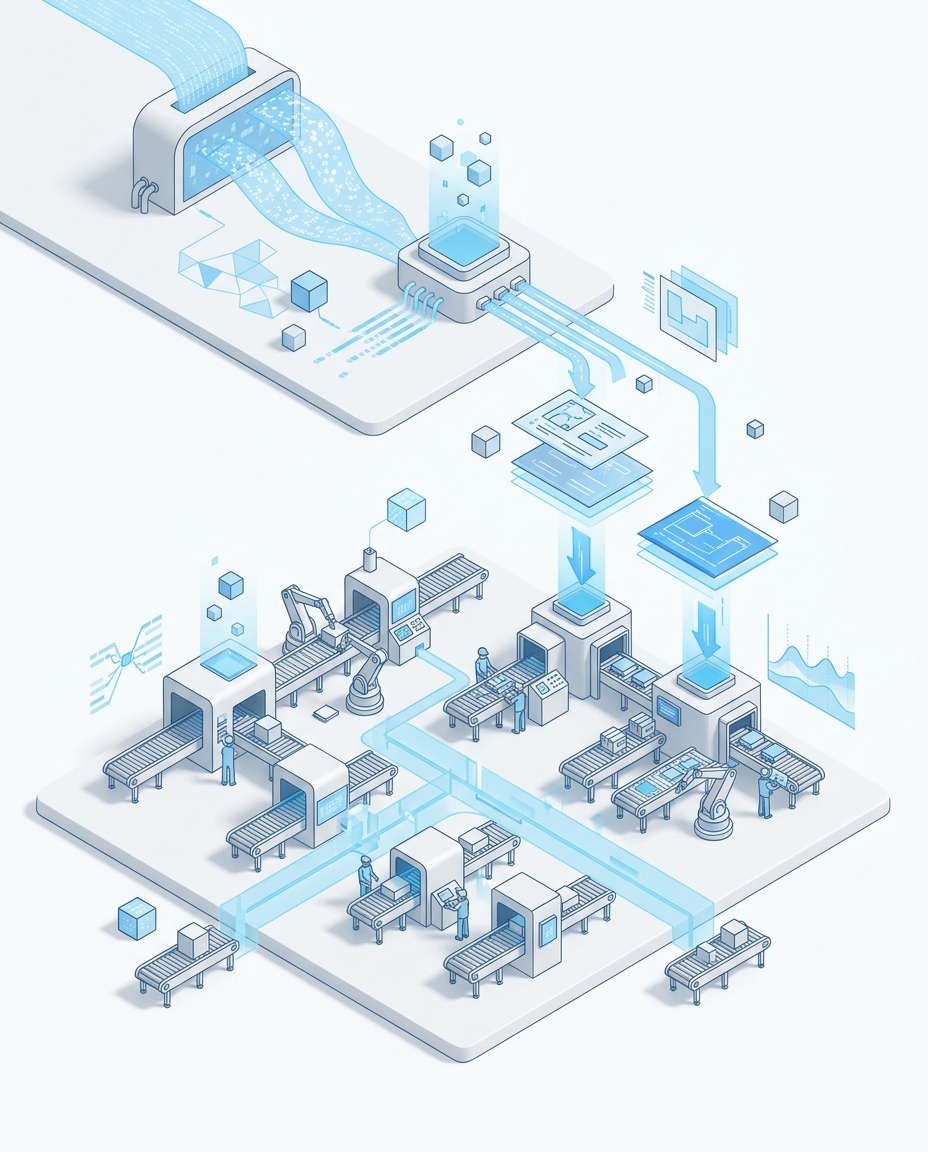
Production Scheduling AI Agent
AI scheduling agent that generates baseline mold line configurations from historical patterns and production constraints, capturing tribal knowledge in an algorithmic system while allowing operators to fine-tune schedules to current conditions.
Two employees per facility. Decades of experience in their heads. And the clock is ticking toward retirement.
At a manufacturing company producing infrastructure components, mold line scheduling was one of the most critical operational processes and one of the most vulnerable. Each facility relied on one or two experienced employees who created production schedules by hand. These schedulers understood which mold configurations worked best for specific product runs, how to sequence jobs to minimize changeover time, which combinations of tooling and materials produced the best quality outcomes, and how to adapt when equipment went down or orders changed mid-shift. None of this knowledge was written down. It existed entirely in the heads of people who had been doing the job for decades.
The Production Scheduling AI Agent was built to address this existential operational risk. By encoding historical scheduling patterns, mold specifications, and production constraints into an algorithmic system, the agent generates baseline schedules that capture the institutional knowledge that would otherwise walk out the door with every retirement.
Benefits
This agent transforms production scheduling from a manual, expertise-dependent process into a systematic operation with built-in knowledge preservation.
- Tribal knowledge captured: Decades of scheduling expertise encoded into algorithmic logic that the organization owns permanently, eliminating the risk of knowledge loss through retirement, turnover, or extended absence
- Significant time savings: Schedulers who previously spent hours constructing schedules from scratch now review and refine AI-generated baselines, redirecting their expertise toward exception handling and optimization
- Consistent scheduling quality: Every facility receives schedules generated from the same algorithmic foundation, eliminating the quality variation that occurred when different schedulers applied different mental models
- Faster new scheduler onboarding: New scheduling staff can be productive immediately by working with AI-generated baselines rather than learning the entire scheduling logic from scratch over months or years
- Operational continuity: Facilities continue to operate with high-quality schedules even when experienced schedulers are unavailable, removing the single point of failure that previously existed
- Continuous improvement: As operators refine AI-generated baselines, those adjustments can inform future schedule generation, creating a feedback loop that systematically improves scheduling quality over time
Problem Addressed
Every manufacturing operation has knowledge that lives nowhere except in the minds of its most experienced people. In mold line scheduling, that knowledge includes which configurations produce the best results for specific products, how to sequence jobs to minimize changeover, what adjustments to make when raw material properties vary, and how to respond when equipment behaves differently than expected. This is not knowledge that can be easily documented in a procedures manual. It is contextual, adaptive, and built from thousands of iterations of trial and feedback over years of daily practice.
The problem is not that the knowledge is complex. The problem is that it is fragile. When the scheduler at a facility retires, that knowledge leaves with them. The replacement inherits the equipment, the orders, and the deadlines, but not the accumulated understanding of how to navigate the thousands of small decisions that make the difference between a schedule that runs smoothly and one that generates quality issues, excessive changeovers, and missed production targets. Every facility that depends on one or two expert schedulers is one resignation away from a significant operational disruption.
What the Agent Does
The agent implements a scheduling generation system that combines historical pattern analysis with constraint optimization:
- Historical schedule analysis: The agent processes years of historical production schedules, identifying patterns in mold configuration selection, job sequencing, changeover optimization, and seasonal adjustments
- Mold specification integration: Current mold specs, tooling availability, and equipment status are ingested to ensure generated schedules reflect actual production capabilities rather than theoretical capacity
- Production order matching: Incoming production orders are matched against available mold configurations and equipment capacity to generate feasible scheduling options
- Constraint-aware baseline generation: The algorithm generates baseline schedules that respect equipment constraints, changeover requirements, material availability, and historical quality patterns for each mold-product combination
- Operator adjustment interface: Generated baselines are presented in an application where experienced operators can review and modify schedules based on current conditions, equipment performance, and real-time production factors
- Schedule publication: Finalized schedules are published to production floor systems with full specification detail for each mold line configuration and production run
Standout Features
- Tribal knowledge encoding: The agent learns from historical scheduling decisions made by experienced operators, capturing the implicit logic that informed their choices and making it available as a permanent organizational asset
- Baseline-plus-adjustment model: Rather than fully automating scheduling decisions, the agent generates starting points that preserve the role of human expertise in final schedule optimization, combining algorithmic consistency with operational judgment
- Changeover optimization: Job sequencing considers changeover time and complexity between mold configurations, minimizing the non-productive time that accumulates when jobs are sequenced without considering transition costs
- Constraint propagation: When a constraint changes mid-schedule, such as equipment downtime or material delay, the agent can regenerate affected schedule segments without rebuilding the entire production plan from scratch
- Cross-facility applicability: The same scheduling framework applies across multiple manufacturing facilities, enabling knowledge sharing between sites while respecting each facility's specific equipment configurations and capabilities
Who This Agent Is For
This agent is designed for manufacturing operations where production scheduling depends on institutional knowledge held by a small number of experienced employees.
- Manufacturing companies where one or two schedulers per facility hold the expertise that keeps production running smoothly
- Operations leaders concerned about knowledge loss as experienced scheduling staff approach retirement
- Production managers seeking consistent scheduling quality across multiple facilities with different levels of local scheduling expertise
- Manufacturing engineers looking to reduce changeover time and improve mold utilization through data-driven scheduling optimization
- Any operation where manual scheduling consumes significant expert time that could be redirected toward continuous improvement and exception management
Ideal for: Production managers, operations directors, manufacturing engineers, scheduling leads, and any manufacturing operation where the combination of expert dependency, retirement risk, and scheduling complexity creates an operational vulnerability that manual processes cannot sustainably address.


Bulk Report Generator AI Agent
AI-architected bulk PDF report engine that enables users to generate up to 100 professionally formatted individual reports in a single action, replacing tedious one-by-one export workflows.
Benefits
This agent eliminates the repetitive, time-consuming process of generating individual reports one at a time, replacing it with a scalable bulk operation that produces professionally formatted output at the click of a button.
- Massive time savings: Users who previously downloaded reports one at a time can now generate up to 100 formatted PDFs in a single action, compressing hours of repetitive work into seconds
- Consistent formatting: Every report follows the same professional template with proper layout, branding, and data presentation, eliminating the formatting inconsistencies that plague manual export processes
- Flexible output options: Users can generate reports as a single combined document or as individual files, adapting the output format to their distribution needs without additional processing
- Filter-aware generation: Reports respect the active filter context, ensuring bulk exports reflect the specific subset of records the user has selected rather than generating the entire database
- Improved platform adoption: Removing a major friction point in the reporting workflow increases user satisfaction and platform engagement, demonstrating that the system evolves to address real user pain points
- Reduced support burden: Self-service bulk export eliminates the support tickets and workaround requests that accumulated when users needed reports the platform could only produce one at a time
Problem Addressed
An education technology platform serving schools nationwide provides assessment-based reports for individual students. Educators relied on these reports for guidance conversations, parent meetings, and administrative reviews. The problem was not the reports themselves. It was getting them.
To generate a report, an educator had to navigate to an individual record, trigger the export, wait for it to generate, download the PDF, and then repeat the process for the next record. For a counselor preparing for a grade-level review covering fifty or a hundred students, this meant an hour or more of clicking, waiting, and downloading. The exported PDFs also suffered from formatting inconsistencies, with layouts that looked different depending on data volume and content length. Educators did not stop needing the reports. They stopped using them at scale because the process was too painful. The organization needed a way to let users generate professional-quality reports in bulk without the one-by-one bottleneck that was suppressing platform value.
What the Agent Does
AI agents designed and built a serverless PDF generation engine that transforms the reporting workflow from individual downloads to scalable bulk operations:
- Bulk selection interface: Users select records through the application's standard filtering tools, then trigger bulk report generation for the entire selected set with a single action
- Data retrieval and assembly: The engine queries the cloud data warehouse to retrieve complete records for all selected individuals, assembling the data needed for each report in a single optimized batch operation
- Template-driven rendering: Each report is rendered against a professionally designed template that handles variable data lengths, optional sections, and conditional formatting, producing consistent output regardless of data complexity
- Asynchronous generation: For large batches, the engine runs asynchronously, notifying users when their reports are ready for download rather than blocking the interface during generation
- Combined or individual output: Users choose between a single combined PDF containing all reports or individual files packaged for download, supporting both distribution and archival use cases
- Filter context preservation: The bulk generation respects whatever filters and selections the user has applied, ensuring exports match the user's intended scope without requiring manual record-by-record verification
Standout Features
- AI-designed architecture: The entire PDF generation engine was designed and built through AI agent collaboration, from data model to rendering pipeline, demonstrating that complex technical infrastructure can be developed through agentic workflows
- Serverless scaling: The generation engine runs on serverless compute that scales automatically with batch size, handling ten reports or a hundred with the same architecture and without pre-provisioned infrastructure
- Professional template system: Report templates produce publication-quality PDFs with proper pagination, headers, data tables, and conditional sections that adapt to each record's content without manual formatting intervention
- Cloud data warehouse integration: Direct integration with the cloud data warehouse enables optimized bulk data retrieval, avoiding the API-call-per-record pattern that makes traditional bulk exports slow and fragile
- Progressive delivery: Users receive reports as they are generated rather than waiting for the entire batch to complete, enabling them to begin working with available reports while the remainder finish processing
Who This Agent Is For
This agent is built for organizations where users need to generate formatted reports for multiple records and the current one-by-one export workflow creates a productivity bottleneck.
- Educators and school counselors preparing student reports for grade-level reviews, parent conferences, or administrative submissions
- Program administrators who need to distribute individualized reports across large participant populations
- Platform teams seeking to improve user experience by eliminating repetitive export workflows that suppress feature adoption
- Operations teams that currently work around one-by-one export limitations using manual processes or third-party tools
- Any organization whose users have stopped using a reporting feature because generating reports at scale is too time-consuming
Ideal for: Education platforms, assessment providers, HR systems, program management tools, and any application where users regularly need formatted PDF reports for multiple records and the current process cannot keep pace with the demand.

Warehouse Optimization AI Agent
AI-powered pack instruction optimization agent that matches demand forecasts with inventory levels to generate optimal packing configurations for warehouse operations, with manager review before publishing to the floor.
How a demand-inventory matching algorithm replaced hours of manual pack instruction creation and reduced costly re-packing in fruit warehouses
In fresh produce logistics, the difference between an optimal pack instruction and a suboptimal one is measured in wasted fruit, wasted labor, and wasted time. A produce packing company operated warehouses where logistics managers created pack instructions, the specific configurations that tell warehouse staff exactly how to pack each order, for every customer shipment. Each instruction had to account for current inventory levels, incoming harvest forecasts, customer specifications, packaging requirements, and shelf-life constraints. The managers built these instructions manually, spending hours each day assembling configurations from demand data and inventory reports. When the instructions were suboptimal, the result was re-packing: warehouse staff would pack fruit according to instructions, discover that the configuration did not work with available inventory, and re-pack entire pallets, wasting labor hours and risking product quality degradation from additional handling.
The Warehouse Optimization AI Agent replaced this manual process with a demand-inventory matching algorithm that generates optimized pack instructions automatically, presenting them to managers for review and adjustment before publishing to the warehouse floor.
Benefits
This agent eliminates the manual construction of pack instructions and the downstream waste that results from suboptimal configurations.
- Eliminated manual instruction creation: Managers no longer spend hours assembling pack instructions from demand reports and inventory spreadsheets, reclaiming that time for exception handling and strategic planning
- Reduced re-packing incidents: Algorithm-optimized instructions account for actual inventory availability and constraints upfront, significantly reducing the costly re-packing that occurred when manual instructions did not align with warehouse reality
- Less product waste: Optimal packing configurations minimize unnecessary handling and maximize product utilization, reducing the spoilage and damage that accumulate when fruit is packed, unpacked, and repacked
- Faster instruction turnaround: Pack instructions that previously took hours to create manually are generated in minutes, allowing warehouses to respond to demand changes and inventory updates throughout the day
- Manager expertise preserved: The system generates baseline instructions that managers can review and fine-tune, preserving their operational judgment while eliminating the tedious assembly work
- Scalable across facilities: The algorithm applies consistently across multiple warehouse locations, ensuring pack quality does not vary based on which manager is creating instructions at each facility
Problem Addressed
Pack instruction creation in produce warehouses is a deceptively complex task. The manager needs to simultaneously consider what the customer ordered, what inventory is currently available, what inventory is forecasted to arrive, what packaging materials are on hand, what the shelf-life requirements are for each destination, and how to maximize the use of available fruit while meeting every customer specification. Experienced managers develop an intuition for this, but that intuition takes years to build and cannot be easily transferred or scaled.
The consequences of suboptimal instructions are immediate and expensive. When a pack instruction calls for a fruit grade or size that is not available in sufficient quantity, warehouse staff either substitute, which risks customer complaints, or re-pack, which wastes labor and handling time. In a high-volume operation processing thousands of cases per day, even a small percentage of re-packing represents significant cost. The manual process also creates a single point of failure: if the experienced manager is unavailable, instruction quality drops, and the warehouse either slows down waiting for guidance or proceeds with less optimal configurations.
What the Agent Does
The agent implements a demand-inventory optimization pipeline that produces warehouse-ready pack instructions through an automated matching process:
- Demand data ingestion: The agent pulls current customer orders, scheduled shipments, and standing requirements to establish what needs to be packed for each production cycle
- Inventory and forecast integration: Current warehouse inventory levels and incoming harvest forecasts are integrated to establish what is available and what will be available during the packing window
- Constraint-aware matching: The optimization algorithm matches demand to available inventory while respecting constraints including customer specifications, packaging requirements, shelf-life windows, and warehouse capacity limitations
- Optimized instruction generation: The agent produces specific pack instructions that maximize inventory utilization, minimize waste, and reduce the probability of downstream re-packing due to availability mismatches
- Manager review interface: Generated instructions are presented in an application where managers can review, adjust, and approve configurations before they are published to the warehouse floor
- Publication to warehouse: Approved instructions are pushed to warehouse systems where packing teams can execute them immediately with full specification detail
Standout Features
- Demand-inventory optimization algorithm: The matching engine goes beyond simple availability checking to optimize across the full set of orders simultaneously, finding configurations that maximize total fulfillment rather than optimizing each order independently
- Forecast-aware planning: Pack instructions account for inventory that is in transit or forecasted to arrive, enabling managers to commit to configurations that depend on incoming supply with visibility into the risk of that supply being delayed
- Manager-in-the-loop workflow: The agent produces recommendations rather than final instructions, preserving the operational judgment of experienced managers while eliminating the hours of manual configuration assembly that preceded their review
- Re-pack probability scoring: Each generated instruction includes an estimated re-pack probability based on inventory confidence levels, giving managers visibility into which configurations carry higher execution risk
- Multi-facility consistency: The same algorithm and optimization logic applies across all warehouse locations, ensuring consistent pack instruction quality regardless of individual manager experience levels at each site
Who This Agent Is For
This agent is designed for warehouse and logistics operations where pack instruction creation is a manual, time-intensive process with direct cost implications for packing efficiency and product waste.
- Logistics managers spending hours daily creating pack instructions from demand and inventory data in produce or perishable goods operations
- Warehouse operations directors seeking to reduce re-packing costs and improve first-pass packing accuracy across multiple facilities
- Supply chain leaders looking to scale packing operations without proportionally increasing the management overhead required for instruction creation
- Fresh produce and perishable goods companies where handling efficiency directly impacts product quality and shelf life
- Operations teams managing seasonal volume fluctuations that make manual pack instruction creation unsustainable during peak periods
Ideal for: Logistics managers, warehouse operations leads, supply chain directors, and any produce or perishable goods operation where the manual creation of pack instructions represents a daily bottleneck that introduces waste, delays, and inconsistency into warehouse operations.

Expense Optimization AI Agent
AI-driven negotiation and scoring engine that processes hotel RFP submissions across hundreds of properties, calculates composite rankings per market, and generates strategic pushback recommendations for procurement teams managing complex travel sourcing.
Here is the reality of corporate hotel sourcing: 300 hotels, 717 fields per RFP, two negotiation rounds, and a procurement team that has been doing this in spreadsheets
A Fortune 50 health services company needed to optimize its corporate travel spend across hundreds of hotel properties nationwide. The annual hotel sourcing process involved collecting rate proposals from approximately 300 hotels, each submitting RFP responses with up to 717 data fields covering room rates across seasons, commission structures, dynamic pricing agreements, included amenities, blackout periods, and contractual terms. The procurement team then needed to evaluate every submission, compare hotels within each market, conduct two rounds of strategic negotiations, and ultimately select the optimal portfolio that balanced cost, quality, and coverage across all corporate travel destinations.
The Expense Optimization AI Agent was built by practitioners who understood this workflow intimately. It implements a composite scoring model that ranks every hotel submission per market, generates data-driven negotiation pushbacks for each round, and provides the procurement team with a structured decision framework that replaces the spreadsheet gymnastics that previously consumed weeks of analyst time.
Benefits
This agent transforms hotel portfolio selection from a manual spreadsheet exercise into a systematic, data-driven negotiation and ranking process.
- Standardized evaluation framework: Every hotel submission is scored using the same composite model, eliminating the subjective variation that occurs when different analysts evaluate different markets using their own criteria
- Strategic negotiation guidance: The agent generates specific pushback recommendations for each hotel based on their submission data relative to market benchmarks, giving negotiators data-backed positions rather than generic requests
- Compressed evaluation timeline: What previously required weeks of manual spreadsheet analysis across 300 properties completes in hours, freeing procurement analysts for strategic work rather than data manipulation
- Market-level optimization: Portfolio selection considers the full competitive landscape within each market, ensuring that the final hotel selection optimizes coverage, cost, and quality at the market level rather than evaluating properties in isolation
- Scalable sourcing process: The same framework applies whether the portfolio spans 100 or 1,000 properties, making it feasible to expand corporate travel programs without proportionally expanding the procurement team
- Audit-ready decision documentation: Every ranking, score, and recommendation is traceable to specific data points in the hotel submission, creating a defensible record for stakeholders who need to understand why specific properties were selected or rejected
Problem Addressed
Corporate hotel sourcing at scale is a problem that looks manageable on the surface and becomes overwhelming in the details. Each hotel RFP response contains 717 fields. Some of those fields are straightforward: the standard room rate for Q1. Others are complex: dynamic pricing formulas that vary by booking window, seasonal rate adjustments with blackout exceptions, commission structures that change based on volume commitments, and amenity inclusions that differ between rate tiers. Now multiply that complexity by 300 hotels across dozens of markets, add two rounds of negotiations where each pushback needs to be specific and data-informed, and the procurement team is staring at a project that will consume their best analysts for weeks.
The historical approach was spreadsheets. Lots of them. Analysts would build comparison models for each market, manually identify outliers, flag properties with unfavorable terms, and prepare negotiation talking points based on their analysis. The process worked, but it was slow, inconsistent across analysts, and impossible to scale. Every year, the same work was rebuilt from scratch. Insights from previous sourcing cycles were locked in last year's spreadsheets rather than systematically informing the current evaluation.
What the Agent Does
The agent manages the end-to-end hotel portfolio evaluation and negotiation workflow through a structured analytical pipeline:
- RFP data ingestion: The agent imports hotel RFP submissions with all 717 fields, normalizing data formats, currencies, and rate structures into a consistent analytical framework
- Net rate calculation: For each property, the agent calculates true net rates by factoring in base rates, commission percentages, dynamic pricing adjustments, seasonal variations, blackout day impacts, and amenity valuations
- Composite scoring model: Each hotel receives a composite score derived from weighted factors including net cost, amenity quality, location convenience, historical performance, contract flexibility, and strategic fit within its market
- Market-level ranking: Hotels are ranked within their respective markets, giving procurement teams a clear view of the best-value options in each corporate travel destination
- Negotiation pushback generation: For each negotiation round, the agent generates specific, data-backed pushback recommendations identifying where each hotel's submission falls below market benchmarks and what improvements would be needed to improve their competitive position
- Portfolio optimization: The agent recommends the optimal hotel portfolio per market, balancing cost efficiency, coverage requirements, quality standards, and relationship considerations across the full property set
Standout Features
- 717-field RFP processing: The agent handles the full complexity of hotel RFP responses, including multi-season rate structures, dynamic pricing formulas, and conditional amenity packages that make manual comparison across 300 properties impractical
- Two-round negotiation engine: Strategic pushback recommendations evolve between negotiation rounds, with second-round guidance informed by first-round counter-offers and updated competitive positioning within each market
- Composite scoring transparency: Every component of the composite score is individually visible and auditable, allowing procurement leads to understand exactly why a property ranks where it does and to adjust weighting factors based on strategic priorities
- Market-aware benchmarking: Negotiation pushbacks are calibrated to market-specific benchmarks rather than portfolio-wide averages, ensuring that recommendations reflect realistic expectations for each geographic market
- Year-over-year trend analysis: Historical submission data informs current evaluations, identifying properties whose value proposition is improving or degrading relative to their market over successive sourcing cycles
Who This Agent Is For
This agent is built for procurement and travel sourcing teams managing large-scale hotel portfolio selection processes where the volume and complexity of RFP data exceed what manual analysis can handle efficiently.
- Travel sourcing managers responsible for evaluating hundreds of hotel submissions across multiple markets annually
- Procurement teams conducting multi-round negotiations who need data-driven pushback strategies rather than generic rate reduction requests
- Finance leaders seeking standardized, auditable evaluation frameworks for travel spend optimization
- Corporate travel program managers expanding their property portfolio who need scalable evaluation processes
- Any organization where hotel sourcing decisions involve enough properties and data fields that spreadsheet-based evaluation has become a bottleneck
Ideal for: Travel sourcing managers, procurement directors, corporate travel leads, finance analysts, and any enterprise where the annual hotel sourcing process ties up analyst bandwidth for weeks because the data volume exceeds what manual tools can efficiently process.

Regulatory Report Builder AI Agent
Coordinated AI agents collaborating across project management, architecture, development, and QA roles to transform manual regulatory report compilation into interactive, data-driven applications.
Benefits
This agent system transforms a manual, document-heavy regulatory reporting process into an automated, interactive, and dramatically more efficient delivery model.
- Eliminated manual compilation: Regulatory appendix reports that previously required weeks of manual assembly from multiple data sources are now generated automatically from live program data
- Dramatically reduced file sizes: Static documents that ballooned to over 100MB are replaced with interactive tables that present the same information in a fraction of the storage footprint, making distribution practical rather than painful
- Interactive data exploration: Regulators and program administrators can filter, sort, and drill into report data interactively rather than scrolling through hundreds of static pages searching for specific records
- Accelerated development cycles: The multi-agent sprint workflow compresses application development timelines by coordinating specialized AI agents across project management, architecture, coding, and quality assurance simultaneously
- Living reports: Reports reflect current program data rather than point-in-time snapshots frozen in static documents, ensuring regulatory submissions contain the most current information available
- Reproducible quality: The agentic development process produces consistent, tested code across all seventeen report types, eliminating the quality variation that comes from different developers building similar reports independently
Problem Addressed
A national compliance technology provider operates a state-level environmental inspection program that requires seventeen distinct regulatory appendix reports to be compiled and submitted on a regular basis. Each report aggregates program data across different dimensions: inspection volumes, compliance rates, equipment certification status, failure patterns, and remediation tracking.
Historically, these reports were compiled manually. Analysts pulled data from multiple systems, formatted it into prescribed layouts, and assembled the results into massive static documents. A single reporting cycle could produce documents exceeding 100MB. These files were difficult to distribute, impossible to search interactively, and immediately outdated the moment they were generated. The compilation process consumed significant analyst time and introduced the risk of manual errors in data aggregation. The organization needed a way to produce all seventeen reports from live data, in an interactive format, without the manual assembly bottleneck.
What the Agent Does
A coordinated set of specialized AI agents collaborates across defined roles to design and build interactive report applications through a structured sprint workflow:
- Project management agent: Decomposes each report requirement into development tasks, defines acceptance criteria, sequences work across sprints, and tracks progress against delivery timelines
- Architecture agent: Analyzes report data requirements and designs the application structure, defining data models, API endpoints, component hierarchies, and rendering strategies for each report type
- Development agent: Generates production-grade application code that connects to live program data sources, renders interactive tables with filtering and sorting capabilities, and supports PDF export for formal submission requirements
- Quality assurance agent: Reviews generated code against acceptance criteria, validates data accuracy by comparing rendered outputs against known reference values, and identifies edge cases in data formatting or volume handling
- Sprint coordination: The agents operate in defined sprint cycles, with each sprint targeting a subset of the seventeen reports, allowing progressive delivery and refinement based on stakeholder feedback
- Integration and deployment: Completed report applications are integrated into the program's operational platform, connecting to live data pipelines that ensure reports always reflect current program status
Standout Features
- Multi-agent collaboration model: Rather than a single AI generating code in isolation, four specialized agents with distinct roles work in coordination, mirroring the structure of a human development team with built-in review and quality gates
- Sprint-based delivery: The agentic workflow follows sprint methodology, producing working report applications incrementally rather than attempting all seventeen reports simultaneously, enabling early stakeholder feedback and course correction
- Live data connectivity: Reports connect directly to operational data sources rather than static exports, ensuring regulatory submissions reflect current program status without manual data refresh cycles
- Interactive PDF replacement: Static 100MB+ documents are replaced with interactive web applications that support filtering, sorting, and drill-down while maintaining PDF export capability for formal filing requirements
- Reproducible development process: The agentic development pipeline can be re-executed when report requirements change, producing updated applications without manual redevelopment of each report from scratch
Who This Agent Is For
This agent system is built for organizations that produce complex regulatory reports from operational data and need to modernize from static document compilation to interactive, data-driven reporting.
- Compliance technology providers managing regulatory reporting obligations across state or federal programs
- Program administrators who need interactive access to compliance data rather than static document archives
- Regulatory affairs teams producing periodic appendix reports from large operational datasets
- Development teams looking to accelerate report application delivery through AI-assisted sprint workflows
- Public sector organizations seeking to transform document-heavy reporting processes into modern, interactive data applications
Ideal for: Compliance officers, regulatory program managers, public sector technology providers, environmental agencies, and any organization where regulatory reporting involves compiling large volumes of operational data into prescribed formats.
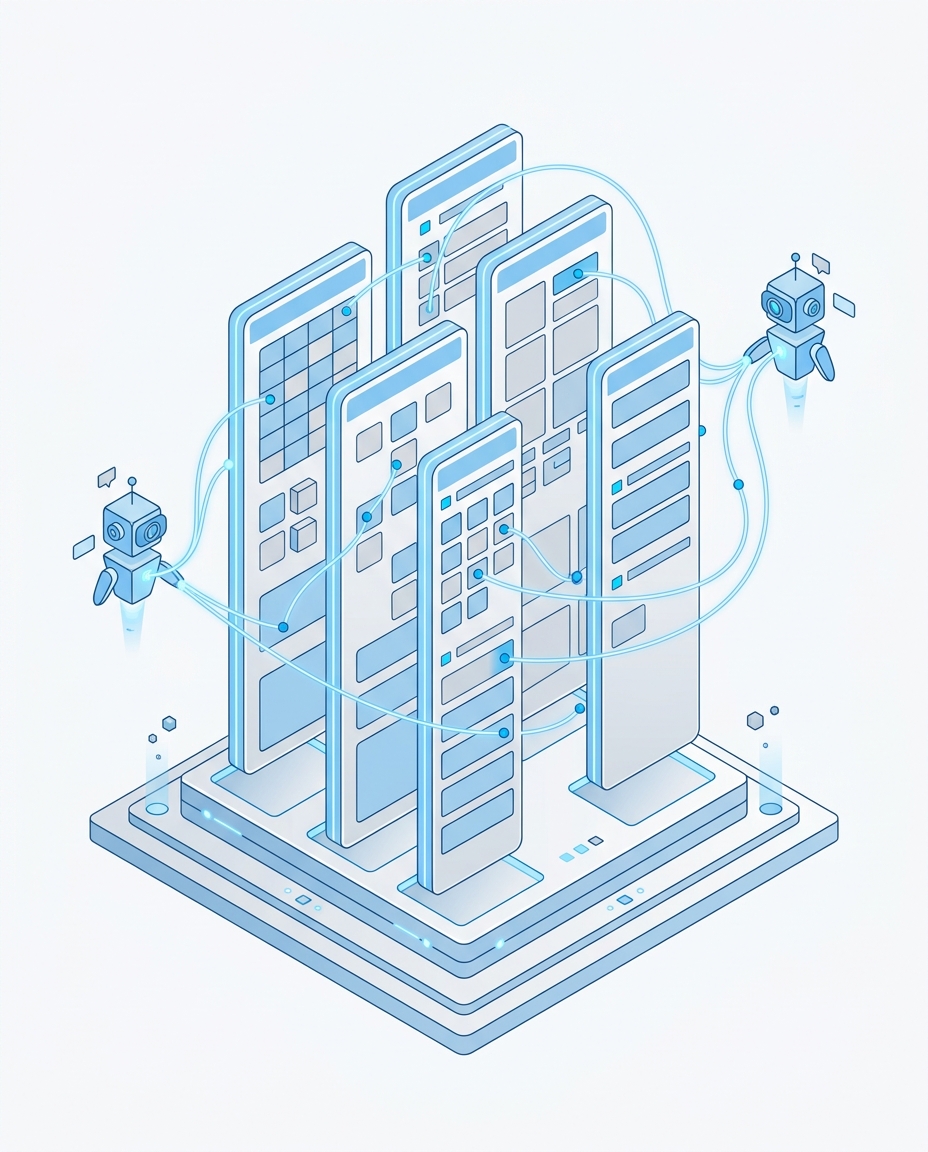
AI Readiness Deployment AI Agent
Automated AI readiness agent that selects datasets and auto-generates comprehensive column definitions and business-friendly synonyms, with a global AI dictionary for shared governance across the enterprise.
Enterprise customers went from months of manual AI preparation to deployment-ready datasets in hours
When organizations adopt AI-powered chat interfaces for their data, there is a hidden prerequisite that blocks deployment at scale: every dataset column needs a clear definition and a set of business-friendly synonyms before the AI can interpret natural language questions correctly. A column named "rev_q3_adj" means nothing to an AI model without context. Multiply that by datasets with hundreds of columns across dozens of business units, and the preparation work alone can stall AI adoption for months. Enterprise customers were hitting this wall consistently. The technology was ready. The data existed. But the metadata preparation required to make AI chat functional was a manual, tedious, expertise-dependent process that no team had the bandwidth to complete.
The AI Readiness Deployment AI Agent eliminated this bottleneck entirely. Adopted by major enterprises across hospitality, logistics, healthcare, staffing, and tourism, this agent transforms what was once months of manual column documentation into an automated process that delivers deployment-ready metadata in hours.
Benefits
This agent removes the single largest barrier to enterprise AI chat deployment: the manual metadata preparation that blocks every dataset from being query-ready.
- Dramatic time reduction: What previously required weeks or months of manual column documentation per dataset now completes in hours through AI-powered auto-generation of definitions and synonyms
- Enterprise-scale deployment: Organizations with hundreds of datasets can prepare their entire data estate for AI chat capability without proportionally scaling their metadata team
- Consistent governance: A global AI dictionary ensures that the same business term means the same thing across every dataset, eliminating the definitional drift that occurs when different teams document columns independently
- Accelerated AI adoption: By removing the metadata preparation bottleneck, organizations move from AI pilot to enterprise deployment on a timeline measured in weeks rather than quarters
- Reduced expertise dependency: Auto-generated definitions capture the semantic meaning of columns from metadata patterns and data samples, reducing reliance on the few subject matter experts who understand legacy column naming conventions
- Bulk governance updates: When business terminology changes or definitions need refinement, the global dictionary propagates updates across all connected datasets simultaneously rather than requiring manual updates to each one
Problem Addressed
AI readiness is not a technology problem. It is a metadata problem. Every enterprise that deploys conversational AI over their data discovers the same blocker: the AI cannot answer questions about columns it does not understand. A dataset with 300 columns needs 300 definitions and potentially 900 or more synonyms before a natural language query engine can reliably interpret user questions. The people who understand what those columns mean are the same people who are already overcommitted to daily operations. The documentation work gets deprioritized. Datasets sit in a queue waiting for metadata enrichment. AI chat pilots remain limited to the handful of datasets that someone found time to document manually.
The compounding problem is governance consistency. When different teams document their own datasets independently, the same business concept gets defined differently across the organization. "Revenue" in one dataset means gross revenue. In another, it means net. The AI inherits these inconsistencies and produces answers that are technically correct according to the metadata but misleading in business context. Without a centralized governance layer, every independently documented dataset introduces a new source of potential confusion.
What the Agent Does
The agent automates the complete AI readiness preparation workflow from dataset selection through governance-consistent deployment:
- Dataset selection and analysis: Users select a target dataset and the agent analyzes column names, data types, sample values, and structural patterns to understand the semantic content of each field
- AI-powered definition generation: For each column, the agent generates a clear, business-friendly definition that explains what the field contains, how it should be interpreted, and what business context it represents
- Synonym auto-generation: The agent produces multiple natural language synonyms for each column, anticipating the various ways business users might refer to the same data point in conversational queries
- Global AI dictionary integration: Generated definitions and synonyms are checked against a centralized dictionary of approved business terms, ensuring consistency across all datasets in the organization
- Bulk review and refinement: Subject matter experts can review, edit, and approve generated definitions in bulk rather than creating them from scratch, focusing their expertise on validation rather than initial authoring
- Cross-dataset governance updates: When a term definition is updated in the global dictionary, the change propagates to every dataset that references that term, maintaining consistency as business language evolves
Standout Features
- Intelligent column interpretation: The agent goes beyond simple name parsing, analyzing data samples, column relationships, and structural patterns to generate definitions that reflect actual data content rather than just column header text
- Global AI dictionary: A centralized governance layer ensures that business terms are defined consistently across the entire data estate, preventing the definitional drift that undermines AI accuracy when teams document independently
- Bulk operations at enterprise scale: The agent processes datasets with hundreds of columns in a single operation, making it feasible to prepare entire data estates for AI deployment rather than working through them one column at a time
- Expert-in-the-loop workflow: Auto-generated definitions serve as a starting point that subject matter experts refine, combining AI speed with human domain knowledge for definitions that are both comprehensive and accurate
- Proven enterprise adoption: Deployed and validated across organizations in hospitality, logistics, healthcare, financial services, staffing, and tourism, demonstrating reliability across diverse data environments and governance requirements
Who This Agent Is For
This agent is designed for organizations preparing their data infrastructure for AI-powered natural language querying at enterprise scale.
- Data governance teams responsible for maintaining metadata quality across hundreds of datasets with thousands of columns
- IT and analytics leaders tasked with enabling AI chat capabilities across the organization without proportionally expanding their metadata teams
- Enterprise architects designing AI readiness programs who need to reduce the timeline from pilot to production deployment
- Business intelligence teams managing datasets where column naming conventions have diverged across departments and legacy systems
- Any organization where the gap between having data and having AI-ready data is measured in months of manual documentation work
Ideal for: Data governance directors, BI managers, AI deployment leads, enterprise architects, and any organization where the metadata preparation bottleneck is the primary obstacle standing between their current data estate and enterprise-scale AI chat deployment.

Knowledge Base RAG Chat AI Agent
AI chat agent powered by Retrieval-Augmented Generation that searches internal knowledge bases stored in filesets, surfacing contextual answers to help support and RFP teams respond to client inquiries accurately and efficiently.
Turn your knowledge base into instant answers with AI-powered search.
Every organization that has invested in building an internal knowledge base has encountered the same paradox: the information is there, but the people who need it cannot retrieve it fast enough to matter. Support teams responding to client emails spend more time searching for the right document than composing the actual response. RFP teams copying and pasting from previous submissions know that a better answer exists somewhere in the repository, but the search function returns too many irrelevant results to be useful under deadline pressure. The knowledge base becomes a write-only system: information goes in but rarely comes back out at the speed the business requires.
The Knowledge Base RAG Chat AI Agent was built to close this retrieval gap. Using Retrieval-Augmented Generation over internal document filesets, the agent provides a conversational interface where team members ask questions in natural language and receive contextually relevant answers drawn directly from the organization's own knowledge base, complete with source references for verification.
Benefits
This agent transforms a static document repository into an active intelligence layer that delivers answers at the speed of conversation.
- Immediate answer retrieval: Support teams get contextually relevant answers from the knowledge base in seconds instead of the minutes or hours spent manually searching through documents and folders
- Higher response accuracy: Answers are grounded in actual company documentation rather than individual memory, ensuring consistency and accuracy across all client-facing communications
- Faster RFP turnaround: RFP teams can query the knowledge base conversationally for specific capabilities, compliance details, and technical specifications instead of manually searching previous submissions
- Reduced onboarding time: New team members access institutional knowledge immediately through conversation rather than spending weeks learning which documents contain which information
- Knowledge base ROI realized: The investment in building and maintaining internal documentation finally pays off when every team member can actually access that knowledge at the point of need
- Consistent client experience: Every support interaction draws from the same authoritative source material, eliminating the variation that occurs when different team members rely on different personal notes or memories
Problem Addressed
A client emails asking whether your platform supports a specific compliance standard. The support engineer knows the answer is documented somewhere. She opens the knowledge base and types the compliance standard name into the search bar. The results include forty-seven documents. Some are product specs from three years ago. Some are meeting notes that mention the standard in passing. Some are RFP responses that address it in the context of a specific client's requirements. None of them directly answer the question as asked. She opens the five most promising results and begins scanning. Twenty minutes later, she has pieced together an answer from three different documents and composed a response. The client waited twenty minutes for information that the organization already had.
Now multiply that by every support ticket, every RFP question, every pre-sales inquiry, and every internal question that requires referencing company documentation. The problem is not that the knowledge base is incomplete. The problem is that traditional keyword search is fundamentally inadequate for retrieving specific answers from large document collections. Users need answers. Search returns documents. The gap between those two things is filled by human reading time, and that time adds up to one of the largest invisible costs in knowledge-intensive operations.
What the Agent Does
The agent implements a Retrieval-Augmented Generation pipeline over internal document filesets, combining semantic search with generative synthesis:
- Document ingestion and indexing: The agent processes documents stored in filesets, chunking content into semantically meaningful segments and generating vector embeddings that capture the meaning of each passage
- Conversational query interface: Team members interact with the agent through a chat interface, asking questions in natural language as they would ask a knowledgeable colleague
- Semantic retrieval: When a query is received, the agent converts it to an embedding vector and retrieves the most semantically relevant document passages from the index, going beyond keyword matching to understand intent
- Grounded answer generation: The agent synthesizes retrieved passages into a direct answer to the user's question, grounding every claim in specific source documents rather than generating information from training data
- Source citation: Every generated answer includes references to the specific documents and passages used, enabling users to verify the answer and access the full source context when needed
- Iterative refinement: Users can ask follow-up questions that build on previous context, allowing progressive exploration of a topic without restating background information
Standout Features
- Fileset-native integration: The agent works directly with document filesets, meaning existing knowledge bases can be connected without reformatting, re-uploading, or restructuring the underlying document repository
- Citation-backed responses: Every answer includes specific source references, distinguishing this from generic chatbots that generate plausible-sounding answers without verifiable grounding in company documentation
- Cross-document synthesis: When an answer requires combining information from multiple documents, the agent pulls from several sources and synthesizes a unified response, something that would take a human researcher significant time to accomplish manually
- Contextual conversation memory: The agent maintains session context, so a follow-up question like "what about for the healthcare vertical?" correctly references the topic from the previous exchange without requiring the user to restate the full question
- Global deployment readiness: The agent architecture supports deployment across multiple teams and geographies, with role-based access controls ensuring that each team sees answers drawn from the document sets relevant to their function
Who This Agent Is For
This agent is designed for organizations where internal knowledge exists in document form but team members cannot retrieve specific answers from those documents fast enough to meet operational demands.
- Support teams responding to client inquiries who need instant access to product documentation, compliance details, and technical specifications
- RFP teams assembling proposals under tight deadlines who need to query previous submissions and internal documentation for specific capabilities
- Sales engineers answering pre-sales technical questions who need accurate, current information grounded in official company documentation
- Customer success managers preparing for account reviews who need quick access to product capabilities, feature roadmaps, and implementation details
- Any team that maintains an internal knowledge base but finds that traditional search cannot deliver specific answers at the speed the business requires
Ideal for: Support managers, RFP coordinators, sales engineers, customer success leads, and knowledge management teams in organizations where the gap between having documentation and being able to use it under time pressure represents a measurable operational cost.
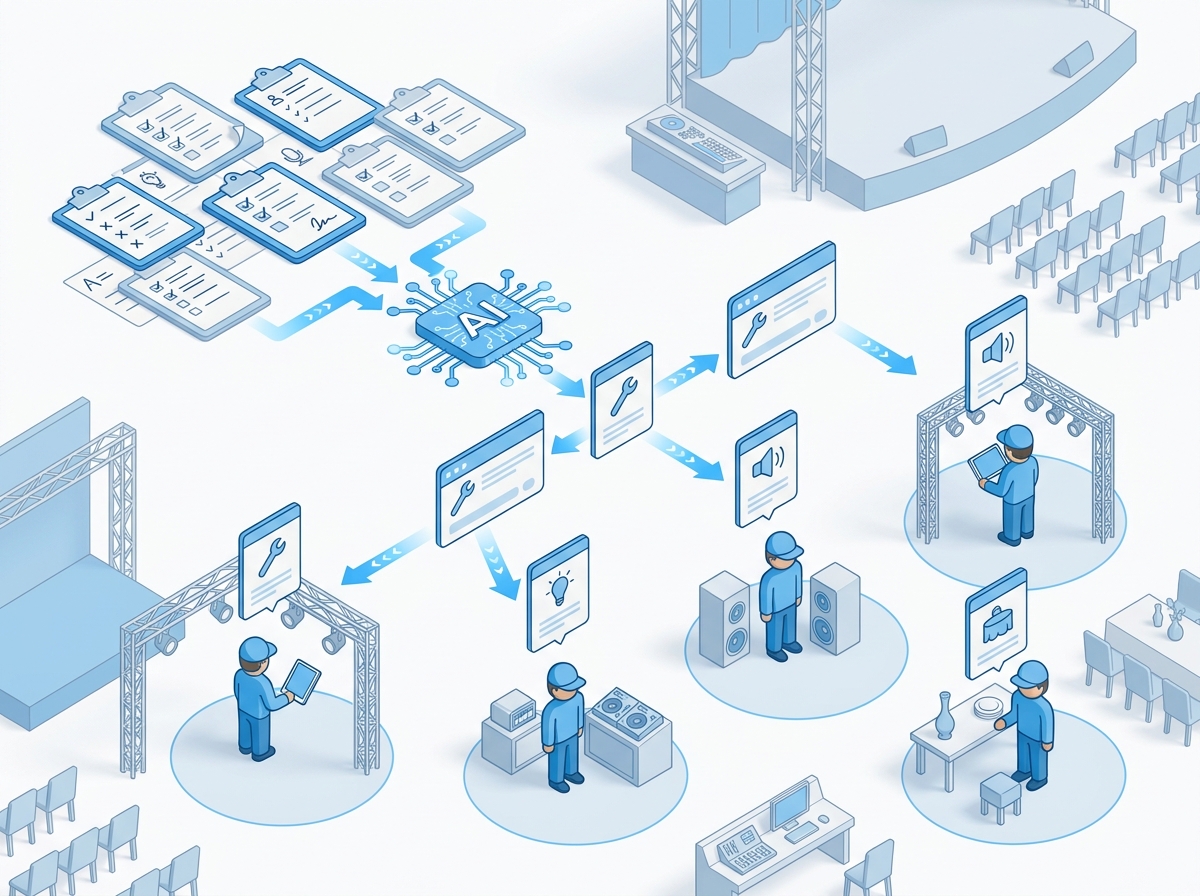
Facility Task Assignment AI Agent
Automated quality auditing and task assignment agent for event venue operations that transforms survey-driven inspections into structured work orders with follow-up confirmation workflows.
Benefits
This agent closes the loop between quality inspection and corrective action, ensuring that identified issues do not sit in a spreadsheet waiting for someone to notice them.
- Streamlined audit-to-action workflow: Quality findings transform into assigned work orders within seconds of survey submission, eliminating the delay between identifying an issue and initiating the fix
- Mobile-first survey submission: Auditors conduct inspections using mobile devices with structured survey forms covering all quality dimensions, replacing paper checklists and post-audit data entry
- Automatic staff routing: Work orders are automatically assigned to the responsible staff member or team based on the issue category, location, and severity, removing the manual coordination step that causes delays
- Follow-up confirmation: Auditors receive notifications when work orders are completed and can circle back to verify the issue was properly resolved, creating a closed-loop quality management cycle
- Consistent standards enforcement: Every venue and every audit follows the same structured criteria, ensuring quality standards are applied uniformly regardless of which auditor conducts the inspection
- Historical trend visibility: Aggregated audit data reveals recurring issues by venue, category, or time period, enabling operations leadership to address systemic problems rather than repeatedly fixing symptoms
Problem Addressed
A facilities management company overseeing operations at major event venues conducts regular quality audits covering everything from staff presentation and greeting protocols to restroom cleanliness and condiment station maintenance. These audits were historically conducted using paper forms or basic spreadsheets. An auditor would walk through the venue, note issues, and then manually communicate findings to the relevant staff or managers.
The problems with this approach accumulated quietly. Issues documented during an audit might not reach the responsible party for hours or days. There was no systematic way to create work orders from audit findings. Follow-up depended entirely on the auditor remembering to check back. When operations leadership wanted to know whether quality standards were being met across venues, the answer required manually compiling data from multiple auditors, multiple formats, and multiple communication channels. The gap between identifying a problem and confirming its resolution was unmeasured and unmanaged.
What the Agent Does
The agent manages the complete quality audit lifecycle from inspection through resolution confirmation:
- Survey-driven inspection: Auditors use structured mobile surveys covering predefined quality categories including greeting standards, staff dress code, food service areas, condiment stations, restroom cleanliness, signage compliance, and facility condition
- Scoring and aggregation: Survey responses are automatically scored against defined benchmarks, with results aggregated by category, venue section, and overall facility rating
- Work order generation: Any survey item that falls below the quality threshold automatically generates a work order with the issue description, location, severity level, and photographic evidence if captured during the audit
- Intelligent staff assignment: Work orders route to the appropriate staff member or team based on configurable rules mapping issue categories to responsible personnel, with escalation paths for critical findings
- Completion tracking: Assigned staff update work order status as they address issues, with the agent tracking time-to-resolution and flagging overdue items for escalation
- Resolution verification: Auditors receive notifications when work orders are marked complete and can conduct follow-up inspections to verify the corrective action meets quality standards
Standout Features
- Configurable audit templates: Quality criteria, scoring thresholds, and work order routing rules are fully configurable per venue type, allowing the same system to manage quality across stadiums, convention centers, concert halls, and corporate event spaces
- Photo-documented findings: Auditors can attach photos directly to survey items, providing visual evidence that travels with the work order and eliminates ambiguity about what needs to be fixed
- Real-time venue dashboard: Operations managers see a live view of audit status, open work orders, and resolution rates across all managed venues, enabling data-driven staffing and resource allocation decisions
- Trend analysis engine: Historical audit data reveals patterns in quality failures, identifying whether issues are isolated incidents or systemic problems requiring process changes rather than individual corrections
- Closed-loop verification: The follow-up confirmation workflow ensures that marking a work order complete is not the end of the process, auditors verify the fix meets standards before the issue is truly resolved
Who This Agent Is For
This agent is designed for organizations that manage quality standards across physical venues and need to connect inspection findings to corrective action systematically.
- Quality auditors conducting regular inspections at event venues, stadiums, or hospitality facilities who need a faster path from finding to fix
- Venue operations managers responsible for maintaining consistent quality standards across multiple locations and event types
- Facilities management companies overseeing contracted quality obligations at client venues
- Operations leadership tracking quality trends and staff performance across a portfolio of managed properties
- Event production teams ensuring venue readiness before high-profile events where quality failures have reputational consequences
Ideal for: Venue operations directors, facilities management companies, event production firms, hospitality chains, stadium operators, and any organization where physical space quality is regularly audited and corrective action must be tracked to completion.

Content Finder AI Agent
AI-powered chatbot agent that searches an entire BI instance using natural language queries, automatically surfacing relevant dashboards, cards, and data content to users without requiring them to know where information lives.
An AI chatbot that turns natural language into instant content discovery across your entire BI environment
A precision manufacturing company with thousands of dashboards and cards across its BI instance faced a structural navigation problem. The data existed. The dashboards had been built. The cards contained exactly the metrics people needed. But users could not find them. The instance had grown organically over years, with departments creating content independently, naming conventions diverging, and folder structures reflecting organizational charts that had been reorganized three times since the dashboards were originally placed. A plant manager looking for quality defect rates had to know that the relevant card lived inside a dashboard called "Q3 Ops Review" nested two levels deep in a folder named after a director who left the company eighteen months ago.
The Content Finder AI Agent was built to solve this navigation gap by implementing a natural language search interface that understands what users are looking for and surfaces the right content regardless of where it lives in the instance hierarchy.
Benefits
This agent eliminates the navigation tax that prevents users from accessing the BI content that was built specifically for them.
- Instant content discovery: Users describe what they need in plain language and receive direct links to relevant dashboards and cards in seconds, bypassing the folder navigation and tribal knowledge that previously gated access to critical data
- Reduced BI support burden: The volume of internal requests asking where to find specific reports or metrics drops significantly when users can search the instance themselves through a conversational interface
- Higher content utilization: Dashboards and cards that were built but underused because their target audience could not find them begin receiving the traffic they were designed for
- Faster time to insight: The gap between having a question and seeing the relevant data shrinks from minutes of navigation to seconds of conversation, accelerating decision-making at every level
- Democratized data access: New employees and cross-functional team members can access relevant content immediately without needing to learn the organizational history behind the instance structure
- Self-service analytics adoption: When finding content is effortless, more users engage with the BI platform independently rather than requesting exports from the analytics team
Problem Addressed
Every BI platform eventually reaches a scale where the content itself becomes the obstacle. It is not that the dashboards are missing. It is that the person who needs the data does not know which dashboard contains it, what it is called, or which folder it sits in. The instance has hundreds or thousands of content objects created by different teams over different time periods using different naming conventions. Some dashboards are titled descriptively. Others are titled after the project that spawned them. Cards may contain exactly the metric a user needs, but that card sits inside a dashboard the user has never seen because it belongs to a different department's workspace.
The traditional solution is documentation: build a catalog, maintain a wiki, train users on the folder structure. This works until the first reorganization, the first batch of new hires, or the first time the wiki falls behind the actual content. The structural problem is that hierarchical navigation does not scale. The more content exists, the harder it becomes to find any specific piece of it. Users default to asking colleagues, emailing the analytics team, or simply going without the data entirely. The intelligence the organization invested in building sits unused because the last mile, connecting the user to the content, was never automated.
What the Agent Does
The agent provides a conversational search layer over the entire BI instance, translating natural language queries into content matches:
- Natural language query processing: The agent accepts conversational questions like "show me our customer churn metrics" or "where can I find the regional sales breakdown" and interprets the intent behind the query to identify relevant content
- Instance-wide content indexing: The agent maintains an index of all dashboards, cards, and data objects across the instance, including titles, descriptions, column names, and metadata that inform relevance matching
- Semantic similarity matching: Beyond keyword matching, the agent understands that a query about "employee attrition" should surface content labeled "turnover analysis" or "retention metrics," bridging the vocabulary gap between how users ask and how content is named
- Direct content linking: Search results include direct navigation links that take users straight to the relevant dashboard or card, eliminating the need to traverse folder hierarchies
- Context-aware ranking: Results are ranked by relevance to the user's query, with the most directly applicable content surfaced first and related content available for broader exploration
- Conversational refinement: Users can refine their search through follow-up messages, narrowing results by time period, department, metric type, or other contextual filters through natural conversation
Standout Features
- Zero-training deployment: The agent indexes existing content automatically, meaning users can begin searching immediately without any manual catalog creation, tagging, or metadata enrichment
- Cross-workspace discovery: The agent searches across all accessible content regardless of workspace or folder boundaries, surfacing relevant results that users would never find through manual navigation of their own workspace alone
- Vocabulary-agnostic matching: Semantic understanding bridges the gap between user terminology and content naming, so a search for "profit margins by region" finds the card titled "Geographic P&L Analysis" without requiring exact keyword matches
- Conversational memory: Within a session, the agent maintains context from previous queries, allowing users to progressively narrow their search without restating the full context each time
- Usage-informed relevance: Content that is frequently accessed and recently updated receives appropriate weighting in results, ensuring that active, maintained dashboards appear ahead of stale or deprecated content
Who This Agent Is For
This agent is designed for organizations where the volume of BI content has outgrown the ability of hierarchical navigation to connect users with the data they need.
- IT and analytics teams fielding repetitive requests from users who cannot find existing dashboards and reports
- Large enterprises with thousands of dashboards created across dozens of departments over multiple years
- New employees who need immediate access to relevant metrics without learning the institutional history behind content placement
- Executives and managers who need specific data points quickly without navigating complex folder structures
- Organizations investing in self-service analytics adoption where content discoverability is the primary barrier to user engagement
Ideal for: BI administrators, analytics team leads, IT directors, department managers, and any organization where valuable dashboards go unused because the people who need them cannot find them.
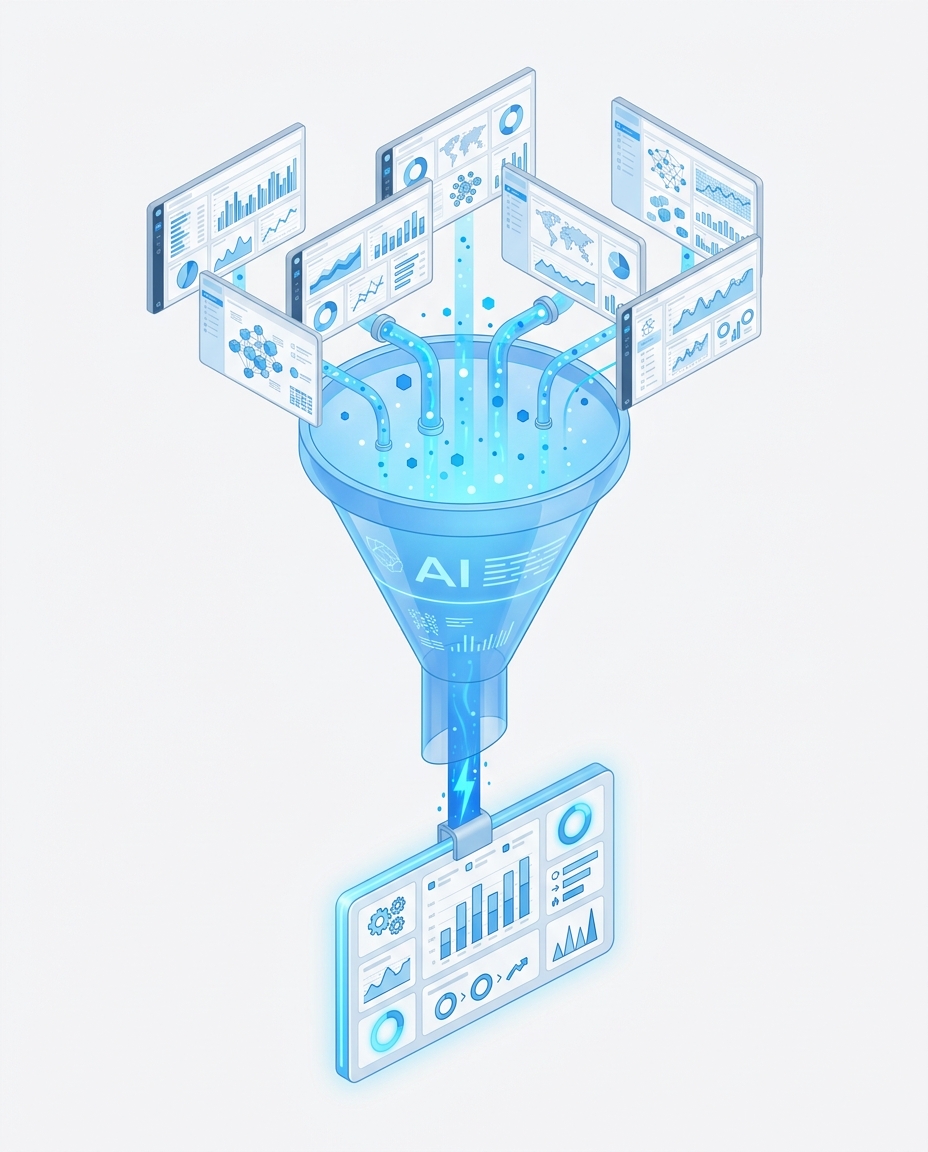
Performance Metric Summarization AI Agent
AI agent that analyzes brand performance metrics across a portfolio and generates executive-level summary highlights with drill-down capability, filterable by brand and audience segment.
Benefits
This agent bridges the gap between comprehensive analytics and executive attention spans, transforming walls of dashboard data into the specific insights that drive decisions.
- Instant executive awareness: Leadership receives AI-generated summaries highlighting what matters most across the entire brand portfolio without opening a single dashboard or scrolling through data tables
- Brand-level filtering: Summaries are filterable by individual brand and audience segment, allowing executives to drill into the specific business units they oversee without wading through irrelevant metrics
- Source-linked transparency: Every summary highlight includes hyperlinks back to the source cards and underlying data, maintaining analytical credibility and enabling deeper investigation when a summary raises questions
- Consistent insight cadence: The agent generates summaries on a reliable schedule, ensuring leadership always has a current view of portfolio performance without depending on analyst availability or manual report compilation
- Reduced analyst burden: Analysts who previously spent hours preparing executive summaries can redirect that time toward deeper strategic analysis, knowing the routine summarization is handled automatically
- Multi-level drill path: The agent establishes a structured information hierarchy where executives start with summaries, drill to individual cards, and then into granular data, each level a single click away
Problem Addressed
A large automotive services organization manages a diverse portfolio of brands, each with its own audiences, performance metrics, and business objectives. The analytics team had built comprehensive dashboards covering every dimension of performance. The problem was not missing data. It was too much of it.
Executives responsible for the portfolio did not have time to review dozens of dashboards spanning multiple brands. They needed the answer to a simple question: what is important right now? But answering that question meant someone had to manually review each brand's metrics, identify the notable movements, and compile a summary that captured the signal without drowning in noise. That person was usually a senior analyst who could have been doing higher-value work. When the analyst was unavailable, the summary did not happen, and leadership made decisions with stale or incomplete information. The organization needed a way to automatically surface what mattered from across its entire analytics footprint, personalized by brand and audience, without requiring human curation for every cycle.
What the Agent Does
The agent analyzes content presented across the organization's analytics application and generates structured, filterable executive summaries:
- Content scanning: The agent reads the full set of analytics cards and dashboards across the portfolio, ingesting current metric values, trend directions, threshold breaches, and comparative benchmarks for every brand and audience segment
- Significance detection: AI analysis identifies which metrics represent meaningful changes versus normal fluctuation, applying statistical and contextual thresholds to surface only the movements that warrant executive attention
- Summary generation: For each brand, the agent produces concise narrative highlights explaining what changed, why it matters, and what the trend implies, written in language appropriate for executive consumption rather than analyst detail
- Filter context application: Summaries are organized and filterable by brand and audience segment through data permission controls, ensuring each executive sees performance intelligence relevant to their scope of responsibility
- Source linking: Every generated insight includes hyperlinks to the specific source cards containing the underlying data, creating a seamless drill path from summary to detail
- Drill-path architecture: The agent establishes a three-level information hierarchy: AI-generated summaries at the top, individual metric cards in the middle, and granular data tables at the base, each accessible from the level above
Standout Features
- Portfolio-wide analysis: The agent processes metrics across every brand and audience in the portfolio simultaneously, identifying cross-brand patterns and relative performance differences that single-brand reviews miss
- Contextual significance filtering: Rather than simply flagging metrics that moved, the agent evaluates whether a movement is significant given historical patterns, seasonal expectations, and business context, reducing false alarms
- Permission-aware summaries: Summary content respects existing data permission policies, ensuring each user sees only the brands and segments they are authorized to access, maintaining governance even in AI-generated content
- Executive-calibrated language: Generated summaries use business language rather than statistical jargon, translating data movements into implications and recommended attention areas that executives can act on immediately
- Linked source traceability: Every AI-generated statement can be traced back to its source data through embedded hyperlinks, supporting the trust and verification workflow executives require before acting on automated insights
Who This Agent Is For
This agent is designed for organizations managing complex brand portfolios where executive teams need performance visibility without dashboard fatigue.
- Portfolio executives overseeing multiple brands who need a consolidated view of what demands their attention across the entire business
- Brand leaders who want AI-curated performance highlights specific to their business unit without manually reviewing every dashboard
- Analytics teams seeking to automate routine executive summarization so analysts can focus on strategic deep-dive work
- Operations managers responsible for cross-brand performance comparison and resource allocation decisions
- Any organization with extensive dashboard infrastructure where the challenge has shifted from data availability to data consumption
Ideal for: Portfolio executives, brand managers, chief marketing officers, analytics directors, and any multi-brand organization where leadership needs insight density rather than data volume.
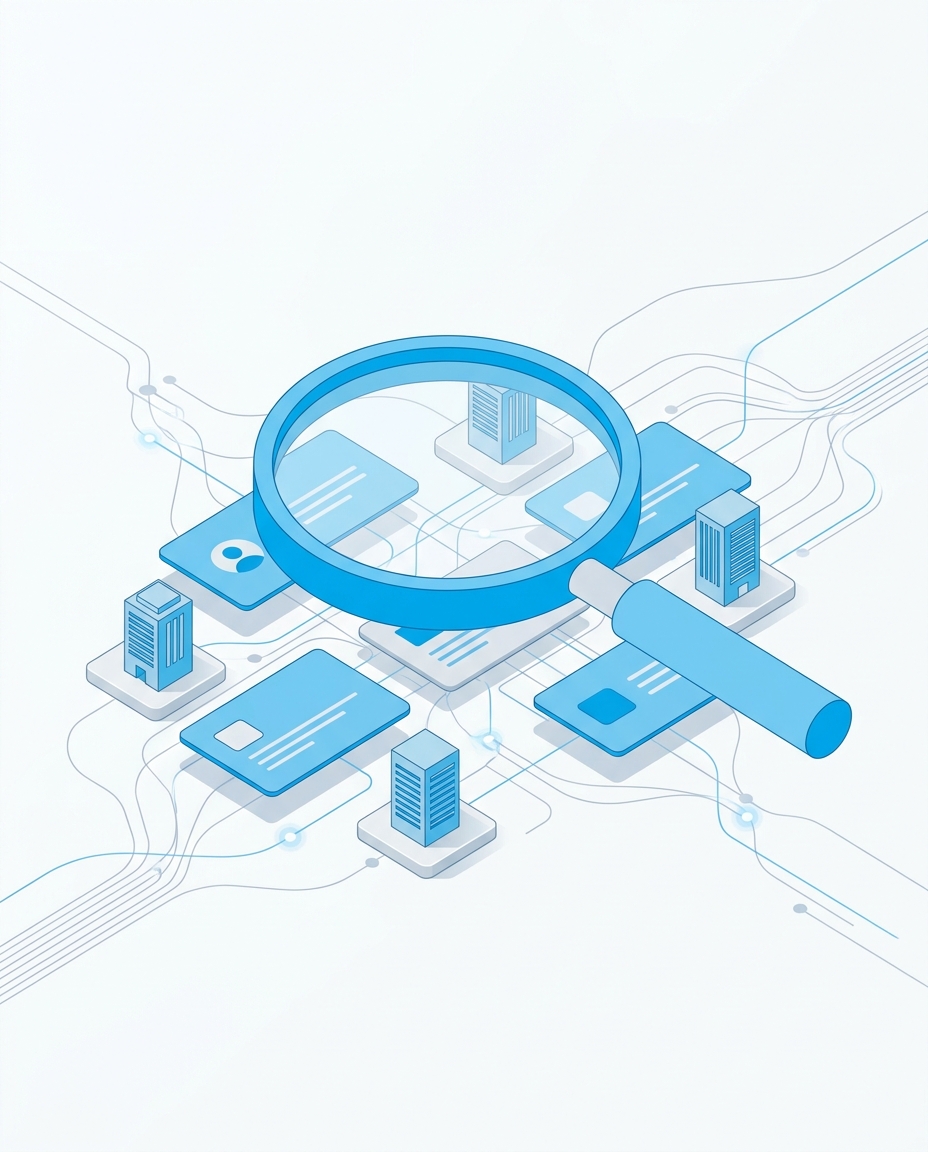
Skip Tracing AI Agent
AI-powered skip-tracing agent that automates business intelligence research before collection calls, gathering ratings, websites, profiles, corporate structures, and regulatory filings to improve recovery outcomes.
Benefits
This agent transforms the labor-intensive process of pre-call research into an automated intelligence pipeline that delivers structured business profiles at scale, enabling collection teams to enter every conversation fully informed.
- Automated multi-source research: The agent simultaneously queries business rating databases, corporate websites, professional networks, and regulatory filing repositories, assembling a comprehensive intelligence profile in seconds rather than the hours manual research requires
- Improved recovery rates: Collection agents armed with detailed business intelligence conduct more effective conversations, identifying the right contacts, understanding corporate structures, and referencing relevant financial indicators that accelerate resolution
- Scalable operations: Research that previously limited the number of accounts an agent could prepare for each day now runs automatically across the entire portfolio, removing the bottleneck between account assignment and first contact
- Consistent intelligence quality: Every account receives the same depth of research regardless of volume, agent experience, or time pressure, eliminating the variability that comes with manual research habits
- Reduced agent ramp time: New collection agents receive the same quality of pre-call intelligence as veterans, compressing the learning curve and enabling productive conversations from day one
- Structured data output: Research results arrive in a standardized format that integrates directly into the collection workflow, replacing scattered notes and browser tabs with organized, actionable intelligence
Problem Addressed
A global accounts receivable management firm handles thousands of commercial collection cases across international markets. Before every outbound collection call, agents need context: Who runs this business? Are they still operating? What is their financial health? Are there regulatory filings, liens, or judgments that affect the collection strategy?
Historically, agents gathered this intelligence manually. They searched business rating services, checked corporate websites, reviewed professional network profiles, looked up corporate filing records, and scanned regulatory databases. A thorough research session for a single account could consume thirty minutes or more. Multiply that across hundreds of daily assignments, and the math becomes clear: either agents skip the research and call blind, or the team's capacity is capped by how fast humans can read web pages. Neither outcome serves the business. The organization needed a way to deliver comprehensive, structured business intelligence for every account without requiring manual research time from their highest-value resource: the collection agents themselves.
What the Agent Does
The agent operates as an automated business intelligence researcher, taking basic company identifiers and returning structured, enriched profiles ready for collection use:
- Identity resolution: Starting from a company name, address, or registration number, the agent resolves the entity across multiple data sources, handling name variations, subsidiary relationships, and DBA registrations to ensure research targets the correct organization
- Business rating aggregation: The agent queries commercial rating services to retrieve current credit ratings, payment history scores, and risk indicators, providing agents with an immediate snapshot of the debtor's financial standing
- Digital presence analysis: Corporate websites and professional network profiles are scanned for current operational status, key personnel, contact information, and recent activity that indicates whether the business is active and reachable
- Corporate structure mapping: Parent companies, subsidiaries, and affiliated entities are identified and mapped, revealing corporate relationships that may affect collection strategy or identify alternative payment sources
- Regulatory filing review: Public filings, liens, judgments, and regulatory actions are retrieved and summarized, flagging any legal encumbrances or compliance issues relevant to the collection approach
- Intelligence packaging: All gathered data is structured into a standardized briefing format, organized by relevance to the collection conversation and delivered directly into the agent's workflow before the scheduled call
Standout Features
- Parallel multi-source querying: Unlike sequential manual research, the agent queries all intelligence sources simultaneously, compressing research time from thirty minutes to seconds while covering more ground than any individual researcher
- Enrichment scoring: Each intelligence profile receives a completeness score indicating data coverage quality, so agents know whether they have a full picture or need to supplement specific areas during the conversation
- Entity disambiguation: Advanced matching logic resolves common business names across jurisdictions, preventing research contamination from similarly named but unrelated entities
- Jupyter-orchestrated pipeline: The research pipeline runs within Jupyter Workspaces, enabling rapid iteration on data sources, enrichment logic, and output formatting without redeploying infrastructure
- Continuous source expansion: New data sources can be added to the research pipeline without redesigning the agent, allowing the intelligence profile to deepen over time as additional APIs and databases are integrated
Who This Agent Is For
This agent is built for organizations where pre-engagement research quality directly impacts revenue recovery and operational efficiency.
- Collection agents who need comprehensive debtor intelligence before every outbound call but lack time for manual research
- Account managers overseeing large commercial portfolios who need scalable research across hundreds of active cases
- Operations leaders seeking to increase agent productivity by eliminating the research bottleneck that limits daily contact rates
- Compliance teams requiring documented due diligence on debtor entities before initiating collection activities
- Training managers looking to equip new agents with the same intelligence depth that experienced staff develop over years
Ideal for: Commercial collection agencies, accounts receivable management firms, financial services companies with recovery operations, and any organization where pre-contact intelligence quality drives engagement outcomes.

Dataflow Generator AI Agent
AI-powered tool that generates fully working dataflows from user specifications, leveraging multiple input sources and a wide range of ETL tiles to dramatically reduce pipeline creation time and technical complexity.
Benefits
This agent fundamentally changes the economics of dataflow creation by replacing hours of manual ETL construction with AI-generated pipelines that are ready to execute the moment they are built.
- Dramatically reduced creation time: Dataflows that previously required hours of manual tile placement, configuration, and wiring are generated in minutes, including multi-input joins, transformations, and output configurations
- Broad ETL tile coverage: The agent works with a wide range of available ETL tiles including filters, joins, group-by aggregations, formulas, unions, rank and window functions, and output datasets, producing pipelines with real transformation logic rather than simple pass-throughs
- Accessible to non-specialists: Users who understand what transformation they need but lack the ETL expertise to build it can describe their requirements and receive a working dataflow, democratizing pipeline creation across the organization
- Consistent pipeline architecture: Generated dataflows follow best-practice patterns for tile organization, naming conventions, and data flow structure, producing cleaner, more maintainable pipelines than ad hoc manual construction often achieves
- Faster iteration cycles: When requirements change, regenerating or modifying a dataflow is significantly faster than manually rewiring an existing pipeline, supporting the iterative data modeling workflows that real-world analytics projects demand
- Reduced error rates: AI-generated dataflows eliminate the configuration errors, missed join conditions, and incorrect formula syntax that plague manual ETL development, reducing debugging time and improving data quality
Problem Addressed
Building dataflows manually is one of the most time-intensive tasks in any BI platform. Even experienced ETL developers spend significant time on the mechanical work of placing tiles, configuring join conditions, writing transformation formulas, and wiring inputs to outputs. For complex pipelines with multiple source datasets, branching transformation paths, and aggregation layers, the construction process can consume an entire day or more.
The bottleneck is compounded by the expertise requirement. Building effective dataflows requires understanding not just the business logic but also the specific tile types available, their configuration parameters, and their behavior under different data conditions. Organizations with limited ETL expertise find themselves dependent on a small number of specialists who become the bottleneck for every pipeline request. Even with sufficient expertise, the manual nature of the work means that capacity scales linearly with headcount rather than exponentially with tooling.
What the Agent Does
The agent operates as an AI-powered dataflow construction engine that translates user specifications into fully functional ETL pipelines:
- Requirement interpretation: Accepts user descriptions of the desired data transformation, parses the requirements to identify source datasets, transformation logic, filtering conditions, aggregation levels, and output specifications
- Source dataset analysis: Examines the schema and sample data from each specified input dataset to understand column types, key relationships, and data characteristics that inform tile selection and configuration
- ETL tile selection and sequencing: Selects the appropriate ETL tiles for each transformation step from the available tile library, ordering them into a logical execution sequence that respects data dependencies
- Join and merge configuration: Configures join tiles with appropriate key columns, join types (inner, left, right, full), and column selection, handling multi-table joins and complex key relationships
- Transformation and formula construction: Builds formula tiles with the correct syntax for calculated columns, type conversions, conditional logic, string manipulations, and date arithmetic specified in the requirements
- Output dataset configuration: Configures the output tile with appropriate column selection, naming, and data type settings, producing a dataset that matches the specified output schema
Standout Features
- Multi-input pipeline support: The agent handles dataflows that read from multiple source datasets, configuring the appropriate join, union, or append operations to combine data according to the specified logic
- Wide tile type coverage: Generated dataflows can include filter tiles, select columns, add formula, group by, join, union, rank and window, alter columns, and output tiles, covering the majority of real-world ETL requirements
- Schema-aware configuration: All tile configurations are validated against the actual source dataset schemas, ensuring that column references, data types, and key relationships are correct before the dataflow is saved
- Execution-ready output: Generated dataflows are not mockups or templates. They are fully configured, executable pipelines that can be run immediately against live data sources
- Iterative refinement: Users can review generated dataflows, request modifications, and regenerate specific sections without rebuilding the entire pipeline, supporting the iterative development process that complex transformations require
Who This Agent Is For
This agent is built for anyone who builds or needs dataflows, from specialists who want to work faster to business users who need pipelines built without waiting in the ETL queue.
- Data engineers who build dataflows daily and want to accelerate their productivity on routine and moderately complex pipeline construction
- BI developers who understand their data transformation requirements but want to reduce the mechanical work of manual tile configuration
- Analysts who need custom data pipelines but lack the ETL expertise to build them from scratch in the dataflow editor
- Platform administrators managing large dataflow inventories who need to standardize pipeline architecture and naming conventions
Ideal for: Any organization where dataflow creation is a regular activity and the time spent on manual pipeline construction represents a measurable constraint on analytics delivery speed.
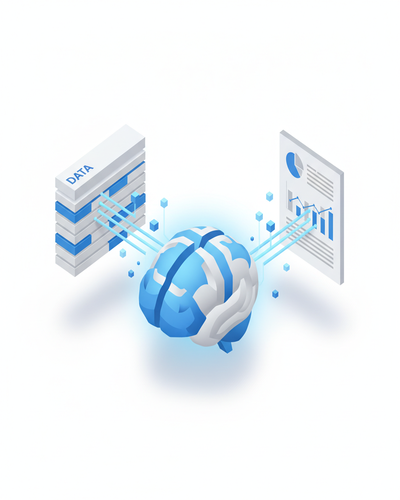
Report Generation AI Agent
Reusable AI component that automatically generates analysis reports from connected datasets, designed as a scalable building block for rapid deployment across customer environments and use cases.
Benefits
If you have ever built the same report generation logic three times for three different customers, this agent exists to make that a one-time investment. It is a reusable component designed to be demonstrated quickly and deployed faster.
- Build once, deploy everywhere: The agent is architected as a reusable component that connects to any dataset, analyzes its structure and content, and produces formatted analysis reports without requiring custom development for each deployment
- Rapid time-to-value: New deployments take hours rather than weeks because the core analysis and report generation logic is already built, tested, and proven across previous implementations
- Consistent report quality: Every generated report follows the same analytical structure, formatting standards, and quality checks, eliminating the variability that comes from manual report creation by different analysts
- Scalable AI adoption: Organizations can introduce AI-powered reporting as a capability rather than a one-off project, building institutional confidence through repeatable, demonstrable results
- Reduced analyst burden: Routine analysis reports that previously consumed hours of analyst time are generated automatically, freeing skilled analysts to focus on the interpretive and strategic work that requires human judgment
- Demonstrable ROI: Because the agent produces tangible, readable outputs from real data, it provides immediate proof of value during evaluations and pilot programs rather than requiring abstract capability assessments
Problem Addressed
Here is a pattern that plays out in every analytics organization: someone builds a beautiful report generation solution for one specific use case, one specific dataset, one specific customer. It works great. Then the next customer wants something similar, and the team builds it again from scratch because the first solution was too tightly coupled to its original context. After the third rebuild, everyone agrees that a reusable component would save enormous effort, but nobody has the bandwidth to build one because they are too busy building one-off solutions.
The deeper problem is that one-off AI solutions do not scale. Every bespoke implementation carries its own maintenance burden, its own testing requirements, and its own upgrade path. The organization accumulates technical debt faster than it accumulates customers. What is needed is a report generation component that is genuinely reusable: one that can connect to different data sources, analyze different data structures, and produce different report formats while sharing the same core intelligence.
What the Agent Does
The agent functions as a plug-and-play report generation engine that connects to data sources, performs analysis, and produces structured reports:
- Dataset connection and profiling: Connects to any available dataset, reads its schema and content, and builds an internal profile of the data including column types, value distributions, null rates, and potential analytical dimensions
- Automated analysis execution: Applies a configurable analysis framework to the connected data, running statistical summaries, trend detection, outlier identification, and comparative analysis appropriate to the data type and structure
- Report generation: Transforms analysis results into formatted, readable reports with executive summaries, key findings, supporting data visualizations, and detailed appendices
- Template customization: Supports configurable report templates that control structure, formatting, branding, and section emphasis, allowing each deployment to produce reports that match organizational standards
- Scheduled execution: Can be configured to run on schedules, automatically generating updated reports as underlying data refreshes and distributing them to configured recipients
- Output flexibility: Generates reports in multiple formats including rich text, HTML, and structured data outputs that integrate with existing distribution and archival workflows
Standout Features
- Schema-adaptive analysis: The agent examines the actual structure and content of each connected dataset rather than relying on predefined analysis templates, enabling meaningful analysis of datasets it has never seen before
- Demonstration-ready packaging: Designed specifically to be impressive in demonstrations, the agent can connect to a new dataset and produce a complete analysis report in minutes, making it an effective tool for evaluations and proof-of-concept engagements
- Progressive complexity: Reports automatically scale in depth and sophistication based on data richness, providing simple summaries for sparse datasets and multi-dimensional analysis for complex ones
- Cross-deployment learning: Configuration improvements and analysis enhancements developed for one deployment can be propagated to all deployments sharing the same component version, creating a positive feedback loop across the install base
- Embedded quality validation: Every generated report includes automated quality checks that verify data completeness, flag statistical anomalies in the analysis, and ensure that findings are supported by the underlying data
Who This Agent Is For
This agent is purpose-built for practitioners who are tired of rebuilding the same report generation logic and want a component they can deploy, demonstrate, and scale.
- Solution architects designing repeatable AI implementations that need to demonstrate value quickly during customer evaluations
- Analytics teams producing recurring analysis reports who want to automate the generation process without sacrificing quality or consistency
- Managers and executive stakeholders who consume regular analysis reports and want faster delivery with consistent formatting and structure
- Platform teams building internal AI toolkits who need proven, reusable components rather than one-off implementations
Ideal for: Any team that produces analysis reports at scale and wants to replace custom-built, single-use generation logic with a reusable component that works across datasets, use cases, and deployment environments.
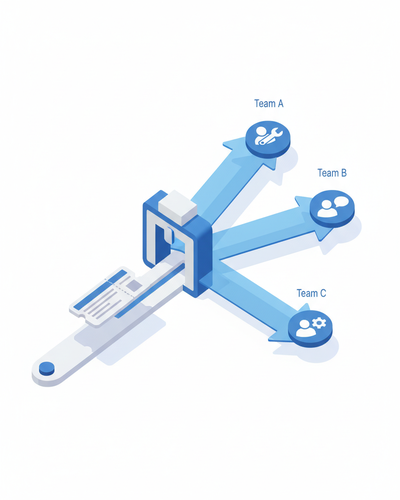
Work Order Ticketing AI Agent
AI-powered work order management system that automatically routes submissions to the right team based on task type and priority, notifies stakeholders at every stage, and provides full visibility into work order status and progress.
Benefits
This agent delivers measurable operational outcomes from day one: faster response times, complete accountability, and the kind of systematic visibility that transforms work order management from a coordination headache into a competitive advantage.
- Immediate routing without human intervention: Work orders reach the right team member within seconds of submission, eliminating the hours or days that requests previously spent waiting in shared inboxes or on someone's desk
- Full accountability at every stage: Every work order carries a complete audit trail showing who submitted it, when it was routed, who received it, when action was taken, and what the resolution was, ending the ambiguity that lets requests fall through cracks
- Priority-driven resource allocation: Critical work orders automatically receive elevated routing and faster notification cycles, ensuring that urgent requests do not compete for attention with routine maintenance tasks
- Stakeholder confidence through visibility: Requesters, team leads, and managers can see the real-time status of every work order without sending follow-up emails or walking to someone's desk to ask for an update
- Reduced coordination overhead: By automating the routing and notification logic that previously required manual coordination, the system frees supervisors to focus on execution rather than dispatch
- Data-driven capacity planning: Every completed work order contributes to a growing dataset of request volumes, resolution times, and resource utilization that enables evidence-based staffing and process decisions
Problem Addressed
In most organizations, work order management starts with good intentions and deteriorates quickly. Requests arrive through email, hallway conversations, messaging apps, and paper forms. A supervisor reads each one, decides who should handle it, and either forwards it or adds it to a list. Stakeholders who submitted the request have no way to check its status without asking someone. When the assigned person is out sick, the work order sits untouched until someone notices the delay.
The consequences are predictable: urgent requests get buried under routine ones because there is no systematic prioritization. Work orders are completed but nobody notifies the requester. Identical requests are submitted multiple times because there is no visibility into what has already been logged. Supervisors spend more time dispatching and tracking than their teams spend executing. The organization lacks the data to answer basic questions about request volumes, average resolution times, or resource utilization because none of that information is being captured systematically.
What the Agent Does
The agent operates as an intelligent work order management system that automates the complete lifecycle from submission through resolution and stakeholder notification:
- Self-service submission portal: Provides a structured submission interface where users create work orders with all required information including task description, category, priority level, location, and requested completion date
- Intelligent routing engine: Analyzes each submitted work order and automatically routes it to the appropriate team member based on configurable rules including task type, priority level, location, skill requirements, and current workload distribution
- Automated stakeholder notifications: Sends targeted notifications at every workflow stage, alerting assigned workers of new assignments, notifying supervisors of high-priority submissions, and updating requesters when their work order status changes
- Status tracking dashboard: Provides real-time visibility into all active work orders with filtering by status, priority, assignee, category, and date range, giving every stakeholder the information they need without manual follow-up
- Escalation management: Monitors work order aging and automatically escalates overdue items to supervisors, ensuring that stalled requests receive management attention before SLA thresholds are breached
- Resolution capture and feedback: When work orders are completed, the system captures resolution details, time spent, and materials used, then notifies the original requester with a completion summary and satisfaction feedback option
Standout Features
- Dynamic priority recalculation: As work orders age or as conditions change, the system automatically recalculates priority scores, ensuring that aging routine requests eventually receive elevated attention rather than being perpetually deprioritized
- Workload-aware routing: Assignment logic considers each team member's current queue depth and active commitments, distributing new work orders to balance load rather than always routing to the same default assignee
- SLA monitoring with early warning: Configurable service level targets trigger proactive alerts when work orders approach their deadlines, giving teams time to respond before commitments are missed
- Duplicate detection: The system identifies potential duplicate submissions based on description similarity, location, and timing, reducing wasted effort on requests that have already been logged
- Historical analytics engine: Aggregates work order data across time periods to surface trends in request volume, resolution efficiency, category distribution, and team performance, supporting continuous process improvement
Who This Agent Is For
This agent delivers immediate value to any team where work requests are currently managed through informal channels and manual coordination.
- Operations teams managing facilities maintenance, equipment repair, and service requests across multiple locations
- IT service desk teams handling internal support tickets, access requests, and infrastructure change orders
- Facilities managers coordinating building maintenance, space allocation, and vendor work across campus environments
- Team leads and supervisors who currently spend significant time manually dispatching, tracking, and following up on work assignments
Ideal for: Operations departments, facilities management, IT service desks, field service organizations, and any team where the volume and variety of incoming work requests has outgrown email and spreadsheet-based tracking.

RFP Budget Approval AI Agent
AI-powered RFP pipeline that automates budget finalization through an editable app, distributes requirements to vendors as CSVs, and routes vendor responses for review with automated acceptance and change request handling.
Benefits
This agent transforms the fragmented, email-heavy RFP process into a controlled pipeline where budgets are finalized collaboratively, vendor communications are automated, and every response lands in front of the right reviewer without manual coordination.
- End-to-end RFP automation: From the moment a marketing budget is finalized in the app to the point where vendor responses are routed to reviewers, every step executes without manual intervention or email-based coordination
- Elimination of manual vendor distribution: Budget requirements are automatically packaged as structured CSV files and distributed to the appropriate vendors, replacing the error-prone process of manually preparing and emailing documents
- Automated response routing: When vendors reply via email, their responses flow through a connector into the system and are automatically routed to the correct reviewer based on vendor, budget category, or response type
- Collaborative budget finalization: Teams work together in an editable app interface to finalize budget allocations before distribution, eliminating the version control problems that plague spreadsheet-based budget workflows
- Real-time visibility: Every stakeholder can see the current status of the RFP process, which vendors have responded, which responses need review, and which budgets are still pending finalization
- Reduced cycle time: By removing manual handoffs between budget finalization, vendor distribution, and response routing, the overall RFP cycle compresses from weeks to days
Problem Addressed
Anyone who has managed an RFP process knows the pain. Marketing teams spend days finalizing budgets in shared spreadsheets, only to discover that someone overwrote the latest version. Then the distribution begins: someone has to manually prepare vendor-specific documents, compose individualized emails, and track which vendors received what. Responses trickle back through email over days or weeks, and someone has to read each one, determine whether it is an acceptance or a change request, and forward it to the right person for review.
The manual coordination overhead is enormous. Every handoff between budget finalization, vendor distribution, and response routing introduces delays, errors, and lost context. Vendors receive outdated requirements because someone sent from the wrong version. Responses sit in inboxes because the reviewer did not know they were expected. Change requests get lost in email threads. The result is a process that takes weeks when it should take days, and produces outcomes that depend entirely on whether the coordinator remembered every step.
What the Agent Does
The agent operates as a complete RFP pipeline orchestrator, connecting budget finalization, vendor distribution, and response routing into a single automated workflow:
- Collaborative budget app: Provides an editable interface where marketing teams finalize budget allocations by line item, with version control, approval gates, and real-time collaboration that eliminates spreadsheet conflicts
- Automated CSV generation: Once budgets are finalized and approved, the system automatically packages each vendor's relevant budget items into a structured CSV document formatted to their requirements
- Vendor distribution engine: Distributes prepared CSVs to the appropriate vendors via email or secure file transfer, with delivery confirmation tracking and automatic retry for failed deliveries
- Email response ingestion: Monitors incoming email via a dedicated connector, capturing vendor responses and parsing them to identify acceptances, rejections, change requests, and questions
- Intelligent response routing: Routes each vendor response to the appropriate reviewer based on configurable rules including vendor assignment, budget category, response type, and escalation thresholds
- Status dashboard: Provides a real-time view of the entire RFP pipeline showing which budgets are pending, which vendors have been contacted, which responses have been received, and which items need reviewer action
Standout Features
- Editable in-app budget interface: Teams finalize budgets directly in the platform rather than in external spreadsheets, eliminating version conflicts and ensuring that the distributed version is always the approved version
- Vendor-specific formatting: CSV outputs are formatted according to each vendor's requirements, handling variations in column order, naming conventions, and data formats without manual adjustment
- Change request workflow: When a vendor submits a change request, the system creates a structured review task with the original budget line, the proposed change, and the vendor's rationale, enabling fast, informed decisions
- Multi-round negotiation tracking: The agent tracks the full conversation history across multiple rounds of vendor responses, maintaining context so reviewers do not have to reconstruct the negotiation timeline from scattered emails
- Approval cascade automation: Budget approvals flow through configurable approval chains before vendor distribution, ensuring that appropriate sign-offs are captured without manual routing of approval requests
Who This Agent Is For
This agent is built for teams where RFP processes involve multiple stakeholders, multiple vendors, and the kind of coordination overhead that consumes hours of administrative time per cycle.
- Marketing operations teams responsible for managing annual or quarterly budget RFP cycles across multiple vendors and agencies
- Procurement professionals coordinating vendor selection, budget allocation, and response evaluation across departments
- Vendor managers who need to track multi-vendor response timelines, negotiate change requests, and maintain audit trails
- Finance teams requiring visibility into budget finalization status and vendor commitment tracking across the organization
Ideal for: Marketing departments, procurement teams, and any organization running recurring RFP cycles where manual coordination between budget owners, vendors, and reviewers creates bottlenecks and risk.

Cloud Amplifier Migration AI Agent
AI agent that analyzes existing Snowflake connector configurations, auto-generates Cloud Amplifier dataset parameters, and orchestrates complete migration including content, PDPs, tags, cards, and dataflows with zero manual reconfiguration.
Benefits
This agent eliminates the engineering overhead and operational risk inherent in migrating from legacy Snowflake connector configurations to Cloud Amplifier, replacing weeks of manual reconfiguration with a systematic, automated cutover process.
- Zero-manual-reconfiguration migration: The agent reads every parameter from the existing Snowflake connector setup and auto-generates the equivalent Cloud Amplifier configuration, eliminating the line-by-line manual translation that previously consumed days of engineering time per dataset
- Complete dependency mapping: Migration extends beyond the dataset itself to include all downstream dependencies including cards, dataflows, PDPs, and tags that reference the original connector, ensuring nothing breaks when the source changes
- Reduced migration risk: Automated configuration translation and dependency rewiring removes the human error vectors that cause post-migration data discrepancies, broken dashboards, and permission gaps
- Accelerated platform modernization: Organizations running dozens or hundreds of Snowflake connectors can execute batch migrations at a pace impossible with manual processes, compressing multi-month modernization timelines into weeks
- Minimized operational downtime: The orchestrated cutover process executes the switch with minimal disruption to end users, preserving data continuity and dashboard availability throughout the transition
- Audit-ready migration logs: Every configuration mapping decision, dependency update, and validation check is logged, creating a complete migration record for compliance review and rollback planning
Problem Addressed
Upgrading from Snowflake connectors to Cloud Amplifier is a high-value platform modernization that unlocks better performance, more granular control, and simplified architecture. But the migration path itself is a wall of manual work that stalls most teams before they start.
Each Snowflake connector carries a unique configuration: connection parameters, query definitions, scheduling rules, column mappings, and security settings. When that connector feeds dashboards, dataflows, PDP policies, and tagged content, every one of those downstream objects must be updated to reference the new Cloud Amplifier dataset. Multiply that by dozens or hundreds of connectors across an enterprise instance, and the migration becomes a months-long project requiring deep platform expertise. Miss a single PDP rule or dataflow input reference during the manual cutover, and the result is broken permissions or silent data pipeline failures that may not surface until a stakeholder sees wrong numbers in a quarterly review.
What the Agent Does
The agent operates as a migration orchestration engine that reads legacy configurations, translates them to Cloud Amplifier equivalents, and systematically updates every dependent object in the platform:
- Configuration analysis: Scans each existing Snowflake connector to extract the complete parameter set including connection strings, query definitions, column schemas, refresh schedules, and security configurations
- Cloud Amplifier parameter generation: Translates extracted configurations into equivalent Cloud Amplifier dataset parameters, mapping legacy settings to the new architecture while preserving query logic and schema definitions
- Dependency graph construction: Builds a complete map of every object that references each connector including cards, dataflows, Beast Modes, PDP policies, alerts, and scheduled reports, identifying the full blast radius of each migration
- Orchestrated cutover execution: Executes migration in a controlled sequence: creates the Cloud Amplifier dataset, validates data parity with the legacy source, updates all downstream references, and retires the old connector
- PDP and tag migration: Transfers all personalized data permission policies and content tags from the legacy dataset to the Cloud Amplifier replacement, ensuring access controls and organizational metadata survive intact
- Post-migration validation: Runs automated checks across all migrated objects to confirm data consistency, dashboard rendering, dataflow execution, and permission enforcement before marking the migration complete
Standout Features
- Batch migration orchestration: Rather than processing one connector at a time, the agent queues and executes migrations across an entire instance, managing dependencies and sequencing to avoid conflicts between concurrent migrations
- Pre-migration impact analysis: Before executing any changes, the agent produces a detailed impact report showing every object that will be affected, every configuration change, and every risk factor, giving administrators full visibility before committing
- Rollback capability: If post-migration validation detects issues, the agent reverses the cutover by restoring original connector references, ensuring that a failed migration does not result in prolonged downtime
- Incremental migration support: Organizations can migrate connectors in phases rather than all at once, with the agent tracking which connectors have been migrated and which remain, supporting controlled rollout strategies
- Configuration drift detection: Identifies cases where legacy connector configurations have diverged from documented standards or where Cloud Amplifier offers improved alternatives, surfacing optimization opportunities during migration
Who This Agent Is For
This agent is designed for platform teams facing the operational challenge of modernizing their data connectivity layer without disrupting the dashboards, dataflows, and permissions that the organization depends on daily.
- Data engineers responsible for maintaining and upgrading data connectivity infrastructure across enterprise BI instances
- BI administrators managing hundreds of datasets and connectors who need to modernize without breaking downstream content
- Platform operations teams executing planned migrations from legacy connectors to Cloud Amplifier as part of infrastructure modernization
- Migration project managers who need accurate dependency mapping and progress tracking across large-scale connector upgrade initiatives
Ideal for: Any organization running Snowflake connectors at scale that wants to modernize to Cloud Amplifier without the engineering overhead, risk, and downtime of manual reconfiguration.


Contract Intelligence AI Agent
AI-driven contract analysis agent that ingests complex multi-page agreements, extracts critical terms into structured datasets, tracks expiration milestones with automated notifications, and provides a conversational interface for natural-language contract queries.
Hundreds of contracts. Eighty pages each. Every critical term buried in dense legal language that someone has to read line by line.
The Contract Intelligence AI Agent was built to solve a problem that scales faster than any team can hire: extracting, tracking, and querying critical information locked inside complex multi-page agreements. A national behavioral health organization managing services across multiple states faced this challenge at its most acute. Hundreds of active contracts, each running 80 pages or more, governed the terms under which the organization delivered care. Renewal dates, compliance obligations, rate structures, termination clauses, and performance requirements were all embedded in those documents. And every one of those data points had to be manually located, read, interpreted, and transferred into spreadsheets by staff members who had dozens of other responsibilities competing for their attention.
Benefits
This agent eliminates the manual labor and oversight risk inherent in managing large volumes of complex contractual agreements, replacing human document review with systematic AI extraction and monitoring.
- Elimination of manual contract review: Staff no longer spend hours reading through 80-page agreements to find specific terms, rates, or dates buried in dense legal language, reclaiming hundreds of hours per quarter for higher-value compliance and relationship work
- Proactive expiration management: Automated milestone tracking and stakeholder notifications surface upcoming renewals, terminations, and compliance deadlines weeks before they arrive, replacing the reactive discovery that previously led to missed windows and unfavorable auto-renewals
- Instant access to contract intelligence: A conversational AI interface lets authorized staff ask natural-language questions about any contract and receive immediate, citation-backed answers instead of searching through folders and spreadsheets
- Reduced oversight risk: Systematic extraction ensures that every critical term, obligation, and condition is captured consistently across the entire contract portfolio, eliminating the human variability that allowed important clauses to be overlooked
- Improved compliance visibility: Structured contract data feeds directly into compliance dashboards, giving leadership a real-time view of organizational obligations, approaching deadlines, and risk exposure across the full agreement portfolio
- Faster stakeholder response: When executives, regulators, or partners ask about specific contract terms, staff can provide accurate answers in minutes rather than the hours or days previously required to locate and review the relevant documents
Problem Addressed
Picture this: a compliance officer needs to know the termination notice period for a specific state contract. She opens a shared drive, locates the folder for that state, finds the most recent version of the agreement, and begins scrolling through 87 pages of legal text. Twenty minutes later, she finds the clause on page 64. Now multiply that by the three other contracts she needs to verify before a Friday deadline. This is not an edge case. This is Tuesday.
Organizations that manage large portfolios of complex agreements face a structural problem that becomes more dangerous as the portfolio grows. Each contract contains dozens of critical data points: effective dates, renewal windows, rate schedules, performance requirements, compliance obligations, termination conditions, and amendment histories. When those data points live only inside the documents themselves, the organization's knowledge of its own contractual position depends entirely on someone having recently read the right page of the right document. Contracts expire without renewal because no one flagged the deadline. Rate changes go unnoticed because the amendment was filed but never extracted. Compliance obligations are missed because the requirement was on page 71 of a document last reviewed eighteen months ago. The risk is not theoretical. It is operational, financial, and regulatory, and it compounds with every new agreement added to the portfolio.
What the Agent Does
The agent operates as an end-to-end contract intelligence pipeline, transforming unstructured legal documents into queryable, monitored, and actionable structured data:
- Document ingestion: Connects to document repositories and file storage systems to ingest contracts in PDF, Word, and scanned formats, processing documents of any length including the 80+ page agreements that are most critical and most difficult to review manually
- AI-powered term extraction: Analyzes each document using trained extraction models to identify and pull critical data points including effective dates, expiration dates, renewal terms, rate structures, performance obligations, termination conditions, and amendment provisions
- Structured dataset creation: Transforms extracted terms into normalized, structured datasets that integrate with existing business intelligence tools, compliance dashboards, and reporting workflows
- Milestone tracking and notifications: Monitors every extracted date and deadline, generating automated notifications to designated stakeholders at configurable intervals before critical milestones such as renewal windows, compliance deadlines, and termination notice periods
- Conversational query interface: Provides a natural-language AI interface where authorized users can ask questions about any contract in the portfolio and receive immediate, citation-backed responses referencing specific clauses and page locations
- Portfolio-level analytics: Aggregates contract data across the entire portfolio to surface organizational-level insights including total obligation exposure, upcoming renewal volume, rate variance across similar agreements, and compliance risk concentration
Standout Features
- Multi-format document processing: The agent handles PDFs, Word documents, and scanned images with equal reliability, applying OCR where needed so that even legacy paper contracts converted to scans are fully searchable and extractable
- Citation-backed conversational answers: When users ask questions through the natural-language interface, responses include specific document references, page numbers, and clause identifiers so that answers can be verified against source material in seconds
- Configurable notification cascades: Stakeholder alerts follow customizable escalation patterns, starting with the contract owner at 90 days before expiration, adding management at 60 days, and escalating to leadership at 30 days, ensuring that critical deadlines receive attention proportional to their proximity
- Cross-contract pattern detection: The agent identifies inconsistencies and patterns across the portfolio, flagging situations where similar agreements contain materially different terms, where rate structures diverge from organizational standards, or where amendment histories suggest renegotiation opportunities
- Living contract repository: As new contracts are added and existing ones are amended, the structured dataset updates automatically, maintaining a current single source of truth that eliminates the version confusion and stale data that plague manual tracking spreadsheets
Who This Agent Is For
This agent is designed for organizations where the volume and complexity of contractual agreements have outgrown the capacity of manual review and spreadsheet-based tracking.
- Legal teams responsible for managing and interpreting large portfolios of multi-page agreements across jurisdictions or service areas
- Compliance officers who need reliable visibility into contractual obligations, deadlines, and regulatory requirements without manual document review
- Contract administrators tracking hundreds of renewal dates, rate changes, and performance milestones across a growing portfolio
- Healthcare and behavioral health organizations managing state-by-state service agreements with varying terms, rates, and compliance requirements
- Procurement departments overseeing vendor agreements where missed renewal windows or overlooked terms create financial and operational exposure
Ideal for: General counsel, contract managers, compliance directors, procurement leads, and any organization managing 50+ active agreements where the cost of a missed deadline, an overlooked clause, or an unanswered stakeholder question represents real financial and regulatory risk.

User Provisioning Intelligence AI Agent
Self-learning AI agent that classifies users into access roles based on identity management data, delivers confidence-scored provisioning recommendations, and continuously refines its logic as new personnel data is introduced.
75% less manual provisioning. Right access from day one. A system that gets smarter with every new hire.
The User Provisioning Intelligence AI Agent delivers a measurable transformation in how organizations handle access management. By replacing manual role assignment with confidence-scored AI classification, a national wealth management platform eliminated onboarding delays that left new advisors locked out of the tools they needed to serve clients. The agent analyzes job titles, department codes, and historical assignment patterns from identity management data, then recommends the correct access tier for each user with a transparent confidence score. When confidence is high, provisioning happens automatically. When it is not, a human reviewer receives a pre-analyzed recommendation that takes seconds to approve rather than hours to research. The result is a 75% reduction in manual provisioning work, faster time-to-productivity for every new team member, and an access management system that continuously refines its own classification logic as organizational roles evolve.
Benefits
This agent transforms user provisioning from a reactive, manual bottleneck into a proactive, self-improving system that delivers measurable operational results from the first week of deployment.
- 75% reduction in manual provisioning: The vast majority of role assignments are handled automatically with high-confidence classification, freeing IT administrators from repetitive ticket-based workflows that consumed entire workdays
- Right access from day one: New personnel receive correct dashboard and system access immediately upon onboarding, eliminating the days or weeks of limited access that previously hampered advisor productivity and client responsiveness
- Self-learning classification: The agent continuously refines its role-mapping logic based on approved assignments, override patterns, and new job title variations, becoming more accurate with every provisioning cycle without manual retraining
- Transparent confidence scoring: Every classification includes a confidence score and reasoning explanation, giving reviewers the context they need to approve or override decisions in seconds rather than conducting independent research
- Reduced compliance risk: Systematic, auditable role assignment replaces ad-hoc decisions made under time pressure, ensuring that access grants in regulated financial environments follow consistent, defensible criteria
- Elimination of onboarding bottlenecks: Provisioning no longer depends on a single administrator's availability or institutional knowledge, removing the single point of failure that previously caused cascading delays during peak hiring periods
Problem Addressed
In financial services organizations managing hundreds of independent advisors, getting access management right is not an administrative convenience. It is a business-critical function. When a new advisor joins the platform, they need immediate access to portfolio management dashboards, compliance reporting tools, client communication systems, and market research resources. Every day without access is a day that advisor cannot fully serve their clients, a day the organization absorbs onboarding cost without productive output.
The traditional process required IT administrators to manually evaluate each new user, interpret their job title, determine which access role applied, and provision the correct set of permissions. With no systematic classification framework, decisions varied between administrators. Similar roles received different access levels depending on who processed the ticket and when. The backlog grew during hiring surges, creating a compounding delay where the advisors who most needed rapid onboarding waited the longest. Meanwhile, the organization had no mechanism to learn from its own provisioning history. Every new job title variation required the same manual evaluation, even when nearly identical titles had been classified dozens of times before.
What the Agent Does
The agent operates as an intelligent classification layer between identity management systems and access provisioning, analyzing user attributes and delivering scored role recommendations:
- Identity data ingestion: Connects to identity management platforms and HR systems to extract job titles, department assignments, reporting structures, and employment metadata for each user requiring provisioning
- Role classification with confidence scoring: Analyzes user attributes against historical provisioning patterns and organizational role definitions, producing a recommended access tier accompanied by a numerical confidence score and plain-language reasoning
- Automatic high-confidence provisioning: When classification confidence exceeds the organization's configured threshold, the agent provisions access automatically, eliminating human involvement for clear-cut assignments that represent the majority of provisioning volume
- Human-in-the-loop escalation: Ambiguous cases, novel job titles, or sensitive access tiers are routed to designated reviewers with the agent's analysis pre-attached, transforming a research task into a review-and-approve task
- Continuous learning loop: Every approved assignment, manual override, and correction feeds back into the classification model, allowing the agent to recognize new title patterns, adjust confidence thresholds, and improve accuracy over successive provisioning cycles
- Audit trail and compliance reporting: Maintains a complete record of every classification decision, confidence score, human review action, and provisioning event for regulatory compliance and operational analysis
Standout Features
- Adaptive confidence thresholds: Organizations set their own confidence thresholds per access tier, applying stricter human review requirements for sensitive financial system access while allowing full automation for standard dashboard provisioning
- Title normalization engine: The agent handles the real-world messiness of job titles, recognizing that Senior Financial Advisor, Sr. Financial Advisor, and Financial Advisor III all map to the same access role without requiring manual synonym management
- Self-improving accuracy: Unlike static rule-based provisioning, the classification model learns from every decision cycle, achieving measurably higher accuracy each quarter as it accumulates organizational knowledge that no single administrator could maintain
- Explainable decisions: Every recommendation includes a human-readable explanation citing the specific attributes and historical patterns that drove the classification, making audit reviews straightforward and building trust with compliance teams
- Bulk onboarding acceleration: During acquisition events or large hiring cohorts, the agent processes hundreds of provisioning requests simultaneously with consistent quality, eliminating the linear scaling problem that made manual provisioning unsustainable during growth periods
Who This Agent Is For
This agent is built for organizations where user provisioning volume, compliance requirements, or onboarding speed demands exceed what manual processes can reliably deliver.
- IT administration teams spending disproportionate time on repetitive role assignment rather than strategic infrastructure work
- Financial services platforms onboarding independent advisors who need immediate system access to begin serving clients
- Compliance officers seeking consistent, auditable provisioning decisions that follow documented criteria rather than individual judgment
- Operations leaders managing organizations where hiring surges or acquisitions create provisioning backlogs that delay business productivity
- Any enterprise with complex role hierarchies where the number of distinct access tiers makes manual classification error-prone and inconsistent
Ideal for: IT administrators, identity and access management teams, compliance officers, operations directors, and any organization in regulated industries where provisioning accuracy, speed, and auditability directly impact business performance and regulatory standing.
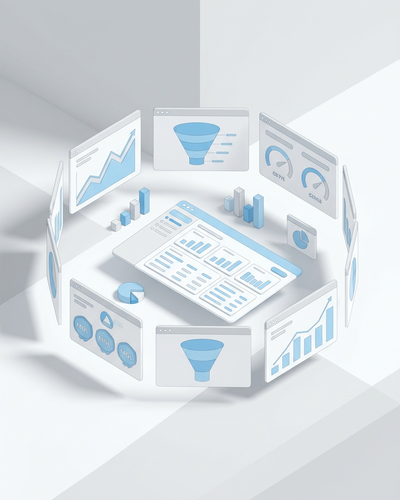

Paid Media Optimization AI Agent
AI copilot for paid media directors that consolidates campaign performance across ad platforms, generates optimization recommendations, and drives measurable MQL growth with reduced cost per acquisition.
Benefits
Instead of manually pulling reports from six ad platforms every morning and spending three hours stitching together a cross-channel view, the paid media director opens a single copilot interface that has already done the analysis. Here is what changes when AI handles the heavy lifting.
- Unified cross-platform intelligence: Campaign data from LinkedIn, Meta, Google, programmatic, and additional paid channels is consolidated into a single analysis layer, eliminating the spreadsheet gymnastics required to compare performance across platforms with different attribution models and reporting structures
- 298 MQLs generated in a single quarter: The agent's optimization recommendations directly contributed to generating 298 marketing qualified leads during its first full quarter of operation, demonstrating that AI-driven campaign adjustments translate into measurable pipeline
- 20% reduction in cost per MQL: By identifying underperforming audience segments, reallocating budget toward high-converting placements, and recommending bid adjustments based on conversion velocity rather than vanity metrics, the agent drove cost per MQL down by approximately 20%
- 15% reduction in cost per SAL: The improvements cascaded past the MQL stage, with cost per sales-accepted lead declining roughly 15% as the agent optimized for deeper-funnel outcomes rather than top-of-funnel volume alone
- $180K+ pipeline contribution: The MQLs generated through agent-recommended optimizations converted into over $180,000 in attributed pipeline within the same quarter, providing a clear line from AI recommendations to revenue impact
- Hours recovered weekly: The manual analysis, reporting, and cross-platform comparison work that previously consumed 10-15 hours per week of the paid media director's time is now handled by the agent, freeing that time for strategic planning and creative development
Problem Addressed
An internal marketing team manages paid media campaigns across six or more advertising platforms simultaneously. Each platform has its own reporting interface, attribution logic, and optimization levers. The paid media director spends the first several hours of every work day pulling data from each platform, normalizing metrics into a common framework, and building a consolidated view of what is working and what is not. By the time that analysis is complete, the window for acting on the insights has already narrowed.
The deeper problem is not just the time spent on reporting. It is the optimization decisions that never get made because the analysis takes too long. Budget reallocation between platforms happens weekly at best, when the data suggests it should happen daily. Audience segments that begin underperforming are caught days later instead of hours. Creative fatigue goes unaddressed because the comparison data lives in different dashboards. The team knows which levers to pull, but the manual overhead of identifying which levers need pulling across six platforms simultaneously makes it impossible to operate at the speed the data demands.
What the Agent Does
The agent operates as an always-on copilot for the paid media director, continuously analyzing campaign performance and surfacing actionable recommendations that the director reviews and executes:
- Multi-platform data consolidation: Campaign data from all active advertising platforms is ingested, normalized, and unified into a single performance model that applies consistent attribution logic and metric definitions across channels
- Automated performance analysis: The agent runs continuous analysis on spend efficiency, conversion rates, audience segment performance, creative engagement, and funnel progression metrics, comparing current performance against historical baselines and targets
- Optimization recommendation engine: Based on its analysis, the agent generates specific, actionable recommendations including budget reallocation between platforms, audience segment adjustments, bid strategy changes, and creative rotation suggestions
- Funnel-depth optimization: Rather than optimizing solely for clicks or impressions, the agent tracks MQL conversion, SAL progression, and pipeline attribution, recommending adjustments that improve deeper-funnel outcomes even if they temporarily reduce top-of-funnel volume
- Anomaly detection and alerting: Sudden performance changes, such as cost spikes, conversion drops, or audience saturation signals, are flagged immediately with contextual analysis of probable causes and suggested corrective actions
- Weekly synthesis reports: The agent produces a comprehensive weekly analysis that summarizes performance trends, highlights the impact of implemented recommendations, and proposes the optimization agenda for the coming week
Standout Features
- Copilot interaction model: The agent does not make changes autonomously. It surfaces recommendations with supporting data and rationale, and the paid media director decides which to implement. This preserves human judgment on creative and strategic decisions while eliminating the analytical bottleneck
- Pipeline-attributed optimization: The agent traces optimization decisions through to pipeline contribution, providing a closed-loop view of which campaign adjustments generated actual revenue impact rather than just improved platform-level metrics
- Cross-platform budget arbitrage: By maintaining a unified view of cost-per-outcome across all platforms, the agent identifies opportunities to shift budget from higher-cost to lower-cost channels for the same conversion outcome, a calculation that is extremely difficult to perform manually across six platforms
- Creative fatigue detection: The agent monitors engagement decay curves on creative assets across platforms, recommending rotation before performance degrades significantly rather than after the damage has already impacted campaign economics
- Benchmark-calibrated targets: Performance targets are dynamically calibrated against the team's own historical data and industry benchmarks, ensuring recommendations account for realistic performance expectations rather than arbitrary goals
Who This Agent Is For
This agent is designed for marketing teams that run multi-platform paid media programs and need to move faster than manual analysis allows, without sacrificing the strategic judgment that experienced media buyers bring to the table.
- Paid media directors and managers responsible for campaign performance across three or more advertising platforms
- Demand generation leaders accountable for MQL targets and pipeline contribution from paid channels
- Marketing operations teams responsible for attribution reporting and cross-channel performance analysis
- CMOs and VPs of Marketing seeking to improve paid media ROI without adding headcount to the media buying team
- Performance marketing agencies managing multi-platform campaigns for clients who expect data-driven optimization
Ideal for: B2B marketing teams, SaaS companies, demand generation organizations, performance marketing agencies, and any marketing operation where multi-platform paid media efficiency directly impacts pipeline and revenue targets.

Production Floor Scheduling AI Agent
AI agent that analyzes job requirements, cross-references worker certifications and skill matrices, and dynamically orchestrates production floor assignments based on availability, workload capacity, and priority routing.
Benefits
This agent transforms a manual, error-prone workforce allocation process into a systematic, constraint-aware scheduling engine that runs continuously across every active production line.
- Certification-driven assignment logic: Every job-to-worker match is validated against the organization's certification matrix before assignment, eliminating the risk of placing unqualified personnel on safety-critical welding operations that require specific process qualifications (GMAW, GTAW, SMAW, FCAW)
- Dynamic capacity utilization: The agent continuously monitors workforce loading across all active production cells, redistributing assignments in real time when capacity imbalances emerge between shifts or between fabrication lines
- Priority-weighted scheduling: Production orders are weighted by due date, customer priority tier, and downstream dependency chains, ensuring high-priority fabrication jobs receive first allocation of the most qualified available welders
- Reduced idle time and overtime: By matching supply (qualified workers) to demand (open jobs) algorithmically rather than through supervisor intuition, the system minimizes both underutilization during standard hours and emergency overtime calls when critical jobs are discovered late in the shift
- Skill gap visibility: The scheduling engine surfaces certification gaps proactively, identifying situations where insufficient qualified personnel exist for upcoming job requirements, giving operations leadership time to cross-train or hire before bottlenecks materialize
- Audit-ready compliance trail: Every assignment decision is logged with the certification match rationale, creating a defensible record for quality audits, safety inspections, and customer qualification reviews
Problem Addressed
A large industrial manufacturer operates complex welding production facilities where dozens of active jobs must be matched to qualified workers across multiple shifts every day. Each welding job carries specific process requirements, material certifications, and code compliance mandates. Each welder holds a unique combination of certifications that expire on different schedules and qualify them for different process and material combinations. The intersection of these two matrices is the core scheduling problem.
Historically, production supervisors managed this matching process manually, relying on institutional knowledge, printed certification binders, and whiteboard schedules. The consequences were predictable: jobs occasionally assigned to workers lacking the required certification, qualified welders sitting idle while critical jobs waited for assignment, and chronic difficulty balancing workload across shifts. When a supervisor was absent or new to the role, scheduling quality degraded further. The organization needed a system that could evaluate every valid job-worker combination simultaneously, account for all active constraints, and produce optimized assignments faster than any manual process could achieve.
What the Agent Does
The agent operates as an intelligent scheduling engine that ingests production requirements and workforce data, then produces constraint-optimized assignments across the entire active job queue:
- Job requirement ingestion: Open production orders are pulled from the manufacturing execution system with their full specification set, including welding process codes, material types, thickness ranges, position requirements, and applicable compliance standards (AWS D1.1, ASME Section IX)
- Certification matrix cross-reference: Each worker's active certifications are loaded and validated against job requirements, filtering the candidate pool to only those who hold current, unexpired qualifications for every parameter the job demands
- Availability and capacity analysis: The agent evaluates each qualified worker's current shift assignment, active job queue depth, hours worked in the current period, and any scheduled time off, producing a real-time capacity score for each candidate
- Priority routing engine: Jobs are ranked by a configurable priority algorithm that factors production due dates, customer tier, rework urgency, and downstream assembly dependencies into a single weighted score
- Constraint-optimized assignment: The scheduling engine solves the assignment problem across all open jobs and available workers simultaneously, maximizing total qualification fit and priority coverage while respecting capacity limits and labor rules
- Supervisor review interface: Proposed assignments are presented in a live scheduling environment where supervisors can review the agent's rationale, override specific assignments with documented reasons, and approve the final schedule for execution
Standout Features
- Multi-constraint optimization: Unlike simple lookup tables or manual matching, the agent solves across certifications, capacity, priority, and labor constraints simultaneously, finding assignment combinations that no manual process would identify
- Expiration-aware scheduling: Certifications approaching expiration are flagged in the assignment logic, preventing last-minute qualification gaps and triggering recertification workflows before coverage lapses
- Shift handoff intelligence: The agent accounts for in-progress jobs during shift transitions, ensuring continuity of qualified coverage on multi-shift fabrication work without requiring supervisors to manually coordinate handoffs
- What-if scenario modeling: Operations managers can simulate the impact of adding or removing workers, changing job priorities, or adjusting shift structures before committing changes to the live schedule
- Real-time rebalancing: When disruptions occur mid-shift, such as worker absences, equipment failures, or rush orders, the agent recalculates assignments across all affected jobs and proposes rebalanced schedules within minutes
Who This Agent Is For
This agent is built for manufacturing operations where workforce qualification requirements create a complex, high-stakes scheduling problem that manual processes cannot reliably solve at scale.
- Production supervisors responsible for daily shift scheduling across multiple fabrication lines or welding cells
- Operations managers tracking capacity utilization, overtime trends, and throughput across production facilities
- Quality and compliance teams requiring documented proof that every worker assigned to a job held the required certifications at the time of assignment
- Workforce planning analysts identifying certification gaps and cross-training priorities based on actual demand patterns
- Plant managers balancing labor cost optimization against production throughput and delivery commitments
Ideal for: Industrial manufacturers, fabrication shops, shipyards, pipeline contractors, structural steel operations, and any production environment where worker certification matching is a daily scheduling constraint.

Invoice Processing Automation AI Agent
AI-driven invoice automation agent that captures invoices from global operations, extracts data from images and PDFs across multiple languages, and powers a custom application for cross-department approvals, attestation workflows, and financial reconciliation.
Every invoice is a small emergency that nobody has time to handle properly
A global financial services organization processed thousands of invoices every month across offices spanning multiple continents, currencies, and languages. The invoices arrived in every format imaginable: scanned PDFs from vendors in Asia, photographed receipts emailed from field offices in South America, structured XML documents from European partners, and handwritten notes faxed from legacy suppliers who had not updated their processes in a decade. Every single one of those invoices needed to be read, understood, matched to a purchase order, translated if necessary, routed to the correct department for approval, and ultimately attested before payment could be released. And every single one of those steps was performed by a human being staring at a screen.
The Invoice Processing Automation AI Agent replaced this end-to-end manual chain with an intelligent pipeline that captures invoices regardless of format or language, extracts structured data using AI, translates across languages automatically, and routes everything through a custom approval application where department managers can review, attest, and act without touching a spreadsheet or forwarding an email.
Benefits
This agent eliminates the manual bottlenecks, translation delays, and approval black holes that define invoice processing in global operations.
- Eliminated manual data entry: AI extraction pulls line items, amounts, vendor details, dates, and purchase order references directly from invoice images and PDFs, removing the most time-consuming and error-prone step in the entire process
- Multi-language processing without translators: Invoices arriving in any language are automatically translated and normalized into the organization's standard format, eliminating the delays and costs of manual translation workflows
- Faster approval cycles: Automated routing delivers extracted invoice data directly to the correct approver with all supporting context attached, cutting days from approval turnaround times that previously stalled in email chains
- Reduced payment errors: AI-driven matching between invoices and purchase orders catches discrepancies before they reach the payment stage, preventing overpayments, duplicate payments, and misallocated expenses
- Complete audit visibility: Every invoice touchpoint from capture through attestation is logged with timestamps, user actions, and extraction confidence scores, creating an auditable trail that satisfies compliance requirements across jurisdictions
- Unified global workflow: Offices operating in different countries, languages, and time zones all feed into a single processing pipeline with consistent rules, eliminating the regional process variations that created reconciliation nightmares at month-end
Problem Addressed
Picture this: it is the last week of the quarter. The finance team in the headquarters office is trying to close the books. But forty-seven invoices are stuck somewhere in the approval chain. Twelve of them are in Mandarin and sitting in a translator's queue. Eight are photographed receipts from a field office that were emailed to an accounts payable inbox three weeks ago and never processed because the subject line did not match the expected format. Six are waiting for a department head who is traveling and has not checked the approval spreadsheet. The remaining twenty-one are scattered across email threads, shared drives, and a legacy portal that only three people in the organization know how to access. Nobody has a complete picture. The CFO asks for a status update. The answer requires checking four different systems, calling two regional offices, and hoping the translator can prioritize the Mandarin invoices before Friday.
This is not an edge case. This is the default state of invoice processing for any organization operating across borders, languages, and legacy systems. The volume is too high for manual processing to keep pace. The formats are too varied for simple automation rules. The languages create bottlenecks that cascade through the entire approval chain. And the lack of a unified workflow means that every month-end close is a scramble, every audit is a documentation exercise, and every late payment is a relationship risk with vendors who are already operating on thin margins. The problem is not that the organization lacks diligent people. The problem is that diligent people cannot scale to meet the volume, variety, and velocity of global invoice operations.
What the Agent Does
The agent manages the complete invoice lifecycle from initial capture through final attestation across a multi-stage intelligent pipeline:
- Multi-format invoice capture: The agent accepts invoices in any format, including scanned PDFs, photographed images, email attachments, structured XML, and legacy document formats, normalizing them into a consistent processing format regardless of how they arrive
- AI-powered data extraction: Machine learning models analyze each invoice to extract structured fields including vendor name, invoice number, line items, amounts, tax calculations, currency, payment terms, and purchase order references with confidence scoring on every extracted value
- Automatic language translation: Invoices in non-primary languages are automatically detected and translated, with both the original and translated versions preserved for audit purposes and dispute resolution
- Purchase order matching: Extracted invoice data is automatically compared against open purchase orders to verify amounts, quantities, and terms, flagging discrepancies for human review before the invoice enters the approval workflow
- Intelligent department routing: Based on extracted cost centers, project codes, and approval thresholds, the agent routes each invoice to the appropriate approver or approval chain, escalating automatically when approvals stall beyond configured time limits
- Attestation and payment release: Approved invoices are presented in a custom application where authorized personnel can formally attest to the accuracy of the invoice, triggering payment processing and updating financial records in a single action
Standout Features
- Format-agnostic ingestion: Whether an invoice arrives as a high-resolution PDF, a blurry photograph taken on a phone, or a faxed document with handwritten annotations, the extraction pipeline adapts its processing approach to maximize data capture quality
- Confidence-scored extraction: Every extracted field carries a confidence score, allowing the workflow to auto-approve high-confidence extractions while routing low-confidence fields for human verification, optimizing the balance between speed and accuracy
- Cross-border compliance mapping: The agent applies jurisdiction-specific validation rules for tax calculations, currency conversions, and regulatory requirements based on the vendor's country and the invoice's originating office
- Custom approval application: A purpose-built application provides department managers with a unified interface for reviewing, annotating, and attesting invoices with full context including extraction results, PO matches, translation notes, and approval history
- Exception-based workflow design: The system processes routine invoices automatically and only surfaces exceptions requiring human judgment, ensuring that staff attention is focused on the decisions that actually need human expertise rather than repetitive data validation
Who This Agent Is For
This agent is designed for organizations where invoice processing spans multiple countries, languages, and departments, and where manual workflows have become the primary bottleneck in financial operations.
- Global financial services organizations processing invoices across multiple currencies and regulatory jurisdictions
- Commodities trading companies with vendor networks spanning dozens of countries and languages
- Finance teams drowning in manual data entry from invoices that arrive in inconsistent formats
- Operations managers responsible for approval workflows that routinely stall in email chains and shared spreadsheets
- CFOs and controllers who need audit-ready invoice trails without manual documentation assembly at quarter-end
Ideal for: Finance directors, accounts payable managers, operations leaders, compliance officers, and any organization where the gap between invoice receipt and payment release is measured in weeks instead of days because manual processes cannot keep pace with global transaction volume.


Document Image Search AI Agent
AI-powered vector search agent that ingests thousands of school district PDFs, embeds document images into high-dimensional vector space, and enables similarity-based retrieval so sales teams can surface persona-specific intelligence from unstructured education data at query time.
From raw PDFs to queryable vectors: how an image embedding pipeline turns unstructured education documents into a searchable intelligence layer
An education data analytics company needed to solve a retrieval problem that traditional keyword search could not touch. Their core dataset consisted of thousands of PDF documents published by school districts across the United States: board meeting minutes, budget proposals, facility assessments, technology plans, and policy documents. The critical intelligence was not in the text alone. It was embedded in scanned images, charts, diagrams, and formatted tables that appeared as visual elements within those PDFs. A sales team member looking for security infrastructure spending across districts could not simply search for the word "security" and expect comprehensive results. The relevant data lived inside budget line-item images, facility floor plans, and presentation slides embedded within documents that had never been OCR-processed with that query in mind.
The Document Image Search AI Agent implements a vector embedding pipeline that transforms these document images into high-dimensional representations, indexes them for similarity retrieval, and serves persona-specific search results through a query interface. The architecture treats every extractable image from every ingested PDF as a first-class searchable object, not an afterthought appended to text search results.
Benefits
This agent converts a previously unsearchable corpus of visual document data into a structured retrieval system optimized for sales intelligence workflows.
- Sub-second similarity retrieval: Vector indexing enables approximate nearest-neighbor search across the full image corpus, returning ranked results in milliseconds rather than the minutes or hours required for manual document review
- Persona-tuned query context: The embedding pipeline supports filtered retrieval by sales persona, so a technology vendor sees infrastructure-related images while a security vendor surfaces access control and safety diagrams from the same underlying documents
- Unlocked visual intelligence: Budget tables, facility diagrams, organizational charts, and presentation slides that were previously invisible to text search are now indexed and retrievable as standalone intelligence objects
- Scalable ingestion pipeline: New district publications are automatically ingested, images extracted, embeddings generated, and indexes updated without manual intervention, keeping the search corpus current as districts publish new documents
- Reduced false negatives: Vector similarity search surfaces relevant images even when the visual content uses terminology or formatting that would not match keyword queries, capturing intelligence that text search misses entirely
- Actionable opportunity signals: Search results surface specific budget allocations, project timelines, and procurement signals embedded in visual formats, converting raw document images into revenue-driving intelligence
Problem Addressed
School districts publish an enormous volume of documentation. Board meetings generate hundreds of pages of minutes, presentations, and attachments. Budget cycles produce multi-tab spreadsheets rendered as images in PDF format. Facility assessments include floor plans, equipment inventories, and condition photographs. For a company whose business depends on extracting sales signals from this corpus, the challenge is not access to the documents. The documents are public. The challenge is retrieval. How do you find the three images across ten thousand documents that show a specific district is allocating budget to the exact category your product addresses?
Traditional approaches fail at this scale for a structural reason. Full-text search only works on text that has been extracted and indexed. When the intelligence lives inside an image of a budget table, a photograph of aging infrastructure, or a diagram of a technology deployment plan, text search returns nothing. Manual review is theoretically possible but operationally absurd. No sales team can page through thousands of PDFs looking for visual signals. The result is that high-value intelligence sits permanently undiscovered inside documents that were technically available the entire time. The gap is not data access. It is data architecture. Without an embedding layer that treats images as queryable objects, the visual intelligence inside these documents remains invisible to every downstream consumer.
What the Agent Does
The agent implements a multi-stage pipeline that converts raw PDF documents into an indexed, queryable vector store of document images:
- Document ingestion from cloud storage: The agent monitors a cloud storage bucket containing school district PDF publications, pulling new and updated documents on a scheduled cadence and routing them into the extraction pipeline
- Image extraction and normalization: Each PDF is parsed to extract embedded images, charts, diagrams, and visual table renders. Extracted images are normalized for resolution, color space, and format consistency before entering the embedding stage
- Vector embedding generation: A vision-language model processes each extracted image to generate a high-dimensional embedding vector that encodes the semantic content of the visual element, capturing what the image represents rather than just its pixel values
- Index construction and incremental updates: Embedding vectors are inserted into a vector index optimized for approximate nearest-neighbor search, with metadata tags linking each vector back to its source document, page number, district, and publication date
- Persona-filtered similarity search: Query-time filtering applies persona-specific context to search results, re-ranking retrieved images based on relevance to the querying user's sales domain so that the same vector index serves different intelligence to different teams
- Result presentation with provenance: Search results display retrieved images alongside source document metadata, direct links to the originating PDF page, and confidence scores from the similarity calculation, enabling immediate verification and drill-down
Standout Features
- Image-native vector search: Unlike systems that bolt image search onto text pipelines, this agent treats document images as primary retrieval objects with dedicated embedding, indexing, and ranking stages engineered specifically for visual content
- Multi-persona relevance ranking: The same vector index supports parallel retrieval contexts, dynamically re-weighting results based on the querying persona's domain focus without maintaining separate indexes per user type
- Incremental pipeline processing: New documents trigger incremental extraction and embedding rather than full corpus reprocessing, keeping operational costs proportional to new data volume rather than total corpus size
- Source provenance chain: Every search result maintains a complete provenance chain from the retrieved image back through the embedding, extraction, and source document stages, enabling auditable verification of any intelligence signal
- Configurable similarity thresholds: Retrieval precision and recall are tunable per query context, allowing tight similarity thresholds for high-confidence budget signals and broader thresholds for exploratory research across the document corpus
Who This Agent Is For
This agent is built for organizations that need to extract intelligence from large corpora of visually rich documents where the critical information exists as images, charts, and diagrams rather than searchable text.
- Education technology vendors mining school district publications for procurement and budget signals
- Market intelligence teams analyzing public sector documents where key data is published in visual formats
- Sales organizations that need persona-specific retrieval from a shared unstructured document repository
- Data engineering teams building retrieval-augmented generation pipelines over image-heavy document collections
- Research operations processing large volumes of PDFs where manual image review is operationally infeasible
Ideal for: Data engineers, sales intelligence analysts, market research teams, education sector vendors, and any organization where the most valuable information in their document corpus is locked inside images that traditional search cannot reach.

Conversational Data Access AI Agent
AI agent that transforms published research, reports, and expert analysis into an interactive chat experience where users simply ask questions in plain language and receive insight-rich responses grounded in authoritative source material.
Benefits
- Instant access to expert knowledge — Instead of scheduling meetings with subject matter experts or waiting for analyst availability, teams simply ask their questions and receive responses drawn directly from the organization’s published research and expert analysis, available around the clock without resource constraints.
- Research made conversational — Static reports that once sat in PDF libraries or email attachments become living, queryable knowledge. Users no longer need to search through dozens of documents to find the specific insight they need. They ask, and the agent finds it.
- Thought leadership at scale — Organizations that invest heavily in producing expert analysis can now distribute that intelligence to thousands of users simultaneously through a conversational interface, multiplying the reach of every published report without additional labor from the research team.
- Democratized data comprehension — Complex economic analysis, market forecasts, and technical research become accessible to audiences who may not have the background to interpret raw reports. The agent translates expert-level content into clear, contextual answers tailored to each question.
- Reduced consulting dependency — Stakeholders who previously required one-on-one briefings or custom consulting engagements to understand research implications can now self-serve through the conversational interface, freeing expert resources for higher-value advisory work.
- Always current, always consistent — As new reports and analysis are published, the agent’s knowledge base updates accordingly, ensuring that every response reflects the latest available research rather than outdated information from a previous quarter’s briefing.
Problem Addressed
Organizations invest significant resources in producing expert research, economic analysis, and market intelligence. The reports are thorough. The analysis is sound. But the delivery mechanism is fundamentally broken. Reports are published as static documents — PDFs emailed to distribution lists, posted to internal portals, or presented in quarterly briefings. The people who need the insights most often cannot find them, do not have time to read them, or lack the context to interpret them correctly.
The result is a costly paradox. The organization has the answers, but the people asking the questions cannot reach them without scheduling a meeting, filing a request, or hiring a consultant. A chief economist publishes a detailed outlook on interest rate trajectories. A relationship manager needs to know what that means for a specific client’s portfolio. The information exists, but the gap between publication and practical application is filled with friction, delay, and lost opportunity. What teams actually need is a way to simply ask their question and get a grounded, authoritative answer drawn from the research that has already been produced.
What the Agent Does
This agent ingests published research, expert reports, and analytical content, then powers a conversational interface where users ask questions in natural language and receive responses that reflect the depth and perspective of the original source material.
- Processes published reports, research papers, presentation decks, and analytical documents into a structured knowledge base with semantic indexing that preserves the nuance and context of the original analysis
- Provides a natural language chat interface where users ask questions ranging from broad strategic inquiries to specific data points, without needing to know which report contains the answer
- Generates responses that synthesize across multiple source documents when a question spans topics covered in different publications, assembling a coherent answer from distributed knowledge
- Attributes insights to their source material, giving users confidence that responses are grounded in published expert analysis rather than generic information or hallucinated content
- Adapts response depth and complexity to the nature of the question, providing concise answers for straightforward queries and detailed explanations with supporting context for complex analytical questions
- Continuously incorporates newly published content so that the knowledge base evolves with the organization’s research output without requiring manual retraining or system reconfiguration
Standout Features
- Source-grounded responses — Every answer traces back to specific published research, ensuring that users receive authoritative insights rather than generic AI-generated content. The agent surfaces which reports informed each response, building trust and enabling deeper reading when needed.
- Cross-document synthesis — When a question touches on themes covered across multiple reports or time periods, the agent weaves together relevant insights into a unified response rather than pointing users to several separate documents to read independently.
- Expert voice preservation — Responses maintain the analytical perspective and institutional voice of the original research, ensuring that the conversational experience feels like interacting with the expert team rather than a generic chatbot.
- Progressive knowledge base — New publications are absorbed into the knowledge base as they are released, meaning the agent’s understanding grows richer over time and always reflects the most current analysis available.
- Audience-adaptive depth — The same agent can serve both executive-level summary questions and detailed analytical deep dives, adjusting response complexity based on how the question is framed rather than requiring different interfaces for different user types.
Who This Agent Is For
This agent is designed for organizations that produce high-value expert content and need a scalable way to make that knowledge accessible, interactive, and immediately useful to a broad audience without requiring direct access to the experts who created it.
- Research teams whose published analysis reaches a fraction of its potential audience because the delivery format creates friction between insight production and insight consumption
- Relationship managers and client-facing teams who need to quickly contextualize expert research for specific client conversations without reading entire reports
- Executive leadership seeking rapid answers to strategic questions that are already addressed somewhere in the organization’s existing body of research
- External stakeholders and customers who benefit from the organization’s expertise but currently require expensive consulting engagements or scheduled briefings to access it
Ideal for: Banking and financial services institutions, economic research organizations, management consulting firms, healthcare systems with clinical research, and any enterprise that produces proprietary expert content and wants to maximize its strategic and commercial value.

AI-Assisted Application Builder Agent
AI agent that accelerates enterprise application development by generating functional UI components, data models, and linked table architectures in minutes instead of months, turning business requirements into production-ready applications through conversational AI-driven development workflows.
Benefits
- Development cycles measured in minutes, not months — What previously required weeks of requirements gathering, wireframing, sprint planning, and iterative development now collapses into a single conversational session where the agent generates a functional application from a natural language description of the business need.
- Zero-code application architecture — The agent constructs complete data models, linked table relationships, and UI scaffolding without requiring the requesting team to write a single line of code or understand database schema design.
- Feature parity with custom development — Generated applications include advanced capabilities like linked tables, relational data views, and dynamic filtering that previously required dedicated engineering resources and multi-sprint delivery timelines.
- Backlog elimination at scale — Teams that have waited years for specific functionality can now describe their requirements and receive working applications in the same session, clearing accumulated backlogs that traditional development processes could never address.
- Consistent architectural patterns — Every generated application follows the same structural conventions for data modeling, UI layout, and access control, eliminating the inconsistency that emerges when different developers build different tools over time.
- Iterative refinement without rework — Business users can test the generated application immediately and request modifications through the same conversational interface, with the agent updating components in place rather than requiring a full rebuild cycle.
Problem Addressed
Enterprise finance and procurement teams operate in an environment where internal tooling requests compete for scarce engineering bandwidth. A team identifies a clear need — in this case, a mileage tracking application with relational data capabilities — and submits a request. That request enters a prioritization queue alongside dozens of other internal tool requests. Months pass. Sometimes years. The team builds workarounds in spreadsheets. The workarounds become entrenched. And the original need remains unmet because the cost of custom development never justified the priority ranking.
The deeper problem is structural. There is a fundamental mismatch between how business teams articulate their requirements and how engineering teams must translate those requirements into technical specifications. Business users know exactly what they need: linked tables that connect mileage entries to employee records, approval workflows that route through management chains, reporting views that aggregate by department and time period. But expressing those needs in a format that survives the translation into user stories, wireframes, and sprint tickets consistently loses fidelity. The application that eventually ships — if it ships at all — rarely matches the original vision. AI-assisted development eliminates this translation layer entirely.
What the Agent Does
This agent transforms natural language business requirements into fully functional enterprise applications by generating all necessary components — data models, user interfaces, and workflow logic — through an AI-driven development pipeline that operates within the platform’s native application framework.
- Accepts conversational descriptions of application requirements and translates them into structured data models with appropriate field types, validation rules, and relational connections between entities
- Generates linked table architectures that maintain referential integrity across related datasets, enabling the relational data views that business teams have requested through traditional development channels for years
- Produces complete UI layouts with input forms, data grids, filtering controls, and summary views that match the described workflow without any manual design or front-end development work
- Configures role-based access patterns so that generated applications respect organizational hierarchy and data sensitivity constraints from the first deployment
- Creates embedded calculation logic and derived fields that power real-time reporting within the application without requiring separate analytics configuration or dashboard development
- Supports iterative modification where business users request changes to any generated component and see updates applied immediately within the same working session
Standout Features
- Linked table generation engine — Automatically constructs relational data architectures with foreign key relationships, cascade rules, and join logic that would typically require a database architect to design and a full-stack engineer to implement across multiple sprint cycles
- Conversational requirement capture — Transforms plain-language descriptions of business needs into technical specifications without requiring users to learn a specification format, fill out detailed requirement templates, or attend backlog grooming sessions
- Full-stack output in a single pass — Generates data layer, business logic, and presentation layer simultaneously rather than requiring separate design, backend, and frontend development phases with handoffs between specialized teams
- Live preview with instant iteration — Produced applications are immediately interactive and testable, allowing business stakeholders to validate functionality and request adjustments in real time rather than waiting for the next sprint review cycle
- Enterprise-grade data modeling — Generated schemas include proper indexing, data type enforcement, and relationship constraints that meet production standards rather than prototype-quality shortcuts that require rearchitecting before real users can rely on them
Who This Agent Is For
This agent serves organizations where the gap between business tool demand and IT delivery capacity has become a chronic strategic bottleneck. It is built for teams that know exactly what application they need but lack the engineering resources or priority ranking to get it built through traditional development channels within any reasonable timeframe.
- Finance teams managing expense tracking, mileage reporting, and corporate card reconciliation processes that have outgrown spreadsheet-based workflows and need purpose-built applications
- Procurement departments that need custom approval workflows and vendor management interfaces tailored to their specific organizational rules and compliance requirements
- Operations leaders responsible for internal tooling who cannot justify dedicated engineering sprints for departmental applications competing against customer-facing priorities
- IT directors seeking to reduce the internal tool backlog without expanding headcount or diverting development resources from revenue-generating projects
Ideal for: Healthcare enterprises, financial services organizations, insurance companies, and large-scale regulated industries where compliance complexity demands purpose-built applications that generic off-the-shelf tools cannot accommodate.

Skip Tracing Intelligence AI Agent
AI agent that automatically compiles enriched business intelligence from multiple external sources based on basic company identifiers, replacing hours of manual pre-call research with instant, structured intelligence briefings that improve collection outcomes and accelerate revenue recovery.
Research that took hours per account now happens in seconds. The manual bottleneck became a revenue accelerator.
At a global accounts receivable collection agency, every successful recovery started the same way: an agent sat down, opened a browser, and began searching. They checked business rating services. They pulled up company websites. They scanned regulatory filings and industry profiles. They pieced together a picture of the debtor — who they were, how they operated, what their financial posture looked like — before picking up the phone. This research was not optional. An unprepared call was a wasted call, and wasted calls cost money.
The problem was time. With hundreds of accounts in queue, agents could realistically research only a fraction of them thoroughly. The rest got a cursory glance or no preparation at all. The best researchers on the team recovered more because they walked into calls armed with better intelligence, but their methods did not scale. What one experienced agent could do for twenty accounts in a day, the entire team needed done for hundreds. The Skip Tracing Intelligence AI Agent eliminated this bottleneck entirely, turning what was a manual, hours-long research process into an automated intelligence pipeline that delivers structured briefings in seconds.
Benefits
This agent transformed the economics of pre-call research, making thorough preparation the default for every account instead of a luxury reserved for the highest-value ones.
- Dramatic time savings: Research that previously consumed fifteen to thirty minutes per account now completes in seconds, freeing collection agents to focus on the conversations that actually recover revenue
- Improved call effectiveness: Agents enter every call with a comprehensive intelligence briefing, resulting in more productive conversations, better negotiation positioning, and higher recovery rates
- Consistent preparation quality: Every account receives the same depth of research regardless of which agent handles it, eliminating the performance gap between experienced researchers and newer team members
- Increased account coverage: With research automated, the team can prepare for every account in the queue instead of triaging which ones deserve preparation time and which get skipped
- Revenue acceleration: Faster research cycles mean agents make more calls per day with better preparation, directly increasing the volume and quality of collection attempts
- Scalable intelligence operations: The agency can take on larger portfolios without proportionally increasing research headcount, improving margins on every new book of business
Problem Addressed
In accounts receivable collections, intelligence is leverage. An agent who knows a debtor’s business health, ownership structure, regulatory standing, and recent activity walks into a call with a fundamentally different negotiating position than one who only has a name and an outstanding balance. The difference between a successful recovery and a dead-end call often comes down to whether the agent understood the debtor’s situation well enough to have a productive conversation. This is why skip tracing — the process of gathering intelligence on debtors — has always been a critical function in collection operations.
But traditional skip tracing is brutally manual. An agent opens multiple browser tabs, navigates to business rating services, searches company registries, reads through regulatory filings, and tries to assemble a coherent picture from fragments scattered across a dozen sources. For commercial collections, where debtors are businesses rather than individuals, the research is even more complex: ownership changes, subsidiary structures, industry-specific regulations, and financial health indicators all matter. The best agents developed personal workflows and source lists over years of experience. That expertise lived in their heads, not in any system. When volume spiked or experienced researchers left, the agency’s intelligence capability degraded because it depended on individual knowledge rather than scalable infrastructure.
What the Agent Does
The agent takes basic company identifiers — a business name, location, or registration number — and automatically builds a comprehensive intelligence package from multiple external sources:
- Multi-source data aggregation: The agent simultaneously queries business rating services, company websites, regulatory filing databases, industry profiles, and public records, gathering intelligence that would take a human researcher thirty minutes or more to compile manually
- Business profile construction: Raw data from multiple sources is synthesized into a structured business profile that includes company overview, ownership information, industry classification, operational footprint, and recent activity indicators
- Financial health indicators: The agent extracts and normalizes financial signals from available sources, including credit ratings, payment history indicators, legal filings, and business status changes that inform collection strategy
- Contact intelligence enrichment: Beyond company-level data, the agent identifies key contacts, decision-makers, and organizational relationships that help agents reach the right person on the first call
- Risk and opportunity scoring: Each compiled profile receives a structured assessment that highlights recovery risk factors and identifies leverage points that inform the agent’s approach to the collection conversation
- Briefing delivery: The complete intelligence package is formatted as a pre-call briefing document that agents can review in under a minute, providing everything they need to conduct an informed, strategic collection call
Standout Features
- Seconds-not-hours intelligence: The agent compresses what was a fifteen-to-thirty-minute manual research process into an automated pipeline that delivers results in seconds, fundamentally changing the economics of pre-call preparation
- Multi-source triangulation: Rather than relying on a single data provider, the agent cross-references multiple independent sources to build a more complete and reliable intelligence picture, catching discrepancies that single-source research would miss
- Structured briefing format: Intelligence is delivered in a consistent, scannable format designed for rapid consumption before a call, not as raw data dumps that require interpretation and synthesis by the agent
- Scalable to any portfolio size: Whether the agency manages hundreds or tens of thousands of accounts, the agent processes them all with the same depth and speed, removing research capacity as a constraint on business growth
- Continuous intelligence refresh: Account profiles can be automatically refreshed on configurable schedules, ensuring that long-running collection efforts always have current intelligence rather than stale data from initial research
Who This Agent Is For
This agent is built for collection operations where pre-call intelligence directly correlates with recovery success, and where manual research has become a bottleneck that limits both volume and quality.
- Collection agencies managing commercial debt portfolios who need comprehensive business intelligence before every outreach attempt
- Account managers handling high-value recovery efforts who need deeper research than basic skip tracing tools provide
- Operations leaders seeking to increase calls-per-agent-per-day without sacrificing preparation quality
- Agencies scaling their portfolios who cannot proportionally increase research staff to maintain intelligence coverage
- Financial services firms with internal recovery teams who need to standardize research quality across varying experience levels
Ideal for: Collection agents, account recovery managers, skip tracing supervisors, operations directors, and any receivables organization where the quality of pre-call intelligence is the difference between a productive conversation and a wasted dial.
Customer Support Intelligence AI Agent
AI agent that ingests customer support call recordings and automatically categorizes them by product, issue type, and customer sentiment, transforming raw audio into structured analytical reports that reveal hidden patterns across thousands of interactions.
Before this agent, our team listened to hundreds of calls trying to spot patterns. Now the patterns find us.
At a leading home appliance manufacturer, the product support team fielded thousands of customer calls every month. Each one contained valuable signal — a recurring defect, a confusing feature, a warranty question that pointed to a packaging problem. But that signal was locked inside audio files that nobody had time to systematically review. Support supervisors would occasionally listen to a batch of calls after a product launch, jotting notes on a spreadsheet. Quality assurance sampled a handful each week. Product managers relied on anecdotal feedback from team leads who happened to remember what they heard.
The data existed. The insights did not. Every call was a data point, but without a system to categorize, count, and surface what mattered, the support team operated on gut feel and selective memory. Product issues that affected hundreds of customers went undetected for weeks because no single person heard enough calls to recognize the pattern. The Customer Support Intelligence AI Agent changed that by turning every call into a structured, searchable, categorized record that the entire organization can learn from.
Benefits
This agent transforms the support team from reactive listeners into proactive intelligence gatherers, surfacing patterns that drive real product and service improvements.
- Complete call coverage: Every customer interaction is analyzed and categorized, not just a random sample, eliminating the blind spots that come with manual review of a fraction of total volume
- Product-level issue tracking: Calls are automatically tagged to specific products and models, letting product teams see exactly which items generate the most support contacts and why
- Pattern detection at scale: The agent identifies emerging trends across thousands of calls that no human reviewer could catch, surfacing issues in days instead of weeks or months
- Reduced manual review time: Support supervisors no longer spend hours listening to recordings to understand call themes, freeing them to focus on coaching, process improvement, and escalation handling
- Cross-functional intelligence sharing: Categorized call data feeds directly into reports that product, engineering, and marketing teams can use without needing to interpret raw support transcripts
- Faster issue resolution cycles: When a defect or confusion point is identified early through systematic categorization, the fix reaches customers sooner and call volume on that issue drops faster
Problem Addressed
Customer support calls are one of the richest sources of product intelligence any company possesses. Every call represents a customer who cared enough to pick up the phone and describe exactly what went wrong, what confused them, or what they expected but did not get. For a home appliance manufacturer with dozens of product lines and millions of units in the field, that call data is a goldmine of quality signals, usability feedback, and warranty trend indicators. But it is also an overwhelming volume of unstructured audio that resists traditional analysis.
The support team knew certain products generated more calls than others. They could feel when a new issue was emerging because the same questions started coming in clusters. But translating that intuition into evidence required someone to listen, categorize, and count — work that fell to already-stretched supervisors who could realistically review a tiny percentage of total call volume. The result was a permanent gap between what customers were telling the company and what the company actually heard. Product decisions were made on incomplete feedback. Warranty policy was set without understanding the true distribution of issues. Training programs addressed last quarter’s problems because this quarter’s problems had not been systematically identified yet.
What the Agent Does
The agent accesses the complete library of customer support call recordings and processes each one through a multi-stage intelligence pipeline:
- Call ingestion and transcription: The agent connects to the call recording system, ingests audio files, and generates accurate transcriptions that serve as the foundation for all downstream analysis
- Product identification: Each call is automatically tagged to the specific product, model, and product family discussed, creating a direct link between support interactions and the product catalog
- Issue categorization: The agent classifies every call by problem type — defect reports, usage questions, warranty inquiries, returns, installation issues, and accessory requests — using consistent taxonomy across all interactions
- Insight extraction: Beyond simple categorization, the agent identifies actionable insights within each call: specific failure modes, customer suggestions, competitive mentions, and satisfaction indicators
- Sentiment and urgency scoring: Each interaction receives a sentiment score and urgency flag, helping teams prioritize which issues need immediate attention versus long-term tracking
- Report generation: The agent compiles categorized data into structured reports that can be filtered by product, time period, issue type, and severity, giving every stakeholder the view they need without manual analysis
Standout Features
- Full-volume processing: Unlike sampling-based approaches, this agent analyzes every single call, ensuring that low-frequency but high-impact issues are detected alongside the obvious high-volume problems
- Multi-dimensional categorization: Each call is tagged across multiple dimensions simultaneously — product, issue type, root cause, customer segment, and sentiment — enabling rich cross-tabular analysis that reveals non-obvious correlations
- Trend detection and alerting: The agent monitors categorization patterns over time and flags statistically significant shifts, such as a sudden spike in a specific complaint type for a recently launched product
- Hackathon-proven architecture: Originally built during an AI hackathon, this agent was designed for rapid deployment and immediate value delivery, proving that sophisticated call intelligence does not require months of development
- Living product feedback loop: Categorized call data continuously feeds back into product development and quality assurance workflows, creating a closed loop between customer experience and product improvement
Who This Agent Is For
This agent is built for product companies that receive significant customer support call volume and need to transform those interactions from an operational cost center into a strategic intelligence asset.
- Product support teams managing high call volumes who need systematic visibility into what customers are actually calling about
- Product managers who rely on support feedback to prioritize roadmap decisions but lack structured data from the support channel
- Quality assurance teams tracking defect patterns across product lines who need comprehensive data instead of anecdotal samples
- Customer experience leaders measuring satisfaction trends and identifying systemic service gaps
- Operations managers seeking to reduce repeat call volume by identifying and addressing root causes faster
Ideal for: Support operations managers, product managers, quality assurance directors, customer experience analysts, and any consumer products organization where thousands of support calls contain insights that never make it into a report.

Deal Intelligence AI Agent
Three-layer AI architecture combining predictive ML scoring, six generative AI functions, and real-time competitive intelligence in a unified deal review application built on Snowflake, Cortex AI, and Perplexity.
Three AI layers. One interface. Every deal in the pipeline scored, briefed, and intelligence-enriched overnight.
The Deal Intelligence AI Agent is a production-grade application that implements a three-layer AI architecture for sales pipeline analysis. Layer one: a Snowflake ML model trained on 6,500+ historical CRM deals that scores every active pipeline opportunity for close probability on a nightly batch cycle. Layer two: six Cortex AI generative functions that produce deal briefs, action plans, win/loss classification, entity extraction, semantic embeddings, and natural language queries against deal data. Layer three: a Perplexity-powered real-time competitive intelligence engine that surfaces current market positioning, product updates, and pricing changes for any competitor encountered in a deal.
The three layers converge in a unified application backed by serverless compute, giving sales engineers and account executives a single interface where every pipeline deal arrives pre-scored, pre-briefed, and pre-researched.
Benefits
- Eliminates manual deal research: Compresses hours of preparation across multiple systems into an automated overnight pipeline that delivers actionable intelligence at deal-open.
- Consistent pipeline coverage: Every deal receives the same depth of analysis regardless of team capacity, ensuring no opportunity is under-researched.
- Real-time competitive awareness: Sales teams enter every conversation with current competitor intelligence instead of outdated battlecards.
- Data-driven resource allocation: ML-powered close probability scores enable leadership to direct resources toward deals with the highest conversion potential.
- Faster deal velocity: Pre-briefed deals move through pipeline stages faster because preparation no longer depends on individual effort.
Problem Addressed
Deal reviews in enterprise sales organizations follow a familiar pattern: an account executive presents a pipeline opportunity, a sales engineer provides technical context, and leadership asks probing questions. The quality of that conversation depends entirely on how much preparation time was available. In practice, preparation means logging into the CRM, searching for account history, checking a competitive intelligence tool, reviewing recent communications, and synthesizing all of it into a coherent narrative. For a team managing hundreds of active deals, this preparation does not happen consistently. Some deals get deep analysis. Most get a cursory glance at the CRM record minutes before the review.
The absence of systematic deal intelligence means that pipeline risk is identified late, competitive threats are discovered reactively, and resource allocation decisions are based on incomplete information. Organizations do not lack data. They lack the automated synthesis layer that transforms raw deal data into decision-ready intelligence at the speed and scale the pipeline demands.
What the Agent Does
The agent operates across three distinct processing layers, each handling a different class of intelligence:
- Predictive scoring layer: A Snowflake ML model retrains nightly against 6,500+ historical deals, scoring every active pipeline opportunity for close probability based on deal progression patterns, engagement signals, and historical win/loss data.
- Generative intelligence layer: Six Cortex AI functions process each deal to produce executive briefs, recommended action plans, win/loss classification, entity extraction from unstructured notes, semantic embeddings for similarity search, and natural language query capabilities.
- Competitive intelligence layer: A Perplexity-powered search engine queries real-time market data for every competitor identified in a deal, surfacing current positioning, product updates, pricing changes, and strategic moves.
- Pipeline enrichment pipeline: All three layers execute on a nightly batch cycle, enriching every active deal with scores, briefs, and competitive intel before the next business day begins.
- Unified interface delivery: Results converge in a single application where sales teams access deal scores, AI-generated briefs, competitive intelligence, and natural language queries against the full pipeline dataset.
Standout Features
- Three-layer AI architecture: Combines Snowflake ML predictive scoring, Cortex AI generative functions, and Perplexity real-time search into a single unified pipeline that processes the entire deal portfolio overnight.
- Nightly model retraining on 6,500+ deals: The ML scoring layer retrains against the full historical CRM dataset on every batch cycle, ensuring close-probability predictions reflect the latest win/loss patterns and deal progression signals.
- Six generative intelligence functions: Cortex AI powers deal briefs, action plan generation, win/loss classification, entity extraction, semantic embedding creation, and natural language querying — each operating as a discrete serverless function against live deal data.
- Real-time competitive intelligence via Perplexity: For every competitor identified in a deal, the agent queries current market positioning, recent product announcements, pricing changes, and strategic moves — delivering intel that is hours old, not months.
- Entity extraction and vector embeddings: The agent parses unstructured deal notes to identify key entities (people, companies, technologies, deal terms) and generates semantic embeddings that enable similarity search across the entire pipeline history.
Who This Agent Is For
This agent is designed for sales organizations with complex deal cycles where preparation quality directly impacts win rates and deal velocity.
- Sales engineers who need technical context and competitive positioning for every deal review
- Account executives managing large portfolios who cannot manually research every opportunity
- Sales directors who need data-driven pipeline visibility for resource allocation decisions
- Revenue operations analysts responsible for pipeline health metrics and forecasting accuracy
- B2B organizations where deal intelligence quality correlates with win rate and the pipeline is too large for manual analysis

Service Request Workflow AI Agent
AI-powered workflow agent that replaces email-driven document request processes with a centralized digital system managing intake, design, pricing, approval, and delivery with real-time status tracking.
When every request starts with an email, nothing ends with accountability
Inside a global healthcare organization, the internal document services division handled hundreds of material requests each month. Departments needed printed collateral, branded materials, compliance documents, and specialized deliverables. Every single one of those requests started the same way: someone sent an email.
That email sat in a shared inbox alongside dozens of others. A coordinator would manually read each message, interpret what was being asked, create an internal order, and begin the slow process of routing it through design, pricing, and approval. There was no standardized form. No tracking number. No way for the requesting department to know whether their materials were in queue, in progress, or stuck waiting for someone to return from lunch. When leadership asked for status updates, the answer was always the same: let me check.
The Service Request Workflow AI Agent replaced that entire chain with a structured, transparent, and automated process that manages every request from the moment it is submitted to the moment materials are delivered.
Benefits
- Eliminates email-driven chaos: Replaces unstructured inbox-based requests with a standardized digital intake process that captures all required specifications upfront.
- Complete operational visibility: Every request is tracked through every stage, eliminating the need to manually check status or chase down approvals.
- Faster turnaround times: Automated routing and approval workflows remove the bottlenecks that cause requests to stall between handoffs.
- Accountability at every stage: Clear ownership assignments and stage transitions ensure no request falls through the cracks or sits unassigned.
- Priority-based queue management: Requests are ranked by deadline, department priority, and compliance urgency instead of whoever calls loudest.
Problem Addressed
When an organization runs internal document services through email, the problems compound quietly. A department head sends a request for updated compliance materials. The email includes most of the details but is missing the required specifications. The coordinator replies asking for clarification. Two days pass. The clarification arrives in a separate thread. Meanwhile, another department has submitted three urgent requests that jumped the queue because they called instead of emailing. No one has a complete picture of what is in progress, what is waiting, or what has been promised to whom.
This is not a technology problem. It is an operational visibility problem. The work gets done eventually, but the path from request to delivery is invisible, inconsistent, and fragile. One coordinator out sick means requests stall. A pricing approval delayed means materials miss a compliance deadline. The organization absorbs these costs as normal overhead, never realizing how much time, credibility, and responsiveness they are losing to a process held together by individual memory and inbox searches.
What the Agent Does
The agent manages the complete lifecycle of an internal document service request through a structured multi-stage workflow:
- Structured digital intake: Replaces email requests with a standardized form that captures all required specifications, department details, deadlines, and material types before any work begins.
- Automated stage routing: Each request moves through intake, design, pricing, approval, production, and delivery stages with automatic handoffs and ownership assignments at every transition.
- Approval workflow automation: Pricing thresholds, compliance reviews, and manager sign-offs route automatically based on request type, department, and dollar amount.
- Real-time status tracking: Stakeholders receive proactive notifications at every stage transition, providing complete visibility without manual follow-up.
- Priority queue management: Requests are automatically ranked by deadline, department priority, and compliance urgency to ensure optimal resource allocation.
Standout Features
- Zero-email intake: Every request enters through a structured digital form that captures all required specifications upfront — no more back-and-forth threads to clarify missing details before work can begin.
- Stage-by-stage visibility: Requesters and coordinators see exactly where every job sits in the pipeline — intake, design, pricing, approval, production, or delivery — eliminating the "let me check" response entirely.
- Automated approval routing: Pricing thresholds, compliance reviews, and manager sign-offs route automatically based on request type, department, and dollar amount, removing the bottleneck of manual forwarding and follow-up.
- Real-time status tracking and notifications: Stakeholders receive proactive updates at every stage transition, so no one has to ask whether their materials are in progress or stalled waiting on an approval that was never sent.
- Priority queue management: Requests are ranked by deadline, department priority, and compliance urgency — preventing the "whoever calls loudest gets served first" pattern that email-driven processes inevitably produce.
Who This Agent Is For
This agent is built for organizations that manage internal service requests across multiple departments and need to replace ad hoc email-driven processes with structured, trackable workflows.
- Operations managers responsible for internal service delivery and process efficiency
- Document services coordinators managing high-volume material requests across departments
- Shared services directors overseeing centralized service teams that support multiple business units
- Compliance officers who need audit trails and deadline tracking for regulated material production
- Any organization where internal service delivery depends on email inboxes instead of structured systems

Executive Performance Briefing AI Agent
AI-powered agent that combines live KPI dashboards with dynamically generated narrative insights, giving executives both numbers and context in a single interface.
Benefits
This agent changes the way leadership teams prepare for meetings and make decisions. Instead of spending the first fifteen minutes of every review getting up to speed on the numbers, you walk in already knowing what happened, why it matters, and what to watch next.
- Numbers and narrative in one view: You no longer have to toggle between a dashboard full of charts and a separate analyst summary. The KPIs and the AI-generated story behind them live side by side in a single interface
- Always current, always contextual: The narrative layer updates dynamically as new data flows in, adapting its analysis based on what the numbers are actually showing rather than relying on a static template
- Faster path from data to decision: When you can see the trend line and immediately read an explanation of what drove the change, the gap between noticing a signal and acting on it shrinks dramatically
- Reduced reliance on analyst interpretation: Your analytics team can focus on deeper strategic work instead of preparing weekly summaries that explain what the dashboards already show
- Meeting-ready at a glance: Whether you are reviewing performance on a Monday morning or preparing for a board presentation, the briefing is ready when you are
Problem Addressed
A global private aviation company operates in a business where leadership decisions happen fast and the margin for misreading performance signals is thin. The executive team oversees sales pipeline, flight operations, client satisfaction, and margin performance across multiple service lines and geographies.
The challenge was not a lack of data. The dashboards existed. The KPIs were tracked. But the leadership team still relied on analysts to interpret what the numbers meant. Every weekly review started with someone walking through the charts, explaining which metrics moved and offering context on why. That interpretation step created a bottleneck. It consumed analyst hours, delayed insight delivery, and meant that the narrative around performance was only as good as whoever happened to prepare the summary that week.
What leadership needed was not more data. They needed the story behind the numbers delivered alongside the numbers themselves, updated automatically, and available the moment they opened the dashboard.
What the Agent Does
The agent sits inside a custom application alongside live KPI dashboards and generates narrative performance insights in real time:
- Metric ingestion: Pulls live data from sales, lead generation, margin, and client experience datasets to establish the current performance picture
- Historical context analysis: Compares current metrics against historical baselines and prior periods to identify trends, anomalies, and inflection points worth highlighting
- Adaptive reasoning: When historical data is limited or a metric is new, the agent adjusts its analysis approach rather than producing empty or misleading comparisons
- Narrative generation: Produces written performance summaries that explain what changed, quantify the magnitude of change, and surface the likely contributing factors
- Dashboard integration: The generated narratives appear directly alongside the corresponding charts and KPI cards in the same application interface
- Continuous refresh: As underlying data updates, the narrative layer regenerates to reflect the latest performance picture without manual intervention
Standout Features
- Contextual narrative intelligence: The agent does not simply describe what a number is. It explains what changed, by how much, and what likely drove the movement, giving executives the analysis they would normally wait for an analyst to deliver
- Adaptive data handling: When the agent encounters limited historical context or newly introduced metrics, it dynamically adjusts its reasoning depth rather than producing generic or misleading output
- Unified experience: Charts, KPIs, and AI-generated narrative all live in a single custom application. There is no switching between a dashboard and a separate report or email summary
- Executive-calibrated tone: The generated narratives are written for a leadership audience. They lead with impact, quantify significance, and skip the technical noise that clutters analyst-produced summaries
- Real-time responsiveness: The briefing updates as the data updates. When a metric moves, the narrative reflects the change immediately rather than waiting for a scheduled refresh cycle
Who This Agent Is For
This agent is built for leadership teams that already have the data infrastructure in place but need a faster, more consistent way to turn metrics into understanding.
- C-suite executives who review performance dashboards daily or weekly and want the key takeaways surfaced automatically
- VP-level leaders managing multiple business lines who need a consolidated briefing without scheduling analyst time
- Board-facing teams that need current performance narratives ready for presentation at any moment
- Operations leaders overseeing service delivery metrics who want to spot issues before they become escalations
- Any executive who has ever opened a dashboard and thought, "I can see the number moved, but I need someone to tell me why"
Ideal for: Private aviation, financial services, professional services, logistics, healthcare systems, and any organization where executive leadership makes high-stakes decisions based on operational performance data.

Refinance Lead Generation AI Agent
AI agent that automates refinance candidate identification, loan pricing via external rate APIs, savings calculations, and CRM lead assignment with drip campaign activation.
Benefits
- Transforms abandoned portfolios into revenue: Systematically identifies and qualifies refinance opportunities from orphaned loan accounts that would otherwise generate zero follow-up activity.
- Eliminates manual pricing bottlenecks: Automates the 25-minute-per-account rate shopping and break-even analysis process, enabling portfolio-wide evaluation in hours instead of weeks.
- Continuous market responsiveness: Scheduled pipeline cycles automatically re-evaluate the entire servicing portfolio against current rates, surfacing new opportunities as market conditions shift.
- Higher conversion rates: Multi-factor viability scoring prioritizes candidates by conversion probability and revenue potential, focusing loan officer effort on the highest-value opportunities.
- Automated lead activation: Qualified candidates flow directly into CRM with assigned loan officers and triggered drip campaigns, eliminating the gap between identification and outreach.
Problem Addressed
A national mortgage lender and servicer faces a persistent operational challenge: high loan officer turnover leaves a growing inventory of abandoned loans with no systematic follow-up process. Each departing loan officer takes their pipeline knowledge with them, and the accounts they managed become orphaned in the loan database.
When interest rates shift, these abandoned accounts represent a significant untapped refinance opportunity. However, the manual process of evaluating each loan against current rate programs, pulling pricing from external rate engines, and calculating potential borrower savings takes approximately 25 minutes per account. At that rate, a team can realistically process only a fraction of the eligible portfolio before market conditions change again.
The result is a compounding problem: the longer accounts sit without follow-up, the more revenue leaks from the pipeline. Without an automated system to identify, price, and qualify these opportunities, viable refinance candidates are lost to competitor outreach or borrower inaction.
What the Agent Does
The agent orchestrates a multi-stage ETL and automated pricing pipeline that transforms raw loan data into qualified CRM leads:
- Portfolio ingestion and normalization: Pulls raw loan data from the servicing database, normalizes account records, and identifies accounts flagged as orphaned or without active loan officer assignment.
- Automated rate engine integration: Connects to external rate APIs to pull real-time pricing for each candidate loan, executing in seconds what previously required 25 minutes of manual rate shopping per account.
- Break-even and savings analysis: Calculates monthly payment savings, estimated closing costs, and break-even timelines for every candidate, filtering out refinances that would not deliver meaningful borrower value.
- Multi-factor viability scoring: Each loan is scored against current LTV ratios, credit thresholds, rate differentials, and program eligibility, producing a ranked pipeline sorted by conversion probability and revenue potential.
- CRM lead creation and campaign activation: Qualified candidates are pushed directly into the CRM as assigned leads with loan officer routing, and automated drip sequences are triggered immediately based on borrower profile and savings tier.
Standout Features
- Automated loan pricing engine: Connects to external rate APIs to pull real-time pricing for each candidate loan, executing in seconds what previously took a loan officer 25 minutes of manual rate shopping per account.
- Break-even analysis at scale: Calculates monthly savings, closing costs, and break-even timelines for every candidate automatically, filtering out refinances that would not deliver meaningful borrower value.
- Viability scoring with multi-factor qualification: Each loan is scored against current LTV ratios, credit thresholds, rate differentials, and program eligibility — producing a ranked pipeline sorted by conversion probability and revenue potential.
- CRM lead creation with drip campaign activation: Qualified candidates are pushed directly into the CRM as assigned leads with loan officer routing, and automated drip sequences are triggered immediately based on borrower profile and savings tier.
- Continuous portfolio monitoring: The ETL pipeline runs on a scheduled cycle, re-evaluating the entire servicing portfolio against current market rates so that new refinance opportunities surface automatically as rates shift.
Who This Agent Is For
This agent is engineered for mortgage lending operations that manage a servicing portfolio and need to systematically convert refinance opportunities from their existing book of business.
- Mortgage lenders with large servicing portfolios experiencing loan officer turnover and orphaned accounts
- Loan servicing companies seeking to maximize portfolio value through automated refinance identification
- Credit unions with refinance programs that need systematic portfolio evaluation against changing market rates
- Revenue operations teams responsible for pipeline recovery and lead generation from existing customer bases
- Any lending operation where rate fluctuations create recurring portfolio optimization opportunities that exceed manual processing capacity

Training Assignment AI Agent
AI agent that analyzes call transcripts, scores individual performance, and automatically enrolls team members in targeted training while escalating systemic gaps to leadership.
Every conversation becomes a growth opportunity
The Training Assignment AI Agent closes the gap between what happens on the phone and what happens in the training room. Instead of waiting for quarterly reviews or relying on supervisors to manually flag coaching needs, this agent listens at scale, identifies where each team member can improve, and puts the right training in front of them automatically.
The shift is fundamental: training stops being reactive and starts being proactive. Team leaders no longer discover skill gaps after they have already impacted performance. They see patterns forming across their teams in real time, with the context they need to intervene early and coach with precision.
Benefits
- Proactive skill development: Identifies performance gaps as they emerge rather than after they compound, keeping teams improving continuously
- Personalized learning paths: Each team member receives training matched to their specific areas of need, not generic one-size-fits-all modules
- Leadership visibility: Team leaders receive elevated insights about systemic patterns, enabling them to address root causes rather than individual symptoms
- Reduced manual overhead: Eliminates the hours supervisors spend reviewing transcripts and manually assigning courses
- Consistent evaluation: Every interaction is assessed against the same criteria, removing the subjectivity that comes with human-only review
- Faster time to competency: New hires and struggling team members get targeted support sooner, accelerating their path to full productivity
Problem Addressed
A workforce solutions company running call center operations faced a persistent challenge: supervisors had no scalable way to identify which agents needed help and with what. Training assignments were made reactively, often triggered by customer complaints or missed KPIs rather than early indicators of skill deficiency. By the time a gap was formally identified, it had typically been affecting customer interactions for weeks.
Compounding the problem, team leaders lacked visibility into whether issues were isolated to individuals or symptomatic of broader team-wide patterns. A single agent struggling with objection handling might signal a training gap across the entire cohort, but without systematic analysis, that pattern remained invisible until performance metrics deteriorated across the board.
What the Agent Does
The agent operates as a continuous performance intelligence layer, turning every call into structured insight that drives development:
- Ingests call transcripts and applies AI-driven analysis to evaluate agent performance against defined competency benchmarks
- Scores each interaction across multiple dimensions including communication clarity, issue resolution, empathy, and adherence to protocols
- Identifies specific skill deficiencies for each agent by comparing scores against expected performance thresholds
- Automatically enrolls agents in targeted training courses mapped to their identified gaps
- Detects team-wide patterns where multiple agents share the same deficiency, escalating these systemic issues to team leaders
- Generates leadership briefings that contextualize individual performance within team and cohort trends
Standout Features
- Dual-level intelligence: Operates at both the individual and team level, distinguishing between personal skill gaps and systemic training needs that require leadership intervention
- Automatic enrollment: Removes friction from the training pipeline by enrolling agents directly, ensuring identified gaps are addressed immediately rather than waiting in a queue
- Leader escalation: When patterns emerge across a team, the agent surfaces them to leadership with enough context to take meaningful action, not just a flag but a briefing
- Continuous calibration: As agents complete training and return to calls, their subsequent interactions are monitored to verify improvement, creating a closed feedback loop
- Transcript-native analysis: Works directly from conversation data rather than requiring manual scoring sheets, capturing nuances that checkbox evaluations miss
Who This Agent Is For
This agent is designed for organizations where frontline team performance directly impacts customer outcomes and business results.
- Call center managers who need to scale quality oversight beyond what manual review allows
- Training and development leaders looking to connect learning programs directly to observed performance data
- Team leaders who want real-time visibility into how their people are performing and where they need support
- Operations directors responsible for maintaining service quality across large or distributed teams
- HR and L&D teams building competency-based development programs grounded in actual job performance
Ideal for: Call center operations, workforce solutions providers, BPO organizations, customer support teams, and any organization where conversation quality drives business outcomes.

Enterprise Knowledge Assistant AI Agent
AI-powered conversational assistant that searches internal documentation, applies confidence scoring, and orchestrates document retrieval, text generation, and text-to-SQL to answer employee questions instantly.
Your employees already know the answer exists somewhere. They just cannot find it.
Picture this: a new employee needs to understand the expense reimbursement policy. They check the company intranet — three versions of the policy exist across two different portals. They try the internal wiki, but the search returns forty results and none of them are clearly the current version. They ask a colleague, who says "I think it changed last quarter." Finally, they submit a support ticket. Two days later, they get the answer. For a question that should have taken thirty seconds.
Now multiply that by every employee, every day, across every routine operational question — IT troubleshooting steps, HR policy clarifications, platform how-tos, compliance procedures, onboarding checklists. The cumulative cost is staggering: thousands of support tickets for questions that already have documented answers, buried somewhere in systems that nobody can search efficiently.
The Enterprise Knowledge Assistant AI Agent eliminates this friction entirely. It gives employees a single conversational interface that searches internal documentation first, falls back to secondary knowledge bases when needed, scores its own confidence in every answer, and only escalates when it genuinely does not know. No more system-hopping. No more ticket queues for routine questions. No more wondering if the answer you found is still current.
Benefits
This agent transforms how employees access institutional knowledge.
- Instant answers to routine questions: Employees type a question in natural language and receive a sourced answer in seconds, not days. The agent eliminates the support ticket bottleneck for the vast majority of operational and platform questions.
- Reduced support team burden: When routine queries are handled automatically, support staff can focus on complex, high-value issues that genuinely require human expertise. The ratio of tickets-to-resolution shifts dramatically.
- Confidence you can trust: Every answer comes with a confidence score. When the agent is highly confident, it delivers the answer directly. When confidence is lower, it transparently indicates uncertainty and provides the best available sources for the employee to verify.
- Continuous improvement through feedback: Every interaction is logged — the question asked, the answer provided, the confidence level, and whether the employee found it helpful. This feedback loop means the system gets measurably better over time.
- One interface instead of many: Employees no longer need to know which system holds which information. The agent abstracts away the complexity of multiple documentation repositories, wikis, and databases into a single conversational entry point.
Problem Addressed
A global customer experience provider with tens of thousands of employees discovered that a significant portion of its internal support volume came from questions that already had documented answers. Employees were submitting tickets not because the information did not exist, but because they could not find it efficiently.
The root causes were structural. Documentation lived across multiple platforms — an internal knowledge base, a secondary reference system, platform-specific guides, and departmental wikis. Search capabilities across these systems were inconsistent at best. Employees had no reliable way to know whether a search result was current, authoritative, or even relevant to their specific question. The path of least resistance became the support ticket, which created a growing backlog and increased response times for genuinely complex issues.
The organization needed a solution that could unify access to scattered knowledge, deliver trustworthy answers with minimal friction, and reduce the volume of routine tickets without sacrificing answer quality.
What the Agent Does
The agent operates as an intelligent intermediary between employees and the organization’s collective knowledge.
- Accepts natural-language questions through a conversational interface embedded directly within the company’s existing platform, requiring no new tools or logins
- Searches the primary internal documentation repository first, applying semantic understanding to match questions to relevant content even when the exact terminology does not match
- Falls back to a secondary knowledge base when the primary source does not yield a high-confidence result, ensuring broader coverage without manual configuration
- Assigns a confidence score to every response, giving employees a transparent indicator of how reliable the answer is and whether they should verify further
- Orchestrates three capabilities in a single flow: document retrieval for finding existing answers, text generation for synthesizing information from multiple sources, and text-to-SQL for answering questions that require querying structured datasets
- Logs every interaction — prompts, responses, confidence levels, and user feedback — to support continuous improvement and identify knowledge gaps in the documentation
Standout Features
- Confidence scoring with fallback: The dual-layer search pattern is what sets this agent apart. It does not just return the first result it finds. It evaluates confidence in its primary search, and if that confidence falls below a threshold, it automatically expands the search to secondary sources. This means employees get the best available answer, not just the fastest one.
- Text-to-SQL capability: Not every question can be answered from a document. When an employee asks "How many tickets were resolved last week?" or "What’s the average handle time for our team this month?" the agent can translate that natural-language question into a database query and return a precise, data-driven answer.
- Transparent sourcing: Every answer includes references to the source documents or data used to generate it. Employees can click through to the original material if they want to read the full context, building trust in the system over time.
- Feedback-driven learning: The logged interaction data becomes a roadmap for documentation improvement. If the agent consistently receives low-confidence scores on a particular topic, that signals a gap in the knowledge base that the documentation team can address proactively.
- Platform-native deployment: The assistant lives inside the tools employees already use daily. There is no separate application to install, no new credentials to manage, and no additional training required to start asking questions.
Who This Agent Is For
This agent is designed for large enterprises where institutional knowledge is spread across multiple systems and support ticket volume is a persistent operational challenge.
- Employees across all departments who need fast answers to operational, policy, and platform questions without submitting tickets or searching multiple systems
- Internal support and helpdesk teams who want to deflect routine questions and focus their expertise on complex issues
- IT operations teams managing platform documentation and troubleshooting guides across a large user base
- HR and compliance teams fielding repetitive questions about policies, procedures, and benefits
- Knowledge management teams who want data on what employees are asking so they can improve documentation proactively
Ideal for: Global enterprises, BPO and customer experience providers, technology companies with large workforces, financial services firms, healthcare organizations, and any company where finding the right internal information is harder than it should be.

Product Approval Automation AI Agent
Scales product approval from dozens to thousands annually by combining AI-driven spec analysis, sentiment scoring, and visual compliance into one automated decision framework.
Benefits
- Thousands reviewed, not dozens — Transforms product approval capacity from a handful of manual reviews per month to thousands of AI-evaluated products annually, removing the bottleneck that has constrained merchandising growth for years.
- Recall risk reduction — Catches design flaws, durability concerns, and safety red flags before products reach store shelves, dramatically lowering the financial and reputational cost of post-launch recalls.
- Weeks compressed to hours — What once required weeks of cross-functional meetings, manual spec reviews, and email chains now moves through a structured AI decision framework in a fraction of the time.
- Consistent evaluation standards — Every product is measured against the same criteria regardless of which team submits it, eliminating the inconsistency that comes with different reviewers applying different judgment calls.
- Sentiment-informed decisions — Incorporates customer feedback and market sentiment data into the approval process, ensuring product decisions reflect real-world reception rather than internal assumptions alone.
- Legal exposure visibility — Surfaces compliance and liability risks during the approval stage rather than after launch, giving legal and quality teams the early warning they have always needed.
Problem Addressed
Every year, a massive home improvement retailer needed to evaluate new products for its stores. The process was almost entirely manual. Product managers gathered specifications from vendors. Quality teams ran their own separate assessments. Meetings were scheduled, rescheduled, and scheduled again. By the time a product was approved or rejected, weeks had passed. Sometimes months. And during all that time, the market moved on.
The real cost was not just speed. It was scale. With a manual process that demanded significant human attention for each product, the organization could realistically evaluate only dozens of new products per year. Thousands of potential SKUs went unreviewed. Promising products missed their launch windows. And when a flawed product did slip through the cracks, the consequences were severe: recalls, rework, legal exposure, and damaged customer trust. The approval process was not just slow. It was a strategic liability.
What the Agent Does
This agent replaces fragmented manual product reviews with a unified AI-driven evaluation pipeline that assesses market readiness across multiple dimensions simultaneously.
- Ingests product specifications, testing data, and vendor-submitted documentation into a centralized evaluation framework
- Analyzes customer sentiment from reviews, social media, and market research to gauge demand signals and identify potential reception issues
- Evaluates product imagery for quality indicators, packaging concerns, and visual compliance with brand standards
- Executes a multi-step decision framework that scores products across design integrity, durability risk, safety compliance, and market fit
- Generates structured risk reports that highlight specific concerns with severity ratings, supporting evidence, and recommended next steps
- Routes approved products forward while flagging at-risk items with clear rationale for human decision-makers
Standout Features
- Multi-signal risk scoring — Combines structured data from product specs with unstructured signals from customer sentiment and imagery analysis into a single risk profile that no manual process could assemble at speed
- Severity-tiered flagging — Does not simply pass or fail products. Assigns graduated severity levels so that minor concerns can proceed with conditions while critical risks trigger immediate holds
- Visual compliance analysis — Assesses product photography and packaging imagery against established brand and safety standards, catching issues that specification reviews alone would miss
- Transparent decision rationale — Every approval, hold, or rejection includes a detailed explanation of the factors that drove the decision, making the process auditable and defensible
Who This Agent Is For
This agent exists for organizations where the gap between product evaluation demand and review capacity has become a strategic problem. If your team rejects growth opportunities because there is no way to evaluate products fast enough, this is the solution that changes that equation.
- Product managers who spend more time coordinating reviews than managing their portfolio
- Quality assurance teams overwhelmed by the volume of products waiting for evaluation
- Merchandising leaders whose category growth is gated by approval throughput
- Executive leadership seeking to reduce recall risk while accelerating time-to-shelf
Ideal for: Large-scale retailers, consumer goods companies, industrial distributors, and any organization where product approval volume outpaces the capacity of manual review teams.

Operations Performance Summarization AI Agent
AI agent that distills 20-30 operational datasets into persona-aware performance summaries for every level of store management, from executive leadership to department managers.
Stop wading through dashboards. Start making decisions.
If you run store operations, you know the routine. You walk in before the morning rush, sit down with your coffee, and open the operations dashboard. Twenty to thirty datasets stare back at you — sales trends, shrink rates, labor hours, department-level inventory, margin reports. You scroll. You filter. You cross-reference. And by the time you’ve pieced together a picture of what actually happened yesterday, you’ve lost the first hour of your day to data archaeology.
The Operations Performance Summarization AI Agent changes that entirely. It reads the same datasets you would, but it generates a tailored narrative summary written specifically for your role and time horizon. Whether you’re an executive looking at weekly division performance or a department manager checking this morning’s shrink numbers, the agent delivers exactly the context you need — nothing more, nothing less.
Benefits
This agent gives every level of management a faster path from data to action.
- Reclaim your mornings: Instead of manually scanning dozens of datasets, you receive a concise summary that highlights what matters for your specific role. The cognitive load drops dramatically — think of it as having a briefing prepared before you even ask for one.
- Four personas, four perspectives: Executive leadership gets the strategic view. Division managers see regional trends. Store managers receive location-specific insights. Department managers get granular category performance. Same data, completely different lenses.
- Historical context built in: Every summary is stored in a dataset, creating a running archive of AI-generated insights. You can compare this week’s narrative to last month’s and see how the story of your operation evolves over time.
- Flexible delivery: Summaries appear directly on your dashboard or arrive via email — wherever you prefer to consume information during your workflow.
- Faster escalation: When the agent flags a labor variance or an inventory anomaly, you see it immediately in plain language, not buried in a pivot table three tabs deep.
Problem Addressed
In grocery and retail operations, the data is rarely the problem. The problem is what happens between the data and the decision.
A major regional grocery chain operating over a hundred stores found that its comprehensive operations dashboards — while thorough and well-built — created a high cognitive barrier for managers trying to extract actionable insights. The sheer volume of KPIs across sales, shrink, labor, and inventory meant that different managers at different organizational levels were spending significant time each day simply orienting themselves in the data before they could act on it.
Division managers needed to see patterns across multiple locations but were looking at the same dashboard designed for store-level detail. Department managers cared about category performance but had to navigate past executive-level summaries that were irrelevant to their scope. The information was all there, but nobody was getting exactly what they needed.
What the Agent Does
The agent operates as an automated analyst that understands organizational hierarchy.
- Ingests 20-30 operational datasets spanning sales performance, shrink metrics, labor allocation, and inventory levels across the entire store network
- Identifies the target persona — executive leadership, division manager, store manager, or department manager — and adjusts the scope, language, and emphasis of the summary accordingly
- Generates natural-language summaries that highlight key trends, anomalies, and performance changes relative to goals and prior periods
- Writes summaries back to a Domo dataset for historical tracking, auditability, and trend analysis across summary periods
- Surfaces summaries directly on the relevant dashboard so they appear alongside the live data they describe, and optionally sends them via email for managers who prefer inbox delivery
Standout Features
- Persona-aware intelligence: This is not a one-size-fits-all summary. The agent tailors every output to the specific needs of the reader — strategic context for executives, tactical detail for department managers, and regional trends for division leaders. The same underlying data produces four meaningfully different narratives.
- Time horizon flexibility: Summaries can span daily, weekly, or monthly windows, adapting the depth of analysis to match how frequently each persona reviews performance.
- Audit-ready archiving: Every generated summary is stored as a timestamped record, creating a searchable history of AI-generated operational insights. This matters for compliance, trend analysis, and onboarding new managers who want to understand recent performance patterns.
- Dashboard-native delivery: Summaries appear as a top-level element on the operations dashboard itself, not in a separate tool or interface. Managers see the narrative right next to the numbers, creating immediate context without any extra clicks.
- Email fallback: For managers who live in their inbox — and in grocery retail, that’s a lot of them — the agent supports optional email delivery, ensuring no one misses a critical performance update even if they don’t log into the dashboard that day.
Who This Agent Is For
This agent was designed for multi-location retail and grocery operations, but its pattern applies to any organization where different management levels need different views of the same operational data.
- Store managers who want a quick morning read on yesterday’s performance without opening fifteen reports
- Division and regional managers who need cross-location trend summaries to guide their weekly planning
- Executive leadership who want a strategic narrative that connects sales, labor, and shrink into a cohesive story
- Department managers in perishables, grocery, or deli who need category-specific detail at a glance
- Operations analysts who maintain dashboards and want to layer AI-generated context on top of existing KPI views
Ideal for: Grocery chains, multi-location retailers, franchise operations, supply chain organizations, and any business where operational complexity creates information overload for frontline management.

Vendor Document Verification AI Agent
Automates W-9 extraction, EIN validation, and vendor matching with fuzzy logic and full audit traceability across the entire onboarding pipeline.
Benefits
- Automated extraction pipeline — Ingests W-9 forms in any format (PDF, scanned image, fax) and runs multi-layer OCR to extract structured fields including TIN, legal name, entity classification, and address data with over 98% field-level accuracy.
- Fuzzy vendor matching engine — Applies Levenshtein distance and phonetic algorithms against internal vendor master records, catching name variations, abbreviations, and common misspellings that manual reviewers consistently miss.
- EIN cross-validation — Programmatically verifies extracted Employer Identification Numbers against IRS formatting rules and internal databases, flagging mismatches before they propagate into accounts payable systems.
- Signature detection module — Uses image analysis to confirm the presence and validity of required signatures on each document, eliminating a common audit finding in manual review processes.
- Full audit trail architecture — Every extraction, match, validation, and routing decision is logged with timestamps and confidence scores, producing a compliance-ready audit record without additional documentation effort.
- Exception routing with context — Documents that fall below confidence thresholds are routed to human reviewers with pre-populated context, extracted data, and specific flags explaining why automated approval was not granted.
Problem Addressed
Vendor onboarding in multi-location restaurant and hospitality operations generates a continuous stream of W-9 documents that must be verified, validated, and matched against internal records. The traditional approach treats this as a clerical task: a team member opens each document, manually keys in data fields, eyeballs the information against a spreadsheet, and files it. This process is slow, error-prone, and fundamentally unscalable.
The consequences of getting it wrong are not trivial. Mismatched EINs lead to incorrect 1099 reporting. Missing signatures create audit exposure. Duplicate vendor records cause payment errors. And because the work is tedious, experienced staff avoid it, leaving it to the least experienced team members who are most likely to make mistakes. The entire pipeline needs an architectural rethink, not just faster humans.
What the Agent Does
This agent replaces the manual document verification pipeline with a multi-stage automated system that processes W-9 forms end-to-end, from raw document intake through validated vendor records.
- Accepts W-9 uploads in PDF, image, or scanned formats and normalizes them into a consistent processing format
- Runs optical character recognition tuned for IRS tax forms, extracting TIN/EIN, legal entity name, business classification, address, and exemption codes
- Executes fuzzy matching against the existing vendor master database using configurable similarity thresholds
- Validates EIN format and cross-references against known records to detect transposition errors or fraudulent submissions
- Analyzes the signature region of each document to confirm a valid signature is present
- Routes verified documents for automatic approval or flags exceptions with detailed context for human review
Standout Features
- Multi-format document ingestion — Handles PDFs, JPEGs, PNGs, and even photographed documents without requiring standardized input formats from vendors
- Configurable confidence thresholds — Organizations can tune the sensitivity of fuzzy matching and validation rules to match their specific risk tolerance and compliance requirements
- Batch processing architecture — Designed to handle periodic bulk uploads during vendor onboarding waves, not just one-at-a-time processing
- Integration-ready output — Validated vendor records are structured for direct ingestion into ERP and accounts payable systems, eliminating manual data entry at the downstream boundary
- Continuous learning loop — Exception resolutions feed back into matching algorithms, improving accuracy over time as the system encounters new vendor name patterns and document variations
Who This Agent Is For
This agent is built for organizations that process a high volume of vendor documents and cannot afford the compliance risk or labor cost of manual verification. It is particularly relevant in industries with large supplier networks, frequent vendor turnover, or strict regulatory reporting requirements.
- Finance and accounts payable teams managing vendor master data across multiple locations
- Compliance officers responsible for 1099 reporting accuracy and audit readiness
- Procurement departments onboarding new vendors at scale
- Operations leaders looking to eliminate manual bottlenecks in vendor management workflows
Ideal for: Multi-location restaurant groups, hospitality chains, retail networks, and franchise organizations with distributed vendor onboarding processes.

Return Classification AI Agent
AI-powered agent that classifies product returns with 95%+ accuracy, mapping unstructured customer comments to a standardized taxonomy and routing uncertain cases for human review.
95%+ validated accuracy on every return, every day
The Return Classification AI Agent transforms how product teams understand why customers send items back. Instead of relying on manual reviewers to read hundreds of free-text comments and assign inconsistent categories, this agent delivers standardized, high-confidence classifications at scale, turning a bottleneck into a competitive advantage.
Within weeks of deployment, product quality teams gain a living dataset of return intelligence. Patterns that once took months to surface now appear in days. The result: faster design iterations, fewer repeat defects, and a direct line from customer feedback to product improvement.
Benefits
- 95%+ validated accuracy: Matches or exceeds human classification consistency, with continuous improvement built into the feedback loop
- Scalable throughput: Processes 100-200 daily returns without adding headcount, maintaining the same precision at any volume
- Standardized taxonomy: Maps every return reason to a consistent framework covering size, fit, quality, comfort, and appearance
- Early quality signals: Surfaces emerging product issues days or weeks before they would appear through manual review
- Confident triage: Assigns confidence scores to every classification, routing only uncertain cases for human review
- Actionable product intelligence: Gives product and merchandising teams the structured data they need to make faster, better decisions
Problem Addressed
A luxury home goods brand processing 100-200 returns daily faced a compounding problem: every return comment was reviewed manually, and every reviewer had a slightly different interpretation. One person's "too scratchy" became a comfort issue; another logged it under quality. The inconsistency made it nearly impossible to trust aggregate trends or act decisively on product feedback.
Beyond accuracy, there was a speed problem. By the time return patterns were compiled into reports, the window for corrective action on a product run had often closed. Quality teams needed structured, real-time return intelligence to catch issues early and feed insights directly into design and sourcing decisions.
What the Agent Does
The agent operates as a continuous classification engine, processing every incoming return with zero manual intervention for high-confidence results:
- Ingests unstructured customer comments and freeform return reasons from the returns pipeline
- Applies natural language processing to extract the core issue from each comment, even when customers describe problems conversationally
- Maps extracted issues to a standardized return taxonomy covering size, fit, quality, comfort, and appearance categories
- Assigns a confidence score to each classification, distinguishing between clear-cut cases and ambiguous ones
- Routes low-confidence classifications to a human review queue where analysts can validate or correct the assignment
- Feeds validated corrections back into the model to drive continuous accuracy improvements
Standout Features
- Human-in-the-loop precision: Uncertain classifications are escalated rather than guessed, maintaining trust in the data while building model accuracy over time
- Continuous learning: Every human correction strengthens the next round of classifications, creating a compounding accuracy advantage
- Structured output for analytics: Classifications flow directly into dashboards and reporting tools, eliminating the gap between raw feedback and actionable insight
- Volume-independent consistency: Whether processing 50 returns or 500, the classification quality remains identical, something manual review cannot guarantee
Who This Agent Is For
This agent is built for organizations where product returns carry valuable quality signals that manual processes fail to capture at scale.
- Product quality teams tracking defect patterns across SKUs and product lines
- Merchandising and sourcing leaders who need structured feedback to guide vendor and material decisions
- Customer experience teams looking to close the loop between returns data and product improvement
- Operations leaders responsible for reducing return rates through data-driven interventions
- Retail and direct-to-consumer brands processing high volumes of daily returns
Ideal for: Product managers, quality assurance directors, customer insights analysts, and any organization where understanding why products come back is essential to improving what ships out.

Performance Audio Briefing AI Agent
AI-powered agent that transforms weekly performance data into audio briefings executives can listen to before meetings, with multi-language support across five languages.
AI-powered audio briefings from your performance data
The Performance Audio Briefing AI Agent transforms raw performance data into polished, listenable audio summaries that executives can consume before recurring meetings. Instead of spending the first portion of a meeting reviewing numbers, leadership arrives fully briefed on key trends, highlights, and areas of concern.
The agent analyzes structured data such as revenue figures, audience metrics, and operational KPIs alongside semi-structured content like review data and editorial notes. It generates a narrative transcript optimized for natural-sounding speech, then converts it to audio using a text-to-speech model. The resulting audio files are stored and made available through a built-in player accessible on desktop and mobile.
Benefits
This AI agent helps leadership teams stay informed and make better use of meeting time.
- Time efficiency: Replace manual data review with pre-meeting audio briefings that can be consumed during a commute or between meetings
- Consistent communication: Ensure every stakeholder arrives with the same baseline understanding of performance trends
- Multi-language support: Generate briefings in English, Spanish, French, Arabic, and Japanese to serve global teams
- On-demand generation: Request custom briefings on specific topics or data slices through a simple form interface
- Mobile accessibility: Listen to briefings on any device through the built-in audio player
- Flexible analysis: Choose between different analysis types including financial performance, audience metrics, and content review summaries
Problem Addressed
Leadership teams at media and entertainment companies meet regularly to review performance data, but the first portion of these meetings is often spent getting everyone up to speed on the numbers. This is especially inefficient when executives are traveling or commuting and cannot review dashboards beforehand. The lack of a digestible, portable format for data insights means meetings start slow and key discussions get compressed.
The Performance Audio Briefing AI Agent solves this by converting data into audio summaries that can be consumed passively, ensuring meetings start with alignment rather than orientation.
What the Agent Does
The agent operates through an automated workflow triggered by a simple form submission:
- Accepts a briefing request specifying the type of analysis and data scope
- Pulls relevant data from structured datasets and semi-structured content stored in AppDB and Filesets
- Generates a narrative transcript using an AI agent optimized for spoken delivery
- Sends the transcript to a text-to-speech model that produces a natural-sounding audio file
- Stores the audio file and makes it available through a dedicated playback application
- Notifies the requestor when the briefing is ready for listening
Standout Features
- Transcript optimization: The agent uses a helper file to ensure transcripts are written in a style that sounds natural when converted to speech, avoiding awkward phrasing or data-heavy sentences
- Multi-language generation: Supports five languages including English, Spanish, French, Arabic, and Japanese, enabling global teams to receive briefings in their preferred language
- Flexible data sources: Can draw from both structured datasets and semi-structured content stored in AppDB, adapting the analysis based on the type of briefing requested
- Built-in playback: A dedicated application provides a library of generated briefings with in-browser playback, eliminating the need for external audio tools
- Workflow notifications: Automatically notifies users when their requested briefing is ready, removing the need to check back manually
Who This Agent Is For
This agent is designed for organizations where leadership teams need to stay informed on performance data but have limited time for dashboard review.
- Executives who commute and want to use travel time productively
- Leadership teams that meet regularly to discuss performance metrics
- Global organizations needing briefings in multiple languages
- Media, entertainment, and content companies tracking audience and revenue performance
- Operations and strategy teams managing weekly or monthly performance reviews
Ideal for: C-suite executives, VP-level leaders, strategy teams, operations directors, and any organization running recurring data review meetings.


Cart Abandonment Recovery AI Agent
AI-powered agent that automates cart abandonment recovery using behavioral analysis, personalized offers, and multi-channel outreach to boost conversions.
Benefits
The Cart Abandonment Recovery AI Agent automatically identifies abandoned carts, analyzes shopper behavior, and delivers personalized recovery actions across multiple channels. By combining real time behavioral signals with dynamic offer generation, the agent helps ecommerce teams recover lost revenue and improve conversion rates without manual intervention.
Problem Addressed
More than 70 percent of online shopping carts are abandoned, leading to significant revenue loss. Traditional recovery efforts rely on generic messages, delayed follow ups, or batch campaigns that fail to reflect individual shopper intent. Manual segmentation is slow and difficult to scale, resulting in missed opportunities and low recovery performance.
What the Agent Does
The Cart Abandonment Recovery AI Agent continuously monitors cart activity and detects abandonment events in real time. Once abandonment is identified, the agent analyzes behavioral signals such as product views, price sensitivity, and checkout friction to determine the most effective recovery approach.
Based on this analysis, the agent automatically triggers personalized recovery campaigns through email or SMS. Each outreach is tailored with context aware messaging and dynamic incentives such as targeted discounts or free shipping to encourage completion of the purchase.
Standout Features
- Behavior based triggers that activate recovery actions at the moment of abandonment
- AI driven personalization across offers, messaging, and delivery channels
- Multi channel outreach using email and SMS for timely engagement
- Continuous learning from conversion outcomes to improve future recovery performance
Who This Agent Is For
This agent is designed for teams who want to:
- Recover lost revenue from abandoned shopping carts
- Engage shoppers at the right moment with relevant follow ups
- Personalize recovery offers without manual segmentation
- Scale cart recovery efforts across high traffic ecommerce sites
- Improve conversion rates without increasing marketing workload
- Act on real time behavioral signals instead of delayed batch campaigns
Ideal for: e-commerce teams, digital marketing teams, growth marketers, performance marketers, online retailers, and revenue operations teams.




Stock Replenishment AI Agent
AI-powered agent that detects store stockouts and calculates optimal replenishment quantities from warehouse inventory to avoid lost sales and optimize stock levels.
Benefits
The Stock Replenishment AI Agent continuously monitors store inventory, detects emerging stockouts, and calculates the ideal replenishment quantity from available warehouse stock. It keeps shelves full, prevents revenue loss, and improves the flow of goods across your supply chain. By using real-time data instead of manual checks, teams get faster insights and more accurate restocking recommendations.
Problem addressed
Traditional stock replenishment is often reactive and inconsistent. Manual reviews delay restocking decisions, cause store outages, and leave warehouses overstocked. These inefficiencies drive up costs, frustrate customers, and lead to significant sales loss. The Stock Replenishment AI Agent eliminates guesswork by analyzing store-SKU availability in real time and recommending precise transfer quantities that prevent shortages without draining warehouse supply.
What the agent does
- Detects critical stockouts by calculating the Stock Out Percentage for every store-SKU combination
- Matches store need with warehouse availability so replenishment only draws from inventory that can support it
- Recommends optimal replenishment quantities based on current demand patterns and warehouse stock levels
The agent acts as an automated replenishment analyst that continuously evaluates supply gaps and proposes smart, actionable restocking moves.
Standout features
- Threshold-based triggers to flag urgent inventory gaps
- Warehouse-aware logic that prevents accidental overdraw
- A replenishment dashboard built in App Studio with real-time alerts and recommended actions
Who this agent is for
This agent is designed for teams who want to:
- Reduce costly stockouts across high-velocity products
- Improve replenishment accuracy using real-time store and warehouse data
- Lower manual workload for supply chain analysts
- Maintain ideal shelf availability while managing warehouse constraints
- Automate replenishment decisions at scale
Ideal for: retail operations teams, supply chain managers, inventory planners, warehouse managers, merchandising teams, and any company with multi-location store footprints.

Dynamic Suggestion AI Agent
AI-powered discount optimization agent that identifies slow-moving products and applies customer-specific discount strategies based on stock age, while protecting profit margins.
The Discount Suggestion AI Agent automatically identifies slow-moving products and generates targeted discount strategies based on stock age and sales performance. By syncing inventory data with customer profiles, the agent ensures that discounts are applied only when necessary to drive turnover without eroding overall profitability. It provides a data-driven alternative to manual pricing guesswork, allowing teams to move stagnant stock efficiently while maintaining strict pricing floors.
Benefits
- Accelerated Inventory Turnover: Quickly move aging products to free up warehouse space and capital.
- Protected Profitability: Maintain healthy margins by enforcing minimum price floors on all recommendations.
- Data-Driven Precision: Replace manual "gut-feeling" discounts with logic based on real-time sales performance.
- Increased Sales Efficiency: Free up teams from manual pricing tasks so they can focus on high-value account management.
Problem Addressed
B2B organizations and retailers often face revenue loss due to inefficient inventory turnover and manual pricing errors, including:
- Stagnant Inventory: Revenue tied up in products where 60% or more remain unsold past their target deadlines.
- Margin Erosion: One-size-fits-all discounting that cuts into profit margins unnecessarily.
- Manual Guesswork: Sales teams relying on subjective estimates rather than real-time stock-age data for pricing.
- Inconsistent Strategies: Lack of personalized discounting for different customer tiers or product categories.
What the Agent Does
The agent serves as a continuous pricing auditor that identifies aging stock and recommends optimal discount levels:
- Monitors Stock Age: Automatically flags products exceeding specific shelf-life thresholds (e.g., 60+ days).
- Applies Tiered Logic: Generates discount recommendations based on the age of the product and the customer type.
- Enforces Pricing Floors: Ensures every suggested discount respects pre-defined profit margin thresholds.
- Segments Customers: Tailors pricing strategies to specific customer groups to maximize the likelihood of conversion.
Standout Features
- Stock-Age-Based Discount Tiers: Automatically escalates discount depth as products age past specific milestones.
- Customer-Specific Strategies: Delivers personalized offers based on historical buyer behavior and segments.
- Automated Margin Protection: Built-in safeguards that prevent discounts from dropping below a set profit percentage.
- Real-Time Price Enforcement: Continuously updates recommendations as inventory levels and sales data change.
Who This Agent Is For
This agent is designed for inventory managers, pricing analysts, and RevOps teams in B2B or retail environments.
Ideal for:
- Organizations managing large catalogs with varied product lifecycles.
- Teams struggling with high volumes of "dead stock" or slow-moving items.
- Revenue leaders who want to standardize discount policies across global sales teams.

Personalized Product & Color Palette Recommender AI Agent
Hyper-personalized AI agent that recommends products and color palettes by analyzing customer behavior, visual preferences, and stock availability.
Personalized Product & Color Palette Recommender Overview
The Personalized Product & Color Palette Recommender AI Agent delivers hyper-personalized product suggestions by analyzing 12 months of customer purchase behavior and interactions. It evaluates top categories, brands, and specific color palettes to return tailored product matches, complete with images. By batching customers and applying deep preference logic, the agent ensures every recommendation is visually aligned and relevant to the shopper’s unique style.
Problem Addressed
Retail brands often struggle to offer relevant and visually consistent product recommendations at scale:
- Manual Personalization Limits: Human methods cannot scale deeply enough to provide unique matches for thousands of customers.
- Visual Disconnect: Standard recommenders often ignore color palette preferences, leading to suggestions that do not match a customer's aesthetic.
- Ignoring Long-Term Data: Many systems focus only on recent clicks, missing out on deep preferences found in long-term purchase history.
- Delayed Response: Brands struggle to deliver timely recommendations that react to both short-term behavior and historical trends.
What the Agent Does
The agent acts as an automated personal shopper by processing customer data in organized batches:
- Analyzes Engagement: Extracts one year of customer purchases and interactions to identify top categories and brands.
- Identifies Color Palettes: Determines a customer’s preferred colors and style tags to ensure visual alignment.
- Considers Historical Trends: Looks at preferences older than one year to maintain a complete view of the customer.
- Filters for Availability: Cross-references matches with the product catalog to ensure only "In Stock" items are recommended.
- Generates Visual Matches: Recommends up to three top products per customer, including image links for easy display.
- Aggregates Results: Stores final recommendations and totals the data for easy downstream reporting.
Benefits
- Higher Conversion Rates: Deliver product matches that align with the specific colors and brands customers already love.
- Automated Scalability: Process large datasets in batches without losing the depth of individual personalization.
- Enhanced Visual Appeal: Include direct image links to make recommendations more engaging for email and web marketing.
- Complete Customer Profile: Combine recent behavior with long-term data for a truly accurate preference score.
Standout Features
- Color-Aware Personalization: Uses specific color palette logic to match products to a customer’s visual preferences.
- Short and Long-Term Sync: Balances 12-month engagement data with preferences older than one year.
- Image-Ready Outputs: Returns image links specifically designed for embedding into marketing emails.
- Smart Fallback Logic: Includes formatting rules to ensure a professional presentation even if fewer than three matches are found.
- Efficient Batch Loading: Automatically manages data volume by determining row counts and skipping empty batches.
Who This Agent Is For
This agent is built for retail marketing teams, e-commerce managers, and CRM specialists.
Ideal for:
- E-commerce Brands: Retailers with large product catalogs that need to be filtered by color and style.
- CRM Marketers: Teams looking to automate personalized product blocks in weekly email newsletters.
- Merchandise Planners: Professionals who want to ensure recommended products are always currently in stock.
- Digital Strategists: Leaders focused on using long-term customer data to drive repeat purchases.

Smart Rostering AI Agent
The Rostering Agent AI is an intelligent scheduling tool that automates workforce rosters using performance data, leave, and availability.
Automated Workforce Scheduling with Transparent AI Reasoning
The Smart Rostering AI Agent automates weekly employee scheduling by analyzing availability, leave requests, holidays, and historical performance. Built on Domo AI Agent technology, it generates optimized rosters with clear explanations for every assignment, helping managers create fair, efficient schedules in minutes instead of hours.
By combining intelligent automation with human override capabilities, the agent ensures operational efficiency while maintaining transparency and trust in scheduling decisions.
Benefits
- Save time on roster creation
Automatically generate optimized weekly schedules without manual planning or spreadsheet work. - Fair and balanced workload distribution
Allocate shifts using availability, performance history, and leave data to reduce burnout and conflicts. - Transparent scheduling decisions
Every roster assignment includes a clear explanation so managers understand why each employee was scheduled. - Improved productivity
Match higher-performing employees to peak hours while respecting approved leave and holidays. - Scalable workforce management
Easily manage scheduling across teams, departments, or locations as staffing needs grow.
Problem Addressed
Manual rostering is slow, inconsistent, and difficult to manage at scale. Managers often struggle to balance employee availability, approved leave, public holidays, and performance considerations, leading to scheduling errors, unfair workloads, and reduced morale.
The Smart Rostering AI Agent eliminates these challenges by automating schedule creation while applying consistent logic and data-driven decision-making across every roster.
What the Agent Does
Weekly Roster Generation
Automatically creates the upcoming week’s roster using employee availability, leave schedules, holidays, and performance data.
Allocation Reasoning Engine
Provides clear explanations for each scheduling decision, such as why an employee is assigned to peak hours or given reduced shifts.
Employee and Leave Management
Maintains employee profiles, tracks leave requests, and incorporates approved absences into scheduling logic.
Performance-Aware Scheduling
Uses historical performance data to improve shift allocation and overall workforce productivity.
Manual Editing and Overrides
Allows managers to review, adjust, or override AI-generated schedules when needed.
Standout Features
- AI-powered weekly roster generation
- Integrated leave and holiday handling
- Performance-based shift allocation
- Explainable scheduling decisions for full transparency
- Editable rosters with human oversight
- Centralized employee, leave, and performance management
Who This Agent Is For
This agent is designed for teams who want to:
- Eliminate manual roster planning and scheduling spreadsheets
- Reduce scheduling conflicts caused by leave, holidays, or availability gaps
- Ensure fair and transparent workforce allocation
- Improve productivity by aligning shifts with employee performance
- Scale scheduling across teams, departments, or locations without added complexity
Ideal for: operations managers, workforce planners, HR teams, retail managers, hospitality leaders, customer support managers, and any organization responsible for recurring employee scheduling.
Why Use AI for Workforce Rostering?
Traditional scheduling relies heavily on manual judgment and static rules, making it difficult to adapt to changing conditions or scale across teams. AI excels at evaluating multiple constraints simultaneously and applying consistent logic every time.
By using AI for rostering, organizations reduce planning time, improve fairness, and gain confidence that schedules are optimized using real data rather than guesswork. Human managers remain in control, while the AI handles the complexity.


Product Transfer & Allocation AI Agent
AI-driven tool to optimize inter-store stock transfers and restock fast-selling items using real-time data and profitability logic.
Product Transfer & Allocation AI Agent Overview
The Product Transfer & Allocation AI Agent (also known as StoreStock Optimizer AI) analyzes real-time store data to balance inventory across your entire retail network. It intelligently recommends moving underperforming products to locations where they are in high demand and triggers restocking for fast-moving items. By automating these decisions, the agent ensures that stock is always in the right place at the right time, maximizing profitability and operational flow.
Problem Addressed
Inventory misalignment is a major cause of revenue loss and operational waste in retail:
- Stockouts and Overstocks: Some stores face empty shelves for popular items while others are burdened with slow-moving inventory.
- High Working Capital Costs: Capital is often tied up in unsold stock that eventually requires heavy markdowns to clear.
- Manual Monitoring Limits: Tracking stock health across multiple regions by hand is time-consuming and prone to human error.
- Inefficient Logistics: Moving stock without calculating costs can lead to "unprofitable" transfers that eat into margins.
What the Agent Does
The agent manages two critical inventory tasks to keep your supply chain lean and responsive:
- Identifies Profitable Transfers: It matches slow-moving stock from overstocked locations with demand in understocked stores, factoring in fuel and toll costs to ensure the move is profitable.
- Manages High-Mover Refills: It detects when popular items are running low and recommends immediate replenishment from the central warehouse with clear justification.
- Triggers Human Validation: It automatically sends Mail Approvals and Buzz Notifications to managers so decisions can be reviewed and executed quickly.
- Applies Smart Filtering: It uses performance thresholds to focus only on the most critical high- and low-performing products.
Benefits
- Increased Sales Revenue: Reduce stockouts of fast-moving items to ensure you never miss a sale.
- Reduced Markdowns: Move slow-selling products to high-demand areas before they need to be discounted.
- Optimized Logistics Spend: Ensure every store-to-store transfer is financially viable by calculating transportation costs automatically.
- Improved Capital Efficiency: Lower your working capital by keeping inventory levels aligned with actual local demand.
Standout Features
- Two-In-One Inventory Logic: Handles both inter-store transfers and warehouse restocking in a single workflow.
- Profitability Calculation: Accounts for fuel, tolls, and other logistics costs before recommending a stock move.
- Threshold-Based Filtering: Focuses efforts on the items that have the biggest impact on your bottom line.
- Integrated Approval Flow: Uses Buzz and email notifications to keep human decision-makers in the loop without slowing down the process.
Who This Agent Is For
This agent is built for retail operations managers, inventory planners, and supply chain directors.
Ideal for:
- Multi-Location Retailers: Brands managing a network of stores where demand varies by region or neighborhood.
- Inventory Planners: Professionals who need to move away from manual spreadsheets and toward automated, data-driven stock balancing.
- Logistics & Supply Chain Leads: Managers focused on reducing the cost of moving goods while maintaining high stock availability.
- Store Operations Teams: Staff who need clear, justified alerts on when to ship or receive inventory.

Product Allocation Planning AI Agent
AI-powered allocation engine that distributes new products to stores based on historical sales and product similarity, improving sell-through and reducing overstock
Intelligent First Allocation Planning for New Retail Products
Launching a new product requires getting inventory into the right stores from day one. The Product Allocation Planning AI Agent, also called First Allocation AI, recommends optimal store-level distribution for new retail products by learning from historical sales patterns of similar items. It ensures inventory is aligned with real demand signals so high-performing stores are stocked appropriately while low-demand locations avoid over-allocation.
Benefits
The Product Allocation Planning AI Agent helps retail teams launch new products with confidence by aligning inventory to proven demand patterns.
- Improves first allocation accuracy using historical sales data
- Reduces overstocking and markdown risk in low-performing stores
- Prevents understocking in high-demand locations
- Aligns inventory distribution with local demand signals
- Speeds up allocation planning without manual analysis
Problem Addressed
Retail teams often struggle to allocate new product inventory fairly and efficiently across stores. Traditional allocation approaches rely on intuition or high-level averages rather than store-level performance. This leads to inventory imbalances such as excess stock in low-demand stores and missed revenue opportunities in top-performing locations.
The Product Allocation Planning AI Agent solves this by grounding first allocation decisions in historical demand data, product similarity, and store performance metrics.
What the Agent Does
The Product Allocation Planning AI Agent recommends how many units of a new product should be allocated to each store within a selected region or location.
- Identifies historically similar products using multi-attribute matching
- Analyzes store-level sales performance for comparable items
- Estimates demand using rolling sales averages and demand signals
- Generates a proportional store-by-store allocation plan
- Provides clear justification for each allocation decision
- Routes recommendations through a human approval workflow when required
Standout Features
- Intelligent matching of new products with historical counterparts
- Weighted similarity scoring across 8 or more product attributes
- Store-level demand estimation using a 3-week rolling sales average
- Auto-allocation tuned by price, rating, or demand signals
- Built-in business logic prevents allocation beyond historical capacity
- Manager override support through an Approval Queue Trigger
Who This Agent Is For
This agent is designed for teams who want to:
- Improve first allocation accuracy for new product launches
- Reduce markdowns and excess inventory at launch
- Allocate inventory based on real store-level demand data
- Replace manual allocation planning with data-driven decisions
- Maintain control with built-in approval and override workflows
Ideal for: merchandising teams, inventory planners, retail operations leaders, demand planning teams, category managers, and supply chain analysts.


Customer Segmentation AI Agent
Three AI agents that boost conversions, prevent risks, and optimize pricing through smart behavior analysis and real-time insights.
Benefits
This powerful trio of AI agents works together to analyze customer behavior, detect warehouse and demand risks, and optimize pricing and discount strategies. They process massive datasets across marketing, warehouse operations, and pricing systems to uncover patterns humans often miss. The result is real-time segmentation, smarter forecasting, and more accurate pricing decisions that help teams improve conversions, protect fulfillment continuity, and increase revenue with confidence.
These agents enable hyper-personalization, proactive demand planning, and dynamic pricing recommendations at scale. By learning continuously from customer interactions, sales patterns, and inventory trends, the system delivers insights your teams can act on immediately.
Problem Addressed
Disconnected data across marketing, warehouse, and pricing systems creates missed personalization opportunities, inconsistent customer experiences, stockout risk, and costly discounting. Traditional segmentation methods are static and quickly outdated as shopper behavior changes.
This suite solves those challenges by providing intelligent segmentation, forecasting warehouse risk, and optimizing pricing sensitivity in real time. Teams gain the coordinated insight needed for audience targeting, regional prioritization, resilient supply chain operations, and profitable discount strategies.
What the Agent Does
Customer Behaviour Intelligence Agent
Analyzes customer behavior using RFM and demographic traits, identifies high-value personas, and highlights micro-segments with the strongest potential for personalized offers. Adapts segments instantly as customer behavior shifts.
Demand Intelligence AI Agent
Detects volatile product categories, emerging demand spikes, and warehouse-level stock risks using time-series sales data. Recommends restocking, redirects campaign focus, and prevents fulfillment disruptions before they happen.
Dynamic Pricing Intelligence Agent
Evaluates pricing sensitivity across categories, identifies ideal discount ranges, forecasts performance impact, and flags areas where pricing is hurting conversions. Helps teams protect margins and maximize purchase likelihood.
Standout Features
- RFM-based segmentation fused with demographic and category data
- Forecasted demand compared to real-time stock coverage• Volatility and risk scoring for SKU, category, and region
- Price elasticity detection combined with discount optimization
- Multi-agent output delivered in structured JSON and actionable email formats
- Predictive behavior scoring for churn, purchase intent, and lifetime value
- Hyper-specific micro-segmentation that adapts to changing customer signals
Who This Agent Is For
This agent is designed for teams who want to:
- Personalize customer experiences using real-time behavioral data
- Predict demand, prevent stockouts, and improve supply chain continuity
- Identify high-value shoppers and at-risk customers
- Optimize pricing and discounting with data-backed recommendations
- Automate segmentation and campaign targeting
- Turn disconnected customer, warehouse, and pricing data into one unified strategy
Ideal for: marketing teams, lifecycle and CRM managers, warehouse operations teams, ecommerce managers, merchandising teams, pricing analysts, and revenue leaders.


Email & CRM Optimization AI Agent
The Engagement Optimization Agent analyzes campaign data to identify the best time slots, channels, and strategies for maximizing engagement and ROI. Built for CRM and performance marketers, it delivers clear, actionable insights through smart cohort analysis and business-focused logic.
The Email & CRM Optimization AI Agent (also called the Engagement Optimization Agent) helps marketing teams find the best days and times to send messages to their customers. It looks at your past campaign data to figure out which strategies actually get people to open, click, and buy. Instead of guessing, the agent uses clear math and business logic to recommend the best way to run your Email and SMS campaigns for the highest possible return on investment.
Problem Addressed
Marketing teams often waste time and money because of:
- Slow Manual Reviews: Checking the health of inventory and past campaigns by hand takes too long and leads to delays.
- High Costs: When stock sits for too long or messages are sent at the wrong time, it creates unnecessary financial losses.
- Missed Connections: Sending messages without knowing when customers are active leads to poor engagement.
- Vague Advice: Many tools give generic advice that doesn't fit the specific tone or goal of a marketing campaign.
What the Agent Does
The agent acts as a smart assistant that studies your CRM data to improve your outreach:
- Finds the Best Send Times: It identifies the exact day and hour combinations that work best for Email and SMS.
- Groups Customer Data: It analyzes specific groups of customers to see how their behavior changes over time.
- Runs Test Simulations: It uses your real data to simulate A/B tests and find which version of a message will perform better.
- Explains the "Why": It provides clear marketing reasons for its suggestions so your team can make confident decisions.
Benefits
- More Clicks and Opens: Send your messages when customers are most likely to see and interact with them.
- Save Marketing Budget: Stop spending money on channels that don't work and focus on the ones that bring in revenue.
- Faster Decisions: Get actionable insights instantly instead of spending hours on manual data analysis.
- Better Results: Use proven data to ensure your A/B tests lead to a significant boost in performance.
Standout Features
- Smart Timing Intelligence: Uses data from past campaigns to find the peak hours for customer activity.
- ROI Channel Comparison: Directly compares Email and SMS performance to show you the most cost-effective choice.
- Automated Testing: Predicts which campaign versions will succeed, aiming for at least a 38% improvement in results.
- Practical Marketing Advice: Every suggestion comes with a realistic explanation that fits your specific campaign goals.
Who This Agent Is For
This agent is built for teams that manage customer relationships and digital ads.
Ideal for:
- CRM Teams: Marketers who handle daily email newsletters and customer retention.
- Performance Marketers: Experts focused on getting the most sales for every dollar spent.
- Data Analysts: People who need to turn messy campaign history into a clear plan of action.
- Online Retailers: Businesses that send a high volume of time-sensitive promos and alerts.

Automated Exception Handling AI Agent
Real-time delivery monitoring AI that predicts SLA breaches, triggers rerouting or escalations, and reduces manual dispatcher intervention.
Benefits
The Automated Exception Handling AI Agent continuously monitors delivery operations in real time to detect issues before they become problems. By analyzing GPS signals, delivery logs, and historical fulfillment data, the agent predicts SLA risks early and takes action automatically. This reduces delivery delays, improves customer satisfaction, and minimizes manual intervention for dispatch teams.
Instead of reacting after a delivery failure occurs, AutoFulfill AI helps teams stay ahead of exceptions by triggering rerouting, alerts, or escalation workflows at the right moment.
Problem Addressed
Delivery exceptions are often identified too late, after SLAs are already missed. Dispatchers must manually track routes, check logs, and respond to customer complaints, which slows response times and increases operational strain.
Late detection leads to:
- Missed SLAs and penalties
- Increased customer complaints
- Reactive firefighting by operations teams
- Inefficient use of dispatcher and manager time
AutoFulfill AI solves this by detecting risk early and responding automatically, before service levels are impacted.
What the Agent Does
The Automated Exception Handling AI Agent ingests live delivery data and applies predictive intelligence to manage last-mile fulfillment risks.
Real-Time Exception Detection
- Continuously monitors GPS location, route progress, and delivery status
- Identifies anomalies such as delays, route deviations, or stalled vehicles
SLA Risk Prediction
- Predicts potential SLA breaches before they occur
- Scores delivery risk based on traffic, distance, timing, and historical patterns
Autonomous Action Execution
- Automatically reroutes vehicles based on traffic and route feasibility
- Escalates high-risk deliveries to managers with full contextual details
- Enables manual override when human intervention is required
Continuous Learning
- Learns from past delivery exceptions and outcomes
- Improves prediction accuracy and response decisions over time
Standout Features
- Predictive SLA breach detection before failures occur
- Automated rerouting using real-time traffic and route conditions
- Context-rich alerts sent to managers and dispatchers
- Reduced need for constant manual monitoring
- Adaptive learning from historical delivery exceptions
Who This Agent Is For
This agent is designed for teams who want to improve last-mile fulfillment performance while reducing operational overhead.
Ideal for teams that need to:
- Prevent SLA breaches instead of reacting to them
- Reduce dispatcher workload and manual tracking
- Improve on-time delivery performance
- Respond faster to delivery risks and disruptions
- Scale delivery operations without scaling headcount
Best suited for:
Logistics teams, fulfillment operations managers, last-mile delivery teams, dispatch centers, supply chain leaders, and customer experience teams.

Retail Promotion Analysis AI Agent
This AI agent optimizes retail promotions by recommending high-ROI campaigns, tracking real-time performance, and providing actionable summaries using historical and live sales data to align with trends and maximize impact.
Smarter Promotion Planning, Monitoring, and Optimization for Retail Teams
The Retail Promotion Analysis AI Agent helps retailers design, evaluate, and optimize promotional campaigns using predictive intelligence and real-time performance monitoring. By combining historical promotion outcomes with live sales data, the agent identifies which promotions are likely to drive profitable growth, monitors in-flight campaigns, and delivers clear, action-oriented summaries to marketing teams.
This agent ensures promotional spend is aligned with customer demand, regional behavior, and seasonal timing, helping teams maximize ROI while avoiding low-margin or underperforming offers.
Benefits
The Retail Promotion Analysis AI Agent enables marketing and merchandising teams to run more effective, data-driven promotions.
- Improves promotion ROI by recommending only profitable campaign strategies
- Reduces overspending by identifying underperforming promotions early
- Aligns campaigns with seasonal, regional, and customer demand trends
- Delivers clear, action-based summaries instead of raw performance data
- Supports faster decision-making with predictive and real-time insights
Problem Addressed
Retail promotions often fail to deliver expected returns due to limited forecasting, delayed performance visibility, and manual post-campaign analysis. Teams struggle to identify which promotions are worth repeating, which require adjustment, and which should be stopped altogether.
Without predictive insight and real-time monitoring, retailers risk wasted budget, missed seasonal opportunities, and promotions that increase revenue but erode margins. This agent eliminates guesswork by automating promotion analysis before, during, and after campaigns.
What the Agent Does
Track 1: Predictive Promotion Strategy
The agent analyzes historical promotion performance to guide future planning.
- Evaluates past promotions using uplift, revenue impact, and ROI metrics
- Forecasts which promotion types are most likely to be profitable
- Recommends campaigns aligned with seasonal events, regional behavior, and product-category demand
Track 2: Real-Time Promotion Monitoring
The agent continuously evaluates live promotions as they run.
- Tracks in-flight promotion performance using live sales data
- Classifies promotions as repeat, monitor, or stop based on real-time results
- Summarizes key metrics including ROI, revenue lift, and performance trends
At the end of each evaluation cycle, the agent notifies marketing teams with a structured, easy-to-read summary highlighting recommended actions.
Standout Features
- Predictive modeling using historical uplift and ROI data
- Real-time promotion evaluation with automated action classification
- Auto-generated performance summaries delivered via email
- Festival and season-aware timing alignment such as Diwali or Back-to-School
- Region, store, and segment-specific promotion recommendations
Who This Agent Is For
This agent is designed for teams who want to:
- Improve the ROI of retail promotions without increasing manual analysis
- Predict which campaigns will perform before launching them
- Monitor live promotions and take action before margins are impacted
- Align promotional strategy with seasonal and regional demand patterns
- Replace static reports with actionable, real-time insights
Ideal for: retail marketing teams, merchandising teams, revenue managers, category managers, regional marketing leaders, and retail analytics teams.

Campaign Performance AI Agent
This AI agent analyzes campaign performance to identify top and underperforming products, appends key metrics to datasets, and triggers alerts when product-level ROAS falls below set thresholds.
Benefits
The Campaign Performance AI Agent automatically evaluates marketing campaign performance at the product level. It analyzes both underperforming and top-performing items, applies ROAS calculations, enriches your datasets with categorized insights, and triggers alerts when products fall below acceptable thresholds. This allows marketing teams to react quickly and reallocate budget where it will drive the highest return.
Problem addressed
Marketing teams often struggle to understand which products are consistently delivering strong returns and which ones are draining spend. Traditional performance reviews require manual spreadsheet work and can delay optimizations by days or weeks. This results in wasted ad budget, missed revenue opportunities, and slower decision-making. This agent automates product-level ROAS evaluation so teams can take action the moment performance dips.
What the agent does
- Automatically begins when a new marketing campaign execution starts
- Pulls campaign performance from your campaign_performance dataset
- Calculates ROAS at the product level and identifies the top 10 and bottom 10 performers
- Adds categorized insights (over-performing or under-performing) into your designated datasets for historical tracking
- Sends real-time alerts when products fall below minimum ROAS thresholds
Standout features
- Product-level insights that reveal exactly where spend is working
- Instant alerts that help marketers stop budget waste before it compounds
- Dataset appending that builds a complete performance history
- Lightweight flow requiring minimal setup and ongoing maintenance
Who this agent is for
This agent is designed for marketing teams that want to:
- Understand true product-level ROI without manual analysis
- Reduce wasted spend on products that consistently underperform
- Move faster on campaign optimizations
- Improve ROAS by shifting budget toward proven winners
- Build a historical view of product performance across campaigns
Ideal for digital marketers, growth teams, paid media specialists, marketing analysts, and performance-focused CMOs who want to transform campaign optimization from reactive to proactive.

Retail Optimization AI Agent
This AI agent streamlines retail procurement by automating demand forecasting, budget checks, vendor selection, and order placement. It ensures inventory aligns with demand, optimizes costs, manages budgets, and generates purchase requests enhancing efficiency and profitability.
Benefits
The Retail Optimization AI Agent automates demand driven procurement by connecting sales forecasts, inventory levels, budgets, and vendor pricing into a single intelligent workflow. It ensures the right products are reordered at the right time, from the right vendors, and within approved budgets.
By forecasting demand, validating spend, selecting optimal vendors, and generating purchase requests automatically, the agent streamlines retail supply chain operations while improving inventory availability, cost control, and procurement efficiency.
Problem Addressed
Retail procurement teams often struggle with fragmented processes and manual decision making that lead to inefficiencies and unnecessary costs, including:
- Slow and error prone forecasting disconnected from real time inventory and sales data
- Budget overruns caused by reactive or poorly prioritized purchasing
- Missed cost saving opportunities due to inconsistent vendor selection
- Delays and fulfillment issues caused by language barriers and unstructured vendor communication
What the Agent Does
The Retail Optimization AI Agent orchestrates the entire procurement decision process from demand planning to order execution:
- Analyzes forecasted product demand alongside current inventory to identify reorder requirements
- Prioritizes products based on strategic importance and business rules
- Validates proposed purchase plans against available budgets and optimizes allocation across priority items
- Selects vendors offering the lowest effective prices, including planning split purchases across days to reduce costs
- Generates professional, vendor ready purchase emails with automatic language translation when needed
- Logs detailed order records and appends procurement data to master datasets for full traceability
Standout Features
- Demand driven procurement aligned with forecasted sales and inventory readiness
- Automated budget validation with clear, approval ready summaries
- Intelligent vendor selection using daily price comparisons and cost optimization logic
- Multilingual vendor communication with polite, context aware messaging
- Priority based budget allocation across high impact products
- End to end order logging in CSV compatible formats for auditing and reporting
- Seamless integration with datasets and workflows to support no code execution
Who This Agent Is For
This agent is designed for teams who want to:
- Eliminate manual demand forecasting and procurement workflows
- Align inventory purchases with real time demand signals
- Prevent budget overruns and improve spend accountability
- Reduce procurement costs through smarter vendor selection
- Scale purchasing decisions without increasing operational complexity
- Improve traceability and auditability across retail supply chains
Ideal for: retail operations teams, supply chain managers, procurement teams, merchandise planners, finance leaders, and global retail organizations managing multi vendor, multi product inventories.




Operations Intelligence AI Agent
AI-powered interpreter for product development conversations that detects sentiment, classifies risks, and extracts key issues from unstructured communication data
Benefits
The Operations Intelligence AI Agent automatically analyzes product development conversations, comments, and team updates to detect risk signals, classify sentiment, and surface operational issues that are normally buried inside unstructured text. By enriching your product tracking records with context-aware insights, the agent gives teams clearer visibility into risks and blockers so they can make faster, more informed decisions.
Instead of waiting for issues to escalate, the agent proactively monitors conversations, interprets intent, and highlights what needs attention. The result is more accurate planning, smoother execution, and better alignment across teams.
Problem Addressed
Product and engineering teams often share updates inside tools that capture comments, conversations, and decision history. These notes contain valuable context, but they are difficult to analyze at scale. Important signals like frustration, confusion, risk, or dependency issues are easy to miss when teams rely on manual review.
This leads to:
- Delayed discovery of risks
- Reduced clarity in handoffs
- Miscommunication across teams
- More reactive fire drills and last-minute problem solving
The Operations Intelligence AI Agent solves this by transforming unstructured text into structured, actionable intelligence.
What the agent does
The agent continuously monitors the “Recent Conversations” and “Latest Comments” fields within your product tracking dataset. Using natural language understanding and contextual reasoning, it interprets the true meaning behind team discussions, then appends structured insights directly to each record.
The agent is able to:
- Detect sentiment shifts such as concern, frustration, or urgency
- Classify the core issue in each conversation (risk, dependency, requirement gap, delay, etc.)
- Summarize key points so teams can understand what happened without reading long threads
- Provide structured alerts for managers and cross-functional partners
This allows teams to review product updates with much greater clarity and catch problems earlier in the lifecycle.
Standout features
- Contextual language reasoning that identifies meaning beyond simple keywords
- Real-time sentiment detection across conversations and comments
- Automated categorization of operational risks and issues
- Multi-department visibility for product, engineering, ops, and leadership
- Structured insights appended directly into your product tracking rows
A continuous feedback loop that improves accuracy over time
Who this agent is for
This AI agent is designed for teams who want to bring clarity, structure, and predictability to their operations by transforming unstructured conversations into actionable intelligence.
Ideal for teams that want to:
- Spot operational risks earlier in the development cycle
- Reduce delays caused by hidden blockers or miscommunication
- Strengthen collaboration between product, engineering, and operations
- Improve planning accuracy with contextual signals
- Replace manual review of long comment threads with automated insights
- Create a more efficient and transparent operational workflow
Best suited for: product managers, engineering leaders, operations teams, program managers, release managers, workflow owners, and any team responsible for keeping complex initiatives moving smoothly.

Budget Allocation AI Agent
The Marketing Budget Optimization Assistant reallocates budgets to top-performing campaigns, maximizing ROI and ROAS with real-time data and smart, data-backed recommendations.
Benefits
The Marketing Budget Optimization AI Agent gives marketing teams a new, more strategic way to manage spend when their data sources are spread across systems. Instead of relying on manual spreadsheets, delayed reporting, or one-size-fits-all attribution logic, the agent acts as an always-on decision partner that evaluates performance in real time. It identifies the channels, audiences, creatives, and campaigns generating the strongest returns and recommends how budgets should shift to maximize ROI (Return on Investment) and ROAS (Return on Ad Spend) without increasing overall spend.
The agent is designed to help teams eliminate waste, improve financial efficiency, and invest in what works. It monitors performance continuously, detects emerging opportunities early, and provides clear, data-backed recommendations that marketers can implement with confidence. By combining predictive analytics, automated pattern detection, and transparent explanations, it ensures every dollar is working as efficiently as possible.
The benefits go beyond tactical adjustments. When used consistently, the agent helps marketing teams build a repeatable operating rhythm grounded in financial performance rather than intuition. Planning cycles become smoother because budget recommendations are always supported by clean, trusted logic. Creative teams gain clarity on which messages or formats are producing the strongest lift. Media buyers gain the confidence to scale high-performing channels faster. Leaders gain a more reliable foundation for forecasting and reporting.
For organizations running multichannel, multimarket, or multiproduct marketing programs, the agent offers a level of scale and consistency that traditional analysis simply can’t match. It enables smarter quarterly planning, faster mid-flight adjustments, clearer attribution storytelling, and stronger alignment between marketing, finance, and leadership teams.
In short: The Marketing Budget Optimization AI Agent helps marketers prove and improve performance at the same time.
Problem Addressed
Modern marketing teams face a paradox:They have more data than ever, yet making the right budget decisions has become harder. The complexity of digital channels, personalization strategies, campaign experimentation, and regional budgets creates an environment where spend is dispersed, timelines are tight, and performance changes daily.
Most teams still rely on manual reporting cycles: weekly dashboards, monthly budget reviews, quarterly adjustments. But by the time decisions are made, opportunities have already shifted. High-performing campaigns may exhaust the budget too early. Low-performers may continue running longer than they should. Seasonal trends, algorithmic shifts, and audience saturation can create volatility that’s hard to detect without deep, continuous analysis.
Common challenges include:
- Overspending on underperforming campaigns: Campaigns that fail to meet ROI targets often continue consuming budget unnoticed.
- Missing high-yield opportunities: Top-performing campaigns may be artificially constrained by outdated budget caps or cautious manual planning processes.
- Disconnected cross-team budgeting: Global brands struggle with fragmented data and localized decisions, leading to uneven performance across markets or product groups.
- Slow, reactive decision-making: By the time performance issues surface in dashboards or meetings, the window for meaningful optimization may have passed.
- Lack of transparency behind budget decisions: Finance and executive teams increasingly expect marketing to justify spend with stronger evidence than intuition or legacy metrics.
The Marketing Budget Optimization AI Agent solves these challenges with an intelligent, automated, and proactive approach. It continuously evaluates ROI and ROAS, learns from historical patterns, models uplift potential, and recommends dynamic reallocations that maximize the impact of existing budget (no additional spend required).
Why AI agents are transforming budget allocation
AI agents represent a significant shift in how organizations operationalize analytics. Unlike traditional BI dashboards that passively present information, AI agents actively interpret data and propose actions. They operate like highly trained analysts who never sleep, continuously scanning performance, identifying patterns, and recommending adjustments.
When applied to budget allocation, AI agents provide capabilities that were previously inaccessible:
- Real-time responsiveness: Budgets can finally move at the same speed as customer behavior. If a campaign spikes in performance today, the agent can detect it and propose a reallocation today, not next month.
- Objective, consistent decision logic: AI agents remove the guesswork, personal bias, and siloed decision-making that often distort budgeting conversations.
- Pattern recognition at scale: No human team can manually analyze hundreds of campaigns, thousands of creatives, and millions of performance data points with the same speed or consistency.
- Predictive foresight: Agents can forecast which campaigns are likely to outperform before the results fully appear, enabling proactive investment.
- Multidimensional optimization: Effective budget allocation isn’t just identifying winners; it also requires understanding risk, diminishing returns, pacing, seasonality, and cross-channel dependencies. AI agents can balance these factors simultaneously.
Beyond these advantages, AI agents also democratize budget intelligence. They give mid-level marketers access to insights that previously required specialized analysts or advanced modeling teams. They help executives align spend with strategic priorities more easily. And AI agents help finance teams establish a stronger link between marketing activities and business outcomes.
As AI agents continue to evolve, they will shift organizations from episodic budget adjustments to a continuous feedback loop where every decision—large or small—is grounded in evidence.
What the Agent Does
The Marketing Budget Optimization AI Agent acts as an intelligent budget strategist embedded directly into your marketing environment. It evaluates every active campaign across channels, regions, products, and audience segments, creating a comprehensive view of performance efficiency.
Specifically, the agent:
- Analyzes ROI, ROAS, spend velocity, and historical performance trends: It looks beyond surface-level metrics to interpret whether performance is accelerating, stable, or declining, and what that means for future investment.
- Filters out low-quality, early-stage, or incomplete campaigns: This avoids misallocation caused by misleading data, insufficient sample sizes, or outliers.
- Ranks the highest-performing opportunities using financial KPIs: It identifies top campaigns, creatives, and segments based on uplift potential, not just raw performance.
- Recommends optimized budget increases and decreases: Budget shifts are grounded in real-world constraints such as saturation, diminishing returns, and predicted ROI uplift.
- Provides a clear, data-backed justification for every recommendation: Every output includes an explanation your marketing and finance leaders can understand and trust.
- Supports ongoing reallocation at daily, weekly, or monthly intervals: Teams can choose the cadence that aligns with their operational model.
By automating this analysis, the agent ensures that budget decisions are consistently informed, ROI-driven, and strategically aligned across the entire marketing ecosystem.
Standout Features
1. Smart ROI and ROAS filtering
The agent uses precise financial thresholds tailored to your organization’s goals. Instead of simply finding the highest ROAS, it evaluates whether each campaign meets profitability requirements, accounts for attribution nuances, and reflects long-term customer value.
2. Dynamic budget reallocation
The agent models uplift potential based on historical trends, saturation levels, and realistic spend ceilings. Recommendations can include shifts of up to 40 percent, allowing teams to capture strong opportunities without overextending.
3. Diversity-aware allocation
Healthy marketing portfolios require balance. The agent prevents over-investment in a single channel, audience, or region, distributing budget across a mix that supports resilience and long-term scaling.
4. AI-generated strategic justifications
Every recommendation comes with an easy-to-understand explanation that clarifies what changed, why it matters, and how the proposed shift will improve outcomes. These justifications streamline communication with executive teams and finance partners.
5. Impact-driven forecasting
The agent quantifies the value of shifting budget to a top-performing opportunity. Forecasted uplift helps marketers choose next steps confidently and plan future campaigns with clearer expectations.
How AI agents fit into a modern marketing intelligence stack
AI agents are most powerful when integrated into a unified analytics environment. When plugged into existing workflows, the Marketing Budget Optimization Agent enhances decision-making at multiple stages:
- Campaign planning: Budget recommendations become a core input to quarterly and annual planning instead of an afterthought.
- Creative testing: Teams gain clarity on which formats, messages, and audiences produce the highest financial efficiency.
- Finance collaboration: Budget decisions are tied to transparent, defensible logic that accelerates approvals.
- Executive reporting: Instead of simply stating what happened, teams can explain what should happen next and why.
- Attribution modeling: Agents reinforce or challenge assumptions around incremental lift, assisted conversions, and multi-touch performance.
- Marketing mix optimization: The agent’s outputs can feed MMM, econometrics models, or forecasting tools for higher-level scenario planning.
When data integration, transformation, forecasting, and AI agents work together, organizations move from static reporting to an automated optimization loop in which insights continuously drive action.
Common use cases
Several use cases consistently emerge across industries:
- Identifying the next best investment opportunity
The agent surfaces campaigns most likely to generate incremental revenue from increased spend. - Preventing overspend on declining or saturated campaigns
It flags diminishing returns and recommends reallocations before performance drops. - Managing budgets across global markets or product lines
The agent ensures consistency and fairness across regions while allowing localized nuance. - Optimizing performance during peak seasons
Seasonal surges often require rapid decision-making; the agent helps teams respond in real time. - Supporting experimentation frameworks
The agent identifies when tests reach significance and whether they merit scaling. - Strengthening partnership with finance
Clear justifications make budgeting conversations faster and more evidence-driven.
The potential of AI agents in budget allocation
The Marketing Budget Optimization AI Agent template represents only the beginning of what organizations can achieve as AI-driven operational workflows expand. Future scenarios include:
- Autonomous daily budget balancing: Systems that automatically shift small portions of budget within predefined guardrails.
- Multi-agent collaboration: Budget, creative, audience, and forecasting agents working together to form a continuous optimization engine.
- Advanced scenario modeling: Agents simulating various budget allocation strategies for upcoming quarters and providing probabilistic outcomes.
- Cross-functional optimization: Coordinating marketing, sales, and finance insights so budget decisions support pipeline, revenue, and margin goals simultaneously.
- Direct platform execution: Agents that can apply small optimizations automatically or suggest changes with one-click approval.
As organizations move toward fully operationalized analytics, AI agents will become essential partners—helping teams operate faster, reduce complexity, and make high-impact decisions at scale.
Why Domo
Domo provides the ideal environment to deploy and scale marketing AI agents. With data integration, governance, transformation, and model orchestration built into a single platform, organizations can operationalize budget optimization without stitching together multiple tools.
Domo enables:
- Unified, real-time marketing data: Connecting ad platforms, CRM (Customer Relationship Management) systems, analytics tools, and finance data in one place.
- Transparent decision logic: Agents operate using fully observable workflows, not black boxes.
- Customization to fit your business model: Teams can adjust thresholds, business rules, KPIs, and allocation logic based on their objectives.
- Enterprise-grade scalability and security: Trusted by global organizations with complex data environments.
- Human and AI collaboration: Agents augment marketing teams while real-time data ensures human oversight remains central.
When paired with Domo’s platform capabilities, AI agents can deliver immediate value while laying the groundwork for more advanced automation over time.

Fraud & Risk Analysis AI Agent
A multi-stream AI agent designed to monitor financial ecosystems for fraud behavior, customer liquidity risks, and terminal anomalies. Each stream independently evaluates patterns, triggers condition-based responses, and automates communications to relevant stakeholders for preemptive action and continuous risk reduction.
Benefits
The Fraud & Risk Analysis AI Agent continuously monitors financial activity across multiple risk dimensions to help teams detect issues earlier, act faster, and reduce exposure before losses occur.
- Proactively detects fraud, liquidity risk, and terminal anomalies across parallel AI streams
- Reduces financial and reputational risk through early intervention
- Automates alerts and approvals to accelerate response times
- Supports consistent, explainable decision-making with confidence scoring
- Scales risk monitoring without increasing manual review workload
Problem Addressed
Fraudulent transactions, declining customer liquidity, and abnormal terminal behavior often go undetected until after damage has already occurred. Traditional monitoring tools operate in silos, rely on static rules, and require manual review after the fact. This reactive approach increases financial losses, operational burden, and customer impact.
The Fraud & Risk Analysis AI Agent solves this by unifying risk detection into a single, automated system that evaluates multiple risk signals in real time and triggers action before issues escalate.
What the Agent Does
The agent runs three parallel AI-driven evaluations, each focused on a specific risk category.
Fraud Behavior Intelligence Agent
- Analyzes customer and transaction data to identify high-risk fraud patterns
- Applies a binary fraud classification with confidence scoring
- Flags suspicious transactions and notifies fraud teams via email
- Supports approve or deny workflows for downstream action
Customer Liquidity Risk Predictor
- Detects spending slowdowns and low forecasted balances
- Flags customers at risk of liquidity issues
- Notifies relationship managers for proactive outreach
- Optionally sends customer-facing alerts for awareness
Terminal Risk Evaluator
- Monitors terminal usage spikes and abnormal behavior
- Assigns terminal-level risk scores
- Flags suspicious terminals to security or terminal risk teams
- Supports approval, denial, and escalation workflows
Standout Features
- Multi-threaded, parallel risk analysis across fraud, liquidity, and terminal behavior
- Predictive risk scoring using rolling window data
- Conditional logic with human-in-the-loop approvals
- Function-specific notifications for fraud, customer, and security teams
- Real-time dataset updates with automated decision points
Who This Agent Is For
This agent is designed for teams who want to:
- Detect fraud and financial risk before losses occur
- Move from reactive monitoring to proactive risk prevention
- Reduce manual review while maintaining oversight and control
- Coordinate fraud, customer, and terminal risk teams from a single system
- Scale risk operations without increasing headcount
Ideal for: fraud teams, risk management teams, financial operations, compliance teams, customer relationship managers, payments teams, and security operations in banks, fintechs, and payment providers.

Manufacturing Procurement Optimization AI Agent
A chained suite of AI agents streamlining procurement decisions by forecasting SKU-level demand, selecting the best vendor using performance and cost, and simulating optimal vendor negotiation strategies all powered by clean, structured datasets and rules-based pricing logic.
The Manufacturing Procurement Optimization AI Agent is a chained suite of intelligent tools designed to streamline the entire procurement cycle. By forecasting demand at the SKU level and automatically selecting the best vendors based on performance and cost, the agent removes the guesswork from sourcing. It uses structured datasets and rules-based logic to simulate negotiation strategies, ensuring that every purchase is both reliable and cost-effective.
Problem Addressed
Procurement teams in manufacturing often deal with disconnected processes that slow down operations, including:
- Siloed Forecasting: Demand planning is often separated from procurement, leading to overstock or shortages.
- Manual Evaluations: Selecting suppliers by hand is time-consuming and often ignores historical performance data.
- Inconsistent Negotiations: Without a standardized strategy, teams may miss out on significant cost-saving opportunities.
- Operational Bottlenecks: Manual data entry and decision-making slow down the sourcing of critical components.
What the Agent Does
The agent coordinates three specialized roles to automate the procurement decision process:
- Forecasts SKU Demand: Predicts unit demand for every SKU over the next four weeks based on historical patterns and seasonal trends.
- Selects Optimal Vendors: Evaluates suppliers for each SKU by comparing unit prices and vendor performance scores.
- Simulates Negotiations: Uses a three-level negotiation strategy to lower vendor costs through percentage-based pricing logic.
- Syncs Data Automatically: Replaces records in output datasets to ensure your systems always reflect the latest procurement plans.
Benefits
- Lower Procurement Costs: Achieve better pricing through automated, logic-based negotiation simulations.
- Data-Driven Sourcing: Choose the right vendor every time by using a combination of price and performance data.
- Improved Inventory Planning: Align your orders with actual consumption trends using weekly SKU-level predictions.
- Increased Team Efficiency: Automate the repetitive stages of supplier evaluation and demand forecasting.
Standout Features
- Weekly Demand Predictions: Forecasts upcoming unit needs per SKU based on real consumption data.
- Supplier Tie-Breaking Logic: Uses a scoring system to select top vendors when prices are competitive.
- Three-Level Negotiation Strategy: Automates price discussions to drive down costs before a purchase is finalized.
- System-Ready Outputs: Generates JSON-based files that can trigger actions in your existing management software.
- Clean Dataset Management: Features in-place replacement of records to keep procurement datasets accurate and organized.
Who This Agent Is For
This agent is built for procurement managers, supply chain directors, and operations leads in the manufacturing sector.
Ideal for:
- Procurement Departments: Teams that need to manage high volumes of SKU-level purchasing decisions.
- Supply Chain Analysts: Professionals looking for automated tools to forecast demand and evaluate vendor performance.
- Manufacturing Operations: Organizations that require consistent, rules-based pricing logic across all suppliers.
- Inventory Managers: Staff focused on reducing carrying costs by aligning procurement with 4-week demand trends.


Automated Maintenance Approval AI Agent
The Auto-Approve Maintenance Agent automates maintenance decisions by analyzing machine data to approve, reject, or reschedule tasks, reducing downtime and improving efficiency.
Intelligent Maintenance Approval for Manufacturing Operations
The Automated Maintenance Approval AI Agent autonomously evaluates, prioritizes, and approves maintenance tasks across manufacturing environments. By analyzing machine criticality, IoT alert severity, historical failure data, and operational status, the agent determines whether maintenance should be approved, rejected, or rescheduled. Decisions are executed automatically and reflected in central maintenance datasets, helping teams reduce downtime, eliminate approval bottlenecks, and focus resources where they matter most.
Benefits
The Automated Maintenance Approval AI Agent improves maintenance efficiency and system reliability by replacing manual approvals with data-driven automation.
- Reduces machine downtime through faster maintenance approvals
- Eliminates delays and bias from manual decision-making
- Prioritizes high-risk equipment using real-time and historical data
- Improves maintenance planning with confidence and impact scoring
- Keeps maintenance datasets accurate and continuously updated
Problem Addressed
Manual approval and scheduling of maintenance tasks often slows response times and introduces inconsistencies. Critical issues may be delayed due to human bottlenecks, while low-risk tasks consume unnecessary attention. This reactive approach increases downtime, raises operational risk, and limits overall equipment effectiveness.
The Automated Maintenance Approval AI Agent solves this by applying consistent logic to every maintenance request and taking action immediately when risk thresholds are met.
What the Agent Does
The Automated Maintenance Approval AI Agent evaluates each maintenance task using a multi-factor decision framework.
- Analyzes machine criticality and operational importance
- Assesses IoT alert severity and sensor-triggered signals
- Reviews historical failure patterns and maintenance history
- Automatically approves high-risk or urgent maintenance tasks
- Rejects or reschedules low-risk and non-urgent requests
- Calculates confidence and impact scores for each decision
- Updates primary and priority maintenance datasets using machine ID logic
Standout Features
- Autonomous decision-making engine with multi-factor logic
- Impact and confidence scoring for every approval decision
- Event-based or scheduled batch execution
- Seamless integration with existing maintenance datasets
- Validation and overwrite logic using machine ID
- Real-time dataset updates to support downstream workflows
Who This Agent Is For
This agent is designed for teams who want to:
- Reduce downtime by accelerating maintenance approvals
- Automate routine maintenance decision-making
- Prioritize equipment based on operational risk and impact
- Eliminate manual approval bottlenecks in maintenance workflows
- Improve consistency and auditability in maintenance decisions
Ideal for: manufacturing operations teams, plant managers, maintenance planners, reliability engineers, industrial IoT teams, and asset management leaders.

D2C Upsell & Cross-Sell AI Agent
Analyzes existing e-commerce product bundles for optimization and generates new high-performing combinations using customer behavior and transaction data to boost ROI, upsell rates, and conversion.
Smarter Bundle Optimization for Higher AOV and Conversion
The D2C Upsell & Cross-Sell AI Agent helps direct-to-consumer brands increase average order value, conversion rates, and campaign ROI by intelligently optimizing product bundles. It analyzes customer behavior, transaction data, and existing bundle performance to identify what works, what needs improvement, and what new combinations are likely to convert before they go live.
By combining predictive modeling with behavioral analysis, this agent removes guesswork from upsell and cross-sell strategies and ensures bundle decisions are driven by real demand signals.
Benefits
The D2C Upsell & Cross-Sell AI Agent enables ecommerce teams to scale profitable bundling strategies with confidence.
- Increases average order value through data-driven upsell and cross-sell bundles
- Improves conversion by focusing only on high-performing combinations
- Reduces bundle fatigue by retiring or adjusting underperforming offers
- Identifies new bundle opportunities based on actual purchase behavior
- Optimizes pricing and discounts without eroding margins
Problem Addressed
Many D2C brands rely on static bundles or intuition-driven promotions that quickly lose effectiveness. Over time, this leads to bundle fatigue, declining conversion rates, and inefficient discounting.
Manual bundle analysis is slow and often reactive, making it difficult to identify which bundles to scale, adjust, or remove. This agent solves that by continuously evaluating bundle performance and predicting future success before changes are deployed.
What the Agent Does
The D2C Upsell & Cross-Sell AI Agent evaluates both existing and potential product bundles using behavioral and transactional data.
- Analyzes current bundle performance across ROI, AOV, upsell rate, and conversion
- Flags bundles for retention, adjustment, or retirement
- Recommends pricing or structure changes to improve performance
- Discovers new bundle opportunities using frequent itemset mining on non-bundle purchases
- Predicts bundle potential before recommending deployment
Standout Features
- Automated bundle classification into Recommended, Needs Adjustment, Applied, or Retire
- Predictive modeling for ROI, AOV, upsell rate, and conversion lift
- AI-generated bundle ideas by customer segment and season
- Pricing and discount enforcement to protect margins
- Context-aware recommendations based on customer behavior and purchase patterns
Who This Agent Is For
This agent is designed for teams who want to:
- Increase average order value without relying on deeper discounts
- Optimize upsell and cross-sell strategies using real customer behavior
- Eliminate underperforming bundles and reduce promotion fatigue
- Test new bundle ideas with confidence before launch
- Scale ecommerce merchandising without adding manual analysis
Ideal for: D2C ecommerce teams, growth marketers, merchandising teams, digital marketing managers, revenue operations teams, and ecommerce leaders focused on conversion and profitability.

Resource & Capacity Conflict Resolver AI Agent
The Capacity Conflict Resolver Agent detects and resolves production conflicts by analyzing constraints like overloads, labor, maintenance, and materials. It suggests reallocation or rescheduling to optimize flow and reduce bottlenecks.
Resource & Capacity Conflict Resolver AI Agent Overview
The Resource & Capacity Conflict Resolver Agent intelligently detects and resolves production capacity conflicts in real-time manufacturing environments. It evaluates critical job constraints, including machine overloads, labor shortages, maintenance requirements, and material readiness. Based on specific conflict types and efficiency calculations, the agent autonomously suggests reallocating or rescheduling jobs to optimize equipment utilization and maintain a smooth production flow.
Problem Addressed
Unresolved production capacity conflicts lead to significant operational hurdles that impact the bottom line:
- Production Inefficiencies: Machine overloads and material delays cause cascading downtime across the floor.
- Missed Targets: Labor shortages and unmanaged maintenance requirements make it difficult to hit daily production quotas.
- Resource Fragmentation: Without real-time visibility, conflicts between labor, machines, and materials often go unnoticed until they cause a bottleneck.
- Manual Re-planning Delays: Manually rescheduling complex job orders is time-consuming and prone to human error.
What the Agent Does
The agent acts as a real-time production coordinator by monitoring and adjusting the manufacturing schedule:
- Detects Conflicts: Scans machine status, labor availability, and material readiness to find job-level production conflicts.
- Classifies Root Causes: Categorizes every issue into Labor, Machine, Material, or Multi-conflict types for targeted resolution.
- Suggests Actionable Resolutions: Recommends specific machine reallocations or shift changes to clear bottlenecks.
- Calculates Efficiency Gains: Computes the expected improvement for each proposed change to prioritize the most impactful decisions.
- Automates Updates: Automatically updates the production dataset for confident suggestions while escalating complex issues to supervisors.
Benefits
- Minimized Downtime: Resolve capacity issues before they lead to machine idleness or production stops.
- Optimized Resource Utilization: Ensure that labor and machinery are always assigned to the highest-priority jobs.
- Data-Driven Scheduling: Move away from reactive planning by using calculated efficiency gains to drive high-impact actions.
- Seamless Scalability: Support growing production volumes through scheduled batch processing and automated dataset integration.
Standout Features
- Multi-Factor Conflict Detection: Identifies issues using machine status, labor, maintenance flags, and material readiness.
- Intelligent Conflict Classification: Groups problems by their root cause to simplify the resolution process.
- Optimal Reallocation Planning: Recommends the best shift changes or equipment moves to restore production flow.
- Impact Prioritization: Uses efficiency gain calculations to ensure supervisors focus on the most critical conflicts first.
- Dataset Integration: Uses
job_order_idto sync directly with your existing production records for "in-place" updates.
Who This Agent Is For
This agent is designed for production managers, plant supervisors, and industrial engineers.
Ideal for:
- Discrete Manufacturing: Facilities managing complex job orders with multiple machine and labor constraints.
- Production Planners: Professionals who need to automate the rescheduling process to maintain high utilization rates.
- Operations Leaders: Teams looking for real-time visibility into capacity bottlenecks and labor shortages.
- Supply Chain & Logistics Managers: Staff focused on ensuring material readiness aligns perfectly with machine availability.

Hazard Alert Prioritizer AI Agent
This AI safety agent detects and prioritizes hazards using sensor data and incident history, assesses risk, and sends real-time alerts with safety actions to enable rapid, preventive responses.
The Hazard Alert Prioritizer AI Agent is an intelligent safety system that detects, evaluates, and prioritizes environmental or sensor-triggered hazards across your facilities. By connecting real-time hazard signals with historical incident data, the agent determines the specific risk to employees and issues immediate notifications. This ensures your safety response is fast, data-driven, and focused on preventing injuries before they occur.
Problem Addressed
Traditional safety systems are often reactive and fragmented, leading to several dangerous inefficiencies:
- Delayed Responses: Systems are often disconnected from the actual location of employees, leading to slow reaction times.
- Lack of Context: Older tools fail to compare new hazards against historical risks or current shift data.
- Unmanaged Exposure: Without real-time tracking, it is difficult to identify which specific employees are at risk during an event.
- Missed Prevention: Reactive systems focus on what happened rather than providing the intelligence needed for preventive management.
What the Agent Does
The agent acts as a 24/7 safety monitor that processes data from cameras and sensors to manage facility risks:
- Detects Hazards: Monitors real-time environmental data, camera feeds, and sensors to find potential threats.
- Assesses Recurrence Risk: Compares new hazards with past incident logs to see if a pattern is emerging.
- Tracks Employee Exposure: Uses presence and shift data to identify exactly who is in a hazardous area.
- Scores Severity: Automatically classifies events as CRITICAL, MEDIUM, or LOW priority based on a computed risk score.
- Sends Real-Time Alerts: Notifies safety teams and at-risk staff immediately via email with specific safety instructions.
- Automates Compliance Logs: Records every event and action taken into a dataset for easy audit and compliance tracking.
Benefits
- Rapid Incident Response: Reduce the time between hazard detection and employee notification.
- Informed Decision-Making: Use data-driven risk scores rather than manual observations to prioritize safety tasks.
- Improved Employee Safety: Protect staff by accurately identifying their exposure based on live shift data.
- Simplified Compliance: Maintain detailed, automated logs of all safety incidents for regulatory reporting.
- Preventive Management: Move from reacting to accidents to actively managing risks based on historical trends.
Standout Features
- Multi-Source Detection: Combines data from sensors and cameras to get a complete view of facility hazards.
- Intelligent Risk Scoring: Uses incident correlation to calculate the severity of a threat.
- Live Exposure Evaluation: Integrates with operational shift data to track employee locations in real-time.
- Context-Aware Alerts: Sends dynamic emails that include recommended safety actions tailored to the specific event.
- Automated Data Logging: Features an "append-to-dataset" function that ensures all incident resolutions are saved for long-term analysis.
Who This Agent Is For
This agent is designed for safety officers, facility managers, and operations leaders in industrial or high-risk environments.
Ideal for:
- Manufacturing & Warehousing: Facilities that need to monitor large areas for equipment or environmental hazards.
- Safety & Compliance Teams: Professionals responsible for maintaining OSHA standards and incident documentation.
- Operations Managers: Leaders who need to protect their workforce without slowing down productivity.
- Site Supervisors: Staff who require instant, actionable alerts when a high-priority hazard is detected on the floor.

Digital Advertising Optimization AI Agent
A comprehensive AI-powered suite that monitors marketing campaign performance across metrics such as conversions, revenue, CPA, budget efficiency, and customer sentiment.
Benefits
The Digital Advertising Optimization AI Agent is an AI powered solution that continuously monitors, forecasts, and optimizes digital marketing campaigns across critical performance metrics.
It combines real time monitoring, short term forecasting, and automated recommendations to help marketing teams improve efficiency, reduce risk, and maximize return on ad spend.
Key benefits include:
- Continuous monitoring of conversions, revenue, CPA, budget efficiency, and customer sentiment
- Early detection of performance risk before results decline
- Faster and more confident budget reallocation decisions
- Clear, automation ready outputs alongside executive friendly summaries
- Scalable optimization across complex campaign portfolios
Problem Addressed
Digital advertising teams often rely on historical dashboards that explain what already happened but provide limited insight into what is likely to happen next.
Without predictive intelligence, teams struggle to:
- Identify underperforming campaigns early
- Respond quickly to rising CPA or declining ROI
- Detect sentiment shifts that affect conversion rates
- Reallocate budget before inefficiencies escalate
Manual analysis and delayed reporting slow optimization and increase wasted spend. This agent solves those challenges by automating performance analysis, forecasting near term outcomes, and surfacing prioritized actions in real time.
What the Agent Does
The Digital Advertising Optimization AI Agent operates as a coordinated suite of specialized AI agents, each focused on a critical area of campaign performance.
Campaign Performance Forecaster
- Predicts conversions, revenue, CPA, and overall campaign health for the next seven days
- Flags early indicators of underperformance
- Outputs structured JSON and professional email summaries for stakeholders
Campaign Budget Optimizer
- Evaluates ROI, CPA, and spend efficiency across campaigns
- Identifies top performing and at risk initiatives
- Recommends budget reallocations and urgent corrective actions
Campaign Sentiment Forecaster
- Monitors feedback and engagement signals
- Detects sentiment trends and sudden spikes
- Flags customer dissatisfaction risk that may impact performance
Customer Sentiment Risk Detector
- Analyzes individual customer responses
- Predicts likelihood of disengagement or churn
- Enables early intervention before revenue impact occurs
Standout Features
- Seven day predictive forecasting of conversion and revenue KPIs
- Budget increase and reallocation recommendations tied to ROI confidence
- CPA risk tracking with clear corrective action prompts
- Real time sentiment spike alerts with reason and impact context
- Automation ready JSON outputs paired with human readable summaries
Who This Agent Is For
This agent is designed for teams who want to:
- Gain forward looking visibility into campaign performance
- Move from reactive reporting to proactive optimization
- Reallocate budgets faster based on predicted ROI and CPA trends
- Detect sentiment shifts before they affect conversions or brand trust
- Automate performance monitoring across multiple channels and campaigns
- Scale optimization efforts without increasing manual analysis
Ideal for: performance marketing teams, paid media managers, demand generation teams, digital advertising leaders, marketing analysts, CMOs and growth teams managing high spend campaigns.

Digital Marketing AI Agent
This AI workflow segments audiences, evaluates engagement, forecasts results, allocates budgets, and generates summaries helping marketers boost performance and make data-driven decisions.
Benefits
This AI workflow performs multi-stage analysis across your full marketing funnel. It segments audiences, evaluates engagement, forecasts performance, allocates budgets, and produces executive summaries.
The result is a more efficient, more predictable, and more scalable marketing engine — one that helps your team understand what’s working, what isn’t, and where to improve.
What you gain
- Clear insight into audience behavior
- Automated campaign diagnostics and segmentation
- Smarter forecasting based on real historical patterns
- Optimized channel budgets
- Recommendations that improve campaign ROI
- A unified view of performance across platforms
- Less manual reporting and more time for strategic work
Who This Agent Is For
This agent is designed for teams who want to:
- Eliminate manual reporting and spreadsheet analysis
- Scale campaigns without scaling headcount
- Improve targeting, spend efficiency, and ROI
- Identify engagement trends earlier
- Diagnose underperforming content or channels
- Automate optimization across complex marketing funnels
Ideal for: demand gen teams, performance marketers, CMOs, marketing analysts, content teams, and integrated digital teams.
Problem Addressed
Modern marketing teams struggle with fragmented systems, inconsistent reporting, slow manual analysis, and limited visibility into what actually drives performance. Predicting outcomes or identifying underperforming segments often requires hours of manual work each week.
This AI agent solves those challenges by automatically segmenting, forecasting, diagnosing, optimizing, and summarizing campaign performance — all from your existing data.
It identifies problems faster, uncovers hidden opportunities, and improves results with less effort.
What the Agent Does
This workflow includes 11 modular AI agents, designed to work together:
Audience & Segmentation
1. Campaign Segmentation Agent
- Segments campaigns by traffic source
- Scores engagement performance
- Flags underperforming campaigns
- Sends summaries to the Marketing Analytics team
Performance Analysis
2. Campaign Performance Analyzer
- Computes ROI and conversion efficiency
- Diagnoses root causes of low performance
- Sends detailed diagnostics to the Campaign Strategy team
3. Audience Engagement Predictor
- Forecasts future engagement
- Scores CTR, bounce rate, and retention
- Sends predictions to audience and content teams
Creative & Content Optimization
4. Creative Format Optimizer
- Evaluates performance across format types (video, carousel, static, etc.)
- Recommends the highest-impact creative direction
Budget & Resource Management
5. Channel Budget Allocator
- Evaluates channel-level spend efficiency
- Recommends increases or decreases in spend
- Alerts the finance team with suggested adjustments
Funnel & Retention Insights
6. Lead Funnel Drop-Off Analyzer
- Tracks drop-off across the marketing funnel
- Suggests improvements for each funnel stage
7. Attribution & ROI Calculator
- Applies first-touch, linear, and time-decay attribution models
- Calculates attributed ROI across campaigns
8. CLV & Retention Predictor
- Predicts customer lifetime value
- Identifies churn signals
- Suggests customer retention interventions
Anomaly Detection & Optimization
9. Campaign Anomaly Detector
- Flags anomalies in campaign performance
- Sends alerts to operations teams
10. Budget Optimization Agent
- Performs final budget optimization across all marketing sources
- Recommends reallocation based on performance impact
Executive-Level Insight
11. Integrated Insights Agent
- Generates executive summaries across all agents
- Merges anomalies, ROI insights, forecasts, and performance signals
- Provides ready-to-use insights for leadership
Standout Features
- 11 specialized, modular AI agents
- Automatic segmentation, scoring, and diagnostics
- Predictive modeling and real-time insights
- End-to-end automation of campaign performance reviews
- Continuous learning that improves recommendations

Excess Inventory Disposal AI Agent
The AI-Driven Inventory Disposal Agent analyzes slow-moving or at-risk stock and recommends Dispose, Mark Down, or Transfer actions to minimize loss, reduce excess, and boost warehouse efficiency.
AI-Driven Decisions for Aging and At-Risk Inventory
The Excess Inventory Disposal AI Agent helps retailers and operations teams reduce carrying costs and recover value from slow-moving or aging inventory. By analyzing shelf life, sales velocity, demand forecasts, and carrying costs, the agent automatically recommends the most effective action for each item: Dispose, Mark Down, or Transfer.
Instead of relying on manual reviews or delayed interventions, this agent continuously evaluates inventory health at scale. Each recommendation is supported by financial impact simulations, operational impact scoring, and confidence levels, enabling teams to act quickly while maintaining oversight where needed.
Benefits
The Excess Inventory Disposal AI Agent enables smarter, faster inventory decisions across warehouses and stores.
- Reduces carrying costs tied to aging and slow-moving inventory
- Minimizes financial losses through proactive disposal and markdown strategies
- Improves warehouse and store efficiency by clearing excess stock
- Replaces manual inventory reviews with automated, data-driven decisions
- Scales inventory health analysis across thousands of SKUs
- Provides clear rationale and impact estimates for every recommendation
Problem Addressed
Excess and aging inventory creates hidden costs across retail and supply chain operations. Overstocked items increase storage expenses, tie up working capital, and often result in reactive markdowns or waste.
Manual inventory health reviews are time-consuming, difficult to scale, and often happen too late. Without consistent, data-driven decisioning, teams struggle to determine when to dispose of items, apply discounts, or move inventory to higher-demand locations. This agent removes guesswork by automating disposal decisions before losses escalate.
What the Agent Does
The Excess Inventory Disposal AI Agent continuously evaluates inventory health and recommends optimal actions.
- Scans aging and slow-moving inventory in manageable batches
- Evaluates shelf life, sales velocity, demand forecasts, and carrying costs
- Determines the best action for each item: Dispose, Mark Down, or Transfer
- Generates a clear decision rationale for every recommendation
- Simulates financial impact and operational effect for each action
- Assigns confidence scores and flags high-risk cases for review
- Appends or updates decisions in the central disposal dataset
Standout Features
- Shelf life, velocity, and carrying-cost-based decision logic
- Three clear, actionable outcomes: Dispose, Mark Down, or Transfer
- Financial loss avoidance and operational impact simulations
- Confidence scoring with escalation for low-confidence decisions
- Inventory-level integration using inventory_id for traceability
- Designed for autonomous execution with human oversight when needed
Who This Agent Is For
This agent is designed for teams who want to:
- Reduce excess and aging inventory without manual review cycles
- Improve cash flow by acting earlier on slow-moving SKUs
- Standardize disposal and markdown decisions across locations
- Minimize warehouse congestion and operational inefficiencies
- Scale inventory optimization without increasing headcount
Ideal for: retail operations teams, supply chain managers, inventory planners, merchandising teams, warehouse operations leaders, and finance teams responsible for inventory health.

Planogram Optimization AI Agent
This AI suite analyzes sales and shelf efficiency, recommends planogram placements, and identifies product pairings to optimize retail performance with a data-driven, closed-loop merchandising strategy.
Benefits
The Planogram Optimization AI Agent helps retailers improve in store performance by turning sales and shelf data into actionable merchandising decisions. This AI driven agent suite evaluates how products perform on the shelf, identifies inefficiencies in shelf utilization, and recommends optimal product placement to increase visibility, velocity, and revenue.
By combining real world sales performance with shelf metadata and transaction behavior, the agent creates a closed loop system for continuously improving planograms and merchandising strategy across stores and categories.
Problem Addressed
Retail teams often struggle to understand how shelf placement, product adjacency, and space allocation affect sales performance. Traditional planogram decisions are frequently based on static rules or manual reviews that do not reflect real customer behavior.
This agent addresses those challenges by:
- Revealing how shelf position and utilization impact product velocity
- Identifying underperforming or overcrowded shelf sections
- Improving product visibility and discoverability
- Optimizing physical shelf space using data driven insights
- Supporting consistent merchandising decisions at scale
What the Agent Does
The Planogram Optimization AI Agent operates as a coordinated suite of specialized agents, each focused on a critical aspect of in store performance.
Sales Intelligence Agent
- Aggregates product level sales performance across stores
- Analyzes quantity sold, revenue contribution, and discount behavior
- Associates sales trends with promotional campaigns and pricing activity
- Establishes a performance baseline for merchandising decisions
Shelf Efficiency Evaluator
- Calculates sales velocity at the shelf level
- Evaluates shelf utilization and classifies sections as underutilized, overloaded, or optimal
- Identifies visibility issues related to shelf height, position, or congestion
- Highlights where shelf space is not aligned with demand
Planogram Recommendation Agent
- Recommends which products should be repositioned, reallocated, or retained
- Aligns shelf placement with velocity, utilization, and visibility insights
- Supports data driven planogram updates that maximize performance
- Helps teams prioritize changes with the highest expected impact
Product Adjacency Recommendation Agent
- Detects frequently co purchased products using transaction data
- Identifies high value adjacency opportunities that drive impulse sales
- Recommends side by side placement to increase basket size
- Supports smarter cross merchandising strategies
Standout Features
- Velocity based shelf optimization using real sales data
- Shelf utilization scoring to surface underperforming space
- Co purchase analysis for intelligent adjacency recommendations
- Multi agent collaboration across sales, shelf, and transaction data
- Visibility aware filtering using shelf position and discount context
- SKU level recommendations that are easy to act on
Who This Agent Is For
This agent is designed for teams who want to:
- Improve in store sales through smarter product placement
- Optimize shelf space based on real customer behavior
- Identify underperforming planograms quickly and accurately
- Increase product visibility and impulse purchases
- Scale merchandising decisions across stores and regions
- Reduce guesswork in physical retail optimization
Ideal for: retail merchandising teams, category managers, store operations leaders, retail analysts, supply chain planners, and omnichannel retail teams.


Influencer Match & Fit AI Agent
This AI workflow evaluates influencers for brand campaigns using sentiment, audience fit, and engagement, providing scored insights and reports for campaign teams.
The Influencer Match & Fit AI Agent automates the complex process of evaluating creators for brand campaigns. It uses a multi-stage workflow to analyze sentiment, audience alignment, and engagement performance. By moving from manual guessing to analytical scoring, the agent provides campaign teams with a reliable list of influencers who truly match the brand's goals.
Problem Addressed
Brand managers often face high stakes when choosing partners, dealing with issues such as:
- Inconsistent Fit: Choosing influencers who do not actually match the brand’s voice or image.
- Poor Audience Alignment: Partnering with creators whose followers do not match the target customer base.
- Reputational Risk: Accidentally working with high-risk individuals who could damage the brand's name.
- Manual Review Bottlenecks: Vetting dozens of profiles by hand is slow and prone to human error.
What the Agent Does
The agent coordinates several specialized tasks to rank and report on potential partners:
- Calculates Fit Scores: Uses four dimensions—ToneMatch, ValueResonance, Audience Match, and Risk—to grade every influencer.
- Ranks and Comments: Converts raw AI scores into clear ranks and provides specific notes on strengths and risks.
- Generates Detailed Reports: Combines fitment results with influencer profiles to create campaign-ready reports.
- Keeps Data Current: Automatically replaces old data with the latest analysis results to ensure accuracy.
Benefits
- Reduced Reputational Risk: Proactively screen influencers for potential red flags before a contract is signed.
- Improved Campaign ROI: Ensure budgets are spent on influencers whose audiences actually align with your products.
- Programmatic Vetting: Scale your influencer discovery process by scoring up to 100 creators at once.
- Data-Driven Confidence: Move away from "gut feelings" with a standardized "Fit Status" for every recommendation.
Standout Features
- Four-Dimensional Scoring: Evaluates every partner on tone, values, audience, and risk levels.
- Automatic Category Validation: Ensures influencers are relevant to your specific industry, such as Beauty or Fashion.
- Clear Fit Rankings: Categorizes influencers into "Recommended," "Consider," or "Not Recommended" statuses.
- Scalable Batch Processing: Handles up to 100 influencers in a single workflow for efficient campaign planning.
- Safe Dataset Delivery: Generates reports in specialized formats that are ready to be used in your existing business tools.
Who This Agent Is For
This agent is built for marketing departments and agency teams who manage influencer partnerships.
Ideal for:
- Brand Managers: Leaders who need to protect brand reputation while finding new voices.
- Campaign Strategists: Teams looking for data to justify their influencer selections to stakeholders.
- Social Media Managers: Staff who need to vet a high volume of profiles quickly for upcoming launches.
- Influencer Marketing Agencies: Organizations that need to provide clear, professional "fitment" reports to their clients.

SEO Opportunity Mapper AI Agent
This AI agent automates SEO metadata optimization by validating and improving titles with trending keywords, ensuring quality, keyword alignment, and better search visibility for retail products and blogs.
SEO Opportunity Mapper AI Agent Overview
The SEO Opportunity Mapper AI Agent is an autonomous system that automates the optimization of SEO metadata for retail products and blog content. By continuously validating existing titles and identifying keyword gaps, the agent ensures that every page is aligned with current search trends. It replaces time-consuming manual research with data-driven recommendations, delivering improved search visibility and content relevance in real time.
Problem Addressed
Traditional SEO workflows often struggle with the scale and speed of modern search engine changes, leading to several inefficiencies:
- Manual Metadata Audits: Manually checking thousands of product pages for title correctness and formatting is slow and prone to error.
- Outdated Keyword Alignment: Content often relies on declining keywords, missing out on high-traffic trending phrases.
- Lack of Urgency Prioritization: Teams often struggle to identify which pages require the most urgent updates based on performance health.
- Disconnected Data Systems: SEO updates are often siloed, causing delays in publishing metadata changes to live sites.
What the Agent Does
The agent serves as a digital strategist that manages the end-to-end metadata lifecycle:
- Validates Existing Metadata: Scans titles for completeness, correct formatting, and the presence of essential keywords.
- Identifies Trending Opportunities: Detects missing high-impact phrases and flags metadata that has become outdated.
- Generates Optimized Titles: Uses trending keyword intelligence and readability logic to draft high-performing SEO titles.
- Scores and Prioritizes: Calculates a health score and urgency level for every page to focus team efforts on high-impact updates.
- Automates Dataset Updates: Synchronizes changes directly with master datasets to ensure immediate performance readiness.
Benefits
- Significant Search Visibility Gains: Improve organic rankings by ensuring titles always feature current, high-intent keywords.
- Enterprise-Scale Efficiency: Automate repetitive research and tagging tasks, freeing your team for higher-level strategy.
- Real-Time Performance Readiness: Rapidly adapt to algorithm shifts and trending topics without waiting for manual audits.
- Improved Metadata Quality: Maintain a consistent standard of completeness and correctness across every page of your site.
Standout Features
- Multi-Step AI Workflow: Orchestrates the entire process from initial audit to final title generation and publishing.
- Intelligent Title Generator: Incorporates keyword research, current year modifiers, and readability checks for optimal CTR.
- Metadata Health Analytics: Provides detailed scoring and keyword match analysis for every optimized page.
- Priority-Based Logic: Automatically categorizes updates by impact, ensuring the most important pages are fixed first.
- Native Domo Integration: Connects directly with Domo datasets for seamless, "no-copy-paste" metadata publishing.
Who This Agent Is For
This agent is designed for SEO specialists, content marketers, and e-commerce directors.
Ideal for:
- Retail Marketing Teams: Professionals managing large product catalogs that require frequent keyword updates.
- Content Strategists: Managers looking to align blog content with real-time search trends and high-intent phrases.
- E-commerce Directors: Leaders who need to scale SEO efforts across tens of thousands of pages with limited headcount.
- Data & Growth Analysts: Teams focused on measurable search impact and rapid deployment of metadata improvements.

Root Cause Analysis AI Agent
A suite of AI agents ensures manufacturing stability by forecasting shortfalls, assessing location risks, and evaluating safety disruptionsdelivering both system-ready JSON and summaries for stakeholders.
Benefits
The Root Cause Analysis AI Agent is a suite of intelligent tools that help manufacturing and operations teams diagnose disruptions, reduce downtime, and improve stability. The agents analyze large volumes of operational data, including sensor readings, logs, safety records, geographic inputs, and workforce data, to find the true reasons behind shortfalls or incidents. Each agent produces both structured JSON for system integration and clear summaries for leaders who need quick, accurate insight.
Problem addressed
Manufacturing operations face constant pressure from production shortfalls, equipment failures, labor related risks, and geographic or environmental hazards. Manual root cause analysis can be slow and incomplete because the required data is spread across multiple systems and teams. These AI agents solve that problem by pulling information together, detecting unusual patterns, correlating events, and pinpointing the most likely cause of each disruption. Teams gain faster visibility into risks, fewer unnecessary shutdowns, and more reliable continuity.
What the agent does
The Root Cause Analysis AI Agent includes several specialized components that focus on different types of risk and operational challenges.
- Production Shortfall Forecaster
Predicts near term production shortfalls using time based data, identifies variance from expected output, flags potential causes, and recommends quick corrective actions. - Location Risk Classifier
Evaluates geographic, environmental, and operational risk factors to classify facility level risk. It detects regional outliers and highlights locations that need attention. - Safety Continuity Evaluator
Analyzes historical safety incidents, labor impact, and compliance data to detect continuity risks. It alerts teams to potential safety issues that can affect staffing or cause interruptions.
Together, these components help diagnose the root cause of operational issues more accurately and more quickly than manual reviews.
Standout features
- Forecasting for the next 30 days with variance scoring
- Facility level risk indices with tier based classification and regional analysis
- Priority scoring that surfaces only the most critical risks
- Structured JSON outputs and readable summaries for leadership
- Causal reasoning techniques that distinguish the true cause from simple correlations
- Cross agent insights that blend production, safety, and geographic signals into a single operational picture
Who this agent is for
This agent is designed for teams who want to:
- Identify operational issues before they become disruptions
- Reduce downtime without expanding headcount
- Replace manual incident investigation with automated analysis
- Spot safety, production, or location risks earlier
- Understand why performance varies across shifts, sites, or equipment
- Improve forecasting accuracy and strengthen operational continuity
Ideal for: manufacturing leaders, plant managers, operations teams, safety and compliance groups, reliability engineers, and business continuity teams.

Waste Pattern Detection AI Agent
Detects recipe-level ingredient waste patterns, uncovers root causes, and delivers chef-friendly recommendations to cut kitchen wastage.
Waste Pattern Detection AI Agent Overview
The Waste Pattern Detection AI Agent helps professional kitchens reduce food costs by identifying specific ingredient and recipe-level inefficiencies. By analyzing historical usage data and recipe performance, the agent traces waste back to its source—whether it is a prep method or a portioning error. It then provides practical, data-backed guidance to help culinary teams improve stock efficiency and protect their margins.
Problem Addressed
Kitchens frequently deal with "invisible" waste that manual tracking fails to capture:
- Lack of Visibility: Recurring ingredient-level waste often goes unnoticed without deep data analysis.
- Manual Tracking Limits: Traditional logs are often incomplete or too vague to drive real change.
- Vague Accountability: Without clear data, it is difficult to hold teams accountable for specific prep or portioning errors.
- Inflated Food Costs: Unmanaged waste directly impacts profitability and prevents kitchens from hitting their financial targets.
What the Agent Does
The agent acts as a digital kitchen consultant that manages three critical stages of waste reduction:
- Detects Waste Patterns: Analyzes historical kitchen data to find recurring trends at both the ingredient and recipe levels.
- Performs Root Cause Analysis: Links detected waste to specific execution issues like over-prep, portion inaccuracies, or storage problems.
- Recommends Chef-Friendly Actions: Provides practical, tailored suggestions to help the team reduce waste without adding operational complexity.
- Improves Stock Utilization: Ensures that ingredients are used more efficiently by highlighting areas where consumption trends are off-track.
Benefits
- Targeted Food Cost Reduction: Lower your overall food spend by eliminating specific, recurring waste trends.
- Improved Stock Efficiency: Get more value out of your inventory by aligning prep levels with actual historical usage.
- Data-Backed Decisions: Replace "gut feeling" kitchen management with clear insights into recipe performance.
- Enhanced Kitchen Accountability: Use objective data to guide staff and improve prep and portioning accuracy.
Standout Features
- Dual-Level Detection: Identifies waste patterns at both the individual ingredient and full recipe levels.
- Operationally Relevant Insights: Uncovers the "why" behind waste, such as storage issues or prep methods.
- Contextual Recommendations: Delivers simple, chef-focused advice that can be implemented immediately on the line.
- Historical Trend Analysis: Uses past consumption data to predict and prevent future waste.
- Automated Data Linking: Seamlessly connects waste data to recipe execution for full transparency.
Who This Agent Is For
This agent is built for executive chefs, kitchen managers, and food and beverage (F&B) directors.
Ideal for:
- Full-Service Restaurants: Kitchens with complex menus that need to track high volumes of ingredients.
- Catering & Banquet Operations: High-volume teams looking to reduce the impact of over-prep and portioning errors.
- Multi-Unit Operators: Brands that want to standardize waste reduction and accountability across several locations.
- Cost Controllers: Finance professionals focused on reducing food cost percentages through operational improvements.

Warranty Card Processing AI Agent
Scans warranty cards, calculates end dates using purchase details, and instantly verifies warranty status for eligibility decisions.
Warranty Card Processing AI Agent Overview
The Warranty Card Processing AI Agent makes warranty validation instant by extracting data from warranty cards in real time. Using advanced OCR and warranty rules logic, the agent automatically calculates expiration dates and checks for service eligibility. This automation ensures that support teams can handle post-sales demands accurately without the delays associated with manual verification.
Problem Addressed
Manual warranty management often creates bottlenecks in the customer support cycle, including:
- Service Delays: Manual data entry and verification slow down the approval process for repairs or replacements.
- Inaccurate Assessments: Human error in calculating dates or reading card details leads to incorrect eligibility status.
- High Operational Overhead: Support teams must spend significant time on administrative tasks rather than solving customer issues.
- Scaling Difficulties: As sales volume grows, manual teams struggle to keep up with the increasing number of service requests.
What the Agent Does
The agent serves as a digital technician that automates the entire validation workflow:
- Extracts Card Data: Parses both structured and unstructured warranty cards to find purchase dates, product info, and warranty periods.
- Calculates Expiry: Automatically computes the exact warranty end date based on the extracted purchase details.
- Classifies Status: Instantly labels a warranty as "Valid" or "Expired" based on current date comparisons.
- Verifies Eligibility: Determines if a customer qualifies for specific service actions like repairs or replacements.
- Powers Workflows: Feeds accurate data into post-sales service systems to trigger the next steps in the customer journey.
Benefits
- Instant Validation: Move from manual review to real-time status checks for every customer request.
- Improved Accuracy: Eliminate the risk of human error in date calculations and product identification.
- Faster Service Workflows: Enhance the customer experience by providing immediate answers on warranty coverage.
- Resource Optimization: Free up support staff from repetitive data entry, allowing them to focus on complex technical support.
Standout Features
- Unstructured Data Parsing: Capability to read and extract data from various warranty card formats.
- Automated Status Classification: Accurate, date-based logic to determine if a product is currently under coverage.
- Instant Eligibility Verification: Quickly confirms if a product is eligible for repair or replacement.
- OCR-Powered Extraction: Uses optical character recognition to digitize printed or handwritten information from cards.
- Seamless Service Integration: Designed to plug directly into post-sales support pipelines for end-to-end automation.
Who This Agent Is For
This agent is built for customer support departments, service center managers, and post-sales operations leads.
Ideal for:
- Consumer Electronics Brands: Companies managing thousands of individual product warranties and repair requests.
- Appliance Manufacturers: Teams that need to verify long-term warranty eligibility before dispatching field technicians.
- Retail Support Teams: Organizations looking to reduce the administrative burden of post-sales service.
- Quality Assurance Managers: Professionals who need accurate data on product failure rates within warranty periods.


Return Abuse AI Agent
This AI agent detects and mitigates return abuse in retail by analyzing customer behavior and return patterns.
Benefits
The Return Abuse AI Agent proactively detects and reduces return fraud by analyzing customer behavior, product return patterns, and historical transaction data. It identifies high-risk customers and products, flags abnormal return activity, and generates actionable insights for retail, customer service, and operations teams. By automating detection and response, the agent helps reduce revenue loss, logistics costs, and policy misuse while protecting legitimate customer experiences.
Problem Addressed
Retailers face rising return abuse driven by fraud, promotion misuse, wardrobing, and recurring product issues. These behaviors increase operational costs, strain reverse logistics, and erode margins. Manual review processes are slow, inconsistent, and reactive, allowing abuse patterns to persist undetected for too long.
What the Agent Does
- Identifies customers exhibiting abnormal return behavior using historical order and return patterns
- Analyzes product-level return trends across categories, SKUs, and variants
- Flags potential return abuse cases using configurable thresholds and risk scoring
- Routes alerts to customer service, fraud, and quality assurance teams for timely action
- Generates and deploys data-driven return policy adjustments by product category or customer segment
Standout Features
- Behavioral profiling of customers and products using historical order and return data
- Automated return abuse detection with urgency scoring and abuse type classification
- Dynamic return policy rule generation by category, product, or customer risk level
- Two-way feedback loop that continuously updates datasets to improve detection accuracy
- End-to-end execution using a no-code Domo workflow for fast deployment and scalability
Who This Agent Is For
This agent is designed for teams who want to:
- Reduce revenue loss caused by fraudulent or excessive returns
- Identify high-risk customers and products earlier
- Lower reverse logistics and handling costs
- Protect legitimate customers from overly strict return policies
- Turn return data into proactive operational decisions
- Automate return abuse detection without manual review
Ideal for: retail operations teams, ecommerce leaders, fraud prevention teams, customer service managers, finance teams, and merchandising teams.



Invoice Capture, Review & Anomaly Detection AI Agent
Validates incoming invoices against historical trends, flags anomalies, assesses severity, and routes to finance or vendors for faster, accurate resolution.
Benefits
This AI agent streamlines invoice processing by automatically validating invoices against historical patterns, detecting anomalies, and prioritizing issues based on severity and confidence. Finance teams gain faster resolution times, reduced manual effort, and greater confidence in payment accuracy while maintaining compliance with internal financial rules and SLAs.
Problem Addressed
Manual invoice review makes it difficult for finance teams to consistently catch subtle billing errors, overcharges, duplicate invoices, and data inconsistencies. As invoice volumes grow, these issues increase operational risk, delay payments, and lead to avoidable financial losses. Traditional rule based checks often fail to detect nuanced or recurring anomalies across vendors and time periods.
What the Agent Does
Invoice Anomaly Detection Agent
Scans extracted invoice data and compares dates, quantities, unit pricing, and totals against historical benchmarks and vendor trends to surface unusual or suspicious patterns.
Anomaly Classification Agent
Classifies each detected anomaly by severity and explains the underlying reason. A confidence score is attached to every issue so finance teams can quickly assess urgency and impact.
Finance Efficiency Booster Agent
Automates invoice validation workflows and routes anomalies to the appropriate stakeholders. This reduces manual review time and enables proactive resolution before payments are processed.
Standout Features
- Real time invoice validation using historical trend analysis
- Severity and confidence scoring to prioritize finance review
- Reduced manual effort for invoice capture and verification
- Early detection of recurring billing errors and overcharges
- Improved fraud prevention and payment accuracy at scale
Who This Agent Is For
This agent is designed for teams who want to:
- Reduce manual invoice review and approval cycles
- Detect billing errors and overcharges earlier
- Improve payment accuracy and vendor trust
- Scale invoice processing without adding headcount
- Strengthen fraud detection and financial controls
Ideal for finance teams, accounts payable teams, procurement teams, shared services organizations, and enterprises managing high invoice volumes.

Supplier Catalog Ingestion AI Agent
Extracts supplier catalogs from PDFs, compares data with historical norms, flags discrepancies, and routes anomalies to procurement teams for review.
Supplier Catalog Ingestion AI Agent Overview
The Supplier Catalog Ingestion AI Agent intelligently parses supplier catalogs from PDFs and structures them into clean, actionable datasets. By comparing new catalog data against historical norms, the agent ensures that all product details, pricing, and quantities are accurate before they reach your procurement system. Any discrepancies found are automatically flagged and routed to the procurement team for review, ensuring high data quality and faster onboarding.
Problem Addressed
Procurement teams often struggle with manual data entry and inconsistent supplier information, which leads to:
- Ordering Errors: Inaccuracies in product details or codes cause incorrect items to be purchased.
- Pricing Conflicts: Mismatches between catalog prices and contracted rates create financial friction.
- Operational Delays: Manual validation of large PDF catalogs is slow and prevents rapid procurement decisions.
- Data Oversight: Human error during manual review can lead to missed discrepancies in critical fields like Minimum Order Quantity (MOQ).
What the Agent Does
The agent acts as an automated data gatekeeper that organizes and verifies supplier information:
- Parses PDF Catalogs: Automatically extracts product details and structured fields from unstructured PDF files.
- Validates Against History: Compares extracted product data with historical supplier records to ensure consistency.
- Detects Discrepancies: Flags specific issues such as pricing mismatches, MOQ changes, or gaps in product availability.
- Tags for Reliability: Applies factor-based tags to catalog entries, categorizing them based on data accuracy and supplier reliability.
- Routes for Review: Sends flagged items directly to procurement teams using predefined business logic for fast resolution.
Benefits
- Accelerated Catalog Onboarding: Reduce the time it takes to move from receiving a supplier PDF to placing an order.
- Eliminated Manual Effort: Automate the repetitive and error-prone task of manual catalog validation.
- Enhanced Data Trust: Use factor-based tagging to provide full traceability and confidence in your procurement datasets.
- Improved Procurement Speed: Make faster, more accurate purchasing decisions with clean and validated supplier data.
Standout Features
- AI-Based PDF Parsing: Capable of reading and structuring complex catalog data from unstructured formats.
- Discrepancy Detection Logic: Automated monitoring for changes in key fields like pricing, MOQ, and availability.
- Factor-Based Tagging: Enhances traceability by scoring catalog entries based on their accuracy and reliability.
- Historical Norm Validation: Cross-references new data against past performance to catch outliers.
- Automated Escalation: Uses business logic to route issues to the right procurement expert instantly.
Who This Agent Is For
This agent is designed for procurement managers, supply chain analysts, and data operations teams.
Ideal for:
- Enterprise Procurement Teams: Organizations managing hundreds of suppliers with frequent catalog updates.
- Supply Chain Analysts: Professionals who need to ensure data integrity across various supplier documents.
- Sourcing Leads: Teams focused on reducing manual overhead in supplier relationship management.
- Data Quality Managers: Leaders responsible for maintaining clean, validated master datasets for purchasing.

Menu Optimization & Inventory AI Agent
Optimizes daily menu planning by forecasting demand and checking real-time inventory, while aligning vendor selection and procurement to reduce waste and boost profit.
The Menu Optimization & Inventory AI Agent streamlines daily kitchen planning by combining demand forecasting with real-time inventory data. It identifies inefficiencies at the ingredient level to minimize food waste and improve overall profitability. By integrating directly with kitchen operations, the agent ensures that procurement logic and vendor alignment are always based on actual consumption needs.
Problem Addressed
Kitchens frequently deal with rising costs and operational blind spots that manual tracking cannot solve:
- High Food Wastage: Overlooked ingredient-level inefficiencies lead to significant financial loss.
- Recipe Misalignment: Without data, it is difficult to see which specific recipes are driving waste.
- Lack of Real-Time Clarity: Manual logs fail to provide the practical insights needed to make immediate improvements.
- Unmanaged Over-Prep: Storage issues and incorrect portioning often go undetected, leading to spoilage.
What the Agent Does
The agent acts as a digital sous-chef and inventory manager by coordinating three specialized tasks:
- Detects Ingredient Waste: Uses historical consumption, prep, and spoilage data to find recurring waste patterns.
- Identifies Root Causes: Maps waste back to specific recipes to uncover if the issue is over-prep, portion sizes, or storage.
- Provides Actionable Suggestions: Delivers contextual, chef-friendly recommendations such as recipe tweaks or alternate ingredient usage.
- Optimizes Stock Utilization: Uses data-driven insights to ensure ingredients are used efficiently before they spoil.
Benefits
- Lowered Food Costs: Improve kitchen efficiency to reduce the amount of money lost to spoilage and waste.
- Better Stock Utilization: Ensure your inventory is used effectively through smarter procurement and prep logic.
- Increased Accountability: Use data-driven insights to give kitchen staff clear, objective feedback on prep and portions.
- Practical Operational Impact: Receive suggestions that are easy for chefs to implement in a fast-paced environment.
Standout Features
- AI-Powered Pattern Detection: Automatically finds waste trends at both the ingredient and recipe levels.
- Data-Driven Root Cause Analysis: Eliminates guesswork by pinpointing exactly why food is being wasted.
- Chef-Friendly Recommendations: Provides realistic actions like portion adjustments or alternate usages.
- Seamless Kitchen Integration: Connects with existing operations and inventory data for real-time monitoring.
- Profitability Optimization: Aligns vendor orders and menu planning to maximize margins.
Who This Agent Is For
This agent is designed for executive chefs, restaurant managers, and food service directors.
Ideal for:
- Commercial Kitchens: Operations looking to cut down on ingredient-level inefficiencies.
- Restaurant Groups: Managers who need consistent waste tracking across multiple locations.
- Inventory Specialists: Professionals focused on improving stock utilization and lowering food costs.
- Hospitality Leaders: Organizations that want to boost kitchen accountability through clear data.

Cart Abandonment AI Agent
Tracks behavior in abandoned cart sessions, pinpoints drop-off reasons, and auto-generates personalized recovery emails to re-engage users.
Benefits
The Cart Abandonment Recovery Agent monitors shopper behavior during active cart sessions and identifies the signals that indicate a customer is about to leave without checking out. By analyzing historical patterns, clickstream activity, and marketing performance data, the agent uncovers the most likely reasons for abandonment and generates personalized recovery strategies. This gives your team clear, data-backed recommendations designed to improve conversions, recover lost revenue, and deliver a smoother buying experience.
Problem addressed
Cart abandonment remains one of the highest sources of lost revenue in digital commerce. Shoppers often leave due to pricing concerns, checkout friction, uncertainty, or decision fatigue, but these signals are rarely tracked in a structured way. Manual investigation takes time and generic follow-up messages are often ineffective. This agent solves the problem by identifying behavioral triggers in real time, classifying the most likely causes, and suggesting personalized re-engagement strategies that help shoppers return with confidence.
What the agent does
Abandonment behavior analyzer
Reviews cart sessions and identifies behavioral indicators that commonly lead to abandonment. The agent evaluates historical patterns, session flow, hesitation markers, and engagement depth to understand the shopper’s intent.
Reason classification and strategy agent
Categorizes the root causes behind each abandoned session, such as price sensitivity, comparison behavior, promotion hunting, or checkout friction. Based on these insights, it recommends tailored recovery strategies that align with the shopper’s motivations.
Personalized re-engagement recommender
Creates timely and context-aware suggestions for follow-up actions. This may include personalized outreach messages, targeted offers, informational support, or reminders designed to bring the shopper back to complete the purchase.
Standout features
- AI-driven detection of abandonment behavior using clickstream and session signals
- Categorization of behavioral triggers for focused recovery actions
- Personalized recommendations that align with each shopper’s intent
- Reduced funnel leakage and improved conversion rates
- Faster, more confident execution for marketing and lifecycle teams through system-generated insights
Who this agent is for
This agent is designed for teams that want to:
- Reduce cart abandonment and recover revenue at scale
- Understand why shoppers leave without purchasing
- Personalize follow-up messages based on real behavior
- Improve efficiency across CRM, lifecycle, and growth campaigns
- Move from generic reminders to intelligent, context-aware recovery
- Optimize conversion rates with less manual investigation
Ideal for ecommerce marketers, CRM and lifecycle teams, growth and performance marketers, digital product owners, and any team responsible for improving checkout completion rates.

Product Review Intelligence AI Agent
Analyzes product reviews to extract sentiment, flag key issues, recommend next steps, and auto-assigns ownership which is escalating via Buzz and Email when needed.
Product Review Intelligence AI Agent Overview
The Product Review Intelligence AI Agent transforms customer feedback into actionable insights by analyzing reviews for sentiment and recurring pain points. By automating the triage process, the agent identifies the main concerns within high volumes of feedback and assigns specific tasks to the correct departments. It features built-in escalation paths through Buzz and email, ensuring that critical issues are resolved promptly to protect brand reputation.
Problem Addressed
High volumes of customer feedback can quickly become overwhelming, leading to several operational challenges:
- Triage Bottlenecks: Manually sorting through thousands of reviews to find negative comments is slow and inefficient.
- Missed Signals: Subtle but recurring product issues can be lost in the noise of manual analysis.
- Delayed Resolutions: Slow response times to customer complaints can lead to negative brand sentiment and lost customers.
- Fragmented Reporting: Without a central system, feedback often remains siloed and isn't shared with the teams that can fix the root cause.
What the Agent Does
The agent acts as a 24/7 quality control and customer service assistant by coordinating three specialized roles:
- Analyzes Review Sentiment: Processes every review to score sentiment, extract keywords, and pinpoint the core customer concern.
- Categorizes Concerns: Classifies issues into actionable groups and recommends the best steps for a fast resolution.
- Routes and Escalates: Sends tasks to the right department, logs tracking data in Buzz, and triggers QA escalations for high-priority items.
- Notifies Owners: Sends automated emails to assignees and department owners to ensure no issue is left unresolved.
Benefits
- Faster Response Times: Identify and address negative feedback immediately through automated prioritization.
- Improved Customer Satisfaction: Resolve issues more effectively with suggested actions tailored to specific concerns.
- Data-Driven Quality Control: Use recurring pain point data to drive product improvements and prevent future complaints.
- Streamlined Team Collaboration: Ensure every issue is assigned to the correct owner with clear tracking in Buzz.
Standout Features
- AI-Powered Keyword Extraction: Automatically identifies the most important phrases and themes within reviews.
- Priority-Based Triage: Assigns a priority level to every concern to ensure critical problems are handled first.
- Tailored Action Recommendations: Provides specific next steps for staff based on the type of issue detected.
- Seamless Tool Integration: Connects directly with Buzz for issue tracking and email for instant notifications.
- QA Escalation Workflows: Features specialized logic to alert Quality Assurance teams for critical product defects.
Who This Agent Is For
This agent is built for customer success managers, product owners, and quality assurance teams.
Ideal for:
- E-commerce Brands: Companies managing high volumes of daily reviews across multiple platforms.
- Product Development Teams: Engineers and designers who need structured feedback to improve product quality.
- Customer Support Leads: Managers looking to automate the triage and routing of customer complaints.
- Brand Reputation Managers: Professionals focused on minimizing the impact of negative feedback through fast resolution.

Sales Floor Allocation Optimizer AI Agent
It predicts traffic by zone, section, and shift using footfall and event data, then compares it with staffing to flag areas as Understaffed, Sufficient, or Overstaffed, suggesting reallocation as needed.
Sales Floor Allocation Optimizer AI Agent Overview
The Sales Floor Allocation Optimizer AI Agent aligns retail staffing with predicted customer traffic to ensure every department is properly covered. By analyzing historical footfall data and upcoming event schedules, the agent predicts traffic patterns by zone, section, and shift. It then compares these predictions with current rosters to classify areas as Understaffed, Sufficient, or Overstaffed, providing managers with the insights needed to balance the floor in real-time.
Problem Addressed
Inconsistent staffing leads to poor customer service and wasted payroll costs:
- Peak Hour Understaffing: Unexpected crowds in specific zones lead to long wait times and missed sales.
- Resource Waste: Overstaffing low-traffic sections during quiet shifts creates unnecessary labor expenses.
- Fragmented Floor Management: Managers often lack a real-time, data-backed view of where staff are needed most.
- Inflexible Scheduling: Relying on static schedules fails to account for special events or shifting traffic trends.
What the Agent Does
The agent acts as a real-time floor coordinator to maximize workforce efficiency:
- Predicts Traffic Trends: Analyzes hourly footfall data and event calendars to forecast demand by department.
- Analyzes Staffing Levels: Compares live staffing data against predicted needs to find labor gaps.
- Scores Urgency: Highlights the most critical staffing shortages to capture immediate leadership attention.
- Suggests Reallocations: Recommends moving specific team members between zones to resolve conflicts.
- Projects Impact: Provides projections on how reallocation will improve service levels and sales floor coverage.
Benefits
- Improved Customer Experience: Ensure staff are always available in high-traffic zones to assist shoppers.
- Reduced Labor Costs: Prevent overspending by identifying overstaffed sections and reallocating resources.
- Data-Driven Floor Leadership: Give managers clear, actionable reasoning for every staffing move.
- Increased Sales Potential: Maximize conversion rates by aligning employee presence with peak footfall hours.
Standout Features
- Hourly Footfall Prediction: Uses historical and event-driven trends to forecast traffic with high precision.
- Real-Time Sufficiency Analysis: Instantly classifies sections based on current staff versus predicted demand.
- Intelligent Urgency Scoring: Flags critical staffing needs to help leaders prioritize their responses.
- Actionable Reallocation Plans: Delivers specific instructions on who to move and where to move them.
- Reasoning-Backed Alerts: Provides the data-driven "why" behind every staffing recommendation.
Who This Agent Is For
This agent is designed for retail store managers, shift supervisors, and workforce operations leads.
Ideal for:
- Large Format Retailers: Department stores or big-box retailers with multiple distinct sales zones.
- Store Managers: Leaders who need to manage labor budgets while maintaining high service standards.
- Shift Supervisors: Teams responsible for the hour-by-hour movement of staff on the sales floor.
- Retail Operations Leads: Professionals focused on standardizing workforce efficiency across multiple locations.


Tenant Sentiment Analysis AI Agent
Monitors tenant interactions, detects sentiment and urgency, summarizes complaint themes by building, and notifies managers daily with insights.
The Tenant Sentiment Analysis AI Agent provides property teams with a real-time pulse on resident satisfaction across their entire portfolio. By continuously scanning communications from multiple channels, the agent identifies sentiment trends and urgency levels to ensure no complaint goes unnoticed. This proactive approach allows property managers to address recurring frustrations before they lead to lease non-renewals.
Problem Addressed
Property management teams often operate in a reactive mode due to fragmented communication, facing challenges such as:
- Manual Triage Overload: Staff must manually sift through thousands of emails, chat logs, and feedback forms to find at-risk tenants.
- Missed Sentiment Trends: Negative shifts in a specific building’s mood often go undetected until they become major issues.
- Delayed Escalations: High-priority complaints can get buried in a crowded inbox, leading to slow response times and tenant anger.
- Unidentified Recurring Issues: Without data clustering, it is difficult to see that multiple tenants are complaining about the same root cause.
What the Agent Does
The agent acts as a 24/7 communications auditor to streamline property operations:
- Monitors Multiple Channels: Scans emails, web chat, and digital feedback forms for tenant interactions.
- Classifies Sentiment & Urgency: Detects the emotional tone of messages and flags those requiring immediate attention.
- Clusters Complaint Themes: Groups similar complaints at the building level to identify systemic property issues.
- Generates Daily Alerts: Sends summarized reports to building managers highlighting the top concerns from the last 24 hours.
- Customizes Feedback Taxonomy: Adapts to specific property needs with adjustable urgency thresholds and category tags.
Benefits
- Proactive Service Delivery: Address tenant frustrations early to improve satisfaction and retention rates.
- Faster Issue Resolution: Prioritize the most urgent messages so high-priority maintenance or safety concerns are fixed first.
- Operational Visibility: Gain a clear, data-backed overview of the "top themes" affecting specific properties.
- Consistent Response Standards: Ensure every tenant interaction is analyzed against the same objective sentiment criteria.
Standout Features
- Multi-Source Detection: Unified analysis of text data from email, chat, and feedback platforms.
- Building-Level Clustering: Intelligent grouping of issues to reveal location-specific trends.
- Urgency-Based Escalation: Automated flagging of high-stakes communications for immediate manager review.
- Automated Daily Summaries: Brief, actionable reports delivered every morning to keep teams aligned.
- Flexible Feedback Taxonomy: Allows managers to define which topics and keywords matter most to their portfolio.
Who This Agent Is For
This agent is built for property managers, regional directors, and tenant experience leads.
Ideal for:
- Multifamily Property Managers: Teams overseeing large residential complexes who need to track hundreds of tenant interactions.
- Regional Operations Directors: Leaders who need to compare tenant satisfaction levels across different locations in a portfolio.
- Customer Success & Experience Leads: Staff focused on increasing net promoter scores and lowering churn.
- Asset Managers: Professionals looking for data-driven insights into property performance and tenant sentiment trends.



Recruitment Intelligence AI Agent
Parses resumes, scores candidates based on role fit (skills, notice, CTC), and sends recruiters top matches with full match breakdowns.
Benefits
The Recruitment Intelligence AI Agent streamlines hiring by automatically parsing resumes, scoring candidates, and identifying the strongest matches for open roles. By evaluating skills, experience, notice period, and compensation alignment, the agent helps recruiters focus on high quality candidates faster while reducing manual screening effort and time to hire.
Problem Addressed
Recruiting teams often rely on manual resume reviews and inconsistent evaluation criteria. This leads to delayed hiring decisions, uneven candidate comparisons, and missed opportunities for top talent. Fragmented applicant data and unstandardized resumes make it difficult to assess fit at scale, especially when hiring across multiple roles or departments.
What the Agent Does
Candidate Parsing and Structuring
The agent ingests resumes from multiple file formats and structures candidate data into a consistent, searchable format.
AI Based Candidate Scoring
Each candidate is evaluated against open job roles using AI scoring models that assess skill match, experience relevance, notice period, compensation expectations, and historical fit.
Automated Shortlisting and Alerts
Top matching candidates are automatically shortlisted. Recruiters receive notifications with prioritized profiles, and candidate records are updated in the hiring CRM to ensure fast follow up.
Standout Features
- Resume parsing and normalization across multiple file formats
- AI driven scoring based on skill alignment, notice period, CTC fit, and experience history
- Total match score ranking for easy candidate comparison
- Automated recruiter notifications with best fit profiles
- CRM integration for candidate tracking and hiring status updates
Who This Agent Is For
This agent is designed for teams who want to:
- Reduce manual resume screening and recruiter workload
- Hire faster without sacrificing candidate quality
- Standardize candidate evaluation across roles and teams
- Improve consistency and fairness in hiring decisions
- Scale recruitment efforts without adding headcount
Ideal for HR teams, talent acquisition teams, recruiters, staffing operations, and organizations hiring at scale across multiple roles or regions.

IT Incident Resolver AI Agent
Auto-analyzes new IT tickets, suggests resolutions from history, assigns the ideal resolver, and alerts managers for SLA-critical issues.
The IT Incident Resolver AI Agent (also known as SmartResolver) streamlines the support process by analyzing new IT tickets and recommending the best steps for a fast fix. It automatically matches tickets with the right team member and alerts managers if a deadline is at risk. By using data from past issues, the agent ensures that IT teams spend less time on paperwork and more time solving technical problems.
Problem Addressed
Before using this agent, IT teams often struggled with manual and unorganized support processes, including:
- Manual Triage: Teams had to read every incoming ticket by hand to decide where it should go.
- Missing Context: Support staff often lacked the historical data needed to solve recurring issues quickly.
- Incorrect Assignments: Poor logic led to tickets being sent to the wrong people, causing unnecessary delays.
- SLA Breaches: Critical tickets would sometimes be missed, leading to broken service level agreements (SLAs) without anyone noticing in real-time.
What the Agent Does
The agent acts as an intelligent dispatcher and advisor for your IT service desk:
- Suggests Solutions: Applies machine learning to your past ticket data to recommend the best resolution steps for new issues.
- Assigns the Right Expert: Automatically sends tickets to the best-suited resolver based on the specific problem and the person's performance history.
- Monitors Deadlines: Tracks SLA status and automatically notifies managers if a ticket is at risk of being late.
- Summarizes Issues: Creates quick insights for management so they can understand the state of the help desk at a glance.
Benefits
- Faster Fix Times: Get instant suggestions on how to solve problems based on what worked in the past.
- Better Team Performance: Ensure every ticket goes to the person most qualified to handle it.
- Zero Missed Deadlines: Stay ahead of SLA risks with automatic alerts for management.
- Reduced Manual Work: Eliminate the need for a human to manually sort and assign every incoming request.
Standout Features
- AI-Driven Assignments: Uses ticket context to find the perfect resolver every time.
- Real-Time SLA Alerts: Sends instant notifications before a service agreement is breached.
- Context-Aware Suggestions: Provides helpful resolution tips that are specific to the type of issue reported.
- SLA-Based Prioritization: Automatically moves high-priority or at-risk tickets to the front of the line.
- Auto-Summarized Insights: Delivers brief, easy-to-read reports on ticket trends for managers.
Who This Agent Is For
This agent is built for IT departments, help desk managers, and technical support teams.
Ideal for:
- IT Support Managers: Leaders who need to prevent SLA breaches and improve team efficiency.
- Help Desk Tier 1 & 2: Technicians who want fast, data-backed suggestions on how to resolve tickets.
- Service Desk Analysts: Teams looking to automate the triage and assignment process.
- Enterprise IT Teams: Large organizations dealing with a high volume of daily support tickets.

Competitor Pitch Analyzer AI Agent
Identifies competitors in real-time, classifies their strengths, recommends tagged pitch decks, and generates AI-powered differentiation points.
Real-Time Competitive Intelligence for Sales Conversations
The Competitor Pitch Analyzer AI Agent helps sales teams respond faster and more effectively when a known competitor enters a deal. When a competitor is identified in an opportunity, the agent analyzes historical deal data to classify competitor strengths, recommends the most relevant internal pitch decks, and surfaces clear differentiation talking points. This ensures sellers are equipped with the right message, at the right time, to win competitive deals.
Benefits
The Competitor Pitch Analyzer AI Agent strengthens competitive positioning and improves win rates by delivering targeted insights directly into sales workflows.
- Equips reps with competitor-specific pitch materials automatically
- Highlights clear differentiation points based on real win and loss data
- Reduces reliance on generic sales decks and messaging
- Improves objection handling in competitive sales conversations
- Saves time by surfacing insights directly within CRM and sales tools
Problem Addressed
Sales teams frequently encounter competitive deals but lack timely, tailored insights to respond effectively. Generic pitch decks fail to address specific competitor strengths or buyer objections, leading to missed opportunities and stalled deals.
This agent eliminates guesswork by detecting competitors in active opportunities and delivering precise, data-backed messaging that aligns with proven competitive outcomes.
What the Agent Does
The Competitor Pitch Analyzer AI Agent activates when a competitor is identified in a lead or opportunity record.
- Detects named competitors from CRM opportunity data
- Analyzes historical win and loss data tied to that competitor
- Classifies competitor strengths and common positioning patterns
- Recommends the most relevant internal pitch decks tagged to the competitor
- Generates clear differentiation talking points for sales conversations
- Delivers insights via Buzz, CRM notifications, or a custom App Studio dashboard
Standout Features
- Automated competitor recognition from opportunity records
- Competitor strength classification using historical deal outcomes
- Tailored pitch deck recommendations per competitor
- AI-generated differentiation and objection-handling points
- Flexible delivery through CRM, Buzz, or App Studio experiences
Who This Agent Is For
This agent is designed for teams who want to:
- Win more competitive deals with tailored messaging
- Arm sales reps with real-time competitor insights
- Reduce dependency on generic pitch decks
- Improve objection handling in late-stage opportunities
- Standardize competitive positioning across the sales team
Ideal for: sales teams, account executives, sales enablement leaders, revenue operations teams, solution consultants, and go-to-market leaders.



Initial Call Support AI Agent
Auto-prepares discovery call briefings 24 hours in advance, compiling lead details, competitors, and pain points into ready-to-use talking points and emails.
The Initial Call Support AI Agent helps sales teams prepare for discovery calls by gathering lead details and competitor insights automatically. Exactly 24 hours before a scheduled meeting, the agent compiles a research package that includes known pain points and personalized talking points. By delivering these insights directly to the sales representative, the agent ensures every conversation is grounded in data and tailored to the prospect's specific needs.
Problem Addressed
Sales representatives often struggle with the manual effort required to research leads, which leads to several issues:
- Underpreparedness: Reps may enter discovery calls without enough context about the lead's background.
- Inconsistent Messaging: Without a central research tool, talking points may not align with the lead’s specific pain points.
- Missed Opportunities: Limited insights into the competitive landscape can make it harder to build relationships quickly.
- Time Constraints: Manually digging for lead info right before a call takes away from active selling time.
What the Agent Does
The agent acts as a virtual research assistant that works on a strict timeline to support the sales cycle:
- Gathers Data Automatically: Collects lead information and historical pain points 24 hours before the call.
- Analyzes Competitors: Scans the competitive landscape to find insights relevant to the prospect.
- Creates Custom Content: Generates specific talking points and pre-drafted outreach emails based on the gathered data.
- Delivers Direct Assets: Sends all preparation materials to the rep via Buzz or a dedicated call prep dashboard.
Benefits
- Better Call Quality: Enter every discovery meeting with a clear understanding of the lead's business and challenges.
- Personalized Outreach: Use AI-generated drafts that speak directly to the prospect's context.
- Saves Time: Eliminate the need for last-minute manual research before a meeting starts.
- Faster Relationship Building: Build trust quickly by demonstrating deep knowledge of the lead's industry and pain points.
Standout Features
- 24-Hour Advance Prep: Automatically triggers the research process a full day before the scheduled call.
- Tailored Talking Points: Provides AI-generated conversation starters specific to each lead.
- Ready-to-Use Email Drafts: Creates follow-up or benefit-focused emails that reps can send immediately.
- Embedded Pain Point Insights: Includes historical data on what problems the lead is trying to solve.
- One-Click Dashboard Access: Offers easy access to all prep materials through Buzz or a central dashboard.
Who This Agent Is For
This agent is built for B2B sales teams, account executives, and business development reps.
Ideal for:
- Sales Representatives: Individual contributors who want to be better prepared for every prospect interaction.
- Account Executives: Professionals managing complex discovery calls with multiple stakeholders.
- Sales Managers: Leaders looking to standardize the quality of preparation across their entire team.
- Business Development Teams: Reps who need to move quickly from a scheduled meeting to a meaningful conversation.


Lead Distribution AI Agent
Automatically matches leads to the best-fit sales rep based on region and language, then updates CRM or sends instant notifications for action.
Benefits
The Lead Distribution AI Agent automatically routes inbound leads to the most suitable sales representative based on geography, language match, and team capacity. It removes manual bottlenecks, improves response times, and ensures every lead is handled by the right person. The agent can notify the assigned rep immediately or update your CRM so follow-up happens without delay.
Problem addressed
Manual lead routing often results in delays, mismatched assignments, and uneven workload distribution. Leads may sit untouched, get routed to the wrong region, or reach reps who are not equipped to support the prospect’s language or market. This leads to missed opportunities, inconsistent experiences, and revenue loss. The Lead Distribution AI Agent solves this by evaluating every new lead instantly and assigning it to the best qualified rep.
What the agent does
- Reviews every incoming lead and evaluates it against your Sales_Reps table
- Matches leads to reps using region, language compatibility, and optional availability data
- Sends immediate notifications or updates your CRM to trigger the next action
- Ensures fast and accurate follow-up with zero manual routing
- Creates an audit trail of lead assignments for transparency and compliance
Standout features
- Automated assignment based on real-time region and language fit
- Instant rep notifications or CRM routing for seamless handoff
- Optional load balancing based on rep availability or workload
- Full logging and audit trail of assignment decisions
- Integrates cleanly with your lead intake systems and existing workflows
Who This Agent Is For
This agent is designed for teams that want to improve lead response speed, reduce manual routing, and ensure every prospect reaches the right salesperson on the first attempt. It is especially useful for:
- Sales teams managing multiple regions or languages
- Revenue operations teams seeking consistent routing logic
- SDR and BDR managers who need balanced workloads
- Global sales teams working across time zones
- Organizations losing leads due to delays or misrouting
Ideal for: sales managers, revenue operations, SDR leaders, inside sales teams, and organizations expanding into new markets.


Lease Agreement Extraction AI Agent
Extracts structured data from lease documents using AI, validates key terms, triggers compliance checks, and updates CRM/ERP dashboards.
The Lease Agreement Extraction AI Agent automates the process of pulling structured data from lease documents, including PDFs and scanned images. By identifying key terms like rent clauses and expiration dates, the agent eliminates the need for manual data entry and ensures that lease information is consistent across all business systems. It acts as a continuous monitor, validating contract details and alerting teams to upcoming renewals or compliance risks in real time.
Problem Addressed
Before using this agent, teams often relied on manual processes that led to significant operational risks:
- Manual Entry Errors: Extracting data from images and PDFs by hand often resulted in inaccurate records.
- Compliance Gaps: Without automated validation, critical lease obligations were frequently overlooked.
- Delayed Renewals: A lack of proactive alerts meant that expiration dates could pass without notice.
- Fragmented Data: Lease information was often trapped in individual files rather than being accessible in a central ERP or CRM.
What the Agent Does
The agent serves as an intelligent bridge between raw legal documents and your management software:
- Scans and Extracts: Automatically reads lease agreements to identify start/end dates, rent amounts, and specific obligations.
- Validates Terms: Checks the extracted content to ensure it meets compliance standards and internal rules.
- Issues Proactive Alerts: Raises immediate notifications for upcoming renewals or critical lease milestones.
- Syncs with Systems: Populates lease dashboards and integrates directly with ERP and CRM platforms for full visibility.
Benefits
- Higher Data Accuracy: Reduce human error by using AI to pull structured data directly from source documents.
- Improved Compliance: Stay on top of contract obligations with clause-level validation and risk alerts.
- Real-Time Visibility: Access a centralized dashboard that shows lease terms and expirations across the entire portfolio.
- Seamless Integration: Keep your ERP and CRM systems updated automatically without manual intervention.
Standout Features
- Multi-Format Extraction: Works with PDFs, scanned images, and documents sent as email attachments.
- Clause-Level Validation: Specifically identifies and checks complex clauses for compliance risks.
- Renewal & Expiration Alerts: Sends automated notifications for critical dates to prevent missed deadlines.
- Advanced Lease Analytics: Provides dashboards that turn raw contract data into actionable business insights.
- Automatic ERP/CRM Sync: Ensures data flows smoothly into your existing management tools for a single source of truth.
Who This Agent Is For
This agent is designed for real estate managers, legal teams, and finance departments.
Ideal for:
- Property Managers: Teams overseeing large portfolios who need to track hundreds of expiration dates.
- Legal & Compliance Officers: Professionals who must ensure all lease terms meet corporate or regulatory standards.
- Finance & Accounting: Departments that need accurate rent and obligation data for budgeting and ERP reporting.
- Asset Managers: Leaders looking for high-level analytics on lease health and portfolio performance.

Pitch Deck Optimizer AI Agent
Analyzes a lead’s industry and pain points to suggest the top 3 pitch decks using contextual scoring — delivers links directly via Buzz or email.
Pitch Deck Optimizer AI Agent Overview
The Pitch Deck Optimizer AI Agent helps sales teams find the most effective presentation materials for every prospect. By analyzing a lead's industry and specific challenges, the agent scores your entire content library to find the top three matching decks. It removes the need for manual searching, ensuring that every pitch is personalized, relevant, and delivered exactly when the salesperson needs it.
Problem Addressed
Sales representatives often struggle to find the right materials in large company libraries, leading to:
- Manual Search Delays: Reps waste valuable selling time digging through folders for the right presentation.
- Generic Messaging: Using a "one-size-fits-all" deck can result in missed opportunities and lower engagement.
- Inconsistent Quality: Without automation, different reps may use outdated or mismatched content.
- Slow Response Times: The time spent looking for content can delay follow-ups with interested prospects.
What the Agent Does
The agent acts as an intelligent librarian for your sales content:
- Analyzes Lead Context: Reviews the lead’s industry, problem statement, and campaign details.
- Ranks Content: Uses a contextual scoring system to find the top three decks that best address the lead's needs.
- Delivers Links Instantly: Sends the recommended content links directly to the rep through Buzz or email.
- Connects with Lead Systems: Integrates with your intake forms to provide recommendations as soon as a new lead arrives.
- Updates Repositories: Ensures the content being recommended is always the most current version available.
Benefits
- Faster Sales Cycles: Accelerate your response time by having the right pitch deck ready in seconds.
- Higher Meeting Success: Increase the impact of your discovery calls with presentations tailored to specific pain points.
- Standardized Pitch Quality: Ensure every member of the sales team is using approved, high-quality materials.
- Improved Productivity: Free up your sales team to focus on building relationships instead of searching for files.
Standout Features
- Context-Aware Scoring: Automatically matches decks to a lead's industry and unique business problems.
- Top 3 Retrieval: Filters out the noise to provide only the three most relevant options.
- Multi-Channel Delivery: Seamlessly sends links to the platforms your team uses most, like Buzz or email.
- Dynamic Library Sync: Maintains an up-to-date repository so reps never use old versions.
- Proactive Recommendations: Integrates with lead intake tools to prepare decks before the rep even asks.
Who This Agent Is For
This agent is built for B2B sales teams, account executives, and sales enablement managers.
Ideal for:
- Sales Representatives: Individual sellers who need to personalize pitches quickly for different industries.
- Sales Enablement Leaders: Professionals responsible for ensuring the team uses the latest and most relevant marketing materials.
- Business Development Teams: Reps who need to move from a new lead to a high-quality presentation instantly.
- Content Managers: Marketing teams who want to see their best sales assets being used correctly and consistently.

Anomaly Classification AI Agent
AI-powered anomaly detection system that automatically identifies issues, routes them for expert verification, creates tickets, and continuously improves through feedback. Combines machine learning with human expertise for more efficient problem resolution.
Anomaly detection and classification with continuous learning
The Anomaly Classification AI Agent combines machine learning and human expertise to detect, classify, and resolve anomalies at scale. When models identify suspicious patterns in your data, the agent automatically flags them, applies AI-driven classification, and routes findings to human experts for verification. Once confirmed, the system generates tickets in your system of record for immediate action.
Every human decision feeds back into the workflow, creating a continuously improving training loop. Over time, the agent becomes more accurate, reduces false positives, and adapts to new anomaly patterns without manual rule updates.
Benefits
- Reduced false positives
Machine learning pre-filters anomalies before human review, minimizing unnecessary alerts. - Faster response times
Confirmed anomalies automatically generate tickets, ensuring issues are addressed immediately. - Consistent classification
AI applies standardized classification logic across all anomaly types and datasets. - Continuous improvement
Human feedback is captured and reused to improve model accuracy over time. - Comprehensive audit trail
Every detection, classification, and decision is documented for traceability and compliance. - Optimized use of expert time
Human reviewers focus on validation rather than manual scanning. - Scalable detection
Monitor growing datasets without increasing headcount. - Knowledge retention
Expert judgment is embedded into the system, reducing reliance on individual personnel.
What the agent does
Detects anomalies automatically
Machine learning models monitor data streams and flag unusual patterns based on historical behavior and learned thresholds.
Applies AI-based classification
Each anomaly is categorized using pattern recognition and contextual analysis to determine type, severity, and likely cause.
Routes anomalies for expert review
Agents review flagged cases, capture visual or contextual evidence, and approve or correct classifications.
Generates system-of-record tickets
Validated anomalies automatically create tickets in operational systems to trigger remediation.
Learns from human decisions
Differences between AI recommendations and expert judgments are captured to continuously retrain the model.
Why do this with AI
Traditional anomaly detection relies on static rules or manual monitoring, both of which break down as data volume and complexity grow. Rule-based systems struggle with new patterns, while human monitoring does not scale.
This AI-powered approach combines the strengths of both. Machine learning provides continuous monitoring and pattern recognition, while humans provide contextual judgment where it matters most. The built-in learning loop ensures the system improves over time, delivering sustainable anomaly management without increasing operational overhead.
Who this agent is for
This agent is designed for teams that need reliable anomaly detection without overwhelming their experts.
Ideal for:
- Operations and reliability teams
- Data and analytics teams
- Security and fraud teams
- Manufacturing and quality assurance teams
- IT operations and monitoring teams
- Financial controls and compliance teams
Best suited for organizations that manage large or growing datasets and need scalable, explainable anomaly classification.

Risk Management AI Agent
AI agent that monitors financial ecosystems for fraud behavior, customer liquidity risks, and terminal inactivity. Generates risk scores, flags anomalies, and routes prioritized alerts through approval workflows.
Monitor financial ecosystems for fraud, liquidity risks, and anomalies in real time.
Financial institutions operate in environments where risk is constant, multi-dimensional, and fast-moving. Fraud patterns evolve weekly. Customer liquidity positions shift with market conditions. Terminal networks spanning thousands of endpoints generate transaction volumes that no human team can monitor comprehensively. The organizations that manage risk effectively are the ones that detect signals early, score them accurately, and route them to the right decision-makers before exposure compounds. The Risk Management AI Agent was built to operationalize that entire pipeline.
This agent continuously monitors financial ecosystems for fraud behavior, customer liquidity risks, and terminal inactivity. It generates risk scores, flags anomalies across transaction streams, and routes prioritized alerts through configurable approval workflows so compliance and operations teams can act on verified intelligence rather than raw data.
Benefits
This agent transforms risk management from a periodic review process into a continuous monitoring operation that catches threats before they become losses.
- Real-time fraud detection: Suspicious transaction patterns are identified as they occur rather than surfacing in end-of-day batch reports, giving fraud teams the response window they need to block unauthorized activity before funds move
- Continuous liquidity monitoring: Customer liquidity positions are tracked against configurable thresholds with automatic alerts when risk indicators cross warning levels, preventing the delayed discovery that leads to unexpected exposure
- Terminal health visibility: Inactive or underperforming terminals are flagged automatically, ensuring field operations teams address equipment issues before they impact transaction volume or customer experience
- Prioritized risk scoring: Every detected anomaly receives a risk score based on severity, financial exposure, and historical pattern matching, so teams focus on the highest-impact issues first rather than processing alerts chronologically
- Automated approval workflows: Flagged risks are routed through configurable approval chains that match your organizational hierarchy, ensuring the right stakeholders review and authorize responses without bottlenecks
- Audit-ready documentation: Every detection, score, escalation, and resolution is logged with full context, creating the compliance trail that regulators and auditors require without manual documentation effort
Problem Addressed
Financial risk management has traditionally operated on a review cycle that lags behind the threats it is designed to catch. Fraud analysts review flagged transactions hours or days after they occur. Liquidity assessments run on weekly or monthly schedules against positions that change daily. Terminal monitoring relies on field reports and periodic health checks rather than continuous telemetry analysis. Each of these gaps represents a window where risk accumulates undetected.
The challenge is not a lack of data. Financial systems generate enormous volumes of transaction records, account activity logs, and terminal telemetry. The challenge is processing that volume in real time, distinguishing genuine risk signals from normal variance, scoring them by actual exposure, and routing actionable intelligence to the people authorized to respond. Manual review cannot scale to match data volume. Static rule-based systems generate too many false positives and miss novel patterns. The result is a risk management function that is perpetually catching up rather than getting ahead.
What the Agent Does
The agent operates as a continuous risk monitoring and response orchestration platform across three primary risk domains:
- Fraud behavior monitoring: Analyzes transaction streams in real time using pattern recognition models trained on historical fraud data, detecting suspicious velocity, geographic anomalies, amount patterns, and behavioral deviations that indicate unauthorized activity
- Customer liquidity risk assessment: Monitors account balances, transaction flows, and credit utilization against configurable risk thresholds, generating early warning alerts when customer positions approach or breach risk parameters
- Terminal inactivity detection: Tracks transaction volume and health telemetry across terminal networks, identifying units that have gone inactive, are underperforming relative to baseline, or are exhibiting patterns consistent with tampering or malfunction
- Risk score generation: Each detected anomaly is scored using a multi-factor model that weighs financial exposure, pattern confidence, historical precedent, and potential downstream impact to produce an actionable severity rating
- Alert routing and approval workflows: Scored risks are routed through configurable workflow chains based on risk type, severity level, and organizational jurisdiction, ensuring that escalation follows compliance requirements and authority structures
- Resolution tracking: Once a risk is flagged and routed, the agent tracks the response through investigation, decision, and resolution, maintaining a complete lifecycle record for each identified risk event
Standout Features
- Multi-domain risk correlation: The agent does not treat fraud, liquidity, and terminal risks as isolated domains. It detects patterns that span categories, such as a terminal showing unusual transaction patterns from accounts with deteriorating liquidity positions, surfacing compound risks that siloed monitoring would miss
- Adaptive scoring models: Risk scoring models retrain on confirmed outcomes, improving accuracy over time as the system learns which patterns in your specific environment correspond to actual losses versus false positives
- Configurable approval chains: Workflow routing rules are fully configurable by risk type, severity tier, geographic region, and business unit, allowing organizations to implement their exact compliance and authorization requirements without custom development
- Historical pattern intelligence: Every resolved risk event contributes to a searchable knowledge base that analysts can query to understand fraud trends, seasonal liquidity patterns, and terminal reliability profiles across the entire portfolio
Who This Agent Is For
This agent is designed for financial institutions and organizations that manage transaction ecosystems where fraud exposure, liquidity risk, and terminal reliability directly impact revenue and regulatory standing.
- Fraud operations teams responsible for detecting and responding to unauthorized transaction activity across high-volume payment networks
- Risk and compliance officers who need continuous monitoring coverage and audit-ready documentation of every risk event and organizational response
- Treasury and liquidity managers tracking customer account health across portfolios where early warning of deteriorating positions prevents unexpected exposure
- Terminal operations teams managing distributed payment infrastructure where inactivity or malfunction directly reduces transaction revenue
- Financial operations directors seeking to consolidate fraud, liquidity, and operational risk monitoring into a single platform with unified scoring and workflow
Ideal for: Banks, payment processors, fintech companies, credit unions, and any financial services organization managing transaction networks where the speed of risk detection directly determines the magnitude of potential losses.

Use Case Assistant AI Agent
Use Case Sidekick instantly analyzes company info, documents, and customer personas to recommend tailored use cases, solutions, and next steps, including custom emails and talk tracks. It boosts sales efficiency, uncovers new opportunities, and ensures consistent, data-driven customer engagement.
Use Case Assistant AI Agent Overview
The Use Case Assistant AI Agent (also known as the Strategic Customer Solutions Advisor) acts as an intelligent sidekick for sales and customer-facing teams. By analyzing target company data, financial filings, and customer personas, the agent identifies the most strategic primary use cases and adjacent cross-sell opportunities. It goes beyond simple analysis by providing actionable assets like customized email templates and guided demo suggestions tailored to specific prospect pain points.
Problem Addressed
Sales and success teams often struggle with the heavy lift of pre-meeting research and strategy alignment:
- Manual Research Bottlenecks: Spending hours digging through financial filings and company reports limits active selling time.
- Misaligned Solutions: Entering meetings with "gut-feeling" guesses rather than data-driven use cases can lead to missed opportunities.
- Inconsistent Messaging: Different team members may pitch the same product using fragmented strategies or talk tracks.
- Overlooked Revenue: Manual methods often fail to identify "perfect-fit" adjacent solutions or cross-sell potential within complex accounts.
What the Agent Does
The agent serves as a 24/7 strategic advisor to equip your team for every interaction:
- Analyzes Unstructured Data: Instantly processes financial documents and company information to find hidden patterns.
- Recommends Primary Use Cases: Identifies the "perfect-fit" solution based on the customer’s specific persona and business needs.
- Discovers Cross-Sell Opportunities: Suggestes complementary solutions and adjacent use cases to expand deal size.
- Generates Sales Assets: Automatically drafts persuasive talk tracks, email templates, and demo guides.
- Provides Actionable Next Steps: Delivers a clear roadmap for customer engagement to ensure momentum.
Benefits
- 70% Faster Preparation: Drastically reduce research time with instant analysis and ready-to-use action plans.
- Higher Conversion Rates: Present tailored solutions that speak directly to the customer's actual pain points.
- Unified Team Messaging: Ensure every team member delivers a consistent, strategic message across all touchpoints.
- Accelerated Onboarding: Help new hires become effective immediately with guided workflows and templates.
- Objective Decision-Making: Base your sales approach on factual document analysis rather than assumptions.
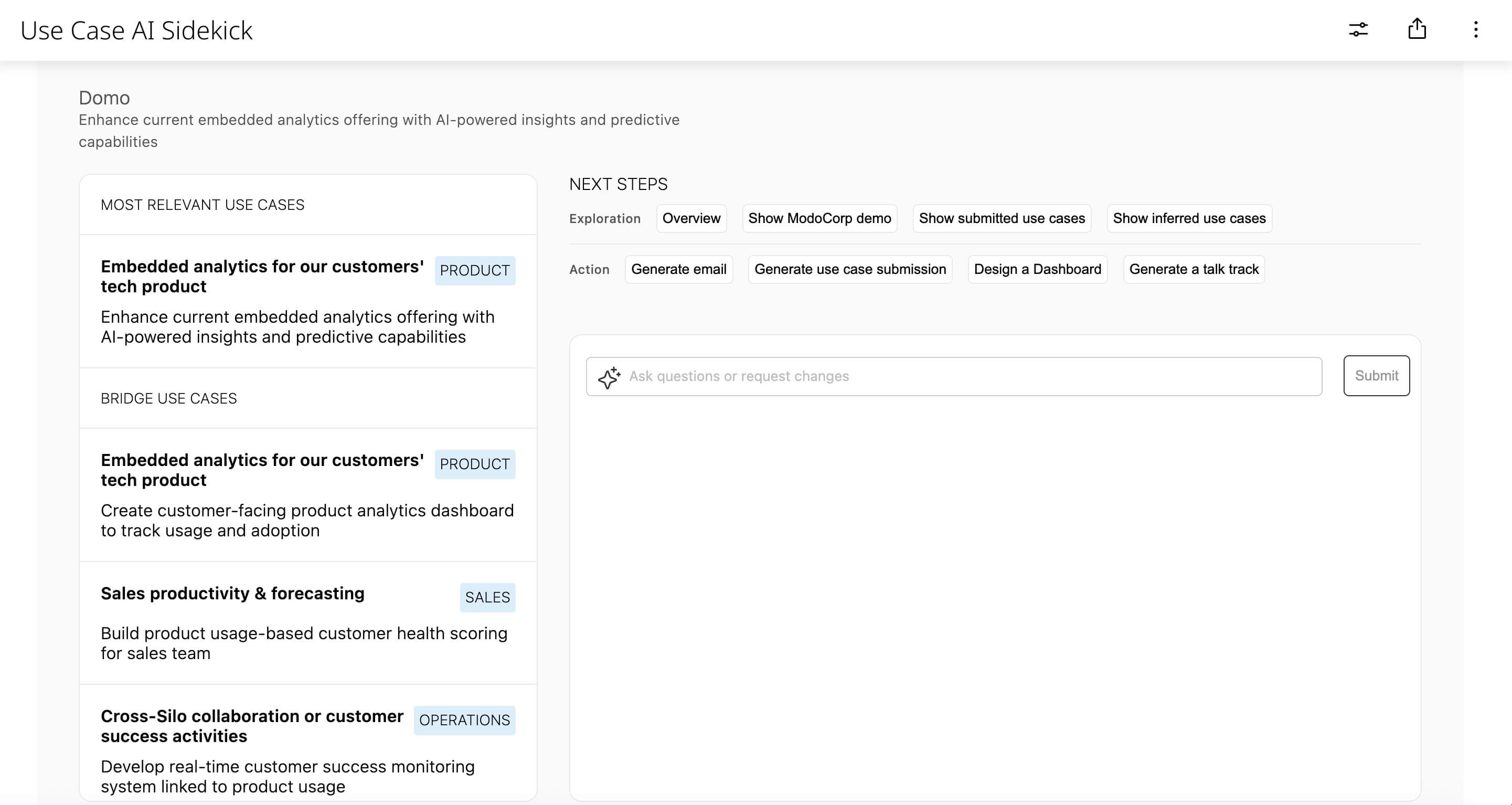
Standout Features
- Financial Filing Analysis: Capability to ingest and interpret complex documents like 10-K or 10-Q filings.
- Persona-Based Intelligence: Tailors all recommendations to the specific role and level of the customer contact.
- Automated Content Creation: One-click generation of follow-up emails and strategic talking points.
- Continuous Learning: Improves recommendations over time by learning from successful customer engagements.
- Guided Demo Suggestions: Provides specific pointers on which product features to highlight for each prospect.
Who This Agent Is For
This agent is built for sales professionals, account managers, and customer success teams.
Ideal for:
- Account Executives: Professionals who need to prepare deep-dive discovery calls for complex B2B accounts.
- Sales Engineers: Teams looking for data-backed justifications to support specific technical use cases.
- Customer Success Managers: Staff focused on identifying expansion and cross-sell opportunities within their existing book of business.
- Sales Enablement Leaders: Managers who want to standardize high-quality sales preparation across the entire organization.
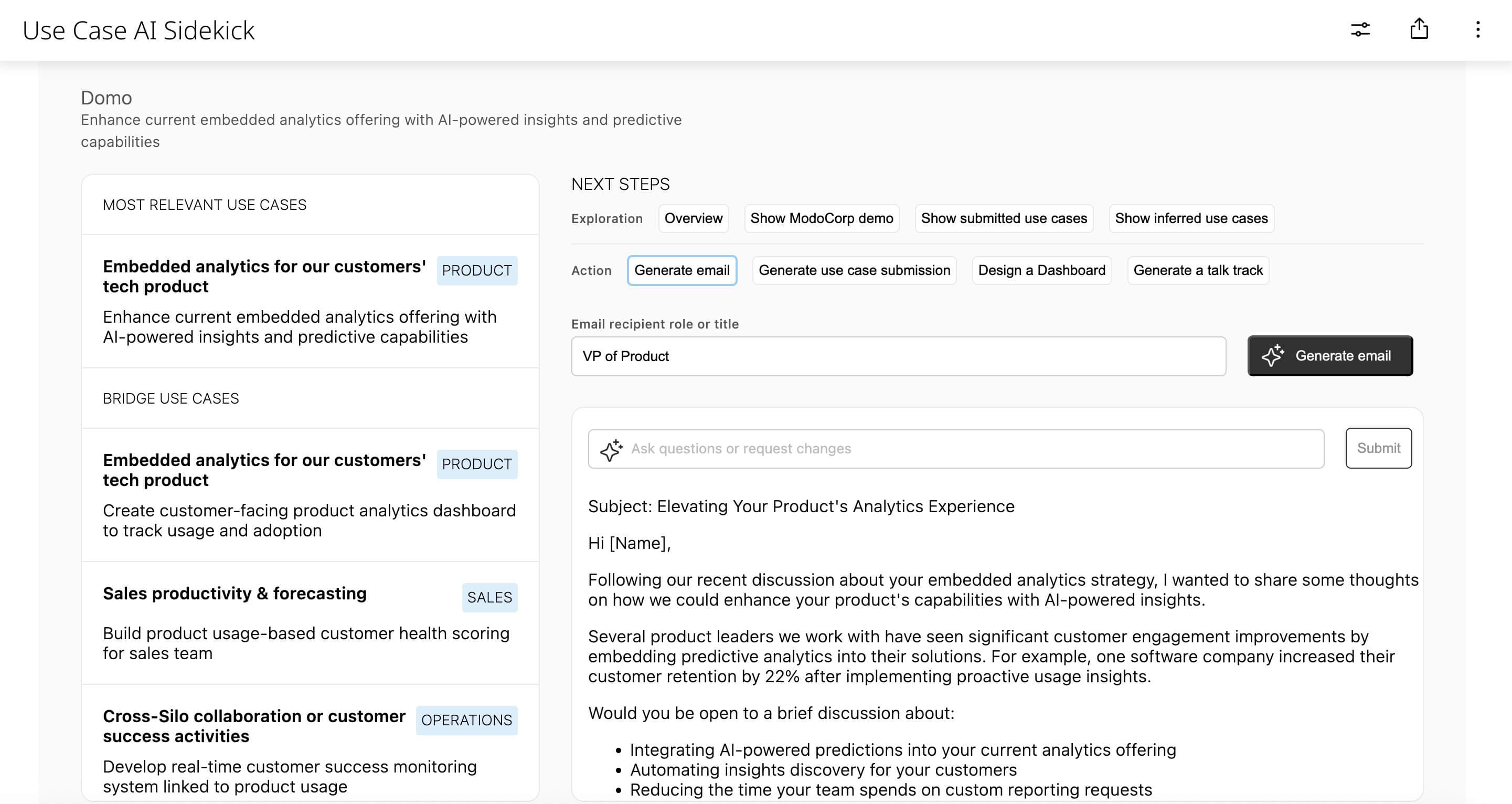

Business Performance Analysis AI Agent
AI-Powered P&L Analysis automates multi-location financial reviews, delivering clear summaries with key metrics, root cause insights, and action recommendations. Accessible via desktop and mobile, it helps you make faster, data-driven decisions with interactive visuals and risk assessments.
AI-powered P&L analysis across locations
The Business Performance Analysis AI Agent automates multi-location profit and loss analysis to help finance and operations teams understand performance faster and with greater clarity. By analyzing P&L data across locations, the agent generates structured summaries with key metrics, strengths, risks, root causes, and recommended actions so teams can move from reporting to decision-making without manual analysis.
Each analysis includes location-level comparisons, root cause insights, and impact assessments that are presented through interactive visuals and dashboards. Results are accessible on both desktop and mobile, making it easier to review performance, identify risks, and act quickly.
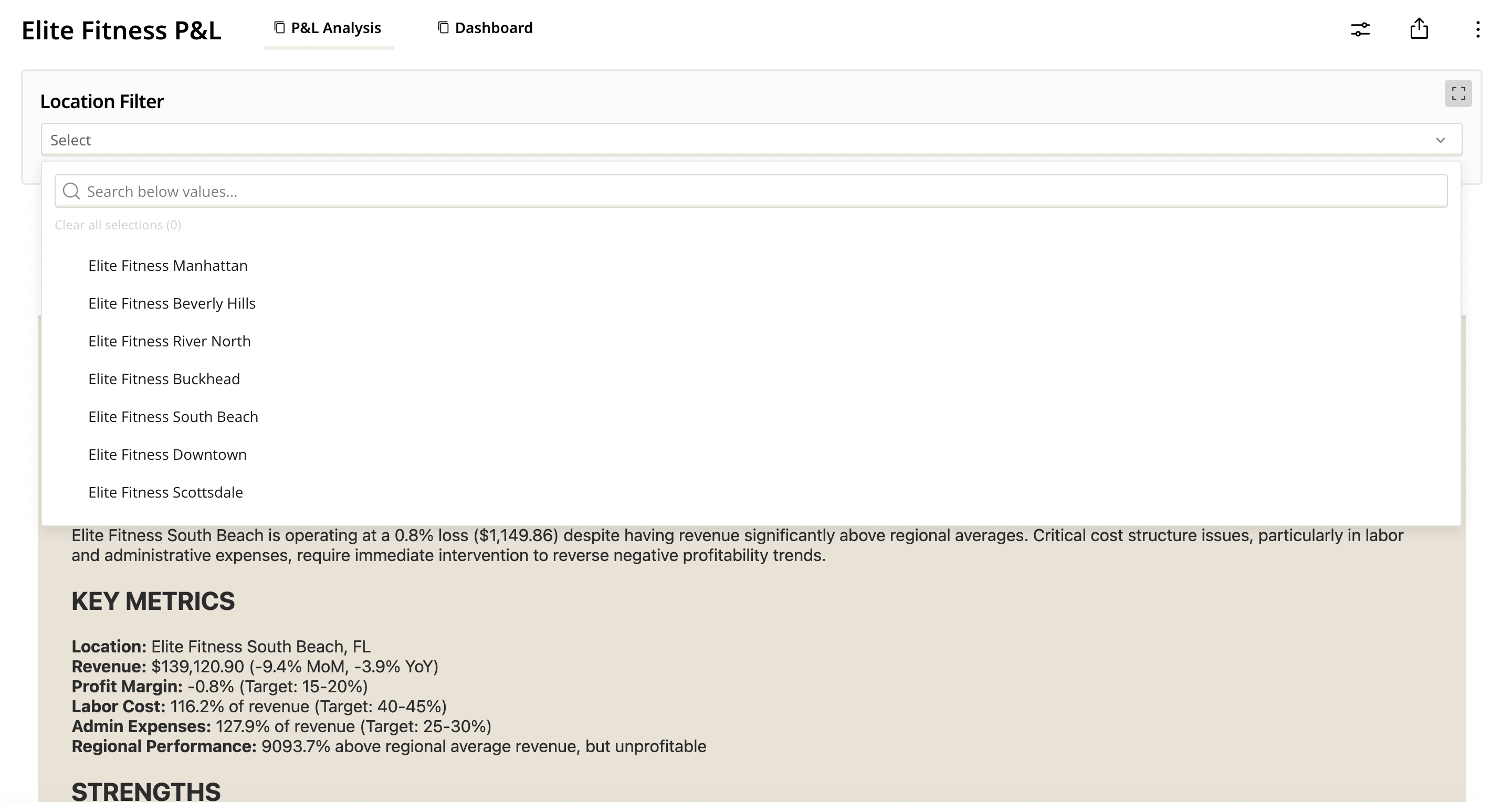
Benefits
This AI agent helps finance teams analyze multi location performance faster and make more confident, data driven decisions.
- Time efficiency: Reduce analysis time from days to minutes with automated P&L processing
- Comprehensive insights: Gain a deeper understanding through standardized metrics and root cause analysis
- Data driven decisions: Act on clear recommendations with projected financial impact
- Consistent methodology: Ensure every location is evaluated using the same analytical framework
- Visual clarity: Quickly absorb insights through interactive charts and trend analysis
- Anywhere access: Review performance and recommendations on desktop or mobile
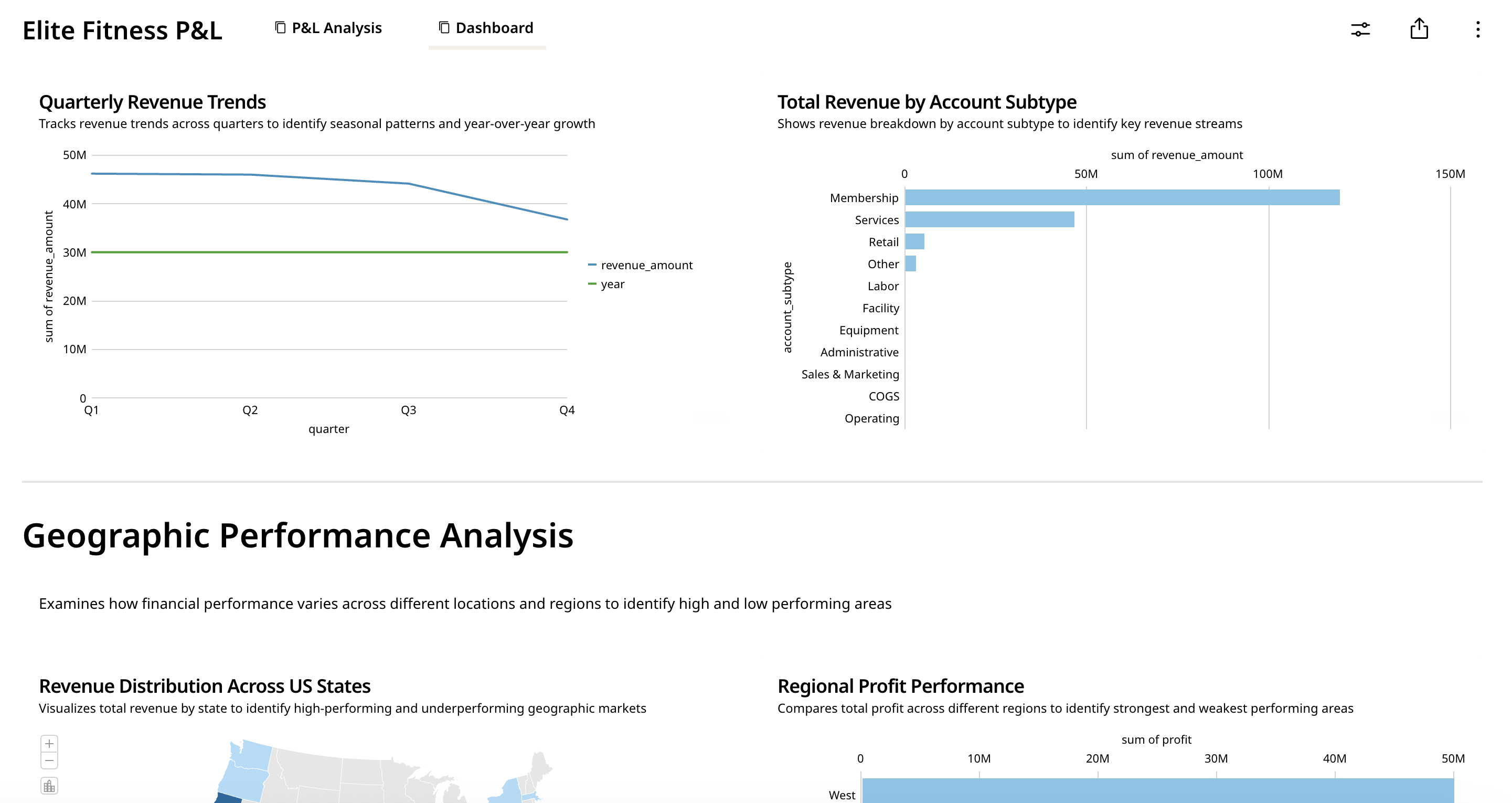
Problem addressed
Traditional P&L analysis is slow, manual, and difficult to scale across multiple locations. Finance teams spend significant time compiling reports, reconciling differences, and identifying patterns after the fact. This often results in delayed insights, inconsistent analysis, and missed opportunities to address performance risks early.
The Business Performance Analysis AI Agent replaces manual review with automated, consistent, and explainable analysis so teams can focus on action rather than preparation.
What the agent does
The agent automatically analyzes P&L data for each location and:
- Generates structured summaries with key metrics and performance drivers
- Compares results across locations using standardized benchmarks
- Identifies root causes behind underperformance or outliers
- Surfaces risks and highlights emerging trends
- Recommends actions with estimated financial impact
- Presents insights alongside dashboards for deeper investigation
Why do this with AI
AI excels at analyzing large volumes of financial data consistently and without bias. By automating multi-location P&L analysis, this agent detects subtle patterns humans often miss, applies the same logic across every location, and delivers insights faster than manual workflows.
Instead of spending time assembling reports, teams can focus on validating recommendations, prioritizing actions, and improving performance across the business.
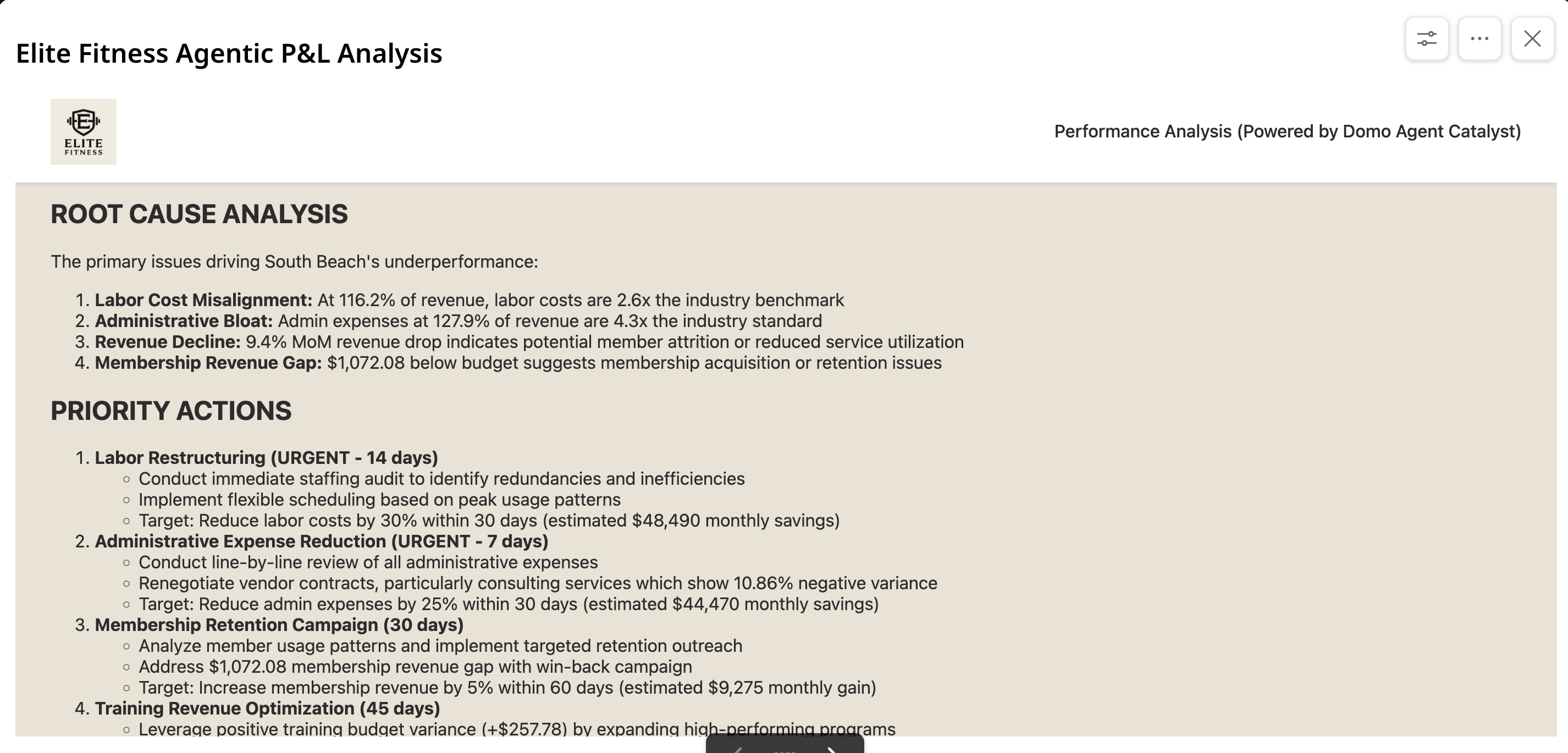
Who this agent is for
This agent is designed for teams who want to:
- Reduce manual financial reporting and analysis
- Compare performance consistently across multiple locations
- Identify root causes behind financial variance faster
- Surface risks and opportunities earlier
- Make data-backed decisions with confidence
- Scale financial analysis without adding headcount
Ideal for: finance teams, FP&A leaders, operations teams, regional managers, multi-location businesses, and executive leadership.
How it works
The solution combines a deterministic workflow with an AI agent that performs analysis for each location. Data is ingested, evaluated using standardized logic, enriched with AI-generated insights, and presented through interactive summaries and dashboards.