
More appointments completed per day. Less windshield time. Zero overlapping assignments. That is what happens when dispatch decisions are driven by algorithms instead of instinct.
A home services technology company faced the operational challenge that defines field service at scale: getting the right technician to the right job at the right time while minimizing the travel time between appointments. Their dispatchers were making these assignments manually, juggling technician availability, skill requirements, geographic proximity, job duration estimates, and customer time windows simultaneously. The result was predictable: inconsistent technician utilization, unnecessary travel between distant jobs, schedule conflicts from overlapping assignments, and a daily capacity ceiling that was lower than it should have been given the number of technicians and appointments in the system.
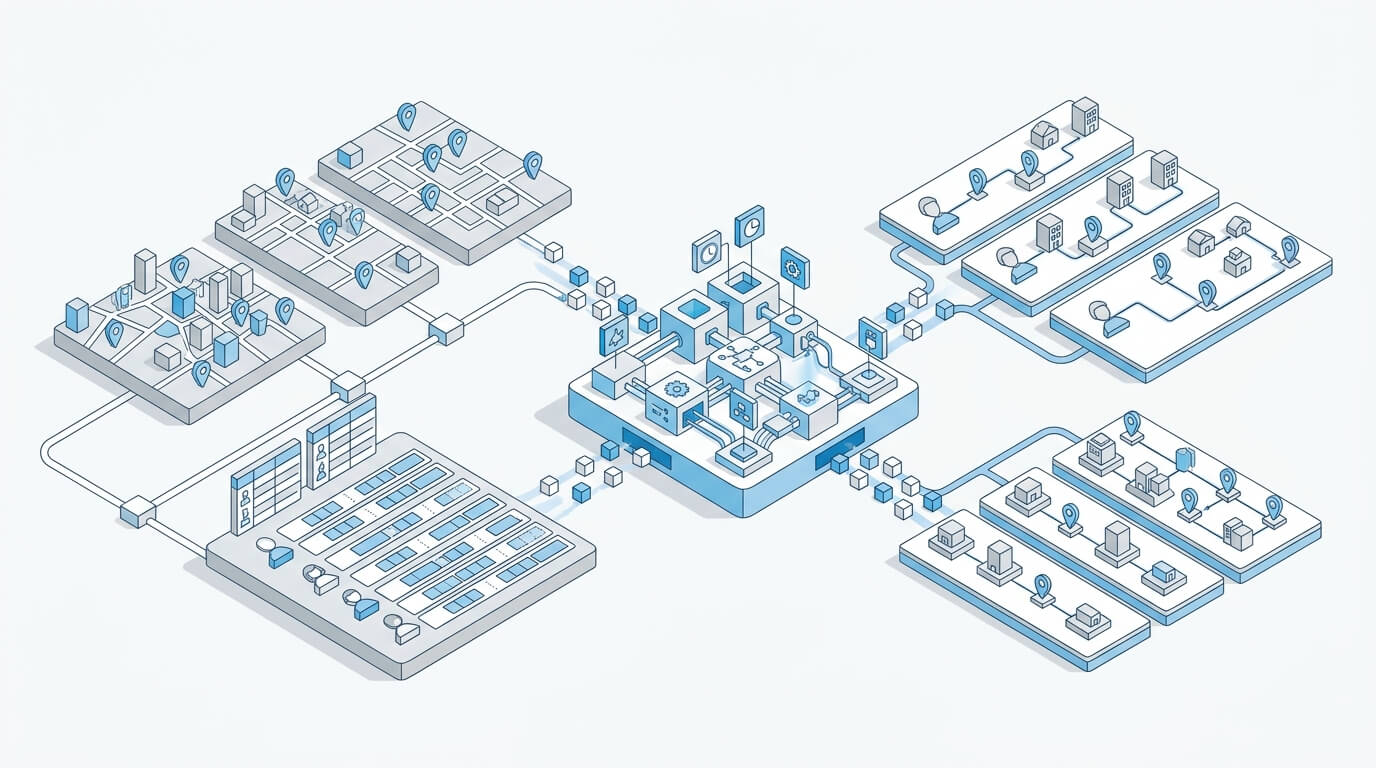
The Route Optimization AI Agent replaced manual dispatch decision-making with a constraint-driven optimization system that processes all variables simultaneously to produce technician assignments and route sequences that maximize productive time and minimize travel waste.
Benefits
This agent delivers measurable operational improvements by replacing heuristic dispatch decisions with mathematically optimized assignments and routing.
- Reduced travel time and fuel costs: Optimized route sequencing minimizes the distance between consecutive appointments, directly cutting the fuel, vehicle, and lost-productivity costs associated with windshield time
- Increased appointments per technician per day: By eliminating scheduling gaps and reducing transit time, each technician completes more productive appointments within the same working hours
- Eliminated schedule conflicts: Algorithmic assignment prevents the overlapping bookings and double-assignments that manual dispatching inevitably produces under time pressure
- Skill-matched assignments: Every job is routed to a technician with the appropriate skills and certifications, reducing the callbacks and repeat visits that occur when underqualified technicians are assigned to specialized work
- Improved schedule consistency: Customers receive more accurate appointment windows because the system accounts for realistic travel times and job durations rather than optimistic manual estimates
- Scalable dispatch operations: The system handles growing technician teams and appointment volumes without requiring additional dispatchers, making it feasible to expand operations without proportionally increasing dispatch overhead
Problem Addressed
Manual dispatching in field service is an optimization problem that humans solve approximately but never optimally. A dispatcher looking at a board of twenty technicians and sixty appointments cannot simultaneously evaluate every possible assignment permutation to find the one that minimizes total travel time while respecting every skill requirement, availability window, and geographic constraint. Instead, dispatchers rely on heuristics: assign the closest available technician, group jobs by neighborhood, alternate between job types to manage fatigue. These heuristics work reasonably well but leave significant efficiency on the table.
The inefficiency compounds throughout the day. A suboptimal assignment at 8 AM creates a geographic positioning problem at 10 AM that cascades into a scheduling gap at 2 PM. By the end of the day, the cumulative effect of locally reasonable but globally suboptimal decisions means the team completed fewer appointments than the schedule could have supported with better routing. The dispatchers are not making mistakes. They are solving an impossibly complex problem with insufficient tools. The math required to find truly optimal assignments across all constraints simultaneously exceeds what any human can process in the seconds available between dispatch decisions.
What the Agent Does
The agent operates as a real-time optimization engine that continuously produces optimal technician assignments and route sequences:
- Appointment and schedule ingestion: The agent pulls current appointment data including locations, time windows, job types, duration estimates, and special requirements into its optimization model
- Technician profile matching: Each technician's current location, skill certifications, availability window, active assignments, and vehicle capacity are integrated into the constraint set
- Constraint-driven assignment: The optimization engine evaluates all feasible technician-job assignments simultaneously, selecting the combination that maximizes total productive time while respecting every operational constraint
- Geographic route sequencing: Once assignments are determined, jobs are sequenced to minimize total travel distance, accounting for real-time traffic patterns and geographic clustering opportunities
- Conflict prevention: The system enforces hard constraints against overlapping assignments, insufficient travel time between appointments, and skill mismatches, preventing the scheduling errors that manual dispatch allows under pressure
- Real-time re-optimization: When conditions change, such as a cancellation, a new urgent job, or a technician running late, the agent re-optimizes affected routes without disrupting assignments that are already in progress
Standout Features
- Multi-constraint simultaneous optimization: Unlike systems that handle skills, geography, and availability as sequential filters, this agent evaluates all constraints simultaneously to find globally optimal assignments rather than locally filtered ones
- Real-time re-optimization: The system does not produce a static daily plan. It continuously re-evaluates and adjusts as conditions change throughout the day, keeping assignments optimal against current reality rather than morning assumptions
- Dispatcher override support: The agent respects manual dispatcher constraints and locked assignments, optimizing around fixed decisions rather than requiring full algorithmic control, supporting a gradual trust-building adoption path
- Capacity-aware scaling: The optimization model scales to handle hundreds of technicians and thousands of appointments without degraded solution quality, using computational approaches that maintain optimization performance as problem size grows
- Geographic intelligence: Route optimization incorporates real geographic data and travel time estimates rather than simple distance calculations, producing routes that reflect actual driving conditions and road networks
Who This Agent Is For
This agent is designed for field service operations where the volume of daily appointments and technicians exceeds what manual dispatching can optimize effectively.
- Home services companies managing dispatching across plumbing, HVAC, electrical, and general maintenance technicians
- Field service organizations seeking to increase appointments completed per technician per day without adding headcount
- Dispatch teams overwhelmed by the complexity of simultaneously managing skills, geography, availability, and customer time windows
- Operations leaders tracking travel time and fuel costs who need systematic route optimization rather than dispatcher-dependent heuristics
- Growing service businesses that need dispatch processes that scale with appointment volume without proportionally scaling dispatch staff
Ideal for: Dispatch managers, field service directors, operations leaders, fleet managers, and any home services or field service organization where the gap between current and optimal technician utilization represents a measurable revenue and cost opportunity.
