Benefits
This agent makes deeply technical, complexly structured public datasets genuinely accessible to people who have important questions but no data engineering skills.
- Democratized data access: Researchers, policymakers, journalists, and citizens can explore complex census data through natural conversation without needing to understand nested data structures, variable codes, or query syntax
- Guided exploration: The agent asks clarifying questions to help users refine vague inquiries into precise data requests, preventing the frustration of getting irrelevant results or no results from poorly formed queries
- Multi-format responses: Answers arrive as summaries, structured data tables, and auto-generated charts, giving users the format most appropriate for their question rather than forcing all answers into a single presentation mode
- Reduced data literacy barrier: Users who previously needed to understand census data structures, geographic hierarchies, and variable naming conventions can now access the same information through plain language questions
- Faster time to insight: Exploration that previously required loading datasets into statistical software, identifying relevant variables, and writing queries now happens in real time through conversation
- Public engagement amplification: By making census data conversationally accessible, the organization fulfills its mission of making public information genuinely public, not just technically available
Problem Addressed
A public policy organization maintains large, complex, publicly available census datasets. The data is deeply nested, inconsistently structured across survey years, and encoded with variable names that require reference documentation to interpret. The organization's mission is to make this data accessible to the public and to researchers studying demographic and economic trends.
In practice, the data was available but not accessible. A researcher wanting to compare educational attainment across counties would need to identify the correct survey tables, understand the geographic hierarchy encoding, locate the right variables across potentially different naming conventions between survey years, and either use statistical software or build custom queries to extract the answer. For the general public, the barrier was even higher. The data existed to inform democratic participation and policy discussion, but only people with data engineering skills could actually use it. The organization needed an interface that could meet users at their level of data literacy and guide them to the answers they were looking for.
What the Agent Does
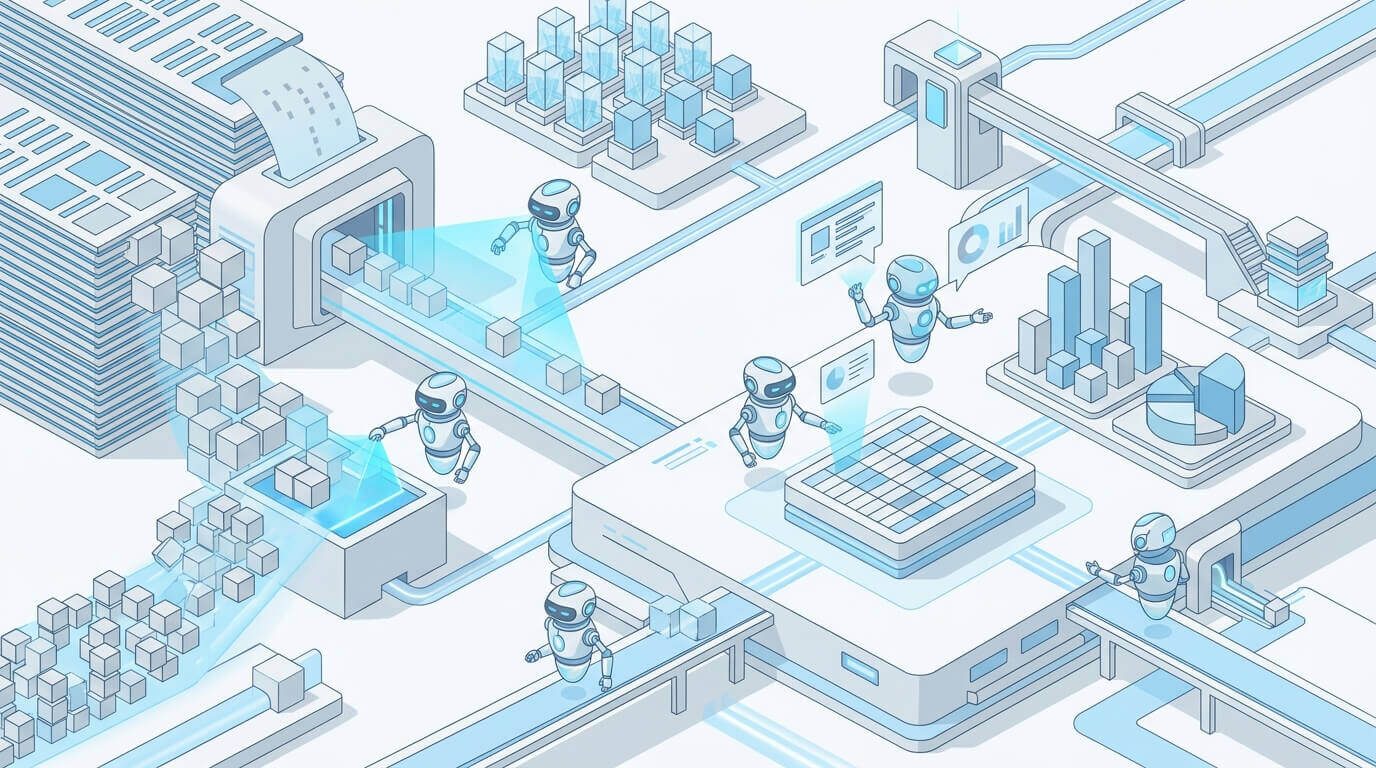
The agent operates as a multi-agent conversational system that translates natural language questions into structured data exploration:
- Question interpretation: The agent parses user questions to identify the demographic dimensions, geographic scope, time range, and comparison type being requested, mapping colloquial language to census data concepts
- Clarifying dialogue: When a question is ambiguous or underspecified, the agent asks targeted clarifying questions rather than guessing. If a user asks about income, the agent might ask whether they mean household or individual income, and for which geographic area
- Dataset scanning: Multiple agent components scan available datasets to identify which survey tables, years, and variables contain the data needed to answer the query, handling cross-year naming inconsistencies automatically
- Query execution: The agent constructs and executes optimized queries against the census data store, retrieving precisely the data needed rather than returning entire tables for the user to filter manually
- Summary generation: Results are presented first as natural language summaries that answer the user's question directly, with key findings highlighted and context provided for interpretation
- Visualization creation: When appropriate, the agent auto-generates charts, maps, or comparison tables that visualize the data, choosing the visualization type that best matches the nature of the question and the data structure
Standout Features
- Multi-agent architecture: Separate agents handle question interpretation, dataset scanning, query construction, and response generation, allowing each component to specialize in its domain rather than forcing a single model to handle all tasks
- Guided exploration mode: Rather than requiring users to know exactly what they want, the agent supports exploratory conversations where users can progressively refine their questions based on initial results
- Cross-year data normalization: The agent automatically handles variable naming changes, geographic boundary adjustments, and methodology shifts between census survey years, presenting consistent results across time periods
- Adaptive response format: The agent selects the best response format based on the question type, a count question gets a number with context, a comparison gets a table, a geographic question gets a map, and a trend question gets a time series chart
- Public-facing deployment: The agent is designed for embedding on public websites where users range from data scientists to citizens with no technical background, handling the full spectrum of data literacy gracefully
Who This Agent Is For
This agent is built for organizations that maintain complex public datasets and need to make that data genuinely accessible to audiences without data engineering skills.
- Public policy organizations seeking to fulfill open-data missions by making complex datasets conversationally accessible
- Researchers who need to explore census and demographic data quickly without loading datasets into statistical software
- Policy analysts comparing demographic indicators across geographies and time periods for briefing documents and reports
- Journalists investigating demographic trends who need quick, accurate data retrieval to inform reporting
- Government agencies that publish public data and want to increase citizen engagement with that information
Ideal for: Public policy organizations, government data portals, research institutions, civic technology providers, and any entity that maintains complex public datasets and recognizes that data accessibility requires more than just publishing files online.
