Benefits
This agent transforms a fragmented, post-merger data landscape into a unified intelligence platform where every employee can access analyst-quality answers through natural conversation.
- 90% reduction in invoice review: Automated analytics reduced the percentage of invoices requiring manual review from 100% to approximately 10%, freeing the finance team to focus on exceptions rather than routine verification
- Month-end close accelerated by 2-3 days: Centralized data and automated reconciliation workflows compressed the monthly close cycle, delivering financial results faster to leadership and stakeholders
- Natural-language data access: Non-technical employees ask questions in plain language and receive accurate, contextual answers without learning query languages, dashboard navigation, or report-building tools
- Secure data architecture: The AI chatbot operates on derived analytics and governed data views rather than accessing raw sensitive data directly, maintaining security boundaries while delivering comprehensive insights
- Organization-wide analytics adoption: Self-service analytics scaled beyond the data team to every department, transforming data from a specialist tool into a strategic asset accessible to the entire organization
- Post-merger data unification: Disparate systems from merged entities were consolidated into a single analytical layer, eliminating the siloed KPIs and inconsistent metrics that plagued cross-entity reporting
Problem Addressed
Following a merger, a people-data solutions company found itself operating across disparate systems with siloed KPIs that made unified analytics impossible. Each legacy entity tracked different metrics in different systems using different definitions. The finance team reviewed every invoice manually because no automated system could reconcile across the fragmented data landscape. Non-technical employees depended entirely on the analytics team for any data question, creating a bottleneck where ad-hoc report requests competed with strategic analysis for limited analyst time.
The organization needed two things simultaneously: a unified data foundation that reconciled metrics across merged entities, and an access layer that made that unified data available to every employee without requiring technical skills. Simply building dashboards was not sufficient. The organization had tried dashboards. Non-technical users still could not find what they needed without help. The access layer needed to meet users where they were: asking questions in natural language and expecting clear answers.
What the Agent Does
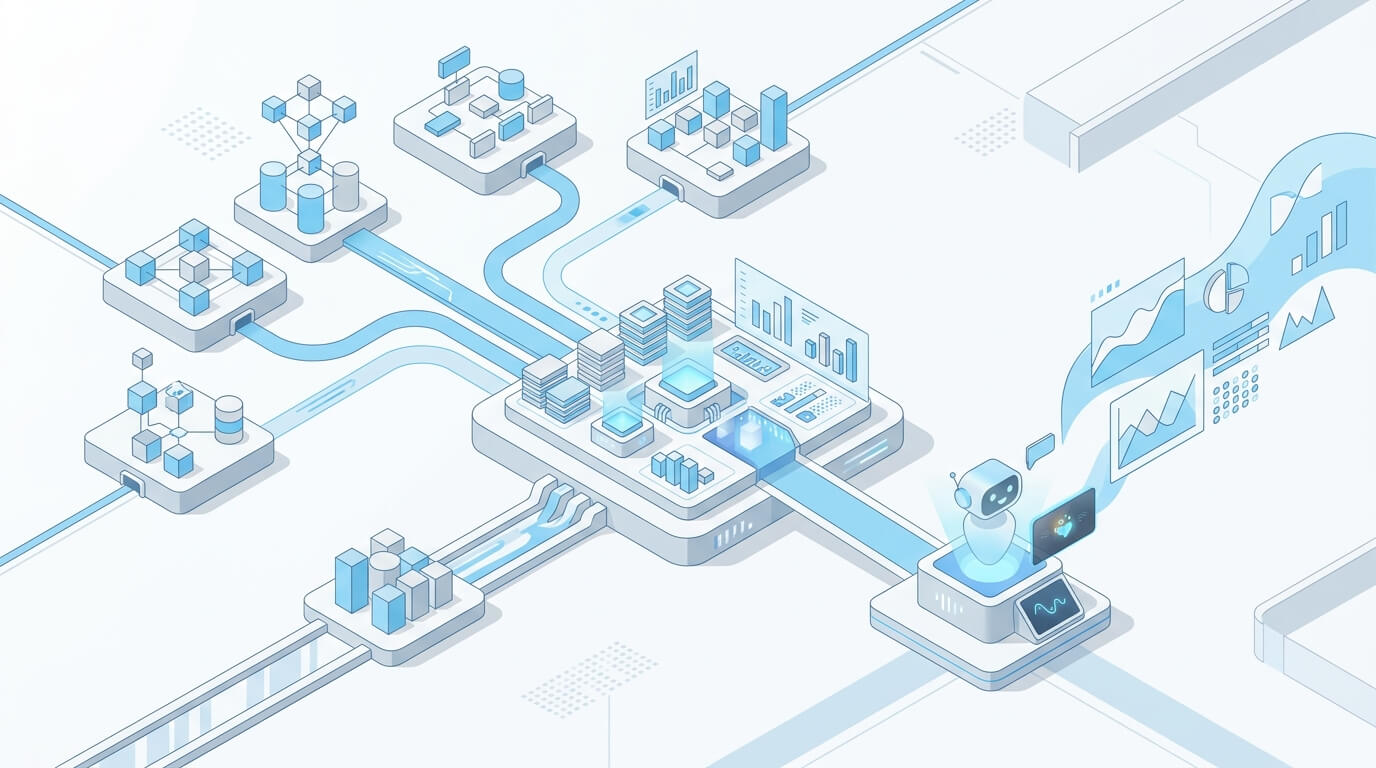
The agent operates across two layers: a data unification foundation and a conversational AI access layer:
- Data centralization: Connectors pull data from all legacy systems into a unified analytical layer, reconciling metric definitions, standardizing dimensions, and creating a single source of truth across merged entities
- Intelligent dashboards: Unified data powers interactive dashboards that provide structured analytical views for teams who prefer visual exploration, with consistent metrics and definitions across all views
- AI chatbot interface: The conversational agent accepts natural-language questions about business performance, translates them into data queries, and returns formatted answers with visualizations when appropriate
- Secure data access layer: The chatbot queries derived analytical views and governed datasets rather than raw transactional data, ensuring sensitive information remains protected while still enabling comprehensive business intelligence
- Automated financial workflows: Invoice processing, reconciliation, and close activities are automated through the unified data layer, reducing manual review requirements and accelerating financial cycles
- Progressive analytics scaling: Starting with finance and operations, the platform expanded department by department, with each team receiving tailored dashboards and chatbot capabilities aligned to their specific data needs
Standout Features
- RAG-powered accuracy: The chatbot uses retrieval-augmented generation to ground responses in actual business data rather than generating plausible-sounding but potentially inaccurate answers, maintaining analytical credibility
- Privacy-preserving architecture: The AI never directly accesses raw sensitive data. All responses are generated from governed analytical views, maintaining compliance boundaries while providing comprehensive intelligence
- Cross-entity metric reconciliation: The unified data layer resolves definitional conflicts between merged entities, so when a user asks about revenue or customer count, the answer reflects a single, agreed-upon definition regardless of data origin
- Finance process automation: The 90% reduction in invoice review demonstrates that the unified data foundation enables process automation beyond just analytics, creating operational value alongside intelligence value
- Scalable self-service model: The chatbot democratizes data access without democratizing data risk, allowing every employee to become analytically self-sufficient within the guardrails the data team defines
Who This Agent Is For
This agent is designed for organizations navigating post-merger data integration or seeking to democratize analytics access across a non-technical workforce.
- Post-merger integration teams facing disparate systems and conflicting KPI definitions that prevent unified reporting
- Finance teams spending excessive time on manual invoice review and reconciliation that could be automated through data centralization
- Non-technical employees who need business answers but cannot navigate complex dashboards or write data queries
- Analytics leaders seeking to scale data access organization-wide without scaling the analytics team proportionally
- Compliance and security teams that need conversational AI to operate within governed data boundaries rather than accessing raw sensitive information
Ideal for: Post-merger organizations, people-data companies, financial services firms, any mid-to-large enterprise where data silos, manual financial processes, and limited self-service analytics create drag on decision speed and operational efficiency.
