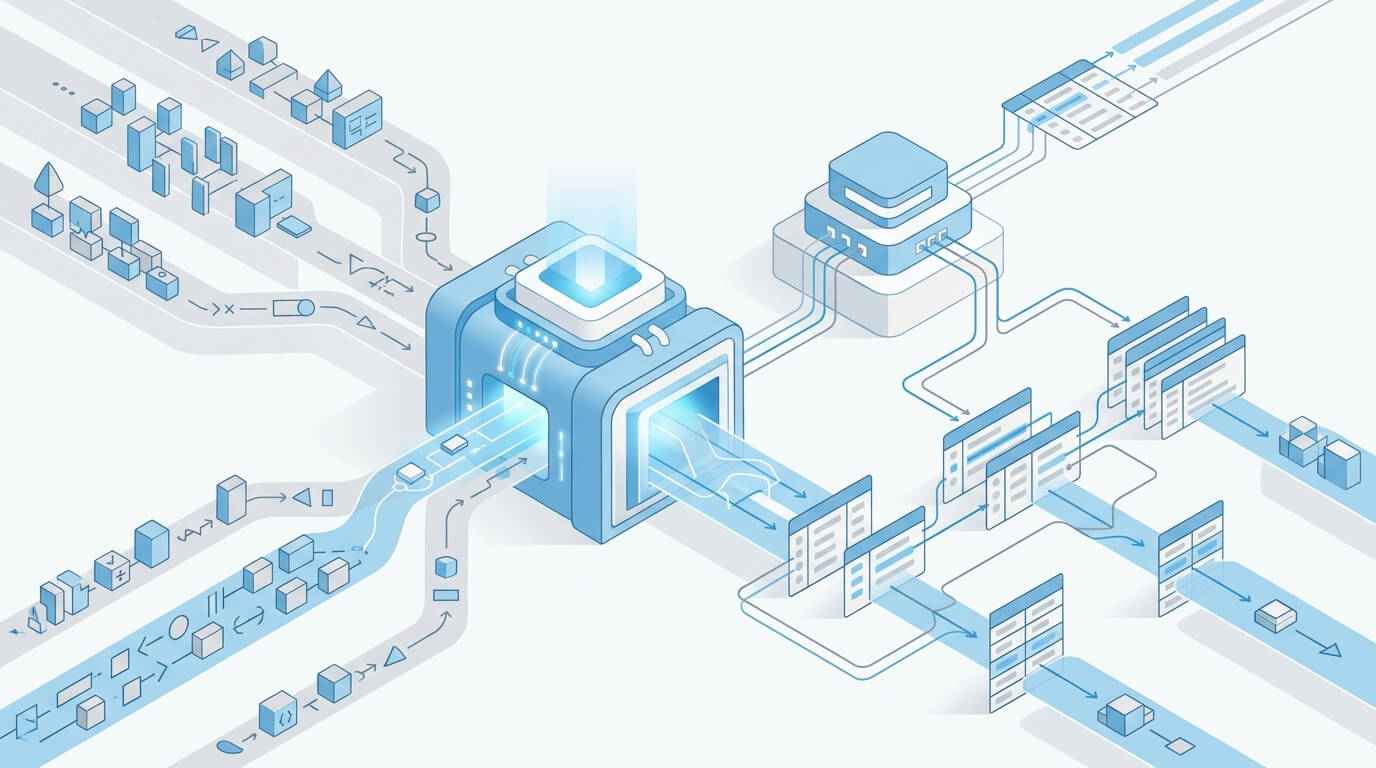
Enterprise customers went from months of manual AI preparation to deployment-ready datasets in hours
When organizations adopt AI-powered chat interfaces for their data, there is a hidden prerequisite that blocks deployment at scale: every dataset column needs a clear definition and a set of business-friendly synonyms before the AI can interpret natural language questions correctly. A column named "rev_q3_adj" means nothing to an AI model without context. Multiply that by datasets with hundreds of columns across dozens of business units, and the preparation work alone can stall AI adoption for months. Enterprise customers were hitting this wall consistently. The technology was ready. The data existed. But the metadata preparation required to make AI chat functional was a manual, tedious, expertise-dependent process that no team had the bandwidth to complete.
The AI Readiness Deployment AI Agent eliminated this bottleneck entirely. Adopted by major enterprises across hospitality, logistics, healthcare, staffing, and tourism, this agent transforms what was once months of manual column documentation into an automated process that delivers deployment-ready metadata in hours.
Benefits
This agent removes the single largest barrier to enterprise AI chat deployment: the manual metadata preparation that blocks every dataset from being query-ready.
- Dramatic time reduction: What previously required weeks or months of manual column documentation per dataset now completes in hours through AI-powered auto-generation of definitions and synonyms
- Enterprise-scale deployment: Organizations with hundreds of datasets can prepare their entire data estate for AI chat capability without proportionally scaling their metadata team
- Consistent governance: A global AI dictionary ensures that the same business term means the same thing across every dataset, eliminating the definitional drift that occurs when different teams document columns independently
- Accelerated AI adoption: By removing the metadata preparation bottleneck, organizations move from AI pilot to enterprise deployment on a timeline measured in weeks rather than quarters
- Reduced expertise dependency: Auto-generated definitions capture the semantic meaning of columns from metadata patterns and data samples, reducing reliance on the few subject matter experts who understand legacy column naming conventions
- Bulk governance updates: When business terminology changes or definitions need refinement, the global dictionary propagates updates across all connected datasets simultaneously rather than requiring manual updates to each one
Problem Addressed
AI readiness is not a technology problem. It is a metadata problem. Every enterprise that deploys conversational AI over their data discovers the same blocker: the AI cannot answer questions about columns it does not understand. A dataset with 300 columns needs 300 definitions and potentially 900 or more synonyms before a natural language query engine can reliably interpret user questions. The people who understand what those columns mean are the same people who are already overcommitted to daily operations. The documentation work gets deprioritized. Datasets sit in a queue waiting for metadata enrichment. AI chat pilots remain limited to the handful of datasets that someone found time to document manually.
The compounding problem is governance consistency. When different teams document their own datasets independently, the same business concept gets defined differently across the organization. "Revenue" in one dataset means gross revenue. In another, it means net. The AI inherits these inconsistencies and produces answers that are technically correct according to the metadata but misleading in business context. Without a centralized governance layer, every independently documented dataset introduces a new source of potential confusion.
What the Agent Does
The agent automates the complete AI readiness preparation workflow from dataset selection through governance-consistent deployment:
- Dataset selection and analysis: Users select a target dataset and the agent analyzes column names, data types, sample values, and structural patterns to understand the semantic content of each field
- AI-powered definition generation: For each column, the agent generates a clear, business-friendly definition that explains what the field contains, how it should be interpreted, and what business context it represents
- Synonym auto-generation: The agent produces multiple natural language synonyms for each column, anticipating the various ways business users might refer to the same data point in conversational queries
- Global AI dictionary integration: Generated definitions and synonyms are checked against a centralized dictionary of approved business terms, ensuring consistency across all datasets in the organization
- Bulk review and refinement: Subject matter experts can review, edit, and approve generated definitions in bulk rather than creating them from scratch, focusing their expertise on validation rather than initial authoring
- Cross-dataset governance updates: When a term definition is updated in the global dictionary, the change propagates to every dataset that references that term, maintaining consistency as business language evolves
Standout Features
- Intelligent column interpretation: The agent goes beyond simple name parsing, analyzing data samples, column relationships, and structural patterns to generate definitions that reflect actual data content rather than just column header text
- Global AI dictionary: A centralized governance layer ensures that business terms are defined consistently across the entire data estate, preventing the definitional drift that undermines AI accuracy when teams document independently
- Bulk operations at enterprise scale: The agent processes datasets with hundreds of columns in a single operation, making it feasible to prepare entire data estates for AI deployment rather than working through them one column at a time
- Expert-in-the-loop workflow: Auto-generated definitions serve as a starting point that subject matter experts refine, combining AI speed with human domain knowledge for definitions that are both comprehensive and accurate
- Proven enterprise adoption: Deployed and validated across organizations in hospitality, logistics, healthcare, financial services, staffing, and tourism, demonstrating reliability across diverse data environments and governance requirements
Who This Agent Is For
This agent is designed for organizations preparing their data infrastructure for AI-powered natural language querying at enterprise scale.
- Data governance teams responsible for maintaining metadata quality across hundreds of datasets with thousands of columns
- IT and analytics leaders tasked with enabling AI chat capabilities across the organization without proportionally expanding their metadata teams
- Enterprise architects designing AI readiness programs who need to reduce the timeline from pilot to production deployment
- Business intelligence teams managing datasets where column naming conventions have diverged across departments and legacy systems
- Any organization where the gap between having data and having AI-ready data is measured in months of manual documentation work
Ideal for: Data governance directors, BI managers, AI deployment leads, enterprise architects, and any organization where the metadata preparation bottleneck is the primary obstacle standing between their current data estate and enterprise-scale AI chat deployment.
