Two employees per facility. Decades of experience in their heads. And the clock is ticking toward retirement.
At a manufacturing company producing infrastructure components, mold line scheduling was one of the most critical operational processes and one of the most vulnerable. Each facility relied on one or two experienced employees who created production schedules by hand. These schedulers understood which mold configurations worked best for specific product runs, how to sequence jobs to minimize changeover time, which combinations of tooling and materials produced the best quality outcomes, and how to adapt when equipment went down or orders changed mid-shift. None of this knowledge was written down. It existed entirely in the heads of people who had been doing the job for decades.
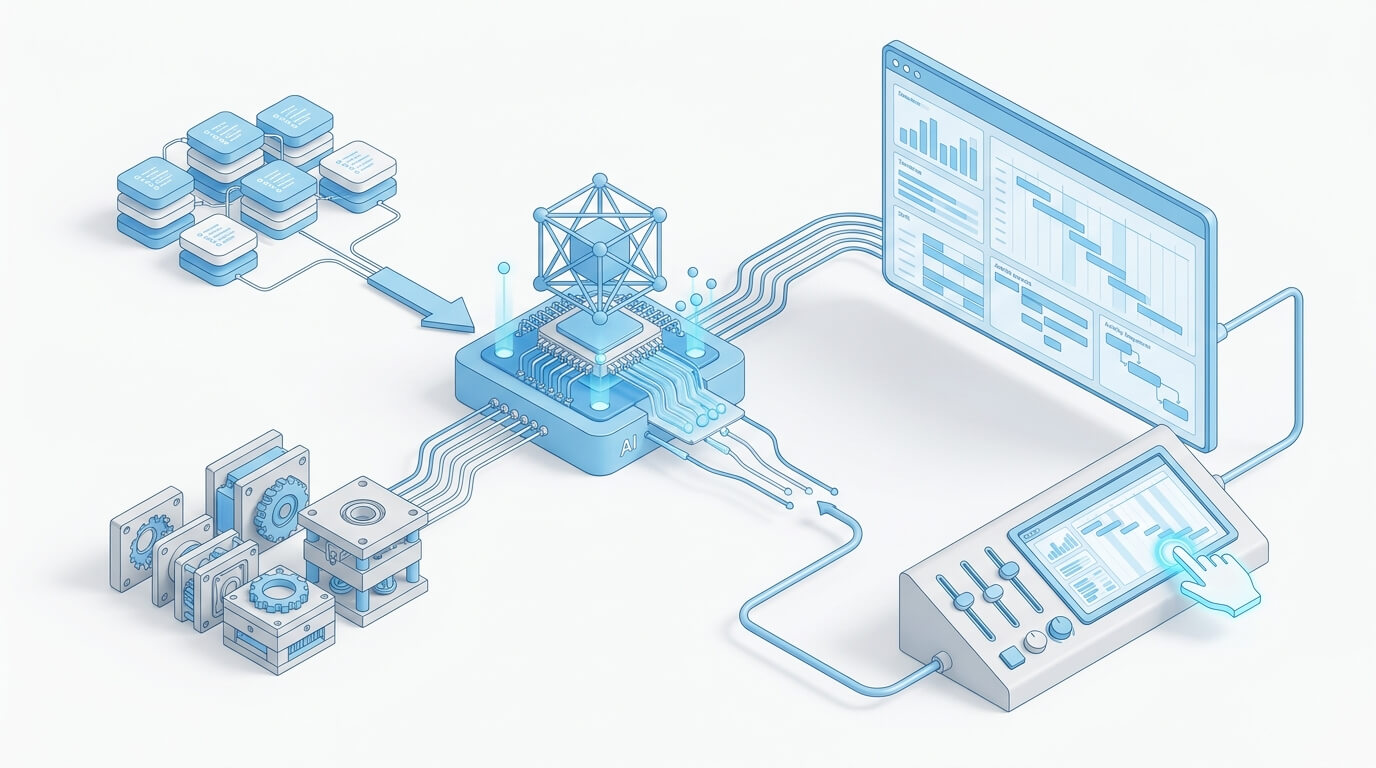
The Production Scheduling AI Agent was built to address this existential operational risk. By encoding historical scheduling patterns, mold specifications, and production constraints into an algorithmic system, the agent generates baseline schedules that capture the institutional knowledge that would otherwise walk out the door with every retirement.
Benefits
This agent transforms production scheduling from a manual, expertise-dependent process into a systematic operation with built-in knowledge preservation.
- Tribal knowledge captured: Decades of scheduling expertise encoded into algorithmic logic that the organization owns permanently, eliminating the risk of knowledge loss through retirement, turnover, or extended absence
- Significant time savings: Schedulers who previously spent hours constructing schedules from scratch now review and refine AI-generated baselines, redirecting their expertise toward exception handling and optimization
- Consistent scheduling quality: Every facility receives schedules generated from the same algorithmic foundation, eliminating the quality variation that occurred when different schedulers applied different mental models
- Faster new scheduler onboarding: New scheduling staff can be productive immediately by working with AI-generated baselines rather than learning the entire scheduling logic from scratch over months or years
- Operational continuity: Facilities continue to operate with high-quality schedules even when experienced schedulers are unavailable, removing the single point of failure that previously existed
- Continuous improvement: As operators refine AI-generated baselines, those adjustments can inform future schedule generation, creating a feedback loop that systematically improves scheduling quality over time
Problem Addressed
Every manufacturing operation has knowledge that lives nowhere except in the minds of its most experienced people. In mold line scheduling, that knowledge includes which configurations produce the best results for specific products, how to sequence jobs to minimize changeover, what adjustments to make when raw material properties vary, and how to respond when equipment behaves differently than expected. This is not knowledge that can be easily documented in a procedures manual. It is contextual, adaptive, and built from thousands of iterations of trial and feedback over years of daily practice.
The problem is not that the knowledge is complex. The problem is that it is fragile. When the scheduler at a facility retires, that knowledge leaves with them. The replacement inherits the equipment, the orders, and the deadlines, but not the accumulated understanding of how to navigate the thousands of small decisions that make the difference between a schedule that runs smoothly and one that generates quality issues, excessive changeovers, and missed production targets. Every facility that depends on one or two expert schedulers is one resignation away from a significant operational disruption.
What the Agent Does
The agent implements a scheduling generation system that combines historical pattern analysis with constraint optimization:
- Historical schedule analysis: The agent processes years of historical production schedules, identifying patterns in mold configuration selection, job sequencing, changeover optimization, and seasonal adjustments
- Mold specification integration: Current mold specs, tooling availability, and equipment status are ingested to ensure generated schedules reflect actual production capabilities rather than theoretical capacity
- Production order matching: Incoming production orders are matched against available mold configurations and equipment capacity to generate feasible scheduling options
- Constraint-aware baseline generation: The algorithm generates baseline schedules that respect equipment constraints, changeover requirements, material availability, and historical quality patterns for each mold-product combination
- Operator adjustment interface: Generated baselines are presented in an application where experienced operators can review and modify schedules based on current conditions, equipment performance, and real-time production factors
- Schedule publication: Finalized schedules are published to production floor systems with full specification detail for each mold line configuration and production run
Standout Features
- Tribal knowledge encoding: The agent learns from historical scheduling decisions made by experienced operators, capturing the implicit logic that informed their choices and making it available as a permanent organizational asset
- Baseline-plus-adjustment model: Rather than fully automating scheduling decisions, the agent generates starting points that preserve the role of human expertise in final schedule optimization, combining algorithmic consistency with operational judgment
- Changeover optimization: Job sequencing considers changeover time and complexity between mold configurations, minimizing the non-productive time that accumulates when jobs are sequenced without considering transition costs
- Constraint propagation: When a constraint changes mid-schedule, such as equipment downtime or material delay, the agent can regenerate affected schedule segments without rebuilding the entire production plan from scratch
- Cross-facility applicability: The same scheduling framework applies across multiple manufacturing facilities, enabling knowledge sharing between sites while respecting each facility's specific equipment configurations and capabilities
Who This Agent Is For
This agent is designed for manufacturing operations where production scheduling depends on institutional knowledge held by a small number of experienced employees.
- Manufacturing companies where one or two schedulers per facility hold the expertise that keeps production running smoothly
- Operations leaders concerned about knowledge loss as experienced scheduling staff approach retirement
- Production managers seeking consistent scheduling quality across multiple facilities with different levels of local scheduling expertise
- Manufacturing engineers looking to reduce changeover time and improve mold utilization through data-driven scheduling optimization
- Any operation where manual scheduling consumes significant expert time that could be redirected toward continuous improvement and exception management
Ideal for: Production managers, operations directors, manufacturing engineers, scheduling leads, and any manufacturing operation where the combination of expert dependency, retirement risk, and scheduling complexity creates an operational vulnerability that manual processes cannot sustainably address.
