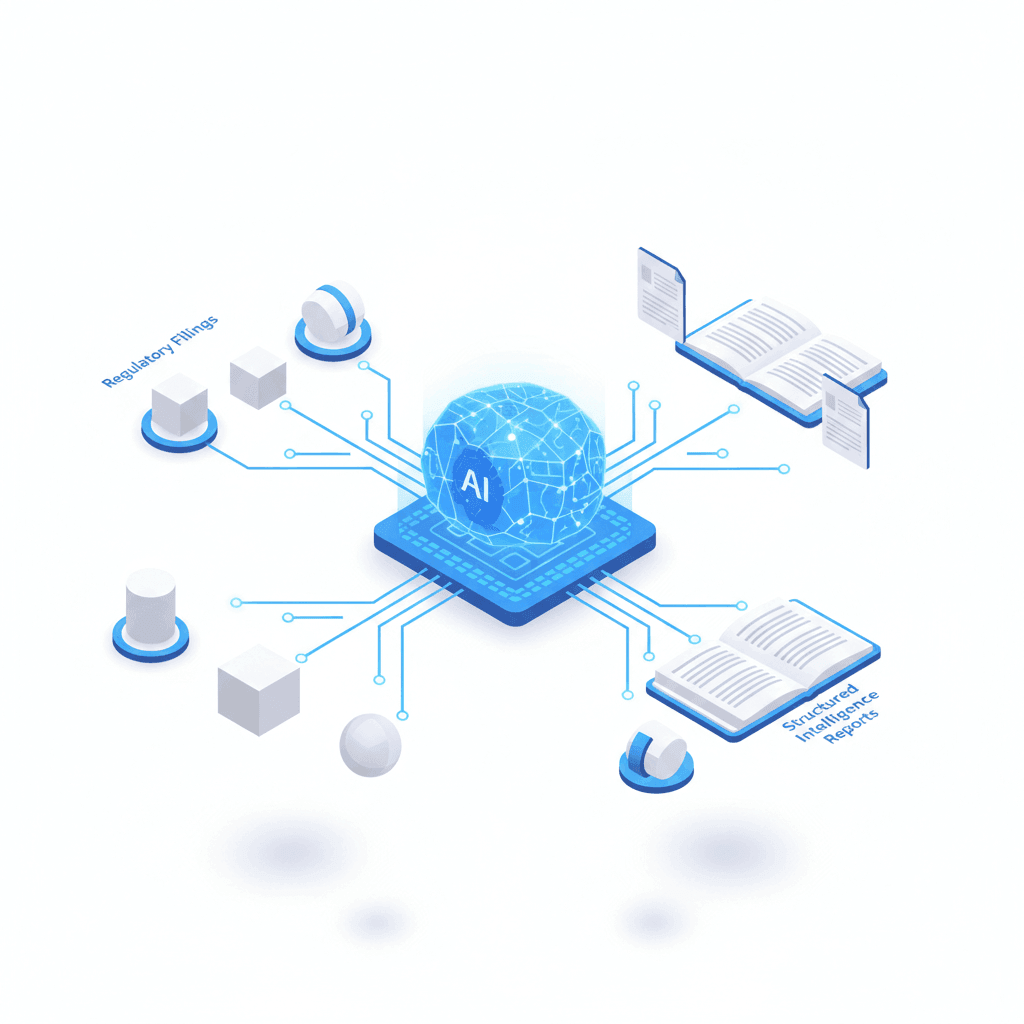


Research that took hours per account now happens in seconds. The manual bottleneck became a revenue accelerator.
At a global accounts receivable collection agency, every successful recovery started the same way: an agent sat down, opened a browser, and began searching. They checked business rating services. They pulled up company websites. They scanned regulatory filings and industry profiles. They pieced together a picture of the debtor — who they were, how they operated, what their financial posture looked like — before picking up the phone. This research was not optional. An unprepared call was a wasted call, and wasted calls cost money.
The problem was time. With hundreds of accounts in queue, agents could realistically research only a fraction of them thoroughly. The rest got a cursory glance or no preparation at all. The best researchers on the team recovered more because they walked into calls armed with better intelligence, but their methods did not scale. What one experienced agent could do for twenty accounts in a day, the entire team needed done for hundreds. The Skip Tracing Intelligence AI Agent eliminated this bottleneck entirely, turning what was a manual, hours-long research process into an automated intelligence pipeline that delivers structured briefings in seconds.
Benefits
This agent transformed the economics of pre-call research, making thorough preparation the default for every account instead of a luxury reserved for the highest-value ones.
- Dramatic time savings: Research that previously consumed fifteen to thirty minutes per account now completes in seconds, freeing collection agents to focus on the conversations that actually recover revenue
- Improved call effectiveness: Agents enter every call with a comprehensive intelligence briefing, resulting in more productive conversations, better negotiation positioning, and higher recovery rates
- Consistent preparation quality: Every account receives the same depth of research regardless of which agent handles it, eliminating the performance gap between experienced researchers and newer team members
- Increased account coverage: With research automated, the team can prepare for every account in the queue instead of triaging which ones deserve preparation time and which get skipped
- Revenue acceleration: Faster research cycles mean agents make more calls per day with better preparation, directly increasing the volume and quality of collection attempts
- Scalable intelligence operations: The agency can take on larger portfolios without proportionally increasing research headcount, improving margins on every new book of business
Problem Addressed
In accounts receivable collections, intelligence is leverage. An agent who knows a debtor’s business health, ownership structure, regulatory standing, and recent activity walks into a call with a fundamentally different negotiating position than one who only has a name and an outstanding balance. The difference between a successful recovery and a dead-end call often comes down to whether the agent understood the debtor’s situation well enough to have a productive conversation. This is why skip tracing — the process of gathering intelligence on debtors — has always been a critical function in collection operations.
But traditional skip tracing is brutally manual. An agent opens multiple browser tabs, navigates to business rating services, searches company registries, reads through regulatory filings, and tries to assemble a coherent picture from fragments scattered across a dozen sources. For commercial collections, where debtors are businesses rather than individuals, the research is even more complex: ownership changes, subsidiary structures, industry-specific regulations, and financial health indicators all matter. The best agents developed personal workflows and source lists over years of experience. That expertise lived in their heads, not in any system. When volume spiked or experienced researchers left, the agency’s intelligence capability degraded because it depended on individual knowledge rather than scalable infrastructure.
What the Agent Does
The agent takes basic company identifiers — a business name, location, or registration number — and automatically builds a comprehensive intelligence package from multiple external sources:
- Multi-source data aggregation: The agent simultaneously queries business rating services, company websites, regulatory filing databases, industry profiles, and public records, gathering intelligence that would take a human researcher thirty minutes or more to compile manually
- Business profile construction: Raw data from multiple sources is synthesized into a structured business profile that includes company overview, ownership information, industry classification, operational footprint, and recent activity indicators
- Financial health indicators: The agent extracts and normalizes financial signals from available sources, including credit ratings, payment history indicators, legal filings, and business status changes that inform collection strategy
- Contact intelligence enrichment: Beyond company-level data, the agent identifies key contacts, decision-makers, and organizational relationships that help agents reach the right person on the first call
- Risk and opportunity scoring: Each compiled profile receives a structured assessment that highlights recovery risk factors and identifies leverage points that inform the agent’s approach to the collection conversation
- Briefing delivery: The complete intelligence package is formatted as a pre-call briefing document that agents can review in under a minute, providing everything they need to conduct an informed, strategic collection call
Standout Features
- Seconds-not-hours intelligence: The agent compresses what was a fifteen-to-thirty-minute manual research process into an automated pipeline that delivers results in seconds, fundamentally changing the economics of pre-call preparation
- Multi-source triangulation: Rather than relying on a single data provider, the agent cross-references multiple independent sources to build a more complete and reliable intelligence picture, catching discrepancies that single-source research would miss
- Structured briefing format: Intelligence is delivered in a consistent, scannable format designed for rapid consumption before a call, not as raw data dumps that require interpretation and synthesis by the agent
- Scalable to any portfolio size: Whether the agency manages hundreds or tens of thousands of accounts, the agent processes them all with the same depth and speed, removing research capacity as a constraint on business growth
- Continuous intelligence refresh: Account profiles can be automatically refreshed on configurable schedules, ensuring that long-running collection efforts always have current intelligence rather than stale data from initial research
Who This Agent Is For
This agent is built for collection operations where pre-call intelligence directly correlates with recovery success, and where manual research has become a bottleneck that limits both volume and quality.
- Collection agencies managing commercial debt portfolios who need comprehensive business intelligence before every outreach attempt
- Account managers handling high-value recovery efforts who need deeper research than basic skip tracing tools provide
- Operations leaders seeking to increase calls-per-agent-per-day without sacrificing preparation quality
- Agencies scaling their portfolios who cannot proportionally increase research staff to maintain intelligence coverage
- Financial services firms with internal recovery teams who need to standardize research quality across varying experience levels
Ideal for: Collection agents, account recovery managers, skip tracing supervisors, operations directors, and any receivables organization where the quality of pre-call intelligence is the difference between a productive conversation and a wasted dial.
