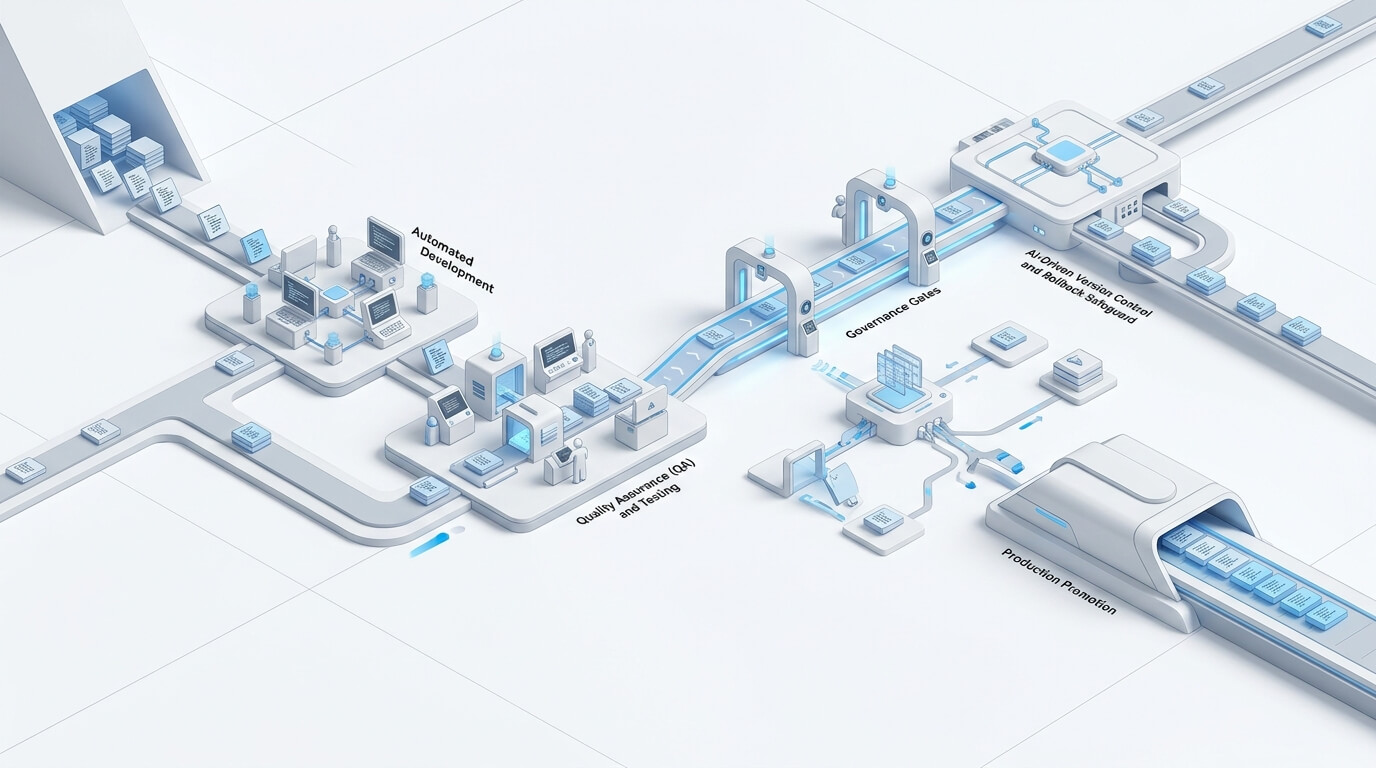
What used to take engineering sprints to deploy now moves through environments automatically with rollback protection built in from day one
A global workforce management platform serving enterprise retailers needed to accelerate its development cycles without sacrificing the governance controls its customers required. Code promotion across their development, QA, and production environments was a manual process that consumed multiple engineering sprints. Each deployment involved coordinating between teams, verifying configurations, running manual checks, and executing the promotion steps in sequence. The process worked, but it was slow, resource-intensive, and created a bottleneck that limited how quickly the engineering team could iterate. In an industry where customers expect rapid feature delivery and zero-downtime reliability, the deployment pipeline was the constraint, not the development velocity.
The Deployment Automation AI Agent was built to solve this with an agentic approach: AI-driven automation handles the promotion mechanics while engineers maintain oversight through governance checkpoints and rollback safeguards. What previously required sprints of engineering coordination was delivered in days.
Benefits
This agent transforms deployment from a manual engineering exercise into an automated pipeline with enterprise-grade safeguards.
- Sprint-to-days acceleration: Code promotion cycles that previously consumed engineering sprints complete in a fraction of the time through automated environment promotion and validation
- Built-in rollback protection: Every promotion includes automatic version snapshots and rollback capabilities, ensuring that any deployment can be reversed without manual recovery procedures
- Enterprise governance preserved: Automated promotion follows the same approval chains and validation steps as manual deployment, maintaining the compliance posture that enterprise customers require
- Reduced deployment risk: Automated validation checks catch configuration mismatches and compatibility issues before they reach production, reducing the incidents that previously occurred during manual promotions
- Engineering time reclaimed: Development teams spend their time building features rather than managing deployment logistics, directly increasing the organization's innovation velocity
- Scalable foundation: The automated pipeline handles increasing deployment frequency and complexity without requiring proportional increases in DevOps staffing
Problem Addressed
For platform companies serving enterprise customers, the deployment pipeline is a paradox. The business demands rapid iteration and frequent releases. The customers demand stability, governance, and zero-downtime deployments. Manual deployment processes try to satisfy both by adding more checks, more coordination, and more people to the promotion workflow. The result is a process that is thorough but glacially slow. Engineering teams that could ship features weekly are constrained to monthly release cycles because the deployment pipeline itself is the bottleneck.
The cost is not just slower delivery. It is compounding technical debt. When deployments are difficult and infrequent, teams batch changes together into larger releases. Larger releases carry more risk. More risk requires more testing. More testing requires more time. The deployment pipeline that was designed to ensure stability becomes the mechanism that makes instability more likely by forcing larger, riskier releases. The solution is not more manual process. It is automation that preserves governance while eliminating the manual coordination that creates the bottleneck.
What the Agent Does
The agent manages the complete code promotion lifecycle across multiple environments through an automated pipeline with built-in governance:
- Environment state management: The agent maintains a current snapshot of code assets, configurations, and dependencies in each environment, ensuring that promotion decisions are based on accurate state information
- Automated promotion execution: Code and asset packages are promoted from development to QA to production through automated workflows that handle the transfer, configuration adjustment, and deployment steps without manual intervention
- Version control integration: Every promotion creates a versioned snapshot that links the exact code state in each environment to a specific deployment event, enabling precise rollback to any previous state
- Validation gates: Automated checks run between promotion stages, verifying configuration consistency, dependency compatibility, and deployment prerequisites before allowing code to advance to the next environment
- Rollback safeguards: If a promotion fails validation or causes issues in the target environment, the agent can automatically or manually trigger a rollback to the previous known-good state
- Human-AI governance checkpoints: Critical promotion steps, particularly the final push to production, include approval gates where authorized personnel review and authorize the deployment, maintaining the oversight that enterprise governance requires
Standout Features
- Days-not-sprints delivery: The agentic AI approach compressed what traditionally required multi-sprint engineering efforts into a deployment pipeline that was operational in days, demonstrating the velocity advantage of human-AI collaboration in infrastructure automation
- Multi-environment orchestration: The agent handles the full promotion chain across development, QA, and production environments, managing the configuration differences and dependency mappings that make cross-environment promotion complex
- Atomic rollback capability: Rollbacks restore the complete environment state, not just the code, including configuration changes, dependency versions, and asset states, ensuring clean recovery without partial state issues
- Governance-first design: Enterprise compliance requirements are embedded in the pipeline as first-class constraints rather than bolted-on approvals, ensuring that automation accelerates delivery without bypassing the controls customers depend on
- Agentic AI collaboration: The system operates as an AI agent that executes promotion steps autonomously while maintaining human decision authority at critical junctures, modeling the human-AI collaboration pattern that balances speed with accountability
Who This Agent Is For
This agent is designed for engineering organizations where manual deployment processes have become the primary constraint on development velocity and release frequency.
- Platform companies serving enterprise customers who require governance-compliant deployment processes that do not sacrifice delivery speed
- Engineering teams spending sprint capacity on deployment coordination rather than feature development
- DevOps leaders seeking to automate multi-environment promotion while maintaining rollback safety and audit trails
- SaaS organizations scaling their deployment frequency who need pipeline automation that grows with their release cadence
- Any software organization where the deployment process takes longer than the development process for a given feature
Ideal for: Engineering managers, DevOps leads, platform architects, release managers, and any organization where manual deployment coordination is the bottleneck between code completion and customer delivery.
