Join the AI + Data Tour for hands-on training, real customer stories, and time with Domo product experts near you.
Register now
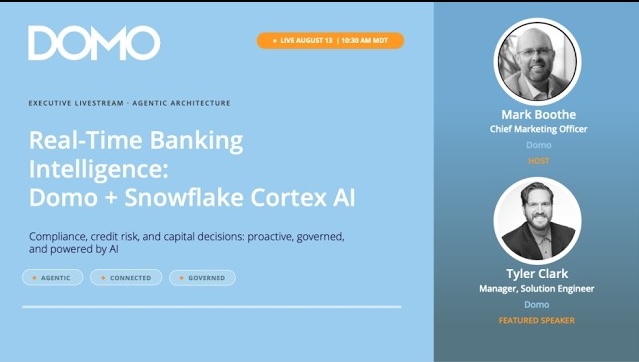

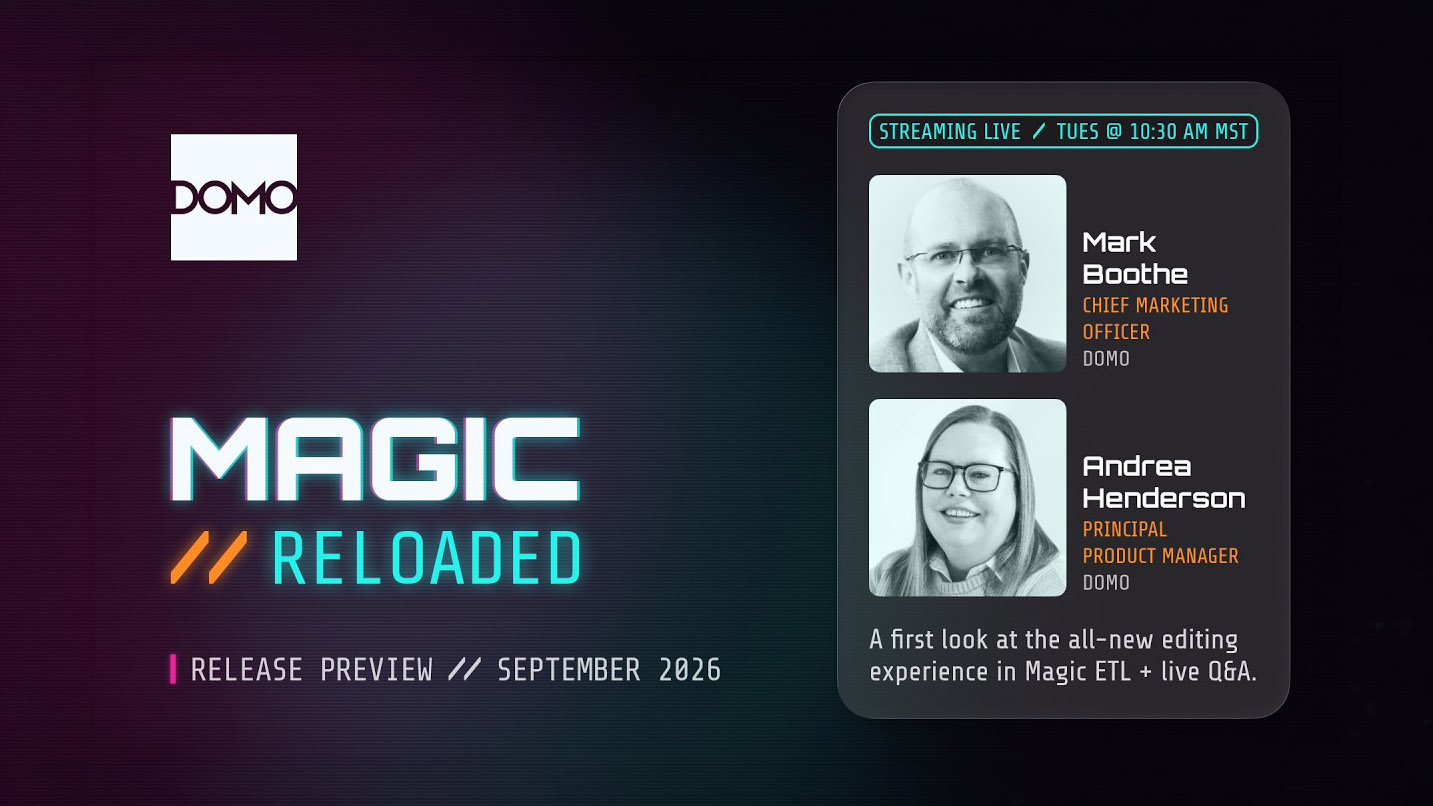
Mark: What's up everybody? We're back again and I am here today with one of the GOATs of Domo, Tyler Clark, one of our managers of solution engineering. Tyler, how long have you been at Domo?
Tyler: I've actually been here for about ten years now at this point. So quite a long time.
Mark: Ten years. Walk us through quickly—where have you been? What all have you done since you've been here?
Tyler: Yeah, it's been quite a journey for me since I came here. Back in 2014, I started in support, actually. I worked there for a few years and then went to what we call the TSMs, as they were formerly known, or the technical solution managers.
Tyler: From there, I actually moved into the sales role, worked as a solutions engineer myself, and was an individual contributor for a couple of years. Then, just back in March, I became a manager finally. So it's been a fun journey for me.
Mark: So TSM, in other words, everyone—he knows Domo and he knows it well. You've worked with, I don't know how many, hundreds, thousands of clients building really cool solutions. So, I'm excited. Today, the GOAT Tyler Clark is going to talk to us all about a banking intelligence solution that he built. Talk to me, Tyler, about why build something like this.
Tyler: Yeah, that's a great question and a lot of people have asked. Over my time at Domo, I've talked to a lot of different clients, some of them being in banking, and we've worked with a lot of them. A lot of people are trying to get into Domo to see what we can do for them. Across my time working with them, I've heard a few main key points that they've always had interest in trying to solve.
Tyler: Some of those being, you know, a one-stop shop to be able to just see: how's the business doing? What can we see? What insights can we get quickly without having to do a ton of work day over day? Most of the time we're seeing that a lot of these banking companies could take up to thirty days to get some of these insights. Trying to speed that up was one of our main things we wanted to solve for them, just to make it a little bit easier. So, a one-stop shop to see how the business is doing.
Tyler: Second, just some information around any regulatory compliance and reporting around that, right? Obviously, there are deadlines that need to be met. How do we make sure that we're moving as fast as we need to and we're not stalling out on anything?
Tyler: And then also loan portfolio analytics—again, faster insights there just so we have a better idea of how to control those and move through everything that they're trying to do day-to-day to just become more efficient. So those are the three main parts that I wanted to help our clients solve when they come to us with these questions, and that's what we built the solution around.
Mark: I love it. Well, give us a look, Tyler. What are we looking at?
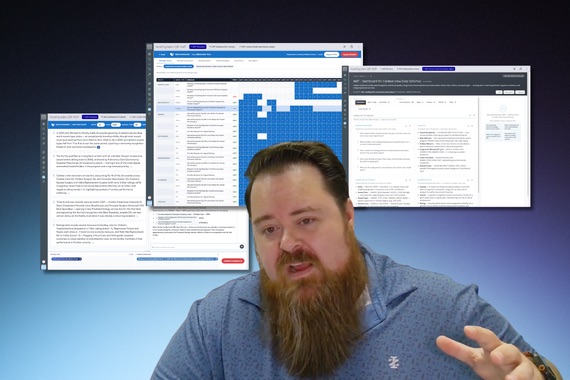
Tyler: Yeah, let me go ahead and share my screen and I will walk you through this.
Tyler: The app is pretty simple. Again, there are a lot of other issues that some of our clients have asked about, but these were the main topics that we always got every time we talked to them. So, we built it just out of this to kind of give a little peak into what this could look like for them, and of course, this can be expanded out.
Tyler: Every time I show this to anybody, they love it. They love where it's going, but they always have the same question: "How do we get started with this?" And of course, anytime we're showing anything, it always starts with the data. We need to make sure our data is clean, and we also need to figure out where the data is coming from.
Tyler: Most of the clients I've been speaking with usually have something like Snowflake, right? They house all their data in Snowflake. Everything flows into there, whether it's coming from different APIs into Snowflake directly, or whether Domo's using one of their thousand connectors to stream it from a third-party system directly, hydrating Snowflake for them. There are a lot of different ways of bringing that data in.
Tyler: Once it's transformed and we get it to that silver or gold layer, at that point we then use Cloud Amplifier to stream it across into Domo to be used for this type of solution and product. That's the first part that we always talk to them about, and they get really excited about that. They're always like, "Wait, we don't have to store our data in Snowflake and in Domo?" It's really funny because their minds are blown. We're like, "No, you just stream it across. It lives in Snowflake; it doesn't have to move. We just virtualize it over."
Tyler: And they love that. It just makes it easier to govern, security still flows through just the same as if you're looking at it directly in Snowflake, and it's a big win for everybody. It just keeps everything much more efficient. Once we get past that part, then we get into the nuts and bolts.
Tyler: Here, to solve one of the main issues, is the executive dashboard. Obviously, we're looking at a few main things, and these could all be adjusted based on what each bank cares about, but these are some of the ones that we've heard about the most.
Tyler: So, total assets—where are we at on that? Net interest margin. We have some hero cards across the top that are the heavy hitters where you can just peek in and know right off the bat, "How are we doing? What maybe do we need to focus on if it's not looking too good?" Obviously, all these green numbers generally show positive growth, but maybe we're saying, "Oh, you know, quarter-over-quarter compression here is down." That's something we need to dig into as we go down to these departmental scorecards, seeing how each of our sections is doing.
Tyler: We also have a revenue forecast with a little bit of projection built in, just to say, "Hey, if we keep on the same trajectory, how are we doing? Do we like those numbers, or do we need to make some adjustments at that point?"
Tyler: Now, one of the heavy hitters here is the data is great. I love seeing this information, but if we have the information, what's next? Obviously, we need to take some kind of action, and we don't necessarily want to leave that up to guessing on like, "Okay, well, maybe we can do this or maybe we can do that to improve our numbers or make adjustments." And that's where this AI insights section at the bottom, which will be across all the different pages I'll show you today, comes in handy.
Tyler: As we're seeing these numbers up top, a lot of this information down below is saying, "This is what we would suggest doing," or, "Here's some deeper insights into that to help you make the decision." We want to be faster to action. We don't want you to sit around and guess. We want you to see what's happening and immediately turn around and say, "Okay, I know what I need to do. Let me go do that." Whether it's a manual process because there's no way of automating it, or automating it with Domo workflows at that point as well, bringing in some of our other products there. Just to show you a little bit of what this looks like.
Mark: Yeah, sorry, I have a question there. This is Snowflake Cortex that we're using on the back end, right?
Tyler: Yes, correct. Because we're utilizing the data straight from Snowflake, we also wanted to utilize the same information and the same experience that we would directly in Snowflake and bring that into Domo. So we are sitting directly on Snowflake and we're utilizing Cortex AI directly. If we were to ask the same questions or try to get the same insights either in Domo or in Snowflake, we should get the same answer there.
Mark: Okay, Tyler, there's still obviously a little bit of confusion, I'm sure, in the market where some people or competitors might think or say, "Well, yeah, you have to move your data out of Snowflake into Domo." Can you just put that one to bed for me?
Tyler: Yeah, and again, Cloud Amplifier is huge about that. It's something where it looks like it's being transferred over, but it's not actually stored in Domo. It's really just a virtual version of that data; we're reading directly from the tables.
Tyler: The data can be as live as you need it to be because as soon as it's in your Snowflake environment, then you can bring that over and it's going to be shown inside of Domo. It's not actually going to store in Domo, and it doesn't need to live in two places. It's just a view of what you already have in there.
Tyler: Of course, we wanted to provide some options for you to adjust that. So, we have different schedules for caching data. If it doesn't need to update super often—maybe it only updates every day or every week—you can cache that data so that way it's not costing extra queries on your Snowflake environment.
Tyler: At that point, as soon as it's in there, it's inside Domo and being visualized. If you have any alerting in Domo based off certain numbers that are very important that as soon as this happens, we need to take action, those alerts can trigger.
Tyler: But for other things where you're just looking at it monthly, quarterly, yearly, or just every other day, we can build the caching in to make sure that, hey, it just keeps a snapshot of what that looks like, but the data is not actually getting transferred over. So that is no longer a problem with the partnership that we've created with Snowflake.
Mark: I love it. Leave your data where it needs to live. Whether that's in Snowflake, Databricks, or GCP, and in this example specifically in Snowflake, it doesn't ever leave Snowflake. Domo is able to help you do the things you need to be successful on top of your data in Snowflake. Okay, keep going, Tyler.
Tyler: Perfect. Yeah, so to show you a little bit of what the insights look like down here at the bottom, obviously, we're calling out the main heavy hitters. "NIM compression requires action." It gives a little blurb about, "Hey, here's what we're seeing," but then also I can click into it to see a little bit more.
Tyler: Again, helping you get faster to action and giving you an idea of maybe what needs to change or what we would suggest, right? "Extending average asset duration by 6 months, shifting 10% of demand deposits into 12-month CDs would add approximately 4 to 6 bps." That's something that somebody might take a little bit of time to come up with, right? They have to do the math and do the calculations to figure out what that would actually look like.
Tyler: Let AI do that part for you, right? A lot of people are worried about AI taking over jobs, but that's not the case. Really, we're just trying to be more efficient. It's something that somebody would have to do, but that could take hours, days, or weeks.
Tyler: Let AI do that part for you, and then you're getting to the main core of what needs to be done for your business, your department, and your team to be even more successful faster. So, that's the whole point of the AI insights that we've added onto this, and a lot of the clients we've shown this to love that aspect because there's no guesswork. It's just straight facts.
Tyler: You'll see that again across here on the compliance reporting board, right? There's a lot of issues when it comes to this where we have mandatory deadlines that we need to hit, and if we don't hit those, there is an issue where you could get fines. Fines could cost hundreds of thousands to millions of dollars depending on how big the bank is and how many different deadlines you might have missed at that point.
Tyler: So, not only is it faster to action, but you're also saving money by making sure that we're on the path of hitting those deadlines that are very important to us. We have the different regulatory statuses here. It breaks it down on how we're doing. BSA and AML monitoring breaks that down, different alert volumes we might want to look at, some upcoming deadlines that we should probably pay attention to, and also trying to give you a breakdown of the risk tiers. Again, down here is just some more information that we can see to get a little bit deeper and make those decisions.
Tyler: The final one is loan portfolio analytics. Again, very similar. We like to keep it clean and keep it minimal. We don't need too much on here, just the things that you care about the most, and these could all be adjusted as we're going through. We have early warning watch lists, credit quality distributions, and then more insights at the bottom.
Tyler: Especially for some of these loans that might be flagged within a 30-day action window, we have an early warning just to make sure we pay attention to these, get in front of them faster, pull in the resources we need, take care of the issue, and move on to the next thing that is hopefully bigger, better, and less risky.
Tyler: We're helping the business along day after day, and everybody's a lot happier because they're not sitting there typing for hours trying to calculate what happened or why this is at risk. It's just all in front of you. It's right there at your fingertips—a game-changer, in my opinion.
Mark: So, Tyler, amazing, amazing demo. We have customers that could use this today. I want you to talk for just a minute about AI. So many people today would say, "Oh, well, yeah, I could just vibe-code that really quickly." Why can you not do what you've built in this solution with just a vibe-coding platform?
Tyler: Yeah, it's a good question and we get it a lot, because vibe coding is really cool. Everybody does it—I do it. I feel like I'm an engineer sometimes, but then I look at the code and I'm like, "I have no idea what this is," and I have Claude or Cortex explain it to me, depending on what you're using. There are a few issues with it that I like to call out, and usually, once we go through this, it makes a lot of sense why I can't just do this on my own and then start distributing it.
Tyler: And that's one of the main issues: the distributing part. You're doing it just vibe coding on your local computer, and you create something really, really cool. What then? Especially in a banking industry, how do I get that to my bank tellers that might need to use the solution I created for them, or all the behind-the-scenes employees at the banks that need to use it? What if they're in a different state, a different department, or even three desks down? They shouldn't have to come to me and say, "Hey, can you do this for me with your cool app that you built?"
Tyler: And so, the distribution makes a huge difference on Domo, right? Obviously, you can bring in everybody in your company and then you can share this out with everybody. On top of that, you don't need a different version for each person to make sure they're only seeing their data, because behind the scenes, you can set up your personalized permission policies.
Tyler: At that point, everybody that comes and looks at it will have the information filtered down to what they should be able to see per person. If I look at it, I'm only going to see my data; if you look at it, you're only going to see your data.
Tyler: But on top of that, it's also very secure behind the scenes. We can bring down your Snowflake rules and policies that you already have on Snowflake. That way, you're not necessarily needing to recreate all those on Domo—we're just passing those through, making sure that people are only able to see the data that they're supposed to.
Tyler: You can distribute it out to anybody you need to, and if they don't have access to that data, they're going to come into a blank page. We don't want to show anybody things that they're not allowed to see.
Tyler: And so, the distribution is a huge one. The security and governance behind it, especially working on something like Snowflake, is a massive one. You don't have to custom-build or hardcode those policies on your laptop directly just because you're vibe coding it. Vibe coding is where it starts, and once you get it to a good spot, get it over into Domo.
Tyler: That way, you can continue to tweak it and build it, but then that's going out to the masses very easily within minutes. You share it out, they jump in, they see it, all the permissions are there, nobody's seeing anything they're not supposed to, and you can feel safe that you're not distributing data that shouldn't be. I've heard a lot of IT teams just scream about this because they love it; they are so worried about people seeing data they're not supposed to, and this immediately eases their mind.
Mark: Safe, secure, governed, auditable, and get it to the right people that need it at the right time. That's Domo, everybody. Tyler, thanks for joining me. We will see everybody next time. Have a good day.

Mark brings over 15 years of diverse marketing experience and is passionate about driving Domo’s business growth through marketing initiatives. His mission is to empower all Domo customers and prospects with the insights and tools they need to make better business decisions and achieve their goals. In his previous role as VP of Community, Partner, and Field Marketing, Mark and his teams established new and strengthened existing programs to address customer pain points and create a greater sense of community. They also executed campaigns, programs and events that showcased the value of the Domo platform. Before joining Domo, Mark spent more than 10 years working in customer relations and marketing at Adobe, and worked at Instructure as its senior director of customer marketing. He received his MBA from Utah State University and a bachelor’s degree from Brigham Young University. Outside of work, Mark enjoys spending time with his family and traveling.

Tyler Clark is a Solution Engineer Manager at Domo, where he leads a team helping customers turn data into action. With nearly seven years at Domo spanning roles as Technical Solutions Manager, Solutions Consultant, and Principal Solution Engineer, Tyler brings deep platform expertise and a strong technical foundation in SQL and Salesforce to every customer engagement. Before returning to Domo in his current capacity, he built out that foundation as a Technical Support Advisor at Domo and a SQL Data Engineer at Artemis Health. Based in South Jordan, Utah, Tyler is known by colleagues for his consistency, work ethic, and eagerness to help others succeed.
Are you ready to give every banker, compliance officer, and portfolio manager the intelligence of your sharpest analyst—available in real time, on every screen?
At Domo, we are building intelligence solutions that go beyond dashboards. They surface what matters, quantify what's at risk, and route every insight through the right decision-maker at the right moment. The Banking Executive Intelligence Suite reads where your data already lives—your core banking system, your AML platform, your loan origination system—and delivers what your teams need to act, not just report. Every KPI is benchmarked against peer institutions in real time. Every compliance deadline is tracked before it becomes a violation. Every credit risk signal is flagged before it becomes a classified loan. Every Cortex AI recommendation carries the rationale, the data, and a drill-in that shows your team exactly what to do next.
Featured Session: Banking Intelligence Suite
Join Tyler Clark, Solutions Engineer Manager at Domo, as he walks through a custom pro-code application purpose-built for a community bank facing the real operational challenges every financial institution knows: siloed reporting, regulatory complexity, and a loan portfolio that demands proactive management at scale.
Tyler will walk through how the platform unifies bank-wide KPIs into a single executive command center, models rate scenarios using Snowflake Cortex AI to quantify NIM compression risk before it hits the income statement, tracks every AML alert, SAR filing, and KYC deadline in one governed compliance center, and surfaces the early warning signals that let credit officers intervene on deteriorating loans before they’re migrated.
What You Will See:
• It's Actionable: Cortex AI delivers rate scenario models that quantify NII impact across four Fed rate environments, identifies $180M+ in deployable capital, flags 8 AML alerts approaching their 30-day regulatory deadline, and surfaces $47.9M in at-risk loans with borrower-level action recommendations.
• It's Connected: This app has a modern React front end, Snowflake Cortex AI for the intelligence layer, and Domo as the governed data platform connecting every system without moving a byte.
• It's Governed: Every AI recommendation includes the rationale, the data behind it, and a drill-in that shows the analyst exactly what to do next. There is human oversight at every critical decision point: capital allocation, regulatory response, and credit intervention all route through the people who own the outcome.
Come see what happens when compliance becomes proactive, credit risk becomes visible, and executive reporting stops being a meeting and starts being a competitive advantage.
Domo transforms the way these companies manage business.