Join the AI + Data Tour for hands-on training, real customer stories, and time with Domo product experts near you.
Register now
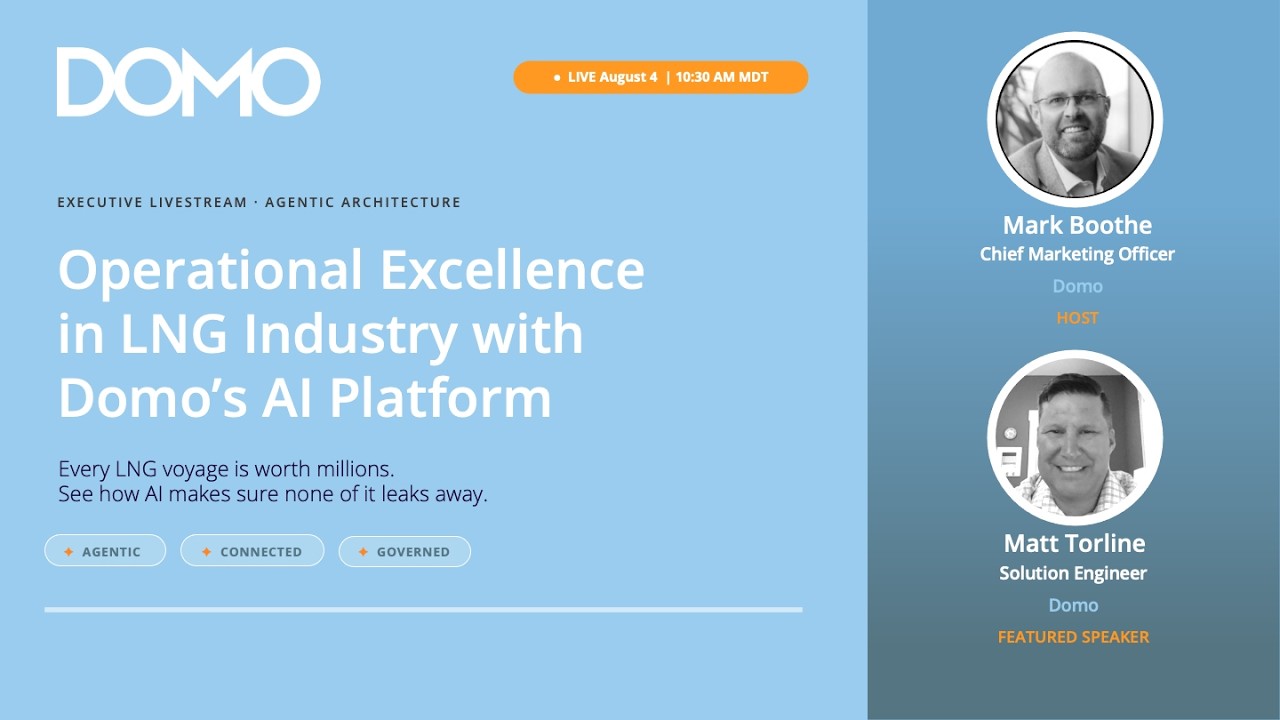

Mark: Good morning, and welcome back everybody. I am here with one of my favorite—don't tell anyone—solutions engineers at Domo, Matt Torline. How you doing, my friend?
Matt: Awesome, Mark. Awesome.
Mark: Well, we're doing something pretty fun today. All of our solutions engineers are super, super deep and technical on helping build incredible apps, agents, experiences, and data products for our customers. Matt, as part of a project the team did recently, spent hours and hours of research and work on a specific industry that I think is pretty cool. He's going to show you the app that he built—an AI solution that could significantly help some really cool companies. So with that, Matt, welcome, my friend. Walk us through, what are we going to do today?
Matt: We're going to talk about LNG carriers. They're the most expensive vessels to operate on the ocean, costing about $200,000 per day to operate. They usually take about 20 days to do a transatlantic voyage, so you can imagine that correcting even small inefficiencies would drive lots and lots of dollars to your business.
Matt: The moral of this story is that this is something you can implement in any business—any business operating in a mobile cadence from point A to point B with lots of inefficiency. Having real-time data is something that would be highly beneficial.
Mark: I love it. So Matt, what did you build?
Matt: I'm going to show you how Domo unified our real-time operational data from these vessels. I orchestrated it through AWS Databricks using DBT, as well as Domo's AI service layer, agents, and humans-in-the-loop to create an end-to-end solution so they can monitor these vessels across the trips they're making and be proactive to make sure they're operating at peak efficiency.
Mark: That's awesome. So what am I looking at right now?
Matt: Right now, you're looking at an executive dashboard that ties into all the data so they can get a high-level, quick view of the vessels being tracked for the year and how they're progressing against their goals. We can use this as a mechanism for them to be able to see that.
Matt: They can also ask AI questions about vessels on the water, where they're going, and where they are headed. You can take users with a limited amount of time in their day and give them the same indicators to make sure they know what's going on. It can give you information down to this level of detail from a chat perspective, which provides a nice, easy overview. I always start with this, but the meat of this is in the command center—the day-to-day for the "worker bees" of this process.
Matt: These are the ones watching the actual vessels going across. We've all seen our favorite movies where they're in their command centers looking at information, and they can do it one of two ways. They can either look through this command center here, or we actually built a vessel tracking map that allows them to see the vessels moving across the water. They can click on those and get real-time information about what's happening.
Matt: This simulation is automated at a faster speed—obviously, they are not moving this fast, but it shows you what's going on. We also have real-time weather alerts hooked up to weather APIs giving us real-time feedback about ocean levels and water trends as they go across their trips so they can be proactive. It gives a great overview of what's happening.
Mark: Hey, Matt, back up just for a minute here. This is super intriguing. List off a whole bunch of the different data sources that would be coming in to power something like this.
Matt: Yeah, so right now we are using weather data points. Not only from NOAA—since NOAA is exclusively for the US—but there are also weather APIs you can use in the real world that give you ocean readings worldwide. It will give you air temps and storms coming in worldwide, which can be populated as real-time calls in a Domo App or a pro-code app.
Matt: This displays the current condition of that weather monitoring station at that exact point in time, so it's not something you even have to process and store. I think that's something a lot of people forget about when they talk about pro-code apps. Yes, we work in a space of governed data, but we also work in a space that allows you to connect to outside APIs to give you the whole picture of what you need, especially when conditions are changing so rapidly.
Mark: Interesting. Very cool. Okay, keep us going.
Matt: Yep. So back to our command center. We can step in here and go through the data life of somebody in the operational area. There are multiple ways they can go about their day, but this gives us some high-level indicators of what's happening with the fleet currently out on the ocean.
Matt: It's giving us indicators about where they're at from a voyage perspective. On the right-hand side, we have real-time weather updates coming in via the API to let us know that vessels like Draco and Jupiter might run into gusts of 35 miles an hour. This allows teams to be proactive and make sure they're headed in the right spot—maybe they need to slow down or speed up.
Matt: On the right-hand side here, we have our alerts that are more time-sensitive. The medium and low alerts will at some point reach "high" if they aren't addressed, but they're on their way. It will actually show our risk to return on investment based on this. If the needs of these particular components are not met, there could be cost implications that we're going to see.
Matt: We had stated that the Sequoia One is obviously our biggest area of concern. I'm going to kick off a process right now, and this is going to run a Domo workflow. That workflow is actually going to use AI agents to take the information it has about the vessel right now and come up with a maintenance plan to get us back on track. We're going to send instructions to the chief engineer on board and also provide some people and resources they should use to resolve it.
Matt: In the meantime, if my staff is over here and they want to look at things, they can just ask, "Hey, what about Clips?" They can start a chat here. This is not only a combination of the data we have, but it's also an AI agent that allows us to have the perspective of an operational user in the command center.
Matt: It starts to give you all this feedback around what's going on and where they're at in their journey. It says, "Hey, I don't have any high alerts, but there are some pieces of this puzzle we should address." They can go through this process and use this as a mechanism to ask questions. I'm not a great typer under pressure, but asking it to "give me a plan" will show you the natural language capability, and it will start giving us a plan around that.
Matt: If I want to look at the Clips vessel, I can click on this and it will take me to a Domo app that shows all the information about that particular vessel. How are their systems doing? If I want to look at the BOG (boil-off gas) system, I can click on that and it tells me, "Hey, I've got these particular issues going on, and these are the responses." This is how the engineer would actually get to it.
Matt: These are ways they can take their data and use RAG to search through documents that tell them how to service these vessels. In this case, they don't even have any queued problems. We'll see later as I start to go through the other process. If I go back to the command center and click on the vessel where I prompted a notification, let's see if it's done yet.
Matt: It's coming up with some AI insights, letting me know a work order has been placed for this. I'm going to click into that particular work order, which uses Domo's queuing system. Now we can have users on mobile devices come in. The engineer can see all of the information that AI suggested, along with the list of steps to complete it.
Matt: Then they can paste in their diagnostic assessment, saying, "Hey, this is how I fixed it, it's back to working normally, and the work is completed." I'm going to complete that process. It will finish up by sending notifications out to let people know that the problem has been resolved.
Matt: After that, we'll run a process that checks to make sure the data is accurate. We are going to get those sensor readings again, pull those in, and update the information regarding that vessel to show how it corrected itself. You can see here the chief engineer's diagnostic report. You can imagine how great it is to have that happen so fast, allowing you to go back to your superiors and report exactly what was corrected.
Matt: Those pieces are running right now, and we're just waiting to get feedback from the ship itself. We check those vessel components every 10 minutes so that they're not over-communicating, but still maintaining enough communication.
Mark: And those are just via, like, IoT devices?
Matt: Yeah, correct. We used AWS IoT's architecture to do that. It puts the data into an S3 bucket, which is then virtualized into Databricks. We use Domo to orchestrate DBT's handling of the data into a medallion architecture so that the end user can have the governed and clean data they expect.
Mark: And just to highlight, none of that is physically sitting in Domo. That is all in your cloud infrastructure, leveraging the architecture pieces you already have versus moving data into multiple places. Now that data can be accessed by other parts of the business that might want to use it for research, marketing, or finance. They can take advantage of that—creating a nice, centralized, governed area for them to have that data.
Mark: So there's not maybe a ton of people who even know what an LNG voyage is—they're learning a little bit during this—but give me some examples. How would this be applicable to someone with a whole bunch of warehouses, or a restaurant? This is not just about LNG voyage ships that cost $200,000 a day to run; it's about much more than that. Give us some examples.
Matt: Yeah, so if you had a diesel fleet, or a fleet of vehicles, and those were pulling into truck stops on their eight-hour journeys. While they're going down the road, you are connected to the internet and can read that sensor data. You bring that back and say, "Whoa, I can see that Matt is driving way too fast and burning way too much fuel."
Matt: It doesn't seem like a lot for one journey, but if you look at it exemplified over a long period of time, you would see that your cost savings could be highly beneficial. You could have this same type of system message the driver to let them know they need to slow down. Or, if they notice that tire maintenance is needed.
Matt: You can see here I have a maintenance log of all the activities going on. You can look at that and say, "Okay, let's alert our command center to tell Matt he needs to pull his truck in this week to get new tires." It's all about monitoring everything you can monitor to make real-life situations happen in a short period of time.
Matt: I spent hours learning about the energy industry, but for people who already understand their own industry, these apps can be spun up in incredibly short periods of time. You can have a proof of concept out in less than a day, and you can probably go to market in a week with no issue whatsoever. We've been building lots of these apps for people. We show them, and they ask, "When can we get to production?" And we say, "Let's make sure your data is clean, let's make sure it's governed, let's have a place for it to reside, and let's move this along."
Mark: I love it. Matt, what else do you have to show?
Matt: I also threw a data pipeline in here for the geeky ETL people watching—myself included, because I was always the geeky ETL guy. I can see what's running, when things are running, and make sure that my models are working the way they're expected to.
Matt: Again, this is all just reading data from those different sources and logging that information into Databricks. Then I can verify things like, "Hey, look, why is there a 5% error on this road route?" Oh, it's because Matt typed "Matt" in a space that should have been a number in our ETL field. So, there are lots of things in that space we can do.
Matt: I did tie it to a Domo dashboard just so you're aware of Domo apps. This is all built on the App Studio Foundation, but here is your typical dashboarding scenario where they can interact and live with each other as they go together. It's really nice from that standpoint because it gives you the ability to easily view information.
Matt: And you can see now that Sequoia is no longer inside my list because I processed that data. They've got some weather alerts, but they're not up here anymore; they're back to operating as normal. It just gives you control and management over your fleets and activities.
Matt: In the past, I would have had to manage database servers, web servers, and mechanisms to talk to each other. Now, you can do that all in one unified place inside of Domo, taking advantage of all the data and processes around your organization.
Mark: Matt, this is fantastic. Wrap us up and tell me, why do you need Domo to do something like this?
Matt: As a five-year employee now at Domo and having been a Domo customer for five years before that, when I first started using Domo, I wasn't sure it was going to be able to work at an enterprise scale. What I quickly learned was it had all the pieces I needed. I could solve simple problems for simple users, and complex problems for complex users, all within one platform.
Matt: If you were doing this with a traditional stack today, you would have to go get web servers, hire web developers, and build all of those integrations from scratch. To me, this is a gem sitting there waiting for people who already have Domo, or potential customers who want to get these types of insights and experiences happening in their organization. That's why I love being here, and I think it's an exciting time at Domo.
Mark: I love it. You heard it here. Bring us your challenges, bring us your problems, no matter how big and audacious you think they may be. Bring them in, and amazing people like Matt and so many of our other solutions engineers will very quickly find a solution that will drive the kind of business outcomes you need to drive. With that, we will be back again very, very soon. Go check out all these other amazing presentations we've had, and we'll see you again shortly. Have a good day.

Mark brings over 15 years of diverse marketing experience and is passionate about driving Domo’s business growth through marketing initiatives. His mission is to empower all Domo customers and prospects with the insights and tools they need to make better business decisions and achieve their goals. In his previous role as VP of Community, Partner, and Field Marketing, Mark and his teams established new and strengthened existing programs to address customer pain points and create a greater sense of community. They also executed campaigns, programs and events that showcased the value of the Domo platform. Before joining Domo, Mark spent more than 10 years working in customer relations and marketing at Adobe, and worked at Instructure as its senior director of customer marketing. He received his MBA from Utah State University and a bachelor’s degree from Brigham Young University. Outside of work, Mark enjoys spending time with his family and traveling.

Matthew Torline is a Solutions Engineer at Domo with over five years of experience helping organizations unlock the full potential of their data through innovative AI and analytics solutions. Based in Grand Rapids, Michigan, Matthew combines deep expertise in data visualization, analytics strategy, and platform integration with a passion for empowering businesses to make data-driven decisions. Prior to Domo, he spent over seven years as a Senior Business Intelligence Analyst at BISSELL Homecare, specializing in Oracle and BI tools. Matthew holds a degree from Michigan State University and is dedicated to continuous learning and delivering impactful insights.
Domo unifies real-time operational data into AI-ready data products, enabling AI agents and human decision-makers to optimize routing, reduce boil-off gas losses, minimize fuel and demurrage costs, and improve fleet utilization—unlocking potential savings of $600K–$1.2M per LNG voyage.
For context, LNG (liquefied natural gas) carriers are among the most expensive commercial vessels to operate, with total operating and voyage costs often exceeding $200,000 per day. Operational inefficiencies—including boil-off gas (BOG) losses (typically 0.10–0.15% of cargo per day on modern vessels and up to 0.25% on older vessels), excess fuel consumption, demurrage charges, port delays, and suboptimal fleet utilization—can significantly increase voyage costs.
AI-driven voyage optimization, digital cargo tracking, predictive analytics, and real-time fleet visibility can reduce these inefficiencies, with potential savings ranging from several hundred thousand dollars to over $1 million per voyage, depending on voyage length, vessel type, charter rates, and operational conditions.
Domo transforms the way these companies manage business.