Grouped Bar Chart: Definition, Examples, and Best Practices


Grouped bar charts answer two questions at once: which category performs best, and how do different series compare within each category. This guide covers when to use them, how to structure your data, common misreadings to avoid, and step-by-step instructions for building them in Excel and BI tools.
Key takeaways for grouped bar charts
A grouped bar chart places multiple bars side by side for each category, letting you compare values across categories while breaking them down by a secondary dimension. It answers the questions of which category performs best, and how do different series compare within each category?
Here's what you need to know before choosing this chart:
- Use this chart when: You need to compare values across categories while showing how a secondary grouping variable breaks down within each category (and you can trust that each series is calculated the same way across teams and dashboards).
- Avoid this chart when: Totals matter more than individual components, or you have more than four series.
- Primary decision supported: Determining which subgroup outperforms or underperforms within each category.
- Best alternative if this fails: Small multiples for many series, or a stacked bar if composition matters more than precise comparison.
What is a grouped bar chart?
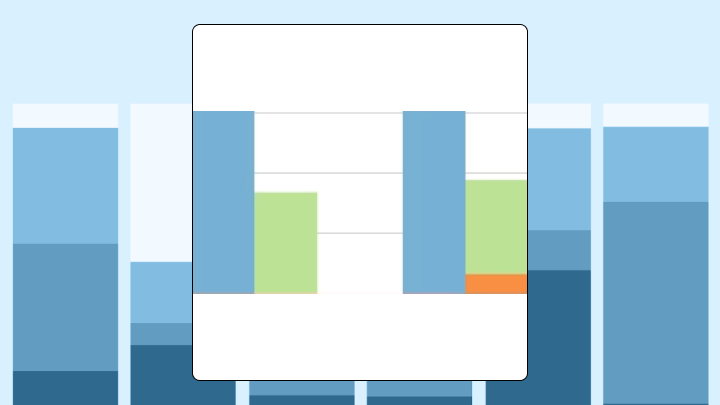
Instead of one bar per category, you get a cluster. Each bar is colored or patterned to represent a different series, and the comparison shifts from asking which category is largest to asking how series compare within and across categories. A grouped bar chart displays multiple bars for each category, with bars representing different series placed side by side. Each cluster shares a category label on one axis, and bar length encodes the value on the other.
You might hear this chart called a clustered bar chart, clustered column chart, side by side bar graph, or paired bar chart. Clustered column typically refers to vertical orientation, while clustered bar often means horizontal (though usage varies by tool).
When to use a grouped bar chart (and when not to)
Use a grouped bar chart when you need to compare discrete values across categories and a secondary grouping variable matters.This structure comes up constantly in day-to-day data work. For example, a line-of-business (LOB) manager may want to see how teams stack up across regions. A sales rep could ask to compare this month vs last by segment. An executive might need a board-ready view of cross-department key performance indicators (KPIs). The grouped bar chart is often the fastest way to make those comparisons feel obvious.
It works well for comparing sales by product line across regions, showing survey responses by demographic group across questions, or tracking quarterly metrics by department.
But there are clear situations where this chart creates problems:
- When totals matter more than components: Viewers will mentally sum the bars in each cluster, but the visual does not encode totals. If stakeholders need total sales by region, a stacked bar serves better.
- When you have more than four or five series: With six or more colors in each cluster, viewers lose the ability to track any single series across categories.
- When categories exceed eight to 10: Clusters start compressing, and comparison within each cluster degrades.
One more failure mode shows up in large organizations: The chart looks fine, but the numbers don't match what someone saw on a different data visualization. That's usually not a grouped bar chart issue. It is a metric definition issue (different calculated fields, different filters, different data sources). If your goal is self-service, consistency has to come first.
Data requirements for grouped bar charts
You might've seen this common problem with group bar charts before: The chart renders but the bars are stacked instead of grouped, or one series is missing entirely. These problems trace back to data shape and data cleansing.
Three columns make this visualization work:
- Category column: The dimension that defines each cluster (Region, Quarter, Product)
- Series column: The dimension that defines each bar within a cluster (Channel, Year, Segment)
- Value column: The numeric measure that determines bar length
Some tools expect wide format, where each series is a separate column. Others expect long format, with one row per category-series combination. Excel prefers wide format.
At minimum, you need two categories and two series to justify a grouped bar chart. With only one series, use a standard bar chart. With only one category, you're comparing series without context.
If you're pulling the data from multiple systems (for example, a customer relationship management (CRM) system for pipeline, an enterprise resource planning (ERP) system for revenue, and a support tool for churn drivers), normalization matters. Grouped bar charts break down quickly when "Region" means different things in different sources, or when time periods do not line up cleanly.
Certain data states cause the chart to render technically but fail analytically. Missing values for some category-series combinations create gaps that many viewers read as zeros. Extreme outliers in one series can compress the other bars, making comparisons hard to judge.
Also, if you build the same grouped bar chart in six different dashboards, hand-built calculated fields are often where consistency falls apart. Centralized metric definitions (often called a semantic layer) help keep "conversion rate" and "on-time delivery" calculated the same way everywhere people see that chart. In Domo, that often shows up as reusable metrics and governed definitions (including Beast Mode calculations) so the chart stays consistent even when many teams publish their own views.
For data engineers, this is also a pipeline problem. If the ETL/ELT (extract, transform, load or extract, load, transform) process does not produce a clean category-series-value data set, every grouped bar chart becomes a one-off data prep project. Tools such as Domo's Magic Transform (also called Magic ETL) exist for exactly this kind of repeated shaping work so analysts stop rebuilding the same dataset over and over.
Why grouped bar charts exist
A single bar chart answers which category has the highest value. When you need to ask which category has the highest value for Series A, and how that compares to Series B, you need a second dimension.
Stacking the bars answers a different question about totals and how each series contributes. Stacked bars optimize for part-to-whole relationships. Grouped bars optimize for precise comparison between series.
The grouped bar chart exists because aligned bar lengths are easier to compare than stacked segments. When bars share a common baseline, small differences become visible. When bars are stacked, the upper segments lose that baseline, and comparison accuracy drops.
That baseline is also why grouped bar charts show up so often in executive reporting. People want a quick, defensible comparison across business units, time periods, or segments.
How grouped bar charts work and how they are commonly misread
Viewers scan left to right across clusters, then compare bar heights within each cluster. The tallest bar in the first cluster draws attention, followed by the pattern of which color wins across subsequent clusters.
Color is the primary identifier for series. If colors are too similar or not colorblind-accessible, viewers lose track of which series is which.
Within-cluster comparisons are easy. Across-cluster comparisons for the same series? Harder. Viewers must track a single color across the horizontal axis while mentally filtering out other bars.
This asymmetry matters. If your key insight is that Series A outperforms Series B in every category, the chart supports that. If your key insight is that Series A grew from Category 1 to Category 4, the chart makes that harder to see because the bars aren't connected.
People tend to misinterpret these charts in predictable ways. They assume totals by mentally summing bars in a cluster. With four or more series, the first and last bars get attention while middle bars become visual noise. And the farther apart two clusters are, the less accurate the comparison becomes.
Grouped bar chart variations
Both grouped and stacked bars use the same data structure. The difference is what question you're answering.
Use grouped bars when you need to compare individual series values precisely. Use stacked bars when you care about totals and want to see how each series contributes to the whole. Stacked bars make totals obvious but make individual series comparison harder because upper segments lose the shared baseline.
Your orientation choice depends on label length and category count. Horizontal bars work better when category labels are long or when you have many categories. Vertical columns work better for time-based categories or when you have fewer than eight categories.
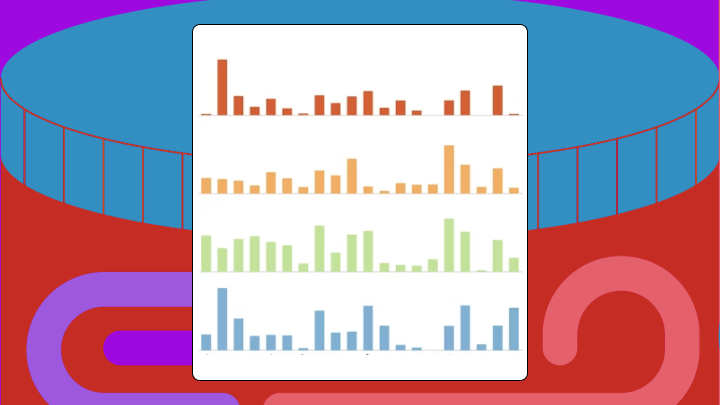
Note that, when you exceed four or five series, a single grouped bar chart becomes unreadable. Small multiples solve this by creating a separate panel for each series, all sharing the same axis scales. Within-category comparison becomes harder, but across-category comparison for a single series becomes much easier.
Of course, grouped bar charts can also show up outside internal dashboards. Embedded analytics (for example, in a customer portal) often needs the same "compare across categories with a second breakdown" view, but with self-service controls. In Domo Embed, those external audiences can pick from a wide variety of chart types, including grouped bar charts, using a drag-and-drop builder. If you publish charts publicly (for example, a grouped bar chart on a blog post), Domo's public embed option lets you publish the same view without relying on screenshots and manual updates.
Best practices for grouped bar charts
When building a grouped bar chart, keep these core principles and best practices in mind:
- With more than four series, viewers lose the ability to track any single color across clusters. Research suggests most people can reliably distinguish about five to seven colors at a glance. Past that, the chart can turn into a color guessing game instead of a comparison tool. If you have more series, use small multiples or filter to the most relevant subset.
- Each additional category compresses cluster width. With more than 10 categories, bars become too narrow to compare accurately. If you have more categories, consider filtering to top performers.
- Truncating the y-axis exaggerates small differences and misleads viewers about relative magnitude. A bar that appears twice as tall should represent a value twice as large.
- Categories are already encoded by position through their cluster location. Color should differentiate series within each cluster. Using color for both creates confusion about what the legend represents.
- Approximately eight percent of men have some form of color vision deficiency. Red-green combinations are particularly problematic. Use a palette that maintains distinguishability for colorblind viewers.
- Alphabetical sorting rarely helps interpretation. Sort by total value, by the value of the most important series, or by a logical sequence like chronological order.
- If your organization has lots of dashboards, add a "metric discipline" best practice: define the metric once, then reuse it everywhere. Analyst firms increasingly treat semantic layers as core analytics infrastructure, which makes governed definitions hard to avoid once you have lots of dashboards.
Grouped bar chart examples
Teams across an organization may use grouped bar charts in their daily work, including:
A marketing team tracks conversion rates for email, paid search, and organic traffic across four regions. The grouped bar chart can make it clear that email outperforms other channels in every region except the West, where paid search leads. A single bar chart showing only totals would hide the channel-level pattern. That kind of pattern suggests your regional strategy should differ. The West region may have audience characteristics that favor paid search, warranting different budget allocation.
An operations team monitors three shipping carriers over four quarters. The grouped bar chart shows that Carrier A consistently delivers on time, Carrier B improved dramatically in Q3, and Carrier C declined. A line chart could show the trend for each carrier, but the grouped bar makes the quarter-by-quarter comparison between carriers more immediate.
A software as a service (SaaS) company can use the same pattern in an embedded customer portal. Clients pick a grouped bar chart to compare monthly revenue across product lines, or compare their usage vs an industry benchmark, without filing a support ticket or waiting for an analyst. You'll notice this same flexibility shows up in nearly every self-service analytics use case.
How to create a grouped bar chart in Excel
Excel expects wide format for grouped bar charts. Structure your data with categories in the first column and each series as a separate column header.
| Region | Paid Search | Organic | |
|---|---|---|---|
| North | 12 | 8 | 6 |
| South | 14 | 9 | 7 |
| East | 11 | 7 | 8 |
| West | 9 | 13 | 5 |
Select the entire data range including headers. Navigate to Insert, then Charts, then Bar Chart. Select Clustered Bar.
If the chart shows categories as series and series as categories, click the chart and navigate to Chart Design, then Switch Row/Column. This swaps the grouping.
Confirm the y-axis starts at zero. If Excel has auto-scaled to a non-zero baseline, right-click the axis, select Format Axis, go to Bounds, and set Minimum to 0.
| Symptom | Cause | Fix |
|---|---|---|
| Bars are stacked instead of grouped | Wrong chart type selected | Change chart type to Clustered Bar |
| Categories and series are swapped | Row/column orientation | Use Switch Row/Column |
| Y-axis doesn't start at zero | Auto-scaling | Manually set axis minimum to 0 |
Excel handles basic grouped bar charts well but becomes cumbersome when you need to filter dynamically or connect to live data sources. For ongoing reporting, BI tools reduce manual refresh work. Platforms such as Domo also help with the parts Excel cannot do cleanly at scale, like governed metric definitions (semantic layer), self-service exploration for non-technical teams, and automated transformation steps that keep the dataset in the right shape.
Limitations of grouped bar charts and when to use alternatives
When you have many series, grouped bars can turn into a color-matching exercise (the earlier series-limit guidance applies here). Small multiples give each series its own panel with shared axes.
When you have lots of categories, clusters compress and labels overlap (the earlier category-limit guidance applies here). Filter to top categories, or use a heatmap if the full matrix matters.
When totals matter more than components, viewers can't see aggregate values. A stacked bar chart or simple bar chart showing totals works better.
In a large enterprise, the limitations aren't only visual. If different teams define the same KPI differently, grouped bar charts can produce conflicting comparisons across business units and reporting periods. A McKinsey survey found only 20 percent of organizations excel at decision-making, a gap that becomes visible the moment executives notice two dashboards telling different stories about the same metric. I have watched this exact scenario derail a quarterly review more than once.
| Chart Type | Better At | Worse At |
|---|---|---|
| Grouped bar | Precise series comparison within categories | Showing totals, handling many series |
| Stacked bar | Showing part-to-whole, totals | Precise comparison of non-baseline segments |
| Small multiples | Handling many series | Within-category series comparison |
Final takeaways about grouped bar charts
A grouped bar chart answers a specific question about how multiple series compare within and across categories. When that's the question stakeholders are asking, this chart delivers clarity that simpler alternatives cannot match.
The decision to use it should hinge on data shape and audience needs. If you have two to four series and fewer than 10 categories, the grouped bar chart is likely the right choice.
Before building, ask what the one comparison is that you want viewers to make. If the grouped bar chart supports that comparison with the data you have, proceed. Swap tips, templates, and gotchas with other data folks when you join the Domo community.