Stacked and Grouped Bar Chart Explained

A grouped and stacked bar chart gives you a way to compare totals across different categories, see how secondary groups perform within each category, and understand the composition of every bar. This guide covers when to use this type of chart, how to build one in Excel, and which alternatives work better when the format creates more confusion than clarity.
What's a grouped and stacked bar chart?
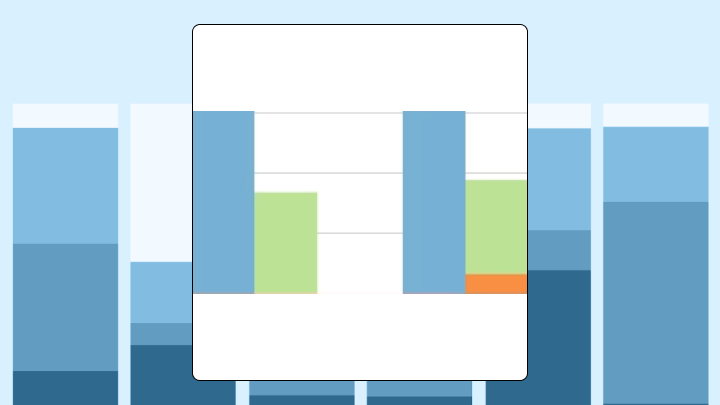
Multiple segmented bars, side by side, within distinct categories. That's the core structure. You get clusters of bars along your category axis, with each bar in the cluster broken into colored segments that stack on top of each other.
Think of it this way: the x-axis shows your primary grouping (quarters, regions, product lines). Within each of those groups, you see two or more bars sitting next to each other representing a secondary grouping (teams, channels, cost types). Then each individual bar splits into stacked segments showing composition.
This differs from a standard stacked bar chart, which only shows one bar per category. It also differs from a grouped bar chart, which shows side-by-side bars but no internal segmentation. The grouped and stacked version encodes three dimensions at once.
When to use a grouped and stacked bar chart
A single question won't cut it here. Maybe you're comparing quarterly revenue across regions, but you also need to see how each region's revenue breaks down by product line. A simple grouped bar chart shows the regional comparison but loses the product breakdown. A simple stacked bar chart shows the breakdown but makes cross-region comparison difficult.
This is why analysts and BI specialists reach for it, and why sales, marketing, operations, and finance leaders ask for it. It tells a compact story when you have multiple stakeholders who all want something slightly different from the same view.
Before you build one, make sure your data is structured to support the comparison you want. These constraints are less about design advice and more about whether the chart be honest.
This format works when your data meets specific conditions:
- 3 to 6 primary groups: More than that and the chart becomes too wide to read.
- 2 to 4 bars per cluster: More than four, visual comparisons fall apart.
- Consistent segments across all bars: If one bar has three segments and another has seven, viewers can't make valid comparisons.
When segment counts vary wildly between bars, the chart fails. Same goes for when your primary goal is comparing specific segments across groups (stacking means those segments sit on different baselines). A finance team once used this chart to compare budget versus actual across departments, but the inconsistent segment counts made the stacks unreadable. They ended up reallocating budget based on visual impressions that didn't match the underlying numbers.
How to create a grouped and stacked bar chart in Excel
Excel doesn't offer a native clustered stacked bar chart. You'll need a workaround using helper columns and manual series configuration.
Step 1: Structure your data
Each row represents one segment within one bar. Your columns should include the primary group (Q1, Q2, Q3), the secondary group (Region A, Region B), the segment name (Product, Service, Support), and the numeric value. If your data sits in a crosstab layout, unpivot it first. Leaving the data in wide format and wondering why Excel can't distinguish between your secondary groups? The chart engine needs each combination as its own row.
If you're building this for recurring stakeholder reports, this "long" layout is also the layout you can reuse in BI modeling, so you're not re-creating the same calculated fields and metric definitions every time someone wants a new cut.
Step 2: Add helper columns for spacing
Insert blank spacer rows between each primary group. These rows use the same secondary group labels but zero values. This forces Excel to render gaps between your clusters.
Here is where a lot of analysts feel the pain. The chart looks fine, then the next refresh breaks the spacing, and suddenly you're babysitting helper rows instead of explaining what the data means. And honestly, that's the part most guides skip over.
Step 3: Build a stacked column chart
Select your data, including helper rows. Go to Insert > Column or Bar Chart, then choose Stacked Column.
Step 4: Adjust series overlap and gap width
Right-click any bar and select Format Data Series. Set Series Overlap to 100 percent. Set Gap Width to around 150 percent. These values usually need tweaking based on your specific data.
Step 5: Assign secondary groups to separate series
This is where it gets tedious. You need to restructure your source data so each secondary group occupies its own column, then add each as a separate series. Excel treats them as clustered bars rather than additional stacked segments.
If you're doing this across multiple dashboards, or different departments want slightly different versions, this is also where inconsistency creeps in. BI and IT managers feel that maintenance drag quickly.
Step 6: Hide spacer series from the legend
Click on the legend, select the spacer entries, and delete them.
Step 7: Validate your work
Sum the segment values for any single bar in your raw data. That total should match the bar height on your chart. If it doesn't, a series is misconfigured. Make sure you do this step every time. Mismatched totals are the most common source of bad decisions from grouped and stacked charts.
This workaround breaks easily. Research suggests 94 percent of business spreadsheets contain errors. In practice, manual spreadsheet work can hide errors, especially when charts rely on helper columns and repeated reconfiguration. Manual workarounds compound that risk. Adding new data often requires re-editing helper columns. For dashboards or recurring reports, BI platforms like Domo support this chart type natively, and charts can refresh automatically when your source data updates (based on your pipeline and refresh settings). That also matters for governance: once a metric is defined in a semantic layer (a shared, governed set of business definitions), it can stay consistent across every grouped and stacked bar chart, even when different teams build their own views.
If you also have data engineers in the mix, they'll usually prefer automating the reshaping step upstream with extract, transform, load (ETL) or extract, load, transform (ELT) logic. That lines up with Python's continued adoption in analytics teams, where automation often replaces manual spreadsheet reshaping. Rather than relying on spreadsheet gymnastics, Domo's Magic Transform supports both no-code and structured query language (SQL) transformations, so the dataset stays analysis-ready without manual rework.
Example grouped and stacked bar chart
Picture a chart with three clusters labeled Q1, Q2, and Q3. Each cluster contains two bars, one for North region and one for South. Within each bar, three segments stack vertically: Product (blue), Service (green), and Support (orange).
Reading this chart follows a specific order. First, compare cluster totals to see which quarter performed best overall. Second, compare bars within each cluster to see whether North or South led in each quarter. Third, examine the segment composition to spot shifts in the Product, Service, and Support mix.
What this chart doesn't show clearly: precise segment-to-segment comparisons across bars. You can't easily compare the Service segment in Q1 North versus Q2 South because those segments sit on completely different baselines. The eye naturally compares things that share a common starting point. Stacked segments don't.
That's also why executives tend to ask for interactivity when this chart shows up in leadership decks. Being able to drill into a segment or filter to one region can turn "I think I see it" into "I know what's driving it."
Grouped and stacked bar chart alternatives
Sometimes this chart creates more confusion than clarity. When that happens?
A grouped bar chart with no stacking works when segment-to-segment comparison matters most. Each segment becomes its own bar sharing a common baseline.
A stacked bar chart with no grouping works when you only have one primary grouping variable. Simpler to read, though you lose the secondary comparison.
Small multiples work when you have too many groups or segments for a single chart. Each small chart shows one slice of the data.
A heatmap works when precise values matter less than relative intensity across many categories.
The choice depends on what question you're actually trying to answer. With "only about 30 percent of employees in most organizations" using analytics regularly, explaining the chart more than discussing the data means you've probably picked the wrong format. That statistic should give you pause. If your chart needs a tutorial, most of your audience has already tuned out. Want a second set of eyes (and a few hard-won tips) before you ship that next dashboard? Join the Domo community.
Key Takeaways:
- Use a grouped and stacked bar chart when you need totals, side-by-side comparison, and composition in one view.
- Keep primary groups and bars per cluster limited, so people can actually read the chart.
- Require consistent segments across bars, otherwise the comparison breaks down.
- Validate totals from the source data before publishing the chart to dashboards or leadership decks.