Faceted Bar Charts Explained: When and How to Use Them
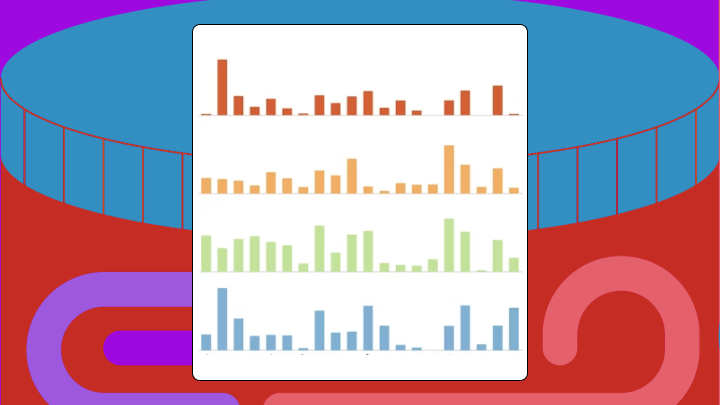

Faceted bar charts give you the clarity of a simple bar chart that's repeated across multiple views, which makes it easy to compare performance across regions, departments, or customer segments. This article explains the data requirements, layout options, and best practices that separate effective faceted visualizations from confusing grids of mini-charts.
Key takeaways
A faceted bar chart is a series of identical bar charts arranged in a grid, with each panel showing data for a different category or segment. You get the clarity of a simple bar chart repeated across multiple views, making it easy to spot which segments behave differently from the rest.
Before you build one, review these guidelines:
- Use this chart when: You need to compare the same metric across more than three categories, and cramming everything into one grouped bar chart would create visual chaos.
- Avoid this chart when: You care more about totals than individual segments, or when you have fewer than three groups to compare.
- Primary decision supported: Identifying which segments outperform or underperform relative to each other on the same measure.
- Best alternative if this fails: A grouped bar chart for fewer categories, or a heatmap when you have dozens of categories and need density over precision.
Data requirements for a faceted bar chart
Want a faceted bar chart that delivers an instant "aha" instead of a grid of confusion? The data has to cooperate first.
Here's the quick checklist BI analysts, data engineers, and IT data leaders tend to care about:
- A consistent metric definition: every facet must use the same governed calculation (for example, the same definition of revenue, conversion rate, or active customers).
- A clean faceting column: no nulls, no accidental duplicates, and no "Region" values that are really five spellings of the same region.
- A stable grain: each row should represent the same level of detail across segments, so one facet isn't daily data while another is monthly.
- A facet-ready shape: most faceted bar charts prefer long data (category, value, facet) rather than wide pivoted tables. If your source data arrives wide, you will likely need a reshape step before charting.
Multiple teams building the same key performance indicator (KPI)? This is exactly where a semantic layer and centralized governance save you from the classic "why do these two panels disagree?" meeting.
What is a faceted bar chart?
Picture the same bar chart structure repeated across multiple panels. Each panel represents a different slice of your data. All panels share a common axis scale, so you can compare values across groups just by scanning left to right or top to bottom.
You might hear these called small multiples, trellis charts, or panel charts depending on who you're talking to. The term faceted plots covers any chart type split into panels, not just bars. Some people also search for what is a facet map, which applies the same panel-splitting concept to geographical visualizations.
The fundamental difference from grouping comes down to real estate. Grouped bars sit side by side within a single chart. Faceted bars get their own dedicated mini-charts. You're trading compact space for visual breathing room, an important consideration when choosing your chart type.
When to use faceted bar charts
More than three categories but fewer than 12? That's the sweet spot. The grouped alternative usually fails here because it requires too many bars in a single view, forcing labels to overlap or rotate awkwardly.
This is also the moment when BI analysts get asked to "compare across every dimension at once." Region and product category. Territory and campaign. Department and quarter. A faceted bar chart can answer those segmentation questions without making you build a separate chart for every group.
Consider these scenarios where faceting makes sense:
- Regional sales comparison: Comparing quarterly revenue across eight sales regions, where a grouped chart would require 32 bars squeezed into one frame.
- Survey response breakdowns: Showing satisfaction scores by department, giving each department its own panel to highlight internal patterns.
- A/B test results by segment: Displaying conversion rates for multiple audience segments across test variants.
A quick validation test: ask a colleague to identify the highest and lowest performing segments within five seconds. If they squint or trace lines with their finger, you probably need to facet.
When to avoid faceted bar charts
Faceting fragments attention. If readers need to see the overall total or aggregate trend, they'll have to mentally sum values across panels. That mental math introduces friction and error.
Avoid faceting under these conditions:
- Fewer than three categories: The visual overhead isn't justified. Use a simple grouped bar chart.
- More than 12 facets: Readers start losing the ability to compare panels quickly, and the grid can read like noise. If you need more categories, filter to the most relevant ones, or switch to a heatmap.
- When totals matter more than segments: Faceting de-emphasizes the whole. A stacked bar chart keeps composition and total visible together.
- Uneven category sizes: If one segment dwarfs the others, the visual weight across panels becomes misleading.
There's a softer failure mode that shows up at large enterprises: different teams build the "same" faceted bar chart with different metric definitions or filter logic. When every team builds their own faceted bar chart their own way, you don't have a comparison. You have a conflict.
A marketing team once faceted campaign results by 20 audience segments. They couldn't identify which segments drove overall performance because the data was too scattered. Budget got spread evenly instead of concentrated on high-performers. A sorted bar chart would have prevented that.
Faceting layout options
Once you decide to facet, arrangement is the next question. Two primary approaches exist:
- Wrap layout: Panels flow left to right and wrap to new rows. Best when you have one categorical variable and want compact presentation.
- Grid layout: Panels sit in a strict row-by-column matrix, with one variable defining rows and another defining columns. Best when you're comparing across two dimensions simultaneously.
Use wrap when you have one faceting variable. Use grid when you have two and their intersection matters.
If you find yourself rebuilding the same layout for every recurring stakeholder request, that's your signal to standardize it. A reusable template (even a simple "known-good" card you duplicate) can save BI teams a lot of copy-paste chart maintenance.
Row vs column facets
Columns encourage left-to-right comparison, which works well for time-based sequences. Rows encourage top-to-bottom comparison, suiting categorical groupings where order is arbitrary. The choice affects how readers scan.
Defaulting to columns regardless of label length forces 45-degree rotated labels. Nobody wants to read those.
Fixed vs free scales
Many tools will lock all facet panels to the same axis scale by default. This makes cross-panel comparison accurate but can waste space when one category has much larger values than others.
Free scales let each panel use its own axis range. This maximizes visual resolution within each panel but makes cross-panel comparison misleading. The same bar length means different values in different panels (a trap that catches even experienced analysts who forget to check axis labels).
Use fixed scales when the question is "which segment is largest?" Use free scales only when examining patterns within each segment, and warn readers explicitly that panels aren't directly comparable.
An analyst once used free scales to show revenue by region. Stakeholders concluded the smallest region was performing as well as the largest because the bars looked similar in height. The axis labels told a different story, but nobody read them.
Panel-to-panel number mismatches (not just scale issues) usually point to a metric definition problem. A governed metric in a semantic layer can stop that drift so every facet is truly apples-to-apples.
Best practices for faceted bar charts
Each guideline below prevents a specific type of misread:
- Limit facets to 12 or fewer per view. If you have more categories, filter to the most relevant ones or paginate.
- Keep axis scales fixed unless you have a specific reason. Free scales make bars look comparable when they aren't. If you must use free scales, add value labels to every bar.
- Order facets meaningfully, not alphabetically. Alphabetical ordering is arbitrary and hides patterns. Order by the metric being displayed (highest to lowest) or by a logical business sequence.
- Use consistent bar colors across all panels. Changing colors between facets suggests the bars represent different things.
- Add panel labels that are readable without abbreviation. Truncated labels force readers to guess which segment they're viewing.
Teams often discover that stakeholders ignore panel labels if they're too small. Position strip labels at the top of each facet with a distinct background color.
Supporting multiple dashboards across teams? Standardizing the facet settings (sort order, axis rules, and the exact KPI calculation) pays off. It reduces those repetitive ad hoc requests where someone asks you to "recreate the same chart, but for my region."
Faceted bar chart examples
Seeing data in a faceted format often reveals insights that other charts obscure.
Quarterly sales by region
A retail company compared Q1 through Q4 sales across six regions. A grouped bar chart with 24 bars was unreadable. The faceted version made it immediately obvious that two regions had strong holiday spikes while others stayed flat. That insight guided inventory allocation for the following year.
Survey responses by department
A human resources (HR) team analyzed engagement scores across 10 departments. Faceting revealed that IT and Finance had bimodal distributions, with clusters of very satisfied and very dissatisfied employees. Other departments showed normal distributions. A single grouped chart would have averaged out this polarization, hiding a retention risk. It's something guides often skip over: Faceting doesn't just show differences, it exposes structural patterns that aggregation destroys.
Feature adoption by customer segment
A product team tracked feature usage across eight customer segments. Faceting showed enterprise customers adopted advanced features at twice the rate of small business customers. A single aggregate view would have hidden this disparity.
Limitations of faceted bar charts
Faceted bar charts trade density for clarity. Each facet needs enough room to be readable, which limits how many you can show without scrolling. Faceting also de-emphasizes totals, so readers see segment-level patterns but lose sight of overall magnitude unless you add a summary panel.
The chart also assumes shared context. With "only about 30 percent of employees" regularly using analytics according to research by Gartner, most readers may not understand what each facet represents and will just see a grid of unlabeled mini-charts. Clear labeling matters because the majority of your audience isn't fluent in data visualization.
A second limitation sits outside the visual layer entirely. Segmented comparisons only stay trustworthy when underlying metrics and filters are consistent across teams. Otherwise, the executive reading the dashboard is comparing definitions, not performance.
How to create a faceted bar chart in Domo
Your dataset needs at least three columns: a category column for the x-axis, a value column for bar height, and a faceting column that defines which panel each row belongs to.
If you want governed facets (so every panel uses the same approved KPI), make sure you're charting the same metric definition across the card and any filters.
- Navigate to your dataset and select "Add Card" or open an existing card for editing.
- Choose "Bar Chart" as your chart type.
- Drag your category field to the x-axis and your value field to the y-axis (use a governed calculation when the KPI has a formal definition).
- In chart properties, locate the "Series" or "Group By" option and add your faceting field.
- Adjust layout settings to control whether facets display in rows, columns, or a wrapped grid.
- Verify that axis scales are fixed across all panels.
- Preview the chart and confirm each panel displays the expected subset of data.
Run a quick validation: sum the values across all facet panels. This total should equal the aggregate in your source data. If it doesn't, check for filtering or null values in the faceting column.
One frequent build error involves forgetting to set a consistent sort order. Bars appear in different positions across panels, making comparison difficult. Set an explicit sort in chart properties.
Data not facet-ready yet? A data engineer can reshape it first. In Domo, Magic Transform (no-code or SQL) can turn wide exports into the long format that faceting likes, and Domo's data integration layer can keep those inputs refreshed from the source.
BI platforms like Domo can make faceting easier because they sync axes and manage panel layout automatically. Excel is widely available and flexible, but faceting usually means creating separate charts and aligning them manually, which can introduce inconsistencies.
Answering the same segmentation question every week? Scheduled refresh and automated reporting mean you can stop rebuilding the same faceted view for every meeting.
To sanity-check your facet choices, swap templates, and see how other analysts keep segments apples-to-apples, join the Domo community and compare notes with people building these views in practice.