Join the AI + Data Tour for hands-on training, real customer stories, and time with Domo product experts near you.
Register now

Mark: What's up, everybody? I am stoked to be here because one of my good friends and one of the smartest individuals that I know, legitimately, Mr. Chris Willis, who happens to be our chief design officer and AI futurist here at Domo, is with me. Chris, how are you?
Chris: Mark, thank you for that introduction. I really appreciate that. I'm really excited because I love what you've been doing here, and I think we've got a lot to talk about.
Mark: Totally agree. So once a month, everybody, Chris hosts a conversation as well on principles about AI and how to build and whatnot. And today, I am going to pick his brain for a bit on the state of agentic AI. Chris, I want to jump right in. You have been, more than anybody in the company, actually, we've put you to work. You've been on the speaking circuit, you've been on with media over the past little bit. Walk me through, as you've talked with so many different publications, what are the questions you're getting asked about AI today?
Chris: Yeah. Well, first, thanks for working me over so hard. I think you and your team have put me in front of fifty different media outlets—everything from podcasts to TV to interviews. And I think the emerging theme, beyond sort of the fear, uncertainty, and doubt, right? There's a lot of disruption going on out there. But I think that the stories that are emerging are one of the gap between ambition and execution. That seems to be the big unknown.
Whether you're talking in sort of the overall economy, with debates about data centers and the capability of these new models, or you're talking about cybersecurity or other things, there's definitely a big gap between what people think can be done or what they hope can be done with this technology and what's actually happening.
Chris: And if we apply it to organizations, because we also have lots of conversations with companies that are investing heavily in this, they're also dealing with the same kind of gap between ambition and execution. And I think this is a kind of historical pattern that repeats whenever you have big technological disruptions.
And in fact, it's interesting because it's sort of affecting everybody at once, which is why I think you're getting this kind of zeitgeist moment as opposed to it only affecting healthcare, or affecting supply chains, or government, or other aspects of business and society. But everybody is kind of dealing with the same problem all at once. And if it's okay, I'd like to share with you that pattern. I think we can actually draw this out pretty simply. It's called a J-curve.
Mark: Yeah.
Chris: So have you heard of a J-curve before?
Mark: Only from you.
Chris: Okay. All right. This is kind of a J-curve. It could probably be a little bit more clear, but whenever you have some new kind of technological disruption, it tends to displace things. And the idea, or the hope, or the fear of any particular technology usually far outpaces the effects of it. So I'll give you a quick example.
I don't know if you remember, but there was a time when we didn't have PCs in the office, right? I don't know how long ago that was—I'm thinking like the '90s or late '80s. And then around the time of the PC, which was even before the internet, there was a similar kind of push in organizations to boost productivity with technology. So all of a sudden, people started finding these computers on their desks, and they didn't really necessarily know what to do with them, how to use them, or whether or not...
I remember back in the day, people trying to figure out which way to stick a floppy disk into the drive—like that wasn't obvious. Or like, "What's a mouse?" right? We can't imagine today doing our jobs without PCs, right? Without laptops. But there was a time when no one knew how to use these things. And when economists went back and looked at the productivity gains in that first ten years after the PCs were released, they found that productivity actually dropped by half.
And this is what the J-curve shows. If you look at the left-hand side, that's your baseline—that's sort of baseline productivity when a new tech arrives. And then whether it's the PC, or the internet, or now with agents, what you see is a dip. You see usually a drop in productivity, and I think you're starting to sense that from conversations you're probably having with people, and frustrations, and maybe even conversations you're having with your own teams.
What that dip represents is the time it takes for us to understand how to use it, the infrastructure that's missing, the software, the best practices, the domain expertise—all of that takes time. I think one of the things that's really tricky is that it doesn't show up anywhere, right? That investment is usually kind of invisible, like incidental investments.
Regardless of whether they're sort of incidental or invisible, they still have real effects. And back to your question, what are we seeing? I think we're seeing this point where, again, the excitement is there, and that's kind of where people are making investments. They're like, "This is exciting. We're going to invest in it." But the reality takes time. There's learning that has to happen, there are integrations that have to happen—and I'm sure we'll talk about some of those—but I think that's the story. That's really the big story: productivity is going to get worse before it gets better.
I think the people who are really smart are the ones who realize that they have to kind of swim through that valley quicker than the next, and I think there are ways to do that.
Mark: Chris, where do you think we are? Because I think we could probably argue here that, yes, you're looking at that kind of tech arrival piece. There are also some who I would say are probably in the harvest phase. For example, as I look at all of these companies—we've seen it how many times: "Oh, we're laying off this many people because AI is going to be able to do their job."
There was a big company that was really big on the bandwagon of letting all of their human SDRs and ADMs go. Well, guess what? Their CEO had an announcement just the other day of them hiring a human SDR. And it's like—yes, they went and they made this giant bet, they tailed off, and then realized, "Oh, okay, yes, this is still amazing technology, but guess what? We need the humans to be able to help us make it really, really successful." So, where are we?
Chris: So it's very uneven. There's that old saying that the future's here, it's just not evenly distributed yet. And I think you're starting to see that. So yes, you've definitely seen certain organizations that are definitely in that sort of excitement phase, and then they over-rotate because they don't necessarily understand, again, what the best sort of human-machine collaboration model is.
I've definitely seen and talked to some organizations where they kind of over-rotated, and they overestimated what the tech could do, and then they realized, "You know what? The tech might be able to automate certain things, and that could prove very useful from an efficiency standpoint." But there are certain aspects of human judgment, intuition, and strategy that do not exist in any model because the model's never seen your business.
Trying to find that sort of augmented model, I think, is where a lot of companies are starting to find success. And the reason that's sort of key is because... I'll show just a different chart right here.
Chris: There's a lot of things happening at the individual level, and this has been happening for some time. I'm sure anyone who's worked with IT or run an IT department has sort of been struggling with this in other sort of tech waves in the past, whether it's cloud or other SaaS-type purchases. There are a lot of people kind of buying tools and doing things, and in the case of AI, I think what's happening is there are individuals who are finding efficiencies, but the structure isn't there for it to diffuse into changing the outcomes in the whole organization because there's always a big gap there.
In fact, there's usually a gap between what leaders understand and what everyone else is experiencing. We've seen that many times in a lot of engagements where leadership is like, "Oh, everyone is already doing this. We understand this. Let's just get them the right kind of tool or the right kind of information, and we'll create some sort of mandate." And there's always a disconnect between levels.
I've sometimes called it the dysfunction of hierarchy. There's just something about how the perception of the business—and what people think they need versus what they think others do—is always kind of a little bit off, whether it's from incentives or vision or whatever. You're seeing the same thing play out, but I think you're seeing it play out more quickly with the introduction of this technology because everyone really cares a lot about this, and it's starting to expose that gap.
Whether it's a gap in sort of our coordination in the organization—we talk a lot about the coordination problem that organizations have—I think agents run the risk of sort of exploding that coordination problem because if you have a team of ten people and they're kind of doing stuff and you don't have complete visibility, well, it's still just ten people. But if those ten people are each running a thousand agents, well, guess what? You've got ten thousand things that are kind of going all over the place.
And I don't mean to sound too doom-and-gloomy about this. I think it's just the reality of organizations and the reality of technological adoption; it's never super clean. So, the companies that are able—and the leaders that are able—to coordinate, have a vision, learn along the way, and turn their organizations more into a learning organization (which is really critical at this point) are the ones who are going to get way ahead, way faster. I think that's kind of a thing that's often overlooked.
Organizations are usually set up as functional hierarchies. Everybody in your organization is doing tasks. Well, if you just mandate a bunch of tools and you ask them to become innovators, that's, in many cases, well outside what they're comfortable in doing and what the organization is designed to support and enable.
So I think—and this is where I'd like to kind of throw it back to you—I think it leads to one of the big obstacles of organizations really being able to adopt new kinds of technologies effectively. And this is a really important pattern that I learned from you and your team, which was: you don't necessarily want to start with tools. With the rise and excitement over "token maxing," which was essentially a way of measuring tool usage, it was like, "Let's give everybody a bunch of tools and they're going to become innovators." That is actually a way to quickly stall progress.
What I learned from other organizations, and especially from up close and personal with your team, is that mindset is the first thing that needs to change. That's a cultural thing, and culture is the OS of your organization. So you've got to change the basic operating system of your organization, and then there's the enablement—these are the things that will support that change in culture. Then you get to the tools.
When that happens, then you've removed a lot of the friction. But I think ninety-nine percent of all the efforts start with tools first. That's what I've seen at the biggest companies to some of the smallest. But the smarter ones, I think, are starting to realize AI isn't just something that is going to change the kind of tech we use; it's something that's going to have us rethink the kind of culture we have. And I think that is super unusual, and if you don't recognize that at the start, you're going to get stuck many times over.
But I'd love to throw it back to you, because you were really forward-thinking in saying, "Let's take the time and let's think about what it is that we want to accomplish, and how do we remove the roadblocks to that."
Mark: Yeah. Part of that came, Chris, because of mistakes that we made initially, if I'm being honest. Like so many, we started with tools. We purchased things that would help them be better with AI. Even before that—some of the listeners may have heard it before—but one of my big mistakes was a couple of years ago. I got a note from an individual who you know well, Chris, named Jake Heaps, who is very forward-leaning, AI-first, and just really, really good. And he sent me a note, and believe it or not, I didn't respond. I didn't respond to him. He wanted to pick my brain, and I do get a fair amount of LinkedIn messages, but that is a bad excuse.
And about a year later, I got a note from someone saying, "Hey, you should look at this guy." And his resume was sent to me, which was a custom GPT that had been programmed to answer just about any question you could think of about him, including deep stuff about security. And I'm like, "What in the world?" So I played with it a little bit, and then I'm like, "I've got to talk to this guy." It was a Saturday. I called him on the phone, we chatted, and I'm like, "Oh my gosh, this is what we need." I need somebody whose entire job—not a third of it, or half of it, or seventy-five percent, but entire job—is how do we make our team leverage AI to help them be two, three, four, five, ten times more valuable.
So I hired him. I think I may have made him an offer that day, and he came on. And so early on, yes, we gave them tools—the whole marketing team, the ADM team. And what happened is that very little, if anything, happened. There are a few outliers who may have built something cool, but what we then started to shift is helping people understand that we want you... You've heard of Jensen Huang talking about the idea of having each employee be X percent more effective because of these agents. He stated that the internet we use today, designed for billions of humans, will soon be overshadowed by an internet populated by hundreds of billions of autonomous AI agents working twenty-four-seven.
So how on earth do we take now employees who, to your point, are the OS of any company, and help them to be the very best at what we need them to be? How do we take them out of some of the minutia that AI agents are better than them at anyway? How do we focus them and help them use their superpowers?
So, part of that went on with Jake going in and having individual meetings with the vast majority of our marketing org and figuring out what are the problems that you are having. Once we knew what those problems were and what we needed the business outcomes to be, we could go and build solutions and agents that would help us. What happens if you give people tools and say, "Okay, go do something"? Well, all of a sudden, I've got a creative marketer who's spending time working on, "Look at this really cool agent that can write stuff for me." I don't need that. Or a comms person who goes, "Hey look, I could build this really cool video." Well, that's not necessarily what we need you to do.
We need you to be two, three, four, five, ten times more valuable, and to be able to do the things that you need to do to be successful. And so, finding out what are their challenges, what are their problems, how do I use tools and tech to help you be more effective, enabling them the right way, and then giving them the tools to be able to actually build it, giving them the skills... We have a whole marketing toolkit that sets people up with the skills and things that they need to be successful. But we tried at first just by giving tools, and we failed miserably, and so we learned from that and then made some shifts.
Chris: Well, I love that, because there are a few things I'd love to comment on. First was your openness to understanding that maybe the status quo of how we're organized, and how we think about what we do in the business, and how we go about doing it, needs to be rethought. That is difficult for people. That's hard because organizations are usually designed, again, as functional hierarchies where they deal with similar problems every day and then work on incrementally improving them and mitigating other kinds of things. Well, now all of a sudden you're saying, "What if we did something else?" But it's really unsettling if you don't know what that other thing is when you start, and that can be uncomfortable for people.
And I'd like to pick your brain a little bit because you mentioned finding someone like Jake. I think new technology and the need for organizations to creatively engineer themselves is kind of calling into, or needs to tap, a different sort of resource or different kind of personality in the organization. I think for people who have been in the creative world, this is actually a really good moment for them because, in a way, organizations have been really good at sort of finding, educating, and promoting specialists.
But what you're talking about is more generalists—you're looking for people with range, who can work across disciplines, who are comfortable with new kinds of technology, even if they don't understand it completely. That's not a specialist in many ways. They might have certain specialized areas of interest, but that might be another kind of discussion around organizational behavior and management, which is: what are the different kinds of personality and talent profiles you need? Because there are going to be different kinds of talents needed going forward.
We've already seen this, and I was actually shocked when I got this response. This was, I think, at our last Domopalooza, and I was talking to the head of a Fortune 100 company and I just asked, "How is AI changing how you hire?" I was just curious; I wasn't really sure how they were going to respond, other than to say, "Well, yeah, we're trying to get more engineers," or, "We're trying to get more AI talent in the door." What they said was, "We're looking for people with better writing skills."
And I was like—that's brilliant, right? Because what do you get with writing? You get people who are really good thinkers, you get people who are good with language, and it turns out the models work well with language. I'm not exactly sure where it's all going to go, but I think it suggests that new questions have to be asked, like: who are the people we need to hire?
And then I think the other thing that you did that was really great was not only did you find the right kind of individuals to say, look, not everyone has to innovate in the same way. Let's find the right people who are able to experiment, and test, and kind of pick themselves up after something didn't work quite right—don't get too discouraged. But also, let's be very honest about what worked and what didn't work. Let's not hide that, because it's not just a self-deprecating mode and a mea culpa, right? You're not just doing it to be humble.
You're doing it because you need to build humility into your team and into your process. Humility is the ability to learn from anywhere and anything. And so when you're like, "Okay, we might have made an investment and we got really excited about it, but it didn't work. Why didn't it work? What specifically didn't work?"—that is critical. That humility is critical because that's what allows your organization, your team, and the individuals in the teams to learn, and that's the way you get through that gap, right? It's going to be the companies that can learn faster, and I think that's a new kind of muscle for many organizations.
So I applaud you and your team for that kind of mindset shift. And then the enablement—you're creating the data, the workflows, and the governance you need so that when you start to do things, and they're well-intentioned, you're also not creating a safety problem because... In fact, I'll pull up another chart right here.
Chris: That's one of the biggest problems, I think—that's the next big blocker. It's the governance problem. It's the fact that everyone's very confident that once they figure it out, it's all going to work. But part of that gap, part of that unseen infrastructure that needs to be built, is: do we have the monitoring infrastructure? What are the agents doing? Do we have a mature, governed model of data? Right? Are the models getting information they should have, not the information they shouldn't have, and creating security risks?
And then, is any of this actually secure, right? What's the oversight, the logging? By the way, as you know, you might create a system that goes and maybe creates a new kind of ad campaign or a new landing page. Well, who's responsible when that thing goes sideways, right? Because I don't think you get away with going to a board and saying, "Well, the model did it," or, "The model made me do it," right? That's not going to fly. These are all lots of bits and pieces that don't exist right now, and I think that's kind of the phase we're in.
Mark: Yeah, and I think, Chris, that part of what AI needs to help people do is, one, focus on the challenge that is currently at hand. These things, as you know, are changing so rapidly. A few months ago, I think there could have been some—sorry, Sam Altman and others who could have said—OpenAI is really falling behind on certain things. And then you look at where they're at today with Codex and you're like, "Holy cow, how did that change?" It really felt like Claude was absolutely destroying other companies, it felt like, and now you look not very long later, Codex is absolutely killing it.
So realize that this is shifting so quickly, and the employees—the people who will be most successful—are those who decide, "Okay, AI can help me be two, three, five times more effective at whatever the challenge of the day is." And here's a quick case in point. Domopalooza, our big show—Chris has been super involved in that for a long time, way longer than I have—we have amazing, beautiful creative. It is a show, a production. We spent, not very long before the show, creating close to twenty videos for our CEO that were shared in his keynote that showed all of these really cool AI agents or apps that could be created to help give value to our customers.
Well, you know as well as I do, Chris, back in the day, we would've spent tens, if not fifties, if not hundreds of thousands of dollars to be able to have an agency put those together. It cost us $1,700 for twenty videos! They were AI-centric, really incredible quality videos.
Now, we also had a video from a creative standpoint that played at the very beginning of the show, and it was a masterpiece. It was the kind that undoubtedly had people with tears streaming down their faces. It was beautiful, the sound was incredible, the story was incredible, and it talked about how the real power is in you. It's not in the model, it's not in the agent, it's in the human. Well, yes—were there some AI components to that video? Of course there were. But we had real, true humans who made that feel and sound the way that it did. There is always, always, always going to be a need for humans to leverage AI to be able to get the very best outcome. And I am a pretty big proponent of that. Am I wrong, Chris?
Chris: No, I think you're right. In fact, it echoes what we talked about earlier around the PC era, right? And that sort of revolution, what it ushered in. It reminds me of something Steve Jobs said during that time, which was: he looked at the PC as the "bicycle for the mind," right? Like it's something that takes a great athlete with curiosity and takes them places faster than they could go by foot. I really think if we design the tools around AI right, they become like rocket ships for the mind.
And I think that's kind of the experience you're talking about, which is: we should be able to help people become not just more creative, but also be able to express that creativity. And by creativity, I'm not just talking about videos or drawings or things like that, but problem-solving, right? Creativity is core to problem-solving.
I think the challenge is: it's incumbent upon the labs, the frontier models, and ourselves, and even in organizations, to create the right kinds of tools to do that. And there's another aspect to this, which is the tools. AI is a new kind of tool, and it represents a quantum leap in how AI has been used before. So, AI previous to large language models and the image generation models was always about predicting and classifying things—"hot dog, not hot dog."
But what you described was that big shift, which is: what happens when AI starts generating things? And that really is a game-changer, and it also has consequences. I was talking to some folks at some of the biggest software companies on the planet recently—mostly their design teams—and I wanted to throw out this one idea for you: those tools need to be built for humans, but they also need to be built... at least in this conversation, it was around: we need to build systems that are trusted or trustworthy.
I get that, and I think that's really critical. However, I just want to throw this out here: I think for those of us who are building projects and trying to figure out how to use AI throughout our enterprises, we talked about the governance gap and some of the organizational challenges involved. But I think we have to wrestle with this idea of trust, because some research that came out of MIT recently basically said large language models are not to be trusted.
So, what you're dealing with here is this idea that—and just a little sidebar—I think of problems in two sort of modes: either a very tame mode, and those would be tools you really understand, they have best practices, you have specialists who understand how to use them, and they're safe, right? They're not that risky because we understand them. Think of it like an autopilot on an airliner. At one point, that was super advanced. We can't imagine flying today without autopilots, but we understand them, they're safe, and they actually make flying safer.
In the case of AI, generative AI, there's a random component to these things, right? And there are other aspects to them that make them both very powerful and flexible, but also make them a little risky, right? They can kind of surprise you.
And the conversation I've been having with designers at some of these really big software companies is: trust is a human thing. Trust is something that we evaluate, but it's not something that's easy to engineer for, if not impossible. But I think what you can engineer for are three things, and I call it the VPC model, which is Visibility, Predictability, and Control.
So, to use your example of videos, those videos worked because you did have human judgment, human creativity, and human talent around storytelling. These were stories that connected with other humans. That's not something that's necessarily built into every model, although they can be helpful in doing those kinds of things.
But I think people who are struggling, or excited about the potential of AI, and aren't really sure how to make it go beyond the pilot phase, need to think about this kind of framework for taking their next steps.
Obviously, things like visibility—what is it these things are doing, right? That just needs to be built in. And some of the projects we're working on, we're just building that essentially into the UI. So, if an agent makes a recommendation or generates something, well, tell me why, and how, and what sources were used to make that recommendation.
Predictability—that is sort of bringing in determinism into your systems, right? When we see the same situation, we should do the same thing. Agents make that a little bit of a challenge, but there are ways that you can definitely make your systems much more predictable. One of the ways is to use sort of certified data products. So if the agent needs to go and say, "Okay, I want to go get this metric, so let me just write a SQL query every time I need it," there's a good chance that SQL query is going to be slightly different every time. But if there's a data product in your platform, like in Domo, and it says, "Yeah, just use that revenue number, that revenue metric," and there are parameters on it, and you now know that it's basically safe and replicable, that's a great thing to do.
Because at some point, if you haven't defined every behavior for an agent, it's going to improvise. And so you need to essentially make the space of where improvisation can happen as small as possible.
And then the last part of it is control, right? How do you bound it? How do you stop it? Where's the human in the loop?
So, I'll give you an example. One thing might be, let's say you're creating agents to update Jira tickets or something like that. It probably makes sense, before an agent makes a Jira change to a ticket on your behalf, to say, "Yes, I approve that change. I approve that message." Right? It's like the political statement.
And I think those are things that are going to become very common and maybe very obvious at some point, but they're not now. These are things that we kind of struggle with. And again, I think those are the things that limit the ability to jump from a pilot-type project to a productionized, fully deployable sort of project. There are other little things that can get in the way, and those are specific to the kind of problem you're trying to solve. But I think, in general, these are the kinds of questions and kinds of conversations that need to be talked about.
Mark: Chris, dig in for a little bit. We've been preaching for quite some time now the idea of AI readiness. We actually have a tool that will help with that. You talk there with your VPC model, which I totally agree with. Most companies, I think it's probably still safe to say, are not ready to leverage the power of AI because their data has never been structured. They've never been given the context that's needed to be able to really get value. Is that still true?
Chris: Unfortunately, I think in many ways it is, and there's a lot of research to suggest that it's still the case, unfortunately. So, again, that's part of that gap, which is that there's a gap not just in the ambition and the execution, but a view of what "AI-ready" means. I don't have it in front of me, but there was something I read out of McKinsey where a lot of leaders—I think it was like eighty-four percent of leaders—think their organization is AI-ready and their data is AI-ready. But then again, that gap: when you talk to the people who are actually working with the data, their view is very different, right?
And I think that's something that organizations and the industry are wrestling with because it's not like organizations haven't invested heavily in their data foundations and their data platforms. But as we talked about before, I think agents are surfacing a lot of cracks in what "AI-ready" meant.
So, what's the strategy? How do you kind of move forward?
Well, one: use this as a time to sort of rally the troops and say, "Look, we should be getting a lot more strategic and tactical value of our data with agents, but we need to do some of the work that maybe we overlooked." But in the meantime, many organizations do have certain data and certain processes that are well understood and could be leveraged in new kinds of ways. You want to start there. Start with the stuff that is credible, verifiable, and trusted in your organization, and start building off of those things.
Start small. That's actually, I think, one of the hardest things for organizations to do because there's a lot of pressure to say, "We became an agentic company." Again, I think McKinsey did a survey, and based on their criteria, they only saw about five percent of organizations as being actually AI-ready across the board.
Mark: Five percent?
Chris: Five percent. So, that means ninety-five percent are kind of missing the boat. And again, I'm not trying to be doom or gloom here—this is just the reality of it. And I think the quicker you kind of understand not just the reality, but the aspects of how you move forward...
And in a way, we kind of joke. I was giving a talk, and I thought of it as like the "AI filter." In cosmology, they talk about the great filter, which is essentially: where's all the intelligent life in the universe? If it's out there, why can't we see it? I think the same question is kind of being asked in organizations. If everyone has all the AI, where are the intelligent organizations? And I think it's because there is this filter problem. It's part of being AI-ready; it's part of having the mindset shift and the enablement.
Chris: But I think we're already starting to see organizations that are starting small. They're using AI to do things they couldn't do before in ways that are agentic-appropriate—using the power of the model, but not relying on a model to be stressed to do things, like, you know, it just can't quite do yet. Part of that is kind of a learning exercise, but it will make a difference.
Now, you mentioned some AI luminaries say, "Well, everyone's going to become ten times more productive and whatnot." If we just made organizations one percent more efficient, that would represent trillions in unlocked value across the globe, right? We don't have to do ten times overnight to create meaningful changes in outcomes.
And I think the other question for a lot of organizations is, even if you're just starting small, be willing to question whether or not you should be using AI at all for a particular thing, right? If you have a process that's already working, that's already efficient, that may be one you don't need to really touch, right?
There are other processes that I've seen where, I think for the sake of making things agentic, they're just sort of recreating an old automated process with new, more expensive, potentially riskier technology, when really I think the question would be: "Well, is this a process we need to automate at all? Is this a process we even still need?" Or maybe with the way we're using this new technology, and we're actually starting to get our data foundation more AI-ready, well, maybe we can apply it, and now we're actually making a real kind of difference in both efficiencies, outcomes, and costs—because that's all part of the infrastructure, right? How much is this ultimately costing us, and was it worth it at the end of the day?
Mark: Chris, as we wrap up, I want you to talk a little bit—you've talked, as we've been working on the AI story over the past while, you've talked about how Domo was made for this moment, and I want you to go into that a little bit more in depth. Why? What does Domo help people do to be able to keep the visibility, the predictability, the control? Why would you say something as audacious as Domo was made for this moment?
Chris: Yeah, this is probably going to sound like a sales pitch, but what you're referring to is something I think I wrote in a presentation quite a while ago. And here was the idea behind it. The reason I said Domo was built for this moment is because Domo is a data platform, ultimately, right?
And I think many up to this point, before agents, you have a lot of organizations that are kind of run by a conglomeration of different tools. So in some ways, it kind of feels like a Frankenstein. You've got a cloud data warehouse technology over here, and you've got an ETL technology over here, and you've got a visualization technology over there, etc.
The challenge is—and you see this a lot in the data and some of the data we covered today—for agents to be effective, you have to close the gap between where your data resides, where your governance resides, how you measure outcomes, how you deploy safely, how you audit, and how you gain visibility into those things.
And I think the platform is... it just sort of turned out that's the way it worked out. The platform is essential to creating an agentic enterprise because an agent needs to have access to an integrated, governed data environment. And if you do that, then you can have the visibility, you can create the predictability, you can control, and you can measure. You can do all of those things that you need to do that are really blocking organizations from taking the most advantage of this new AI technology today. So I think in many ways, Domo kind of built the right thing for this moment, although we didn't really know that moment was coming.
Mark: We could not have known at that time that that was what we were built for, but—
Chris: Yeah. Sometimes it's better to be lucky.
Mark: Amen to that. Everyone, before we end today, I am so grateful that Chris Willis, our Chief Design Officer and AI Futurist, joined us. Monthly, he goes deeper and deeper into conversations around these principles, creating a safe space away from the AI hype. If you're loving what you've heard from Chris today—and I'm sure you did—give Chris a follow. You'll be able to see and subscribe to the page below in the comments.
Visit our website, YouTube, Spotify, or wherever you get your podcasts. Chris is the best of the best and is building not only the now, but the future of what Domo is going to continue to build and help customers do in the AI space for many, many years into the future. Chris, thanks for joining us. Always a good time with you.
Chris: Oh, thanks Mark. Always a great time with you, too. Have a good one.

As Domo's chief design officer and futurist, Chris' hyper focus on combining data, technology and emerging trends in innovative ways helps to make Domo an indispensable platform for its customers. He has nearly three decades of design leadership experience in web, mobile and data visualization. And as one of Domo's earliest employees, he's involved in every aspect – from initial design, strategy and execution – of building and developing solutions that solve even the most complex problems faced by customers.
Prior to Domo, Chris co-founded HOUR Detroit magazine and Footnote.com (now Fold3.com), which was acquired by Ancestry.com for $27 million. Before moving into technology, he was an award-winning illustrator, journalist and author with multiple published works to his name.

Mark brings over 15 years of diverse marketing experience and is passionate about driving Domo’s business growth through marketing initiatives. His mission is to empower all Domo customers and prospects with the insights and tools they need to make better business decisions and achieve their goals. In his previous role as VP of Community, Partner, and Field Marketing, Mark and his teams established new and strengthened existing programs to address customer pain points and create a greater sense of community. They also executed campaigns, programs and events that showcased the value of the Domo platform. Before joining Domo, Mark spent more than 10 years working in customer relations and marketing at Adobe, and worked at Instructure as its senior director of customer marketing. He received his MBA from Utah State University and a bachelor’s degree from Brigham Young University. Outside of work, Mark enjoys spending time with his family and traveling.
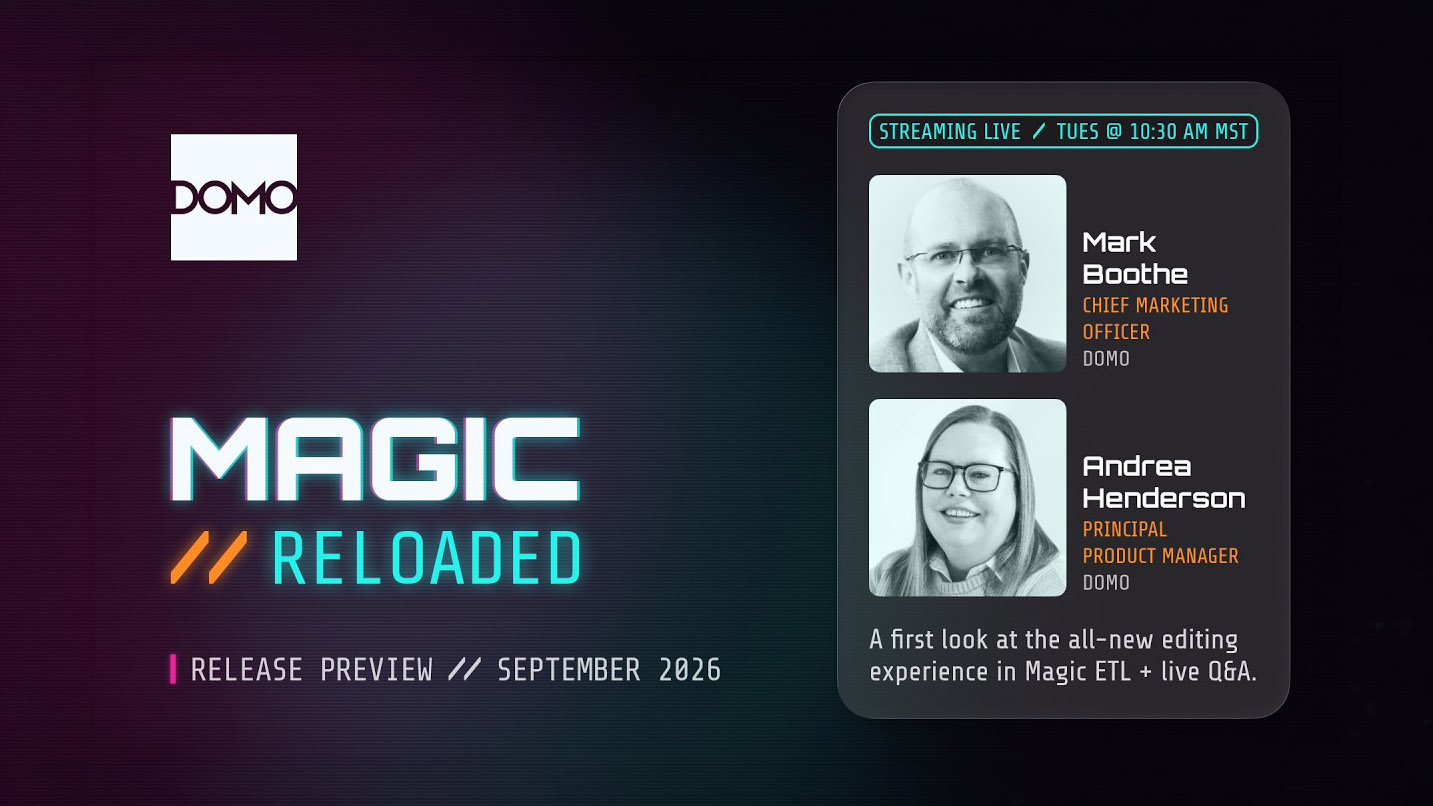
Companies are spending more on AI than ever and seeing almost none of it show up in the P&L. In this episode of Domo's podcast, Governed Data for Agentic AI, Mark Boothe, Chief Marketing Officer, sits down with Chris Willis, Chief Design Officer and AI Futurist, for an honest, hype-free read on where agentic AI actually stands.
They dig into the "J-curve" that explains why productivity gets worse before it gets better (the same dip that hit the PC), why handing teams more tools stalls progress when mindset and enablement should come first, and why most AI usage is invisible to the leaders who assume they can see it.
Chris lays out his VPC model (visibility, predictability, and control) as the practical path from cool pilot to something you can trust in production, while Mark shares hard-won lessons from transforming his own marketing org, including the Domopalooza keynote videos his team produced for $1,700 instead of hundreds of thousands. Listen for a clear-eyed take on crossing the productivity dip, closing the governance gap most companies are ignoring, and building agentic AI that (dare we say) actually pays off.
After listening, you'll learn:
Domo transforms the way these companies manage business.