Join the AI + Data Tour for hands-on training, real customer stories, and time with Domo product experts near you.
Register now
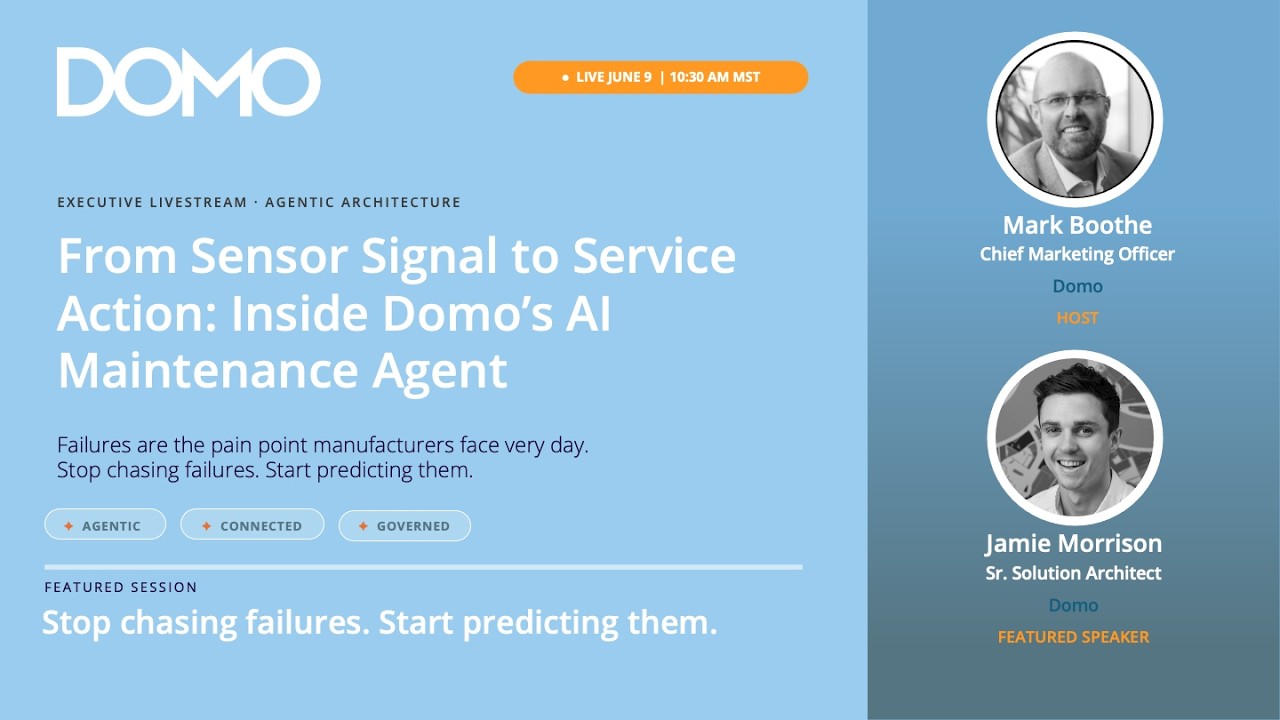

Mark: Good morning everyone. We are back again. I'm here this time with my good friend Jamie Morrison. He's our Field CTO over in our EMEA region. Jamie, how are you my friend?
Jamie: Doing good. Yeah, thank you for having me on today. Excited to make it onto one of the live streams.
Mark: So Jamie is a bit of a Domo celebrity. He's been around for about eight years as a Domo employee, right?
Jamie: That's correct.
Mark: It is common, if you're wondering, for people to spend a significant amount of time here. I haven't reached Jamie's status, but I'm about four and a half years in and plan to be here for a long time. It is a pretty awesome place.
Jamie, today we are talking all things AI and manufacturing. Typically, manufacturing is not seen as the industry in the forefront of all things AI, so I'm interested to get your thoughts. Let's kick off. You've talked a little bit about the idea of moving from signal to action, and I want to get your thoughts on what that actually means. Dive in for me.
Jamie: Yeah, for sure. When we think of signal in manufacturing, especially in the realm of predictive maintenance, the signal is a model telling you that something is about to go wrong. A piece of machinery or a component in some machinery in a facility is about to break. The action is a technician or an engineer going and fixing that, performing the maintenance before it actually breaks, or replacing a part.
There is a series of steps to get from that signal to an action taking place, and we want to stop that downtime from happening. What we've done is build a solution in Domo, a series of apps and an agent that I want to show you today, which really guides us through and helps us automate that signal-to-action process.
Mark: Jamie, how into this are manufacturing people going to be? Are you going to get a lot of pushback, and what are you seeing already with customers?
Jamie: It's interesting. I think there is a maturity curve. Some customers are at the stage where they are ready to start putting in these agentic solutions, while some are not that far along. To give you an example on the other side of that curve, we are working with a customer where we are just moving from paper-based records. Instead of going around a facility and writing down a temperature on pen and paper, we're digitizing it. That is what is nice about the flexibility of Domo—we can start at nothing and digitize, but we can also do really cool things with agents, which is what we will be looking at today.
Mark: They probably see a demo like what you're about to show and think, "What? We could literally have an agent that does all of that work with a human in the loop where it makes sense?" If they are still writing it down on a piece of paper and handing it to the next person, I imagine their minds are pretty blown when they see something like this.
Jamie: Yeah, it's good to see the art of the possible sometimes to see where we can go. Obviously, we often need to start with the basics, and then we can get up to the interesting stuff.
Mark: That's awesome. Jamie, where do you want to go from here?
Jamie: I really want to start off with some numbers and stats to kick things off. It is a good way to illustrate the scale of this problem. Across manufacturing as an industry, a single hour of unplanned downtime can cost an organization roughly a quarter of a million dollars on average. When you move into the automotive sector specifically, that goes north of two million dollars an hour. Siemens did some research with the largest companies in the world and estimated that they are losing roughly 1.4 trillion dollars a year in costs due to unplanned downtime, which is 11% of their revenue. These are huge numbers.
You might be forgiven for thinking that this probably doesn't happen very often because it is such a huge problem, but around 60% of manufacturers in the last year have been hit by unplanned downtime. The really interesting part of that is that we have had predictive maintenance models and outlier detection capabilities to predict these failures for years. This is not necessarily AI; it is just traditional machine learning.
So it begs the question: why are 60% of manufacturers still experiencing downtime? I would argue the answer has very little to do with whether the models are good enough or whether the technology is there, because I believe it is. I think a lot of it has to do with the gap between the signal and taking action, which we are going to look at today.
Another aspect to consider is AI maturity and adoption. In manufacturing, it is the lowest of any major sector. Why is adoption so low? This one is maybe a little bit easier to answer. If we think of a manufacturing facility, there is loads of operational technology living behind firewalls, not connected to the internet. There are lots of sensors on different pieces of machinery and equipment constantly measuring temperature and vibrations, generating tons of data. That all gets fed into systems called historians, which are time-series data stores acting as a system of record of everything that has gone on.
So, you have this one system. Then you have equipment specifications, which might be PDFs in another system. You might have your parts catalog in another system, and your maintenance records in yet another system. Very often, none of this is joined up. When a model flags that a machine is about to break, you still have to go and stitch this whole story together before you actually get to that action. That is what we will look at.
Mark: Jamie, isn't the inefficiency in that just absurd? It is kind of crazy to me. You shared a stat that 88% of organizations are now using AI in at least one business function, yet manufacturing is way below that. It feels like manufacturing is ripe for opportunities like this where they can take away the human error element, which is a massive problem for them.
Jamie: One hundred percent. I think there is a reason why there is some reluctance to adopt these practices, and it is because the consequences if it is not done correctly are physical. I use AI in my day-to-day, and I'm sure you do as well, to summarize an article or draft an email. If the AI doesn't give me a good response, I just get a badly worded email. The stakes are low, and I can easily change it.
If AI in the context of manufacturing gives a poor quality response, the production line is stopped, or the wrong part is ordered. The bar for trust is much higher in this industry, so there is a little more pressure to get things right.
But when we think of Domo and where we sit, this is where we can really shine by tying all these different data sources together to create a solid data foundation. Anyone looking at building AI initiatives in an organization has undoubtedly come across this term numerous times, and for good reason—it is of critical importance.
To give you an example, here in London with Domo, we have been facilitating a series of roundtable discussions with C-suite leaders from all sorts of backgrounds and industries. We have been discussing how to take an AI initiative from pilot into production, and in every single discussion, the data foundation has come up as a critical process that we have to get right.
For Domo, this is what we have been doing since day one. We have our library of connectors to link to operational systems, we can put that data in your cloud data warehouse like Snowflake, and we can use ETL to transform that data. We also have a whole application layer where we can build front-end applications to take action and invoke agents. We have the tooling to take that signal and build a process to allow us to take action on it.
Mark: Jamie, you just gave a bit of a masterclass. I'm calling this out not only for Domo customers and prospects, but for every Domo Sapien in the world today. Jamie absolutely nailed the story we have to be telling across the world. What is Domo expert at? I just got back from San Francisco recently for the Snowflake Summit. Domo is expert. We like to say we are the fastest way to get data into Snowflake.
Whether your data foundation lives in Snowflake, Databricks, or GCP, we will help you get that data in there really fast so you can make it actionable. We help you activate that data by building these apps and agents. But it doesn't stop there. Anybody can go and write code for some solution, but enterprise software isn't going to go away because everything has to be built on a safe, secure foundation that people can trust.
Manufacturing isn't using AI in the way other verticals are because it has to be perfect. They cannot have hallucinations or problems. The idea is to build your data foundation on Snowflake, Databricks, Google, or wherever it lives, let us help you get that data in, combine it, make sense of it, activate it, and then distribute it to an app or an agent while ensuring it is all governed, safe, and secure. That is what Domo is absolutely expert at.
Jamie: One hundred percent. That is the whole point of today—to bring an example to life and show how we do things. Let me give a little bit of context to the demo and then I'll jump in.
If we think of this signal or prediction from a model telling you that a bearing is going to fail in the next few days, that is useful information, but it just created a whole bunch of work for your organization. The model identifying the failing bearing is only the first 10% of the job. The remaining 90% is all the work that comes after: confirming the severity, checking whether the asset is critical, finding the right manual, finding the correct part, identifying the safety procedure, writing the work order, and getting it into the hands of an engineer or technician to perform the inspection or replace the part. This solution is designed to close that gap and make that signal actionable.
I'm happy to jump into the demo and take it from there. I was watching your session with Elliot earlier, and he built a conversational agent that wrote data back into Snowflake. I loved the part where he said there was no smoke and mirrors—it's all real. While this isn't the focus of my demo, we do have Snowflake running in the background here with our raw bearing data of 44 million records, functions to extract features, and models to identify when something is going to go wrong. That is what is generating the signal.
From there, we feed that signal into Domo, where we have created a Procode application sitting on top of the Snowflake data. This is something a reliability engineer would look at to get an overview of all the machinery and everything going on within a facility, such as pumps and generators. At the top, we have a critical alert on our pump.
I can see that vibration and temperature are increasing, creating a critical alert. That is my signal, and I want to take action on it, so I can hit "review details" here. This drills into a granular view for that particular pump. Since this is a Procode app, we can display a CAD model, spectrograms, and spectrum charts. It replays us going from a healthy state to a critical state.
On the right-hand side, we have our alert timeline showing things progressively deteriorating. Vibration frequencies and bearing temperatures are increasing to a critical threshold where the system is recommending we dispatch a technician to inspect or replace the faulty part. We get alerted on our mobile device or via email, prompting us to log in, look at this, and do something about it.
When I select "coordinate response" here, I have a series of screens to work through. The system has already read that Snowflake data and generated some insights. We have a bearing manufactured by SKF in this pump, and we have about four hours before it fails, making this a P0 critical issue.
We have a recommendation to dispatch a technician. Going to the next page, we see another aspect of that data foundation: our staffing data. We want to know who is on-site, who is available, and who has the qualifications and skillset to work with this pump. The system recommends Sarah.
On the final summary screen, we have our first human-in-the-loop step. We have the estimations of time and priority, and then we have the technical documentation. This is what will be sent to our agent to compose a work order for Sarah. I can click edit to adjust what the AI is recommending. The AI recommended swapping in the bearing, but we might want to inspect it first, so I can edit it to say, "Do not replace bearing at this stage. Inspect only," and then hit save and confirm dispatch.
As soon as I click that button, we invoke a workflow in Domo that calls an agent to build a work order and send it to Sarah. Let's look under the hood of that workflow to see exactly what is going on.
In my workflows, I have one in progress. Opening it up reveals a live run-through of what this workflow is doing. In the first tile, we see the data the app just passed into the workflow, including the line of text I edited. The agent is currently at work building the work order.
While I can't show you how we built the agent in this live execution view, I can jump into a development view. When we build agents in Domo, there are a few configurations to check. First is the model selection. In this example, we are using Snowflake Cortex, but we could use our own Domo GPT as well. We use the model that is right for the task.
Next is the prompt, which contains variables since this workflow needs to work for any piece of machinery or part in our facility. Today it is this pump and bearing, but tomorrow it might be a different machine and part. We then give our agent instructions to build an action plan for Sarah, consider safety aspects, and maintain a certain tone of voice.
Crucially, we also give it knowledge in the form of a document collection. We have technical specification documents from the manufacturer stored in Domo, detailing how to disassemble components, refit parts, and torque specifications. When the agent sees the specific part and bearing in the prompt, it locates the exact document from our repository, pulls out the necessary information, and compiles a detailed work order for Sarah.
Mark: Jamie, how would that happen today in a manufacturing company that is still using paper records? If they don't know that specific part, they have to go find a physical paper manual to dig through.
Jamie: That could be the case. If these documents are stored online but you don't have this process, you still have to search for the manual, open it up, find the right page, and piece that information together. It is a pretty time-consuming process.
Mark: The time savings here is pretty spectacular.
Jamie: One hundred percent. While we were talking, our agent finished its job and compiled the work order. It is currently in a pending state, waiting because it has already notified Sarah and sent the work order to her mobile device.
We can now play the role of Sarah, our boots-on-the-ground engineer. Jumping into Domo's Task Center—which could also be embedded in a mobile app or App Studio—this is what Sarah would open. All the text here was written by the agent. It is a highly technical task, but the main thing to call out is that the agent cited its sources.
When looking up the SKF 7314 bearing, the agent found the right document and cited that on page six, the axial clamping force must not exceed 25% of the base static load rating coefficient. This is crucial for building trust and ensuring the AI is not hallucinating. All steps are grounded in what the manufacturer specified. To cross-reference, Sarah can click the URL at the bottom to open the actual documentation, view diagrams, and get specific details while on-site.
Once Sarah goes to the pump and inspects the bearing, she can fill in her observations: safety and isolation were performed, the pitting depth was measured, and the findings show that the bearing has failed, exceeding allowable limits. The recommendation is immediate replacement, requiring a new bearing kit and pump oil. She saves and submits her task.
Refreshing our workflow, we can see that Sarah's response was fed back in real-time, allowing us to move on to the next task. The next agent reads her response, notes that the bearing needs to be replaced, and routes the workflow through a conditional gateway to an inventory check. That agent checks if we have the bearing in stock, and if not, identifies the supplier, lead time, and can even reorder it.
Mark: The agent is doing all of that work.
Jamie: Exactly. We build these based on the systems our customers use. We might also have a step that notifies the plant manager that a pump is going offline so they can adjust production output, or we can send a payload of the work order directly into SAP. We can work and adapt really well with external systems.
Mark: This is amazing.
Jamie: In a short amount of time, we have gone from a Snowflake signal, assessed its severity, coordinated a response, identified an available qualified technician, had an agent build a detailed work order using technical documents, and created a feedback loop based on the inspection results.
Mark: Jamie, that's amazing. Manufacturers, take note: Domo can help you simplify in a safe, secure, and governed way that avoids hallucinations and protects your processes. Give us a call. We're ready. Jamie, what are your closing thoughts on why all manufacturers should be looking at this?
Jamie: It comes down to the cost of downtime. One hour of downtime costing an average of a quarter of a million dollars is a massive expense. Solutions like this close the gap between signal and remediation using factual, grounded data to save costs and increase throughput within facilities.
Mark: Without agents, there are so many areas where human error could disrupt this process—someone having to manually check the bearing, transfer information, and coordinate. This brings in a professional like Sarah to do what she does best, while leaving the minutiae to the agent so our human resources can focus on what they do best.
Jamie: One hundred percent. Absolutely amazing.
Mark: We are so grateful to my friend Jamie Morrison. We will be back again every Tuesday and Thursday at 10:30 a.m. Mountain Standard Time, showcasing how you can solve business challenges with Domo today. With that, we say goodbye. Jamie, thanks again for coming and thanks for joining us today.
Jamie: Thanks for having me. It's been a pleasure.

Mark brings over 15 years of diverse marketing experience and is passionate about driving Domo’s business growth through marketing initiatives. His mission is to empower all Domo customers and prospects with the insights and tools they need to make better business decisions and achieve their goals. In his previous role as VP of Community, Partner, and Field Marketing, Mark and his teams established new and strengthened existing programs to address customer pain points and create a greater sense of community. They also executed campaigns, programs and events that showcased the value of the Domo platform. Before joining Domo, Mark spent more than 10 years working in customer relations and marketing at Adobe, and worked at Instructure as its senior director of customer marketing. He received his MBA from Utah State University and a bachelor’s degree from Brigham Young University. Outside of work, Mark enjoys spending time with his family and traveling.

Jamie Morrison is the Field CTO for EMEA at Domo, bringing over a decade of experience in data, analytics, and applied AI to lead technical strategy for some of the largest enterprise accounts across financial services, consumer goods, and the public sector. Based in London, Jamie combines hands-on expertise in Python and cutting-edge LLMs with a talent for communicating complex technical ideas to both technical and business audiences. Over eight years at Domo, he has guided more than 70 enterprise customers through successful data and AI transformations, while also sharing his insights through writing and public speaking. Jamie holds a Master’s degree in E-Business from Newcastle University and a Bachelor’s in Business Management and Information Management from the University of Sheffield.
Connect with him on LinkedIn: Jamie Morrison
Manufacturing has the lowest AI adoption rate of any major sector. McKinsey's State of AI report puts the picture into sharp focus: 88% of organizations now use AI in at least one business function, but manufacturing sits towards the bottom of the table when it comes to scaling agentic AI inside the enterprise. The reasons are well known to anyone who has spent time on a factory floor.
Operational technology lives behind a wall from the IT estate. Sensor data sits in historians, technical specifications sit in PDFs, and none of it is joined up. A wrong recommendation on a production line has physical consequences, not just a bad email.
At Domo, we are building agentic solutions that help manufacturers find value with AI. For example, our Maintenance Agent reads Snowflake for sensor telemetry, predictive maintenance model outputs, asset history, and writes back where it matters. Every predicted failure gets analyzed for severity, asset criticality, and intervention window. Every work order is grounded in the data, with the rationale attached. Every recommendation pulls in the right technical documentation, the right parts list, the right safety procedures, and is then ready for one-click approval, with human oversight built in at every critical step.
Featured Session: Inside the Maintenance Agent
Join Domo CMO, Mark Boothe, and Jamie Morrison, Field CTO for EMEA, showcasing a solution purpose-built for the unique realities of predictive maintenance at enterprise scale.
Jamie will walk through how the agent: surfaces predicted failures from a model running natively in Snowflake; retrieves the relevant technical manuals and equipment specifications from unstructured documentation in Domo; drafts the work order rationale and parts list your engineers would otherwise build by hand; and dispatches a structured work order to the maintenance technician's mobile device the moment a plant manager signs off. Engineered end to end on the Domo App Platform with data at rest in Snowflake.
What You Will See:
· It's Agentic: The agent doesn't just visualize, it analyses predicted failures, generates work order recommendations, retrieves the right technical documentation, and explains its reasoning. All routed through a workflow to a human in the loop.
· It's Connected: One application, every layer. A modern front end, Domo Workflows orchestrating Code Engine functions, AppDB for persistence, Domo AI calling foundation models, unstructured documentation grounded through Domo. And Snowflake as the governed source of truth for sensor data and model outputs, natively integrated, reading where it should and writing where it matters.
· It's Governed: Human-in-the-loop on every maintenance decision. No autonomous work orders, no autonomous spend, no new vendor, no surprises.
Jamie is going to show you how to build a modern maintenance engine. Join us and see what happens when every sensor signal, every failure prediction, and every work order runs on agentic AI.
Domo transforms the way these companies manage business.