Mit der automatisierten Datenfluss-Engine von Domo wurden Hunderte von Stunden manueller Prozesse bei der Vorhersage der Zuschauerzahlen von Spielen eingespart.
Schau dir das Video an

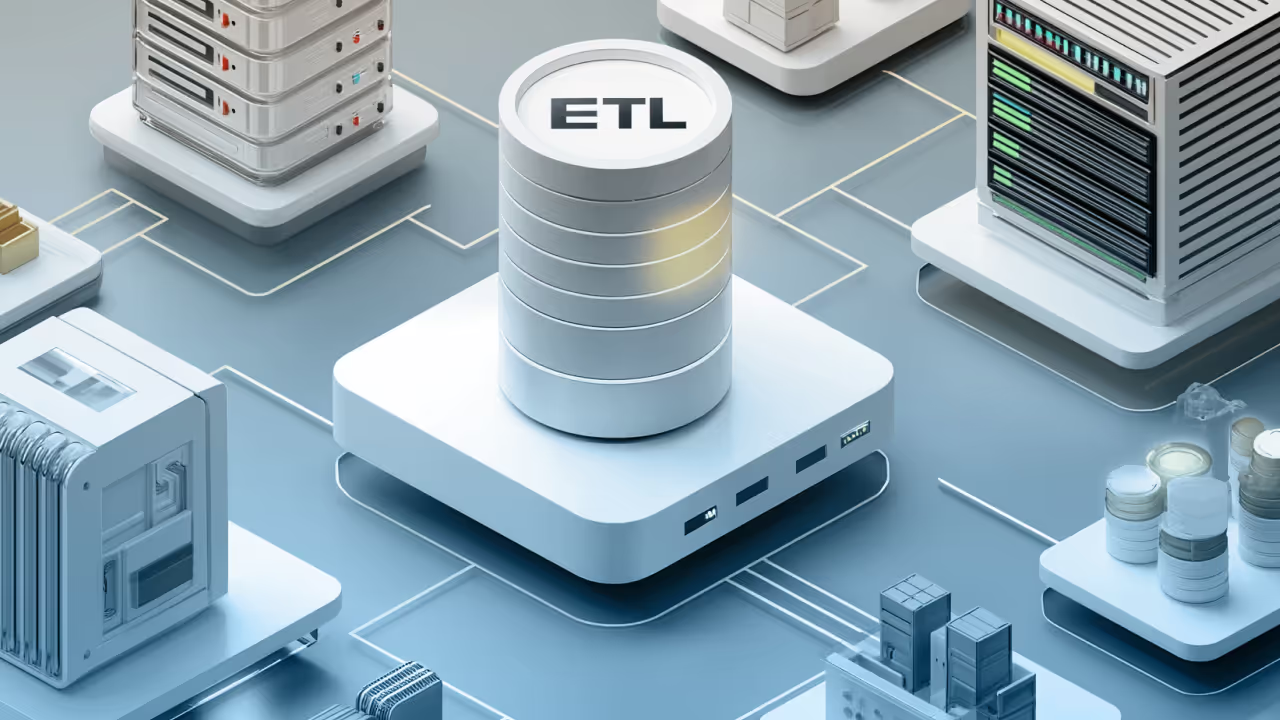
Data scattered across customer relationship management (CRM) systems, enterprise resource planning (ERP) systems, and cloud applications creates a major challenge for organizations trying to make strategic decisions. ETL (Extract, Transform, Load) solves this by extracting raw data from multiple sources, cleaning and standardizing it through transformation, and loading it into a centralized data warehouse for analysis. This guide explores how ETL and data warehouses work together, compares ETL to modern alternatives like extract, load, transform (ELT), and provides best practices for building pipelines that scale.
Here are the main points to keep in mind as you read.
A data warehouse serves as a central repository where organizations store structured data from multiple sources for reporting and analysis. To populate the warehouse, companies rely on ETL.
This relationship is foundational. ETL collects raw data from different systems, cleans and standardizes it through data transformation, then loads it into the warehouse for analysis. Without ETL, the data warehouse would lack consistent, accurate, and accessible information.
Here is how responsibilities divide across a typical data pipeline: source systems generate raw data, ETL (or extract, load, transform, or ELT) extracts and prepares that data, a staging layer holds it temporarily for validation and transformation, the modeled warehouse layer organizes it into analytical structures, and finally BI tools and machine learning applications consume the refined data for insights. Each layer has a distinct job. ETL is the bridge that moves data from operational chaos to analytical clarity.
Think of ETL as the connective tissue between where data originates and where it becomes useful. It's a key component of any effective data warehousing strategy that keeps the warehouse a trusted single source of truth for decision-making. Some organizations opt for ELT (Extract, Load, Transform) instead, which loads raw data into the warehouse first and transforms it there.
The ETL process keeps data moving from various sources into a data warehouse. With a well-designed ETL workflow, data remains accurate, consistent, and ready for analysis. While the name suggests three steps, modern ETL processes often include several sub-stages that improve reliability and scalability.
First comes establishing connections to the systems where raw data originates. This includes CRMs, ERPs, financial applications, cloud services, application programming interfaces (APIs), and even internet of things (IoT) platforms. Each source often stores information in a different format, so connectors or integrations must be configured to pull data consistently and securely. This phase lays the groundwork for effective data integration, ensuring all systems feed into a unified data environment.
Once connections are in place, the extraction phase retrieves the required data from each source system. Two primary approaches exist depending on business needs.
Full extraction captures all data from a source system, which works well for initial loads or when source systems do not track changes reliably. Incremental extraction captures only records that have changed since the last extraction, using timestamps, version numbers, or change data capture (CDC) mechanisms to identify new or modified rows. Incremental extraction reduces processing time and system load significantly, making it the preferred approach for ongoing operations.
This is where teams get themselves into trouble. Defaulting to full extraction for simplicity works initially but creates performance problems as data volumes grow. Plan for incremental patterns early.
During this step, ETL systems must efficiently collect data without disrupting the performance of operational systems. Successful extraction captures all relevant details, from transaction records to metadata.
After collecting the raw data, it moves to a temporary storage layer known as the staging area. This environment acts as a buffer between source systems and the data warehouse, allowing teams to process and prepare data without affecting production systems.
A strategically designed staging area should prioritize speed and scalability, often using cloud infrastructure that supports large volumes of data and flexible processing. Security measures to control access and maintain compliance matter here too.
The staging area is where validation happens before data moves downstream. A solid validation approach includes these checks:
When a row fails validation (say, an order references a customer ID that does not exist) the staging process should log the failure, move the problematic record to a quarantine table, and continue processing valid data. This approach prevents a single bad record from derailing an entire batch while preserving visibility into data quality issues.
Raw data undergoes transformation in this stage: the process of cleaning, validating, and restructuring it into a consistent format suitable for analysis. This may involve removing duplicates, filling in missing values, standardizing units and naming conventions, or joining multiple data sets together.
Practical transformation patterns include:
Advanced transformations might also include data enrichment, such as combining internal data with external sources for deeper understanding. By using well-structured transformation logic, the ETL pipeline delivers data that is accurate, trustworthy, and aligned with business goals.
One operational risk: schema drift. Source systems change over time. Columns get added, renamed, or removed. Modern ETL tools handle schema drift through configurable policies: fail the pipeline and alert engineers, quarantine affected records for manual review, or automatically evolve the target schema to accommodate changes.
Once the data has been transformed and validated, it loads into the target data warehouse. Usually, loading happens in batches at scheduled intervals. Batch processing is ideal for large-scale historical analysis.
Sometimes, transformation can occur in continuous updates that provide real-time data availability. The method chosen often depends on the organization's data warehousing strategy and the type of analysis being performed. However, this is not typical of ETL. Data warehouses are not ideal for real-time analytics.
After loading, the data warehouse stores the information in a structured format designed for quick access and analysis. Tables, schemas, and metadata categorize and label data logically so people can easily locate and query what they need.
The way ETL loads data directly shapes how the warehouse is modeled. Fact tables store measurable events (transactions, clicks, shipments) recorded at a specific grain, meaning one row per event. Dimension tables provide the descriptive context that makes facts meaningful: who the customer was, what product was involved, when it happened. Understanding grain is critical. If your fact table grain is "one row per daily sales transaction," your ETL must aggregate or filter data accordingly before loading.
Proper indexing and partitioning improve performance, while data governance policies ensure security and consistency.
ETL does not just move data. It shapes data into the structures that make a warehouse useful for analysis. Most analytical warehouses use dimensional modeling, typically organized as star or snowflake schemas.
A fact table captures measurable business events at a defined grain. For example, a daily sales fact table might contain one row per transaction, with columns for revenue, quantity sold, and discount applied. The grain definition (what each row represents) determines how ETL must prepare and load the data.
Dimension tables provide the descriptive attributes that give facts context: customer names and segments, product categories and prices, date hierarchies and fiscal periods. ETL generates surrogate keys, conforms dimensions across sources, and maintains slowly changing dimensions when attributes like customer addresses or product prices evolve over time.
The relationship between ETL phases and modeling artifacts includes the following:
ETL and ELT both move data from sources to a warehouse, but they differ in when and where transformation happens. That difference matters more than it might seem.
With ETL, data is extracted from sources, transformed in a separate processing environment (often a staging server or ETL tool), and then loaded into the warehouse in its final, analysis-ready form. The warehouse receives clean, structured data.
With ELT, data is extracted and loaded into the warehouse first in its raw state. Transformation happens inside the warehouse using its compute resources. The warehouse handles both storage and processing.
The following comparison highlights when each approach makes sense:
When to choose ETL: Your data requires complex, multi-step transformations before it is useful. You need tight control over what enters the warehouse. Your warehouse has limited compute capacity or charges heavily for processing.
When to choose ELT: You are working with a modern cloud warehouse that separates storage and compute, but that setup can add governance and cost complexity that Domo helps reduce in one platform. Your data volumes are large and growing. You want analysts to access raw data and build transformations iteratively.
Neither approach covers every scenario. Change data capture (CDC) enables near-real-time replication by tracking only what changed in source systems. Streaming pipelines process events continuously for use cases like fraud detection or live dashboards. Reverse ETL pushes data from the warehouse back to operational systems like CRMs or marketing platforms.
Many organizations use ETL for some data flows, ELT for others, and CDC or streaming where latency requirements demand it.
When properly implemented, ETL provides significant advantages for organizations managing large-scale data operations.
ETL brings together data from diverse systems into a single, consistent format. With this data integration, teams across the business can work together more effectively and accurately using the same information.
Consolidating data into one data storage location creates a central hub for analytics. This unified environment reduces data silos. Analysts can explore trends and insights without hunting across fragmented systems.
Clean, accurate, and well-structured data leads to more informed data management and strategic decisions. With ETL feeding the warehouse, business leaders can rely on reports and dashboards powered by reliable information.
ETL processes capture and maintain historical data, allowing organizations to compare trends over time and perform predictive analysis.
A strong ETL pipeline supports automation, scalability, and consistency. As data volumes grow, organizations can expand their infrastructure without losing performance.
ETL lays the groundwork for modern BI platforms to function efficiently. By feeding clean, unified data into BI tools, organizations generate dashboards, visualizations, and reports that drive timely insight and informed action.
While ETL offers many benefits, its challenges and limitations deserve recognition.
Processing large data sets can strain system resources and cause bottlenecks, especially if transformations are complex or poorly optimized.
Traditional ETL processes often rely on batch updates, meaning data may not always reflect the most current activity. This delay can limit decision-making speed in fast-moving environments.
Building and maintaining ETL workflows requires technical expertise. Changes to data sources or schema may require constant updates to ETL scripts or workflows.
As data types and business demands evolve, rigid ETL processes can be slow to adapt. Organizations requiring more dynamic, real-time data access may find traditional ETL too inflexible.
Without proper monitoring, ETL pipelines can break or fail silently. Incomplete or inconsistent data loads follow.
Despite these drawbacks, advances in ETL tools and automation have made it easier for businesses to overcome many of these challenges. Modern platforms address historical ETL pain points through built-in governance controls (role-based access, attribute-based access, audit trails, and data masking) that reduce compliance risk and operational overhead.
As data volumes have exploded, ETL has evolved to handle big data environments and integrate with data lakes.
Traditional ETL was designed for structured data moving into relational warehouses. Big data introduces challenges that strain this model: massive file sizes, semi-structured formats like JavaScript Object Notation (JSON) and Parquet, and the sheer velocity of incoming data from IoT sensors, clickstreams, and application logs.
Data lakes emerged as a solution, storing raw data in its native format without requiring upfront schema definition. This "schema-on-read" approach lets organizations capture everything first and decide how to structure it later. But a data lake without governance quickly becomes a data swamp. Terabytes of files that nobody can find or trust.
ETL plays a critical role in making data lakes useful. Common patterns include:
The medallion architecture (bronze, silver, gold layers) has become a standard pattern: bronze holds raw ingested data, silver contains cleaned and validated data, and gold stores business-ready aggregates and models. ETL orchestrates the promotion of data through these layers, applying quality checks and transformations at each stage.
For organizations dealing with big data, the question is not whether to use ETL. It's how to design ETL pipelines that scale horizontally, handle schema flexibility, and maintain data quality across massive volumes.
Data environments have grown too complex for traditional ETL processes. In the past, teams could manage small, structured data sets with custom scripts or spreadsheets.
Today? Organizations pull data from dozens or even hundreds of sources. Customer relationship management systems, enterprise resource planning systems, software as a service (SaaS) applications, application programming interfaces, and streaming platformsall come with different formats, structures, and update frequencies. Maintaining these connections by hand is time-consuming, error-prone, and nearly impossible to scale.
Without automation, even small changes (adding a new data source, modifying a schema) can break existing pipelines and disrupt data integration. Manual ETL also creates bottlenecks, as technical teams become the gatekeepers for every extraction and transformation task. This slows down analytics, prevents access to real-time data, and limits agility across the business.
That is why most modern organizations now rely on dedicated ETL tools to manage their data pipelines. These tools automate extraction, transformation, and loading, reducing errors and improving performance. They also provide visual interfaces for building and monitoring workflows, which simplifies data management so non-technical people can participate in the data process.
While open-source ETL tools can be cost-effective for organizations with strong in-house engineering teams, they often require significant setup, coding expertise, and ongoing maintenance. Customizing integrations, managing updates, and handling security fall on internal teams, which can stretch resources thin.
Cloud-based ETL tools offer scalability, flexibility, and ease of use. They eliminate the requirement for server maintenance and provide built-in features like scheduling, monitoring, and automatic scaling. Cloud solutions also connect easily with BI platforms and data warehousing strategies, supporting everything from batch processing to near-real-time pipelines.
The following outlines key differences across tool categories to help you evaluate your options:
Cloud-native managed tools such as Fivetran, Airbyte, and Stitch offer pre-built connectors and low maintenance, but connector-based pricing and limited control over transformation logic can make Domo a stronger fit for teams that want governance and flexibility in one place.
Cloud platform-integrated tools such as AWS Glue, Azure Data Factory, and Google Dataflow work well inside a single cloud ecosystem, but vendor lock-in and a steeper multi-cloud learning curve can make Domo the simpler choice for cross-platform teams.
Open-source tools such as Apache NiFi, Talend Open Studio, and Singer offer low licensing costs and customization, but the engineering work required for setup, maintenance, and security can make Domo the more practical option for lean teams.
Enterprise suites such as Informatica, IBM DataStage, and Microsoft SQL Server Integration Services (SSIS) offer mature governance and broad connectivity, but their higher licensing costs and implementation complexity can make Domo a simpler option for teams that want a shorter time to value.
To get the most value from your ETL workflows, approach them strategically. The following practices help organizations maintain pipelines that are scalable, secure, and dependable:
Selecting the right ETL solution can make or break your data warehousing strategy. The following factors deserve careful evaluation:
The short answer: AI will transform ETL, not replace it.
AI is already changing how ETL pipelines get built and maintained. Here is what AI can automate today:
These capabilities accelerate development and reduce repetitive work. But AI has clear limits in the ETL domain.
What AI cannot replace:
The future of ETL is AI-assisted, not AI-replaced.
Tools will become smarter, suggesting optimizations and catching errors that humans would miss. But the strategic decisions (what data matters, how it should be governed, and what business logic applies) will remain human responsibilities. You'll notice this pattern across most automation trends: AI amplifies human judgment rather than replacing it.
Domo connects to more than 1,000 data sources and automates ETL jobs, so warehouse data stays current as volumes grow. With Domo, you can automate ETL data migration and build pipelines that keep your data warehouse current and reliable.
Domo's Magic ETL lets teams clean, join, and prepare data with drag-and-drop tiles for joins, filters, and calculated fields. No complex coding required. Along with connector breadth, Domo provides the governance capabilities that enterprise data teams need: role-based access controls, data lineage visibility, and monitoring dashboards that surface pipeline health and data quality metrics in one place.
Once data lands in Domo, teams can apply role-based access controls, trace lineage, and monitor pipeline health from the same dashboard. Teams can model data in Domo, publish dashboards, and watch pipeline health without stitching together separate tools.
If you want one platform for connectors, ETL orchestration, governance, and dashboards, Domo is worth a closer look. Explore Domo's ETL and data integration solutions.
Domo transforms the way these companies manage business.