Join the AI + Data Tour for hands-on training, real customer stories, and time with Domo product experts near you.
Register now
Why does a business-critical process still run on a spreadsheet that barely opens? Plenty of teams keep a fragile tool alive out of habit, even as it drains hours and breaks at the worst moments. The encouraging part is that the moment you decide to retire a legacy tool is usually the moment something more dependable begins.
What if the hours spent keeping a brittle tool alive could build something people trust instead? That's the question we explored with Zach Ehasz, director of product management for hospital quality at Healthgrades, and Kristian Ayre, a forward deployed engineer at Domo. Together, they showed how Healthgrades rebuilt a 100 megabyte, macro-heavy Excel tool as a governed AI agent.
What follows is a six-step playbook modeled after their approach. Any data, analytics, or IT team can use it to replace a brittle tool with an AI agent that people trust.
Start by being honest about what the old tool really costs, because the sticker price is never the whole story. At Healthgrades, the tool was an internal catalog the team called AMT. It held the master list of every award and rating the company licenses to hospitals.
That catalog lived as a macro-enabled Excel workbook with hundreds of tabs. Someone had to update it by hand every time new results came through.
The hidden costs piled up from there. Sales and account managers needed high-performance machines just to open one file, the same tier as developers. The workbook broke often, and Zach's analytics and engineering teams lost a large chunk of each year keeping it running.
For all that effort, it produced only five basic reports. Add up the specialized hardware, the constant repairs, and the lost analyst time, and the case for change makes itself.
Once the cost is clear, change what you optimize for. The old model spent every hour on upkeep, so the tool never improved, it only stayed alive. As Zach described it, the team flipped that pattern so the same hours would compound into functional gains.
That reframing changes how you scope the project. Instead of asking how to make the old tool less painful, you ask what it should do if effort actually improved it. For Healthgrades, that shift turned a five-report catalog into a starting point. It gave the team a reason to invest rather than patch.
An AI agent is only as good as the data and the guardrails around it. Healthgrades works with sensitive healthcare data, so consumer AI tools were never an option. The team needed a place where AI could work directly on their governed hospital-award data without it leaking into tools no one controls.
This is where an agentic platform for the intelligent enterprise like Domo fits. It keeps the work inside a governed environment, so role-based access carries from the protected healthcare data through the agent to the final answer.
Domo is unified by design and modular by adoption, so a team can start with one product and expand as data, logic, and governance get reused. It also runs on top of the data platform a company already uses. Information can stay in a warehouse like Snowflake, Databricks, or Google Cloud while Domo makes it AI-ready and puts an agent on top.
Governance, of course, isn't a setting you switch on at the end. It's the foundation that makes the rest of the playbook safe.
The most important build step is the context model, a cheat sheet the agent reads before it answers. It captures how the business actually reads its own data. That's why responses come back accurate instead of plausible but wrong.
Kristian pointed Domo's context engine, for example, at a dashboard and an App Studio project, and it drafted a first version in about 10 minutes.
Behind the scenes, that draft profiles columns and counts how often each one gets used. It also checks how fields are aliased and maps relationships across datasets, then records the result as a shared source of truth.
A person (Zach) stays in charge the whole way. He can review and edit any part of the model. That keeps a human in the loop and keeps the agent inside boundaries the team sets on purpose.
Most legacy tools hide a translation problem, and an AI agent exposes it fast. For example, sales and account teams may describe the world one way, but the backend data often uses older codes and names that no longer match.
So if you ask the raw data a question in the language sales uses, and the agent may return nothing. The answer isn't missing; the problem is the words simply do not line up.
The context model is where you close that gap. When one Healthgrades award changed names years earlier, for instance, Zach mapped the old code to the current name so the agent would recognize both.
Domo also carries this natively through an AI Dictionary, where stored definitions become the first place the agent checks. Once those definitions live in one place, the agent bridges business language and engineering language, and every team gets consistent answers.
The last step is adoption, and you win it by starting with the toughest audience you have. For Healthgrades, that was a head of sales who had seen the old tool for years and expected little from a rebuild.
Within about 10 minutes, he changed his mind. He asked his own questions and checked the answers against his spreadsheets, and the agent kept coming back with the right context and the right numbers.
Proving value this way also settles who gets to build. A developer creates the framework once, and ater that, a capable person on the team can extend it without waiting on an analyst.
Zach showed how. He added his methodology documents and reran the context model in under five minutes. Then he asked how a hospital's critical care award history related to its star ratings and got an answer grounded in those documents.
When the people closest to the work can improve the agent themselves, the tool keeps improving instead of slowly falling behind.
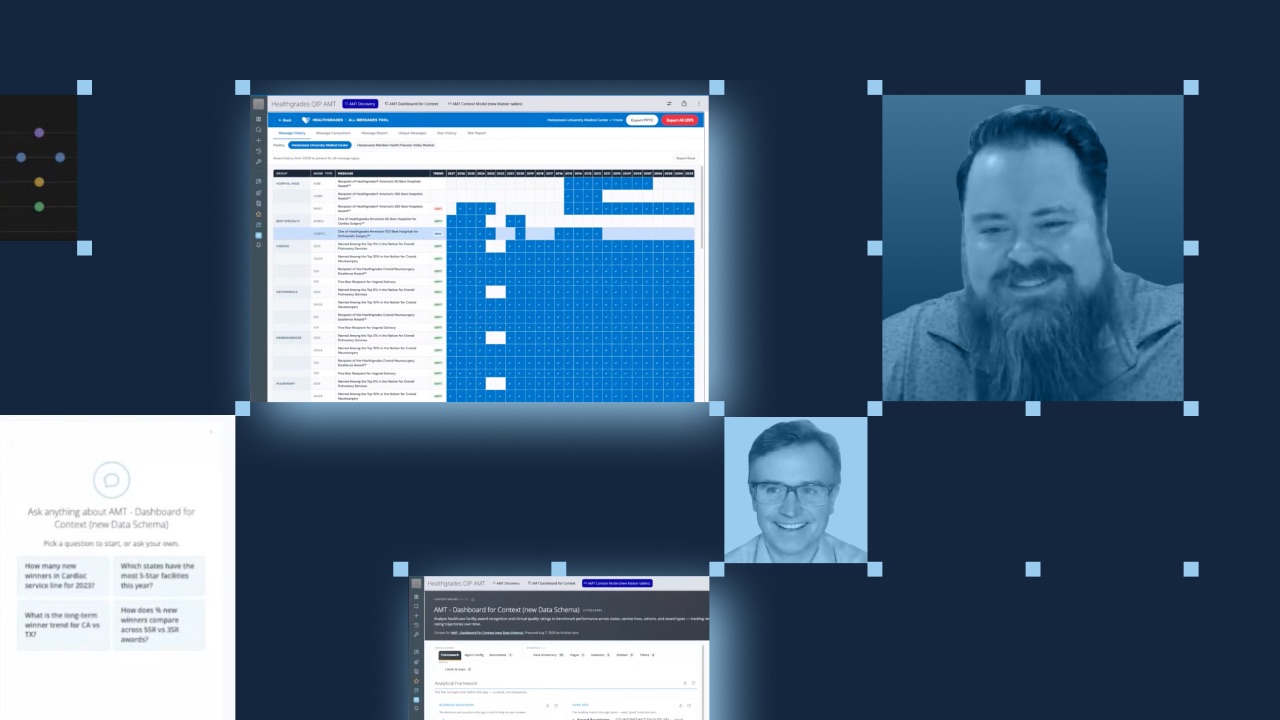
The playbook is clearer once you see it run. In the session, Zach demoed the rebuilt tool live on Hackensack University Medical Center, one that pulls comparative award messaging across city, state, and national levels in the time it takes to ask a question.
We also dug into why Domo fit this project and what it means to put the power of analytics in the hands of the people who use it every day.
Watch the full session to see the agent, the context model edits, and the head-of-sales reaction for yourself.