Nehmen Sie an der AI + Data Tour teil und profitieren Sie von praktischen Schulungen, echten Kundengeschichten und dem Austausch mit Domo-Produktexperten in Ihrer Nähe.
Jetzt registrieren
A 94 percent match looks great when recruiting, but if the answer to “what went into it?” is “resume vs job description,” the score isn’t very helpful. The signals that decide a good hire already exist elsewhere: recruiter notes, interviewer comments, LinkedIn threads, and email history.
In a recent Domo livestream, solution engineer Kenny Scott walked through an AI recruiting agent built on the platform. The centerpiece wasn’t another funnel chart. It was a candidate fit score derived from multiple sources. Teams can then tune that number by role, explain it to hiring managers, and act without handing the process to autopilot.
Here's how Kenny's system works, explained so that hiring and HR teams can create something similar using their own tools.
Every company wants to hire the best talent. Recruiters still lose hours to familiar problems. Open positions go unfilled for too long. Qualified people are overlooked in spreadsheets. Briefs are written from memory instead of shared information.
Kenny framed the core challenge was to find people, run a process they would finish, getting them to accept the position, and ensure they stay. Progress slows when no one can see where candidates drop off, how spend is pacing, or which open seats are actually warm.
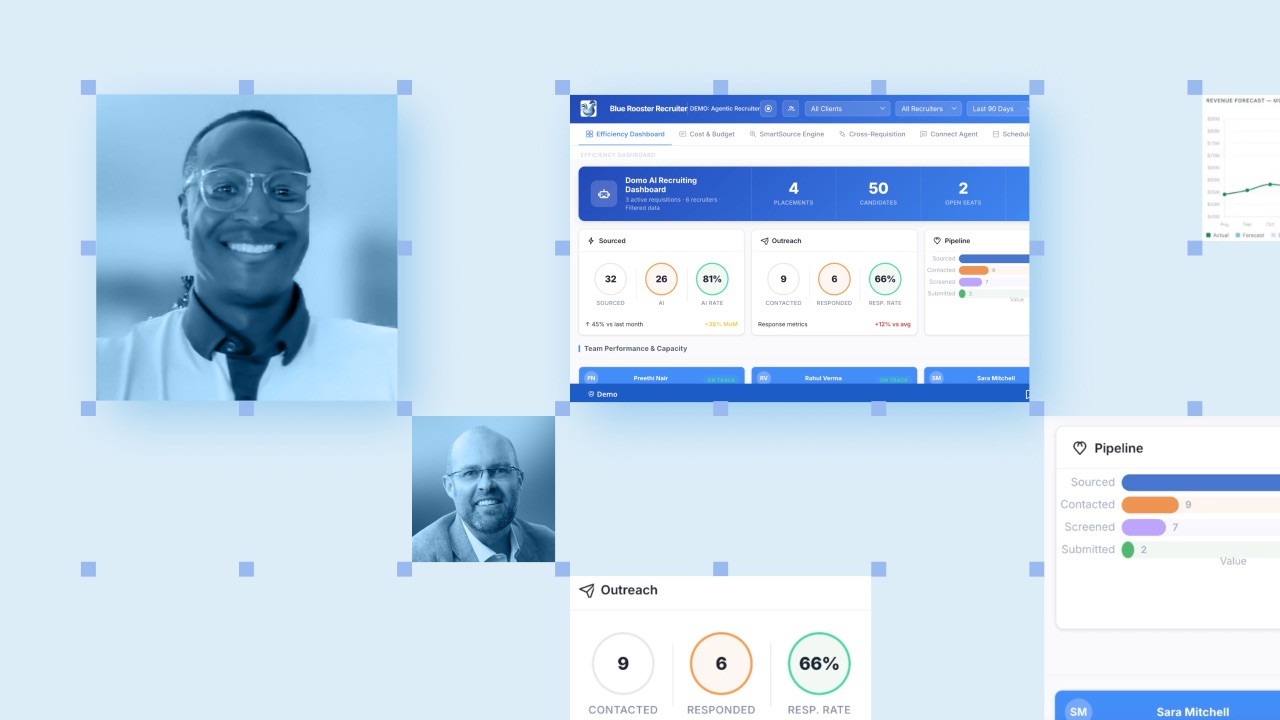
An efficiency view helpsby consolidating placements, candidates, open seats, source and pipeline metrics, and team capacity in one place before anyone chases a single profile. Matching without that foundation layer is really just guessing.
The durable upgrade is the score itself. Domo’s Smart Source pattern treats fit as a governed blend of attributes, not a vibe check.
Kenny called the matching layer the Smart Source Engine. Using Domo’s AI tools, the agent scored candidates for a role based on more than just “good fit and interested.” Preferential signals like salary, location, manager style, and regional preference were considered alongside skills.
Recruiters could raise the bar (for example, above 90 percent) or lower it depending on the role. For a strong profile like Priya’s, the view showed matching skills, a target job opening, and a generated summary of why she was a good match. From there the choice was clear: move her forward in the application process or suggest a more suitable position.
That’s agentic AI in a hiring workflow. The system plans a next step from the governed information it has, then waits for a person to approve it before any final decisions are made.
Follow this sequence.
Kenny opened by focusing on overall recruiting efficiency, not on individual CVs. Information from applicant systems, LinkedIn, and candidate repositories was combined into one view, which showed placements, candidates, open seats, and average match scores. Metrics for source, outreach, and pipeline were displayed together with conditional formatting so attention went to the rows that needed it.
Team performance was below that, with capacity and stack ranks that make it easier to see who’smoving work. Action starts after the backlog is visible, making it easier to evaluate how well things are working.
Where does a 94 percent match come from? Kenny answered that directly when asked how the list of people and scores was created.
Domo tooling can read a resume through optical character recognition (OCR). It can also pull notes from recruiters and interviewers, plus LinkedIn and email conversations, wherever those records already live. The blend of information depends on the current recruiting process. The point isn’t to create a new silo. The point is to have one governed profile the agent can easily read.
Domo’s strength here is the same foundation story that runs across the platform: connect many sources, make sense of the data, then act. This handoff of information is activation on governed data: agents and apps reading context people trust before anyone acts on a score.
Skills matter, but they aren’t the whole job. Kenny’s demo factored preferential bias into the assessment: salary expectations, location, manager type, and regional preference, alongside the skills the req needs.
Scores stay as custom as the attributes a team measures internally for each role. One requisition may need a score above 90 percent, while other may allow for a broader range. The model isn’t the product. The governed blend of hiring data is.
Domo is an AI orchestration and data platform, not a model vendor. Teams bring their preferred inference methods. With Agent Catalyst, builders choose a trusted LLM or bring their own, then ground agents on governed hiring data.
A score without a story isn’t very helpful. Kenny scrolled into matching skills, the target requisition, and a generated match summary for Priya. Recruiters could submit her into the client’s recruiting funnel or reroute her to another position that might fit better.
Cross-requisition routing is the natural twin of a multi-source score. A silver-medalist pattern showed Marcus as a strong fit for a cloud infrastructure lead role. It also surfaced senior Java developer and Salesforce solution architect paths. If market preference pointed to Java, the recruiter could reroute him inside the current hiring process. Prior call notes and email context traveled with him, so a near-miss didn’t force a cold restart.
That’s a complete workflow change, not another task to check off. It protects candidate experience and recruiter time in the same move.
Once a candidate clears the match bar, AI can draft outreach across email, LinkedIn, and SMS. Kenny was explicit about the control model: the message doesn't auto-send. For email, a submit lands the copy in the recruiter’s draft inbox. A person verifies accuracy and tone, then sends.
That's classic human-in-the-loop design, the same idea covered in Domo’s guide on adding a human approval step to AI workflows. Interview scheduling followed the same pattern. Preferential timing for the candidate met AI-suggested slots against recruiter availability. An interview board tracked next steps, notes, stars, and approvals.
Domo frames this as bounded autonomy on an agentic platform for the intelligent enterprise. Humans set objectives and constraints. Machines coordinate the heavy lift. No autonomous offers. No black-box closes.
Kenny’s own path mattered to the build story. He started as an account development manager. He learned Domo by building reports for his book of business. He later extended into AI apps without a deep background in retrieval-augmented generation. Drag-and-drop data work, then AI capabilities on top, let business builders ship rich applications and step outside the tool to run the work itself.
The lasting lesson is architecture, not a one-off demo. Domo organizes that path as Foundation, Activation, and Distribution on governed data:
The platform is unified by design, modular by adoption. Teams can start with the scoring workflow that hurts most, then expand without redefining governance each time.
The recording shows Kenny building the efficiency view, Smart Source matching, multi-source scoring, cross-requisition routing, and draft outreach in sequence. See how the fit score sits at the center of the system, and how every recommendation stays under recruiter control.