What if you could build a complete enterprise solution in under an hour without writing a single line of code?
That's exactly what happened in a May 2026 livestream from Domo, Unlocking the Intelligent Enterprise: Domo's Agentic Platform in Action. It showcased agentic engineering with Domo, Claude, and Cursor, revealing how prompt-driven workflows can generate full data solutions, from ETL pipelines to governed apps, without the traditional drag-and-drop building process.
The approach challenges a common assumption: that AI-assisted development means quick prototypes that never make it to production. Instead, the session presented a repeatable method for building enterprise-ready solutions that include audit trails, human review, and measurable ROI from day one.
Move beyond vibe coding with structured planning
Agentic engineering represents a step beyond exploratory prototyping. While vibe coding gets you started, it only takes you so far. The real differentiator is investing time upfront in due diligence and scope so the AI-driven build process flows through naturally.
"I am of the opinion that...vibe coding will only get you so far," Cassidy Hilton, VP of technology partnerships at Domo, explained. The distinction matters because enterprise solutions require more than clever prompts. They need architecture, data assets, and a clear implementation path.
The workflow starts with what Cassidy called a "guard plan," an engineering roadmap generated through conversation with Claude. This roadmap includes a solution summary, build strategy, architecture decisions, and required data assets before any building begins.
Here's how you can apply his approach to your own projects:
- Start with due diligence: Before prompting, research what would be meaningful for your specific use case. Have conversations with stakeholders and gather requirements.
- Generate your roadmap: Use an LLM conversation to produce a comprehensive engineering plan that covers architecture, data assets, and sprint structure.
- Include sprint zero: Build in a clarification phase where you refine requirements and resolve ambiguities before generating assets.
- Document as you go: The roadmap itself becomes documentation, making it easier for others to understand and maintain the solution.
Generate complete solutions through prompts alone
The livestream showed a full solution, including data preparation, workflows, and a front-end app, generated entirely via prompts. No tiles were dragged, and no code was written manually.
"All of these components were generated via prompts," Cassidy said. "I didn't drag any tiles, I didn't write any code, I literally didn't even start the app, if you will. This was all done via prompts."
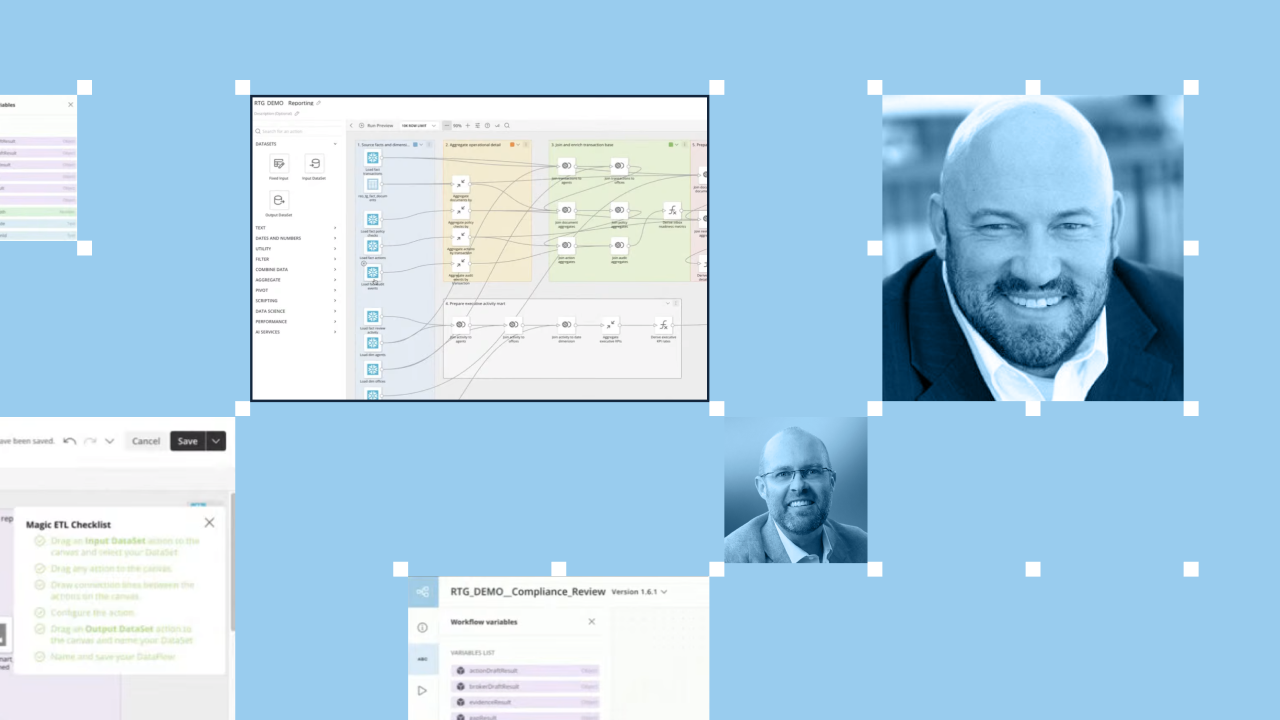
The solution included datasets landing in Snowflake, Magic ETL dataflows for data preparation, agentic workflows for document analysis, an App Studio front end, and AppDB for persisting results. Each component was prompt-generated using a system of platform-specific skills that inform the LLM how to generate each asset type. The whole solution, which was intended for compliance and risk management, came together in less than an hour.
Design for enterprise trust from the start
Speed means nothing if the solution can't be trusted in production. The livestream emphasized that governance and security come natively with the platform, with no configurations or special setups required.
"This is a fully governed operating model that ranges across data, a number of different data tables across the given schema, AI workflows, human in the loop reviews, and so on," Cassidy explained. "Trust comes from the control, meaning recommendations, human review, workflow statuses, auditability, all of that is fully built into the solution."
The solution processed over a thousand file sets, demonstrating that prompt-generated solutions can handle enterprise scale. Results were persisted in AppDB for future audits, and the front end included explicit ROI metrics: review time saved 32 percent, exception reworks down 24 percent.
Building trust into your agentic solutions requires attention to several key areas:
- Persist everything: Store the results of agentic processes for compliance and auditing. Whether you use AppDB, Snowflake, or BigQuery, make auditability a default.
- Include human checkpoints: Build human-in-the-loop review into your workflows for critical decisions. Automation should augment judgment, not replace it.
- Show your work: Embed ROI metrics and operational KPIs directly in your solution so stakeholders can see impact without requesting separate reports.
- Keep data where it lives: The demonstration used Snowflake as the data foundation, with prepared outputs powering downstream solutions. You don't need to move everything into a new system to build on top of it.
The architecture pattern is worth noting: Data lands in Snowflake by default, transformations prepare it for downstream use, and the app layer consumes those prepared outputs. This approach respects existing data investments while enabling rapid solution development.
Key takeaways
- Agentic engineering requires upfront planning: Generate an engineering roadmap before building to ensure your AI-driven process produces production-ready results.
- Prompt-generated solutions can be comprehensive: Full data pipelines, workflows, and apps can emerge from prompts when you have the right skills library.
- Enterprise trust is built in, not bolted on: Governance, auditability, and human review should be part of your solution architecture from the beginning.
- Speed and scale aren't mutually exclusive: Solutions built in under an hour can still process thousands of documents and deliver measurable ROI.
The shift from vibe coding to agentic engineering isn't about abandoning AI-assisted development. It's about channeling that assistance through structured planning and enterprise-grade execution. You now have a pattern you can adapt: start with a roadmap, generate components through prompts, and build trust through transparency and control.
Ready to see the full demonstration? Watch the complete livestream from Domo to explore how agentic engineering works in practice.