Imagine you lead franchise development. You're over 300 locations and have more than 100 open deals for future locations. It's Monday morning, and you open up a stack of dashboards that all tell you the same things: Here's what happened last week.
None of them, unfortunately, tell you what you really need to know. None, for example, point out which deal is about to slip or what to do about it.
What if your command center could flag that stalled deal before your team even spots it? An agent-first command center closes that gap between knowing and acting.
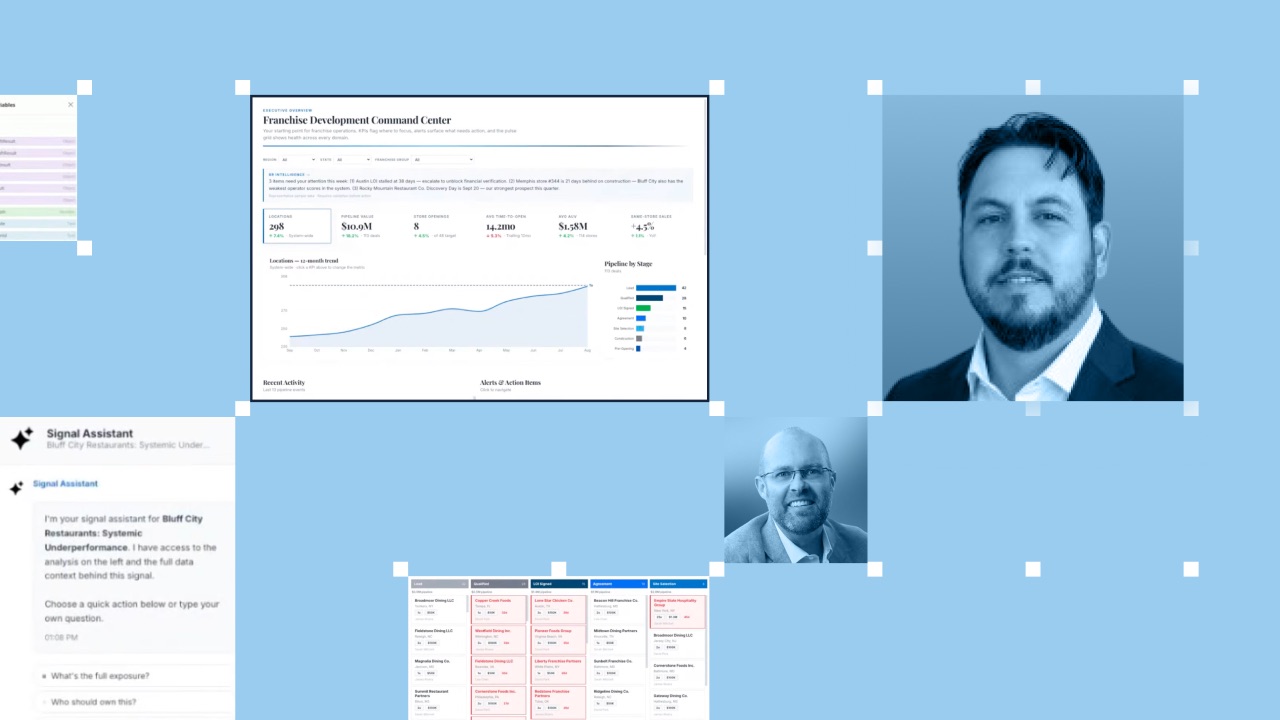
In a Domo livestream, Miles Herleikson, a senior solution architect, tackled that gap, demostrating a franchise development command center for a quick-service restaurant brand. In it, AI agents sit at the center of every decision, not static charts.
In this post, you'll learn a framework for building an agent-first command center like Miles' yourself.
Step 1: Start with the outcome, then work back to the data
Miles recommended a simple starting point: Name the outcome you want before you touch a single dataset. Franchise development teams often begin with whatever data they happen to have, then hope insight appears. That order rarely works.
So flip it instead. Decide what a good week actually looks like, such as no deal stalling past 30 days, then work backward to the signals that predict trouble. This keeps the build focused and gives every agent a clear job when you add them later.
Miles used a simple analogy: Decide what kind of house you want to build first, then gather the materials, rather than starting with data and guessing. The work stays iterative from there. You collect new sources, refine the transformations, and circle back as sharper questions surface.
Step 2: Bring scattered sources into one agent-first command center
In the demo, the brand's information lived everywhere at once. Deal notes sat in a customer relationship management (CRM) system, financials in spreadsheets, broker updates in email, and history in an aging dashboard. There wasn't a single view of the whole picture.
The command center pulled those sources into one governed view of roughly 300 locations, 100-plus active deals, and 29 franchisee groups. An action panel sat in the middle of the screen and pointed straight to what needed attention. Governance carried through every layer, so each person saw only the data their role allowed.
The scale made that fragmentation costly. The portfolio spanned 20 states, with eight stores under construction and information scattered across broker emails and a dashboard built years earlier. A shared business layer, what Domo calls a semantic layer, tied it together so every metric meant the same thing no matter who asked.
Step 3: Give every agent a defined role and human guardrails
Because an agent is only as useful as the instructions behind it, Miles built each agent with a specific role and clear directions. Each one ran on Snowflake Cortex and the customer's chosen AI model for generating answers, so Domo made that model useful on governed data.
To be clear, people set the objectives and thresholds, and the agents operate strictly within them. When a signal crosses a line someone defined, the agent surfaces it for review. The autonomy stays bounded by design, so the team keeps control of what counts as urgent. In the demo, people set the alert thresholds and reviewed every flagged deal before any workflow ran.
Setup starts with your business goals and priorities. For the franchise demo, setup began with key performance indicators (KPIs) like stalled letters of intent, open-territory risk, and franchisee performance thresholds. The agents read both structured and unstructured data against those lines, so they flag a stalled deal or an unusual number early.
Step 4: Turn alerts into workflows people can act on
A surfaced risk still needs a response, and this is where most dashboards falter. The demo shared a live example: an Austin deal with Lonestar Chicken Company, stalled at the letter of intent stage for 38 days. One click brought the deal economics, status, and franchisee profile together on a single screen.
Beneath each deal, the command center placed workflow buttons that move the work forward without leaving the platform. Before firing one, the person confirms a few details, which keeps the action deliberate rather than automatic. Each workflow captures three things:
- Reason: Why the deal needs attention right now.
- Priority: How urgent the response should be.
- Owner: Who gets notified and takes the next step.
The demo offered three ready workflows for that Austin deal: escalate it, reassign the owner, or schedule a follow-up. Each one moves the deal without a detour into email or a separate tool. An agent can even suggest the next steps once the task lands.
Firing the workflow advances the deal stage and routes the task to the right person inside the platform. The system then shows progress through completed work, not another chart to review.
Step 5: Extend the pattern with scorecards and an in-context assistant
Once the deal pipeline was in place, the team reused the same agent-first command center pattern elsewhere. It carried into franchisee scorecards, territory analysis, and store-opening risk.
Scorecards ranked all 29 franchisee groups and drilled into a single location on demand. When a location like Bluff City Restaurants underperformed, the team could investigate right there.
The scorecards flexed by region and peer group, so a leader could compare neighbors or zoom to one operator in seconds. Executive insights ranked which locations needed attention first, then pointed toward outreach. For Bluff City, the assistant weighed the economic impact and mapped who owned the next move.
On every page, an assistant answered plain-language questions using the governed data model and the customer's chosen AI model. Ask why a location lagged, and the answer came from trusted data rather than a guess. That is the true payoff of a governed foundation: the intelligence holds up as you scale it.
Watch the full livestream
This framework covers the backbone of the build, but the livestream goes further. Miles also walked through market expansion analysis. The agents scored open territory and flagged places where a new store might cannibalize an existing one.
He demonstrated store opening risk detection, too. It forecast the revenue impact of a construction delay and suggested how to step in early.
If you manage a growing operation and want to see the pieces work together in motion, the full livestream is worth the 17 minutes. Watch the full session to see the command center in action and gather ideas for your own build.