Join the AI + Data Tour for hands-on training, real customer stories, and time with Domo product experts near you.
Register now
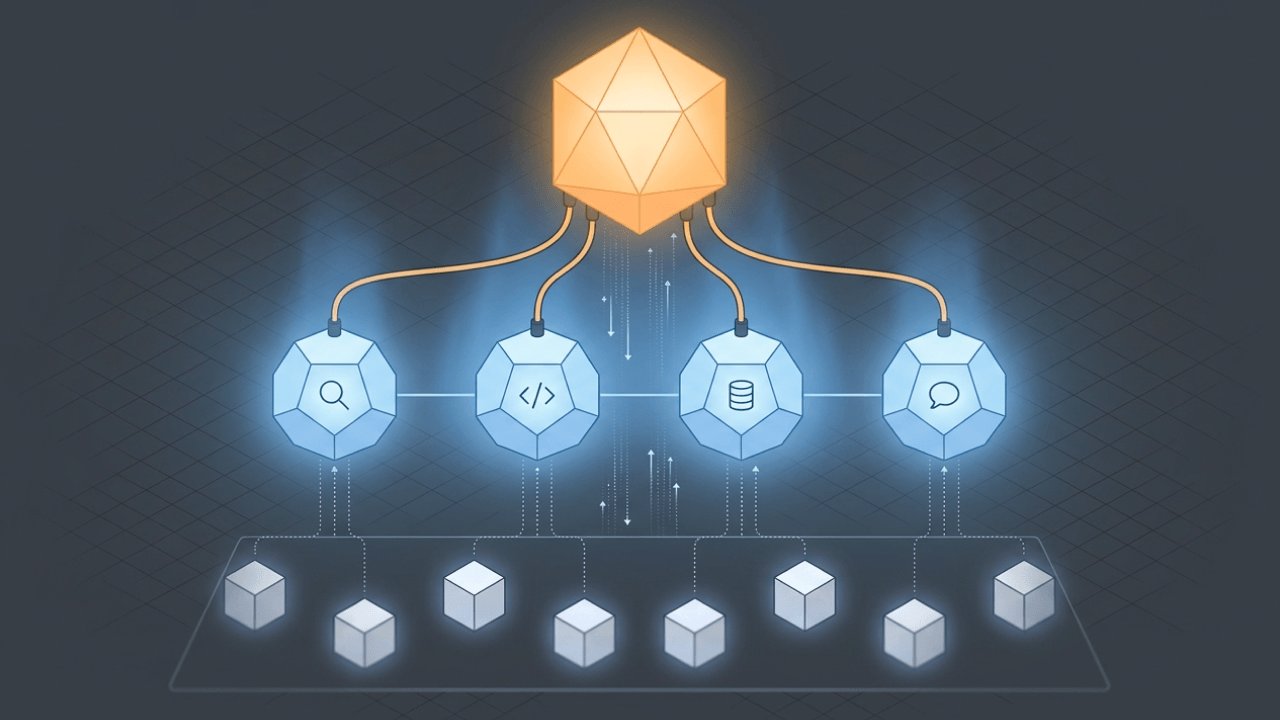

Agentic architecture gives AI systems the ability to pursue complex goals through continuous reasoning, tool execution, and self-correction, all while operating within enterprise governance controls. This guide covers the core components, design patterns, and practical considerations for teams building production-grade agentic systems.
Here are the main points to keep in mind:
Agentic architecture is a system design framework that structures how an AI agent perceives inputs, reasons about goals, takes actions through external tools, and learns from outcomes. All of this happens within a continuous execution loop that can run with minimal human intervention, while still honoring human-defined intent and oversight.
So what makes these systems different from a chatbot? Simple. They decide what to do next. They execute. They evaluate. They adjust. A chatbot answers your question and waits. An agentic system breaks your request into steps, figures out which tools to use, runs them, checks if the results make sense, and tries again if they don't.
The "agentic" qualifier means the system exhibits autonomy in the sense that it can pursue a goal without you hand-holding every step. In enterprise settings, you usually pair that autonomy with controls: policy gates, human-in-the-loop review, and audit logs. McKinsey's State of AI research finds that AI high performers are far more likely to engage in human-in-the-loop validation (65 percent vs 23 percent among peers). That gap matters. It shows mature organizations treat oversight as a feature of agentic architecture, not a constraint on it.
Teams sometimes try to build agentic behavior using chatbot architecture. They write massive prompts hoping the model will figure out a multi-step process in a single pass. This approach fails in production because it lacks the control loop required to observe intermediate results, apply policy, and correct course.
A complete agentic AI architecture diagram shows a continuous execution loop rather than a simple linear flow. When mapping out your agentic AI platform architecture, you need to visualize how data moves between the reasoning engine and external systems (and where you enforce governance).
Seven components work together in a standard reference diagram:
Data flows in a circle. The perception layer feeds the reasoning engine, which consults memory and sends a plan to the tool router. The action layer attempts the task and sends the observation back to the reasoning engine. If the task fails, the reasoning engine adjusts the plan and tries again until it hits a termination path.
If you're designing for enterprise scale, add two mental "overlays" to the diagram:
A production-grade system requires more than connecting a large language model (LLM) to an application programming interface (API). The components of agentic AI must be operationalized with strict inputs, outputs, and interface expectations.
Perception means more than reading text from a chat box. In production, agents consume multiple signal types simultaneously to understand their environment.
The perception layer normalizes these varied inputs into a consistent format the reasoning engine can process.
Teams handling high event volumes need filtering rules at this layer. Otherwise, agents become overwhelmed with irrelevant signals. Teams handling many sources also need to watch for integration drag: if every new signal requires a custom pipeline, agent deployments slow down fast and tool sprawl creeps in. And here's what most architecture guides gloss over: treating all signals as equally important wastes cycles on low-value inputs while missing critical events. Priority weighting isn't optional.
Where does the agent actually think? The reasoning engine. This is where goals get decomposed into executable steps. But you need to define exactly how the agent represents a plan and when it stops.
The execution loop follows this sequence:
Termination criteria get overlooked during initial development. Without explicit stop conditions, agents loop indefinitely and burn through API costs. Step limits. Cost caps. Escalation rules. You need all three before deploying to production.
Human-in-the-loop fits naturally here. If a step crosses a risk line (sending an external email, changing a forecast, approving a refund), the plan should pause for manual review or require an automated score threshold before it proceeds.
Memory in agentic systems serves two purposes: maintaining context within a single session and retaining knowledge across multiple sessions. The decision isn't whether to add memory. It's what to store, when to retrieve it, and how to govern access.
Retrieval triggers matter as much as storage. Define when the agent should pull from memory: at goal intake, before tool selection, or during re-planning.
Teams handling regulated data need to apply the same governance policies to agent memory that they apply to their data warehouse. If the agent is grounded with retrieval-augmented generation (RAG), treat the retrieval index, embeddings, and document access rules as part of your governed data surface. Not a side project. One pitfall teams encounter: assuming RAG automatically inherits your existing access controls. It doesn't. You have to explicitly configure document-level permissions in the retrieval layer.
The action layer is where agents interact with external systems by querying databases, calling APIs, or updating records. This is also where most production failures occur. And honestly? That's the part most guides skip over.
Every tool the agent can invoke needs a clear contract:
Create an allow list of approved tools rather than letting agents discover arbitrary endpoints. Sandbox all write operations in non-production environments first. Require human approval for high-impact actions like financial transactions or external communications.
If your agent can query customer data, it inherits your data access policies. If it can send emails, it needs the same approval workflows as your marketing team.
Tool management becomes its own problem at scale. Every team adding their own "quick integration" leads to duplicated tools, inconsistent permissions, and a security review backlog that never shrinks.
Knowing the available patterns? Easy. Choosing the right one for your specific constraints? That's where teams get stuck. The automated design of agentic systems relies on matching your task requirements to the appropriate architecture pattern.
A single-agent architecture handles the full execution loop within one agent instance. The agent runs its own plan, act, observe, and evaluate cycle. It checks its own work through self-reflection prompts or evaluation criteria you define.
This pattern works best when the task scope is narrow and well-defined, you have fewer than five distinct tools, and you need fast responses. No coordination overhead between multiple agents. Quick.
If you find yourself writing increasingly complex prompts to cover both financial analysis and legal review in one agent, you've outgrown this pattern.
When tasks exceed what a single agent can handle, you distribute the work across multiple specialized agents. AI agent orchestration determines how these agents communicate and coordinate.
Many teams implement a hybrid agentic architecture based on their specific task structure. A common production pattern uses a router to dispatch work to specialist agents, and each specialist runs a sequential pipeline internally.
You know you need multi-agent architecture when single-agent prompts exceed context window limits or response quality degrades as you add more tools.
Trying to sanity-check your architecture choice? Anchor it to the people who will actually live with the system day to day:
The gap between a successful demo and a production deployment is governance, meaning clear control points, measurable value, and consistent oversight. According to Gartner, "more than 40 percent of agentic AI projects will be canceled by the end of 2027" due to escalating costs, unclear value, or inadequate risk controls. That projection should give any team pause. Nearly half of current agentic initiatives won't survive contact with production realities. An agent that works in a notebook fails in production when it can't access the data it needs or triggers security alerts. The agentic layer requires strict control points, metrics, and observability.
Data access governance requires enforcement at three stages:
Every agent execution should produce traceable logs covering the input received, the plan generated, tools invoked with parameters, responses received, evaluation outcomes, and final output or escalation path.
Agent permissions should adapt to the context of the task and the person who initiated the request. If a marketing manager asks the agent a question, the agent should only access data that marketing manager is allowed to see.
This is where "governance built in, not bolted on" stops being a slogan and becomes a design requirement. Deloitte found "only 21 percent of companies report having a mature governance model for AI agents." That means nearly 80 percent of organizations are running agentic systems without the oversight infrastructure to catch problems before they escalate. If governance only lives in after-the-fact reviews or scattered point solutions, you get blind spots, inconsistent oversight, and more security risk as agents scale across teams.
Domo provides platform capabilities that support agentic architecture implementations, especially when you're trying to scale without creating AI sprawl.
The platform's 1,000+ pre-built connectors can help feed signals from cloud apps, databases, and on-premises systems into your governed environment, which reduces custom integration work when you're wiring agents into existing tools.
For memory and context, the data catalog and lineage tracking provide the semantic layer agents need to understand what data exists and how it relates to business concepts. This also helps people trust the output, because you can see where the data came from.
Agent Catalyst centralizes the lifecycle of agentic architecture work in one place: creation, testing, deployment, and monitoring. That centralization matters when you're trying to avoid tool sprawl and keep oversight consistent across teams.
On the data engineering side, Agent Catalyst can link agents directly to governed Domo datasets, FileSets, and unstructured documents using RAG. A big deal if your team is tired of building fragile, one-off pipelines just to ground an agent.
On the AI/ML engineering side, Agent Catalyst supports flexible LLM options, including DomoGPT, third-party models, and bring your own model (BYOM) via Hugging Face. The AI service layer abstraction helps decouple model choice from downstream applications, so swapping models doesn't turn into a re-engineering project.
For action and oversight, the app framework and workflow automation enable agents to trigger actions within governed boundaries: updating dashboards, sending alerts, and initiating processes. Human-in-the-loop controls are built in, so you can add manual review gates or automated agent scoring for compliance-sensitive steps.
Role-based access controls, audit trails, and certification workflows ensure agents operate within the same policy framework as human teams. Agents can also be packaged as Domo Apps and distributed across the organization with enterprise-grade security, which helps teams scale use cases without custom infrastructure.
If you're a line-of-business leader thinking "Cool, but where do I start?", Domo also offers pre-built expert agent templates, AgentGuide recommendations tailored to your priorities, and Executive Transformation Workshops that help you turn AI ambitions into measurable results and a concrete rollout plan.
Agentic architecture represents a meaningful shift in how AI systems operate. We are moving from responding to queries toward pursuing complex goals through continuous reasoning and action.
The core components provide structure. Design patterns determine how you scale complexity.
The real work lies in governance and rollout discipline. You must ensure your agents operate within policy, produce auditable results, and fail gracefully when they encounter boundaries. Start with narrow, well-defined use cases where you can validate behavior before expanding the scope of what the agent is allowed to do. And when you're ready to turn these patterns into something your teams can actually run (with guardrails, monitoring, and governed data baked in), you can watch a demo.