Partecipa all'AI + Data Tour per una formazione pratica, storie di clienti reali e incontri con gli esperti di prodotto Domo vicino a te.
Registrati ora
People are still the costliest asset most companies under-measure. Companies lose 18 percent of employees on average year over year, according to Brendan Carr, solutions engineer at Domo who joined a Domo livestream.
Replacing them often costs 1.5 to 2x that role's annual salary, and backfilling can take months. Also, their institutional knowledge walks out with them, an incalculable loss.
So, attrition is costly, and, unfortunately, many managers only realize it's happening when they get a resignation letter. What they don't need to solve this issue is another static HR report. They actually need something that runs in real time, tracks attrition signals, and calculates flight risk, so that they can intervene before losing their best talent.
In the livestream, Brenda walked through a Talent Retention Engine built on Domo. It achieves all these things, handing managers editable retention plans while keeping private employee information (like pay and promotion details) private. In this recap, we'll walk you through how it works.
A lone “flight risk” flag rarely tells a manager what to say in a one-on-one. Compensation lag, stalled promotions, manager churn, quiet meeting engagement, and thin PTO patterns each tell a different story, and they all need to be combined to properly inform the manager and the HR team.
But when those signals live in separate systems, HR hears secondhand summaries and managers guess. That's why a multi-signal score helps, especially one that shows up where managers already work and runs fast enough that it can help a manager take same-day action.
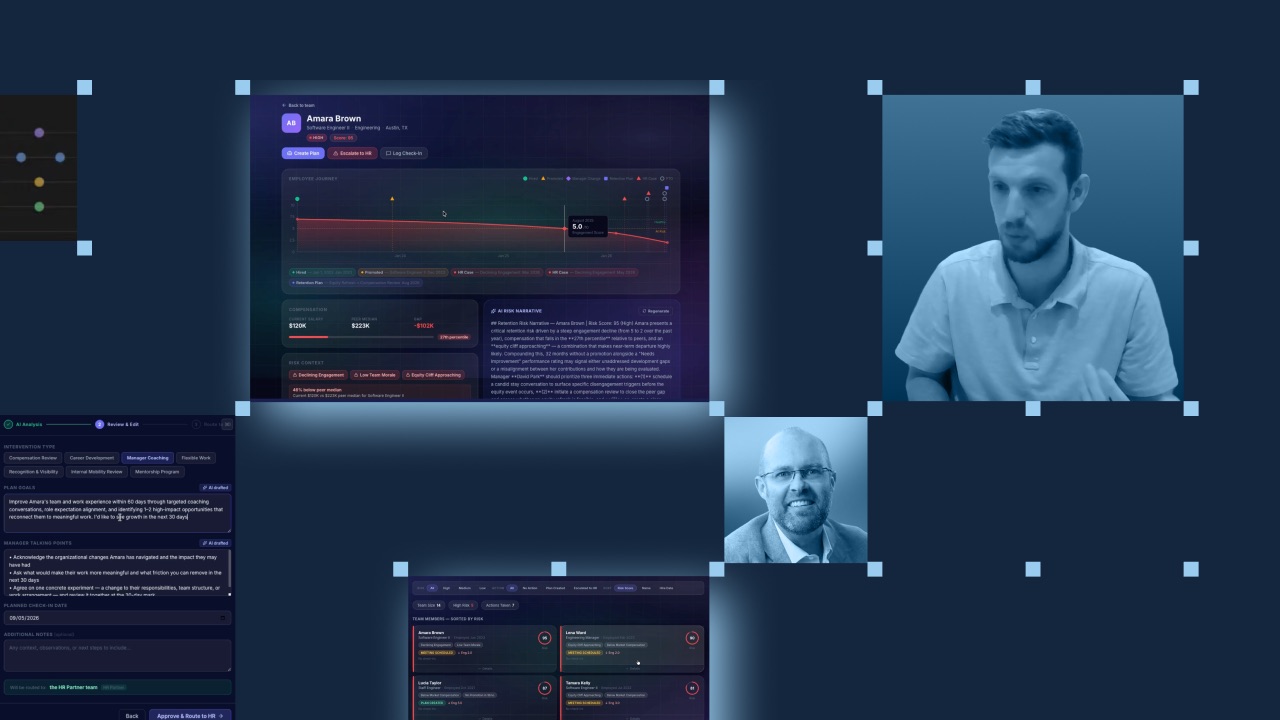
So, in Brendan’s Talent Retention Engine. frontline managers can open one app, see direct reports ranked by likelihood of leaving, and drill into explainable risk factors instead of a naked score.
In the demo, the imaginary engineer Amara Brown sat at an attrition score of 95. The model surfaced the drivers in plain language:
Replacing a software engineer at that level would be expensive, and this score made the cost of waiting hard to ignore.
Brendan called out a mix of systems and signals that keeps the model honest without a brand-new capture program for every factor. Here are the signal groups he tied to the daily attrition score:
The power is in blending these signals. One weak signal is noise, but several moving together become a conversation worth having before a recruiter from another company calls.
Managers won't trust a black-box 95. So, in this app's employee deep view, the app used a chosen inference model to narrate risk in clear language. Claude powered the demo path.
The write-up called out the pay gap, the engagement decline, and prior escalations. Hire date, promotion cadence, and case history sit at the top so context is visible before anyone drafts a plan.
And, the cases surfaced aren't just warnings. Brendan noted that escalations can also flag strong performance that deserves a raise or recognition. As always, Domo operates agents with a humans in the loop. In this case, AI drafts a narrative, but the manager still owns the judgment.
In the same employee view of the app, a manager can log engagement notes after a hallway chat or a virtual check-in. AI then takes all this information and drafts an editable retention path, one that can covers compensation, career development, or performance focus.
Brendan showed adding a 30-day growth expectation before routing the plan to HR. The agent ranks, explains, and recommends. People approve what happens next, with no autonomous employment decisions.
Domo’s governance layer limits managers to their direct reports. HR sees plans in review, pending manager approval, and resolved cases.
In Brendan's demo, for example, eight plans sat in review, seven awaited manager approval, and seven already showed as resolved. HR can open a case, read an AI summary for speed, then jump into the same deep employee view managers use.
One cohesive app beats six manager dashboards plus a seventh for HR. Sensitive salary and promotion fields stay inside role-based permissions.
The pattern maps cleanly to Domo as an agentic platform for the intelligent enterprise. Foundation, activation, and distribution each have a job, and governance runs through all three.
Foundation comes first. Connectors and transformation pull HRIS, survey, payroll, and related feeds into governed, AI-ready data, including data that already lives in Snowflake, Databricks, or Google Cloud.
Activation is the agent and app layer on that governed context: scoring, natural-language explanation, plan drafting, and workflow routing. Model choice stays open through Domo’s AI services. Domo orchestrates rather than acting as the model provider.
Distribution is the manager and HR experience in one App Studio front end, with Workflows, Magic ETL, and Code Engine underneath. Personalized data permissions, HR review on escalations, and a full intervention log keep bounded autonomy honest.
Brendan’s reason for building in Domo was blunt: one cohesive app, many sources, and no duplicated secured views for every audience.
Attrition will keep costing 1.5 to 2x salary when teams only react to resignations. A multi-signal attrition score changes the timing. But explainable plans and governed routing give managers a chance to act while there is still a relationship to save. HR keeps oversight, while IT keeps control of sensitive workforce data.
People stay in charge of employment decisions while the agent handles ranking, narrative, and handoff. That is how flight-risk data becomes retention work instead of another ignored report.