Join the AI + Data Tour for hands-on training, real customer stories, and time with Domo product experts near you.
Register now

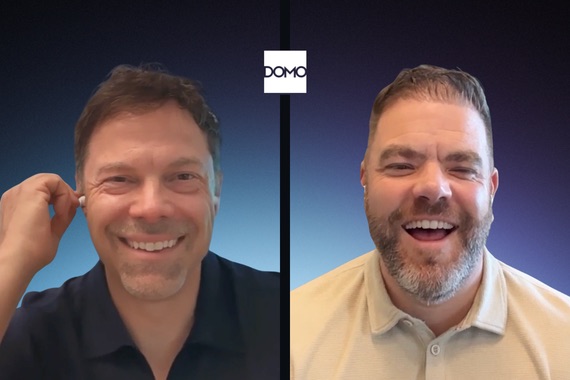
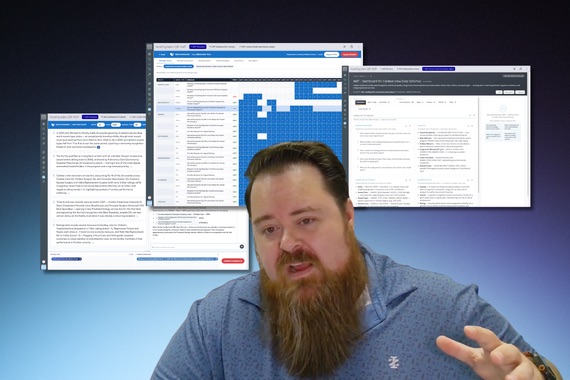
Mark: What's up, everybody? We are live here with my good friend Mr. Mike Christensen. He's the head of rev ops and analytics over at Domo. One of my favorite people and one of the smartest people that we have at Domo. Yeah, I said it. Go ahead. Come at me, people. That's just fine. Mike, how you doing, my friend?
Mike: Doing good. How are you, Boothe?
Mark: Good. So, anyone who is in the go-to-market area arena, one of the things you regularly deal with is, "is my pipeline clean?" If we are forecasting that we got to close a hundred million dollars this quarter, how do I know I'm gonna actually get to that hundred million? You know, Mike, how many times... I want to hear your thoughts. Every company you've ever worked with, is what they have in Salesforce 100% clean?
Mike: No. No, CRMs are never clean.
Mark: Okay.
Mike: That's part of the fun.
Mark: Yeah. I mean, you hear any rep or any marketing person go to any company and they're like, "Yeah, well, because our Salesforce is such a mess." And you're like, "Well, FYI, I've never seen a company whose CRM is really squeaky clean. Have you?"
Mike: No, they're all... No, no. If someone tells you their CRM is clean, that's one of those "run the other way" because they're lying.
Mark: Amen. Amen to that. So Mike, tell me a little bit about the challenges that maybe we face at Domo, and that every go-to-market person actually faces related to how we forecast and prepare for what we got to close in a quarter.
Mike: Yeah, so there's a few things. One is the data quality: How do we make sure we're getting the right data into the rep's hands at the right time? They're doing the right accounts, right contacts, right leads.
The bigger one is then: How do we centralize everything that a rep should be looking at so they don't have to play data archaeologists? It takes a lot of time to go manually dig through your CRM, figure out what opportunities you have open, and what next steps you need to take. Even if you have a visual or business intelligence layer on top of it, a lot of times those aren't prescriptive; they're just telling you what's actually happening. You can still go observe, but you still need to go dig through it and figure out what's going on. It just takes so much time from a rep every single week.
We've gone through and tried to quantify it, and for the average deal every week, a rep is probably spending about half an hour doing some sort of data archaeology work—trying to go through the CRM, go through your call recorder, look at old emails, and try to piece that together. When the average rep has maybe 40 deals that are working in pipeline at any given time, that's 20 hours a week that we're wasting a rep's time on just going towards this data archaeology work trying to piece the deal together. So, if we're only getting 40 hours out of a rep every week, half their time is being spent on this data prep and data discovery.
Mark: And Mike, is it fair to say that not all reps have the vigilance that they need in putting stuff into Salesforce or HubSpot or whatever CRM you're using?
Mike: No, every rep puts everything into the CRM perfect every time. [laughter]
Mark: You're such a liar. Such a liar. So Mike, walk us through... Your team was tasked with building this tool, which is really—we'll talk about more of these in the future—but it's a suite of tools for the revenue organization, right?
Mike: Yeah, so we partnered with our CRO to be able to try to get more intelligent about how we're running the entire revenue engine in this new world of AI native. And so we've built out an entire what we call our revenue suite of apps. The one that we're going to show you today is our sales ops agent. Internally, we call it RevAr. If you see any branding, we tried to go and scrub it to "sales ops agent."
We have a ton of these apps where we have call recorders, we have automatic call scorers, we have the sales ops agent you're going to look at today, we have forecasting tools, we have geo tools, and we're just trying to enable the rep and our sales team to be able to go and act efficiently—to use AI to make that all native and reduce that time they need to be spending looking through the data so they can focus their time on high-value activities.
Mark: Gavin Fraser is one of the goats of Domo, if you're wondering. I agree. This is awesome, Gavin. This is awesome, I couldn't agree more. So, Mike, walk me through: What is it you built? I don't know if you want to pull up the screen right now and start walking through some of what you built and why you built it.
Mike: Yeah, let's do it. We have kind of a one-page landing page here that we put together. It'll walk through what it is, and then I want to get into architecture a little bit because it's not just the solution itself that is really cool. There's also some really cool things that we're doing on the back end from an AI architecture perspective that are relevant to any AI agent you're going to be building within Domo, and so I want to get into those as well.
The overall goal here that we're trying to accomplish is to make every rep 10 times more productive. Again, when we go through and we look at it, if we do 30 minutes per deal, and we have 40 deals that a rep is doing, that's about 20 hours a week that they're spending doing this data archaeology work. Within the sales ops agent, we have six primary actions that have been automated: You can draft emails, you can prep for a call, and you can get coaching on the deal. It'll also build your entire pricing proposal. If you know Domo's pricing structure, we're on consumption, and the fact that we can have an automated pricing proposal in a consumption selling model is really pretty incredible.
It will also build a fully functional demo app. You put in a prompt, and it builds out an entire application for you to then be able to go and show to the prospect. You don't need to write a lick of code. So, we have our reps building live apps on the phone with prospects, which is super cool. Then we also have the ability to go and search everything that you've ever done on the account. We're pulling through four primary sources: our CRM data, our call recorder data, our email data, and then we're doing some general web scraping to get some broad third-party data.
The two primary things that we're seeing come out of this internally so far are that our time to first action and time to action across everything are being reduced, and our pipeline conversion rates are starting to increase for those that are really leaning into this.
Coming down here, there are really four main things that it's going to help us do better. One of these we already hit on in the time to next action reduced, increasing the velocity. Another one is we're increasing the volume. The old ceiling forever has been that maybe there's a 40 to 50 deal ceiling that a rep can have within a selling motion. We're starting to push the limits on that. How many deals can we actually get in a rep's hands and have them still work intelligently?
Accuracy is also going to go way up. This is what we were talking about just a minute ago, Booth. If we can forecast on evidence and not vibes—which frequently we're forecasting on vibes—it improves our overall forecast accuracy, and we're starting to see that materialize.
Mark: Mike, talk me through that a little bit more. So, you're telling me that somebody put something in stage two or stage three or stage one, depending on what your stages are, and it's not always created equal?
Mike: Not always equal. One of the things you're seeing here is that we're moving towards milestone-based selling away from stage-based selling. The evolution of the selling motion for us, and I think more broadly in the revenue organizations that I've talked to, is that we're not going to allow reps to actually enter a stage in Salesforce anymore. We're going to determine: Have you done this set of activities across this account? And then within the CRM, we'll set up rule sets to say, "Hey, if you've accomplished these five activities, that automatically qualifies it as a stage three." So that Mark Booth's stage three is the same as Gavin Fraser's stage three, which is the same as rep C's stage three. We don't get this situation where this rep converts from stage three to four at a really high rate, but we know it's because they don't actually put their deal in until it's actually a stage four. Maybe they're sandbagging. And so this helps prevent some of that as well.
Mark: Any go-to-market leader who is listening right now is thinking to themselves, "You mean people can't just hide things in stage two anymore?" Too often reps will say, "Well, as long as I keep it out of pipeline, I don't have to get grilled on it every single week." But if there are things in stage two that should be in stage three or even stage four, but you don't want to get grilled on it, we're going to make the pipeline cleaner and better so that we can close more deals at the end of the quarter.
Mike: Yeah, and we've gone back and forth on this. The first train of thought was maybe we just introduce more stages to get more granular between the different activities, but reps are always going to find a way to put a deal in a certain stage that isn't getting forecasted right. So this helps eliminate a lot of that, and then it also helps because as a manager is trying to forecast their entire rep's book up to the CRO or to their AVP, a lot of times they're relying on what the rep is saying. They're like, "Hey, maybe I had a really good call with someone, so I'm gonna go forecast this deal pretty confidently. I'm going to put it into a commit stage." But they might be missing an email or a signal that came through, and so the manager might need to actually haircut that deal a little bit, saying, "Hey, rep, I know this last call was good, but these last three calls were not quite as good. You didn't tell me that part, right?"
So, it's a way for managers, AVPs, and RVPs to get a little bit better about managing their rep's books of business as well, and they don't just have to take their rep's word for it. Again, reps, I think, are always trying to accurately forecast, but it's just hard when you have 40 deals to keep context across months and months. 40 deals is not something that most humans can do just in their head.
Mark: I love that. Okay, keep going, Mike.
Mike: Yeah, and then the fourth one here is just the leverage that we can get across the team—raising the floor across the entire sales team. Top reps at any organization are already doing this. They have their own systems set up, and they have their own ways of doing it. It's how they're successful; it's how they're signing millions of dollars of deals every year. But not every rep is able to do that. And so part of this for us is learning from what our best reps are doing and then figuring out: How do we operationalize that? How do we teach that context to an agent so that we can raise the floor across the entire sales organization? It increases our leverage everywhere.
The big shift that we're seeing happen internally is that before, a rep would comb the CRM for context they had a couple of weeks ago but didn't quite remember, then they would need to scrub a 45-minute call for that one quote so they could bring it back—"Oh, I know we talked about this, I need to go find it"—then they would need to draft up a follow-up email, doing that all themselves, and then figure out what deal to go to next based on close dates and their gut ACV in pipe. There was no clear mile marker there.
Now, what they're doing with the sales ops agent is they land, the top action is named, they click into it, and the drafted email or call agenda is already there for them. The quote they need is just right there. They can just send it, mark as done, and move on to the next one. It's the difference of a 5-minute interaction versus a 30 to 35-minute interaction. So, we're saving on average about 30 minutes per deal when the rep is going through and doing all this follow-up.
This is just reiterating the six main things that we're doing within the sales ops agent: We're going to draft the email, we're going to help you prep for the call, and we're going to coach you on the deal. And the coaching here, just so as we get into it, you'll see we have the posture of "you can't be mad at a computer," right? Our sales ops agent is rather direct in the feedback that it gives, but it's great because what are you going to yell at a computer? No, it's going to tell you exactly what you're doing well and exactly what you're doing wrong. It's able to give really candid feedback in a way that managers sometimes aren't able to or shy away from doing, and it's been a huge boon for our managers there.
Mark: So, Mike, in other words, you're saying if a deal is really fluff and they're not going to get it through, the computer just tells them, "Hey, this is garbage." Is that accurate?
Mike: Yeah, and it's maybe a little bit more harsh than that sometimes. Part of the prompt that we put through on the back end on that coaching is, "I don't need a cheerleader, I need a coach." And so it takes that to heart. It does not cheerlead you at all. We talked with our CRO about that piece, and we all came to the conclusion that you need to hear the truth from somewhere, and hearing it from a computer that you shouldn't have emotional feelings towards is the best way to do it.
Down here, I want to get into architecture just a little bit before we get into the app. For everything that we do across all the apps that my team is building here at Domo, we use a layered pipeline approach. We call this our L0 to L4. There are six different discrete pipeline layers, but the main thing that's happening here is two things: what type of data we are processing in each chunk, and then how often we are processing that chunk.
If we walk through these just at a high level: Our L0 is our enrichment. This is all of our CRM fields and our web scraping. This is going to be on-demand. This is stuff that isn't changing often, and it's stuff that isn't high-cost to go query or cache that you can then just pull back through. As things change, it pulls right into the app.
Then the signal extraction that we're doing, we have stuff coming from the call recorder and from emails. This is a daily chunk for us. So we're going to go through every single day in the morning, pull through all the signals from the previous day, and start to load those into the app. If you get into intraday runs on this, you certainly can, but you're going to start running up your token cost and your consumption cost. For us, a daily morning run gets us as much signal as we need.
Then here on L1.5, we're going to rebuild the timeline. As we jump into the app, you're going to see there's a timeline. We take all the signal, and then right after we do that, we rebuild the timeline with any new activities that have come through.
Then every week, this is the big chunk that's happening: What's the overall executive summary? Have any new milestones been reached? Should we surface any new risks or actions across the deal? This takes the longest, and it's the biggest token usage in terms of AI use, so we only run this once a week right now, which has been a pretty good balance for us.
Then we get into the priority scoring and the vector index. These run hourly or on-demand, which is more just for us on the actual scoring, the algorithms behind the model, keeping those up to date, and keeping those running.
The key takeaway here is that you should be chunking each of the different processing steps in any app that you're building and thinking about them discreetly because you don't need to run your enrichment data at the same cadence that you're running your timeline data or your deal intelligence. This isn't specific just to the sales ops agent, but for any AI build that you're creating, you need to be chunking through your processing steps and being very discrete and intentional about how and where you're running those. Otherwise, your token costs are going to be through the roof. For us, our AI costs and our token costs on this are surprisingly cheap because of all the optimizations that we've done on the back end. A solution like this doesn't need to be super expensive in terms of tokens if you're doing it the right way.
Mark: Love it, Mike. I'm ready. I want to see this thing in action.
Mike: Let's jump into it. When you land here, we're going to be Sarah Mitchell for today. When Sarah lands, she has eight deals right now that need attention. If we come over here, this is all the deals that she has across all of her stages. If she wants to take a stage-based view and jump in, she can see high-level, one card per deal, what's actually happening. But this is where most reps land and where they go. We're going to go here to Meridian Health. I'm going to jump over to these other tabs because I have a few of these already wired up and run just for timeliness.
As we land in here, we have all of our CRM information here at the top, and then here's that executive deal summary: what's everything that's happened? If you're either taking over this opportunity from someone else's account, or you're a manager jumping in trying to figure out what's the total story, this is kind of table stakes in the AI world now—just AI summarization of all the data that we've seen, letting you understand what's happened across the deal.
Then we get into these milestones. For us, we care about six main things happening throughout the deal. To what we talked about earlier, we don't necessarily care about the stages that they're in, but we care about the activities they're taking. And so, we have an AI agent that's going through and listening to every call, reading every email, looking at all the notes within Salesforce, and trying to determine if this milestone has been done. In this case, for pricing, it's saying pricing was discussed in a call on January 22nd. James acknowledged the value but flagged CFO approval, noting that anything north of 150 needs Lisa's signature. You're going to see that come back up. AI grabbed it, recognized we need this person for signature, and logged that it happened.
We also allow the ability for a rep to come in here and modify if the AI got it wrong. Spoiler alert: Reps aren't modifying stuff that comes through. It turns out AI is really pretty freaking good when you put the right bounds and context around it.
Then we're going to get the risks that we have: CFO approval is blocking our verbal on this deal, and the rep hasn't reached out to them in 12 days. I don't know what's going on there, but a 12-day communication gap doesn't feel great when you're trying to get a deal signed. Next things that we need to do: We need to get an executive briefing with the CFO, and we need to finish the ROI analysis that James reached out to us for.
Mark: Mike.
Mike: Yeah, go ahead.
Mark: So if this is Sarah's dashboard, what would happen with Sarah's manager? What does that manager see if she hasn't reached out for 12 days? What's happening there?
Mike: Yeah, so the manager view—and it's not loaded into this demo context—but the manager view is that they're going to see all of the risks and activities across their entire book by rep. Think of it kind of like this, where we have each rep and then we have all of their different deals, risks, and actions, and then it's sorted by priority. We have an AI agent that's going through and saying, "This is the most important thing you need to do today." Sarah's manager would jump in and be like, "Hey, I'm seeing for this deal, it's really these two things and then these two action items. I'm seeing that you haven't reached out to the CFO and you haven't talked to this account in 12 days. You got to go immediately talk to them, right?" And that's the idea of the sales ops agent: This is stuff that managers or reps would be doing, but it just takes so much time to get through and do. Can we offload that to an agent?
Mark: What are you hearing, Mike, from sales leaders? Because when I think of sales leaders, let's say you have Sarah who is carrying a book of 40 potential deals, and they've got seven to 10 reps that they're managing. There is no way that they know the ins and outs of what's happening in every one of those 500 or so deals. So, what are you hearing from sales managers specifically?
Mike: Yeah, when we first rolled this out, we didn't have the manager view; we just had the rep view. Within days, we had managers begging for a manager view to help them manage across their entire rep's book. It's been extremely helpful for them that we also have a manager deal assistant. Specific to that manager, they can then go ask questions across their entire rep base. One of our best corporate RVPs who is running a whole section of our corporate business is in here almost every day using this, pushing for new functionality. He loves that the computer yells at him; it helps him get better and understand where in his book he might be a little light or have some risk.
Mark: Valerie just called out, Mike, that's a very simple and self-explanatory visual. The key here is a rep or a leader knows instantly, "This is what I have to do, why I have to do it, and why it's the most important thing for me to do." And in rank order, "Here's the next best thing for me to do," right?
Mike: Exactly. On the visual side, in this new world of AI, the way that we think about any problem is that a visual layer may be part of the solution, but it's not always the solution. You need to first identify the problem, then decompose it and figure out exactly what's happening. Then you can start to architect the solution and actually go and build it. That solution build may include the visual front end like you're seeing here. It may also include some workflows running in the back end. We also have some Jupyter notebooks running some logic, and that's where a lot of the processing for our LLMs is coming from—through eight different Jupyter notebooks that we have running coming into here. For these AI solutions, they're truly solutions, and if you're just thinking about how to go build an app for this, you're missing the point. It's: How do I go build a solution for this? Sometimes the solution is a front-end interface, sometimes it's not. In this case, it's a combination of the two.
Mark: Love it. Okay, keep going, Mike.
Mike: This timeline view then just pulls through all the different data sources so you can get a feel for what's going on. We have a couple of different AI fields across milestones, risks, momentum, and use cases that we call out as well. And then this bottom section writes back to Salesforce, or to whatever CRM you have. The goal for us is to keep our reps from needing to even log into the CRM. Our CRM is just becoming a database, and all the action and activity is happening here within the sales ops agent. I can update my stage, I can update my forecast category, and I can add forecast comments. As soon as I do any of this, I'm just going to say, "talk to the CFO, deal is closing." I can hit save, and that's going to successfully write back to Salesforce. Now it's updated in Salesforce, and I don't ever even need to log in, right?
One last thing that I want to show from a functionality perspective: You've seen over here on this right panel the deal assistant. This is my favorite part of the sales ops agent. It's a contextual agent that lives in this opportunity, whatever context window you're in. Right now, it's living in this opportunity. If you're a manager, it lives across all the opportunities or reps that you're viewing. There are a few of these pre-canned prompts that we have—like building their pricing or writing the next email, those actions that we talked about a little bit ago. I want to show off two of them. The first one I want to show off is: "help me prep for my next call."
Mark: Mike, will you zoom in a little bit just on that area?
Mike: Sure can. It's going to help me. If I was landing in here as a rep, I'm like, "Hey, I need to have a call. Help me prep." It's like, "Okay, you're 26 days from close. You got to get the CFO involved." You already have strong champions across your VP of ops and across your director of analytics. You ran a successful POC that showed a 22% cost reduction. You need to get the CFO involved, and here's how we're going to do that: First, you're going to go deliver the ROI model that they requested—you haven't done that yet, you just got to go do that. Second, you're going to secure a CFO briefing—you got to talk through it with them and get the CFO on the phone. Then, you need to confirm your mutual close plan. You've already asked for the sale, but this rep, after they asked for the sale, never went through and actually created the close plan. Like, "Hey, will you buy Domo?" and they said, "Yes," and they're like, "Okay, cool." Let's start building the workback plan. What do we actually need to operationally happen there? It's recommending that they go through and address any outstanding questions, recapping with a timeline.
Then, this is my favorite: "Here's likely objections you're going to get." Like, "Hey, Lisa's swamped." Cool, what if we did 20 instead of 30? What if we did 15 minutes here? It's helping them roleplay what they might run into as they're going through this call.
This one is my favorite. A lot of reps, especially new reps, when someone asks for a price reduction, they kind of freeze, right? Like, "Uh, they're not seeing value. Do I just try to get a discount through CPQ? What do I do here?" I love the way that our agent handled this one. So the objection being, "Can you come down on price to make this easier?" The recommended response is perfect: "Hey, I want to make sure we're solving for the right thing. If the issue is budget authority, I'm happy to explore a phased rollout. Maybe we start with eight instead of 14; that gets you in at the budget you need, then we can expand." You're not reducing the total scope of what you want to do, but you're changing it to a phased rollout. You can still capture that later as an upsell without kneecapping yourself on the discounts and pricing that you're giving them out of the gate. So, really, really well done here, I think, on the agent side. And then it's like, "Hey, you've been silent. Own it, but don't dwell on it. I want to help you get this closed."
The last one I'll show here is: "coach me on this deal." This is where we get to the agent being rather direct. It's like, "Hey, overall execution grade, you got a C+." I don't know, C's get degrees, I think that's what I've heard, so this is still passing. We want all our reps to be getting an A. So what is the rep not doing here? It's like, "Hey, what you did really well: You ran a really great POC, you showed strong execution, you showed ROI, you did really good multi-threading early on, and you got a few different high-level champions involved. Here's where you're struggling: You haven't engaged the economic buyer, she's now blocking the deal, and you also went silent when the deal needed urgency." It's been 12 days—this demo example is stuck in the beginning of March, so don't try to figure out how it's been 12 days since February 18th—but you went silent when the deal needed you. You're not controlling the close process. Your activity cadence dropped off exactly when it mattered the most.
It'll do a full MEDDPICC audit across everything that they needed to do or should have done, and it's like, "Okay, here's three things that you need to do differently: First, you need to stop selling through intermediaries when you need executive access—go straight to the exec. Second, you need to treat your deliverable requests from champions like they're on fire. I cannot believe that we got an ROI request for this deal and the rep has waited 12 days to give that back. That's mind-boggling. If it wasn't just demo data, I'd be pretty enraged right now. Thankfully, this is all just made-up demo stuff, but if this was an actual rep, the CFO asked for ROI and it has been almost two weeks and we still hadn't given it to him—like, what are we doing? And then the third one here: You need to build a mutual close plan. You asked for the sale and then you stopped. You never actually said, 'Okay, what's our workback here?'" And it's like, "Hey, you did great work, but now you're stuck, and here's why. You need to get to the CFO, you need to deliver the ROI analysis, and you can still salvage the March 28th close date, but if you wait longer, you're going to slip into Q2."
Mark: That's pretty awesome. Pretty awesome. So, Mike, give me one reason why any go-to-market exec wouldn't be losing their mind right now when they're seeing this. Because most companies aren't doing this.
Mike: No, most are not. Even really AI-forward, AI-native companies that I've spoken to are working on getting something like this spun up, thinking about doing something like this, but I haven't seen many with a solution—if anyone—with a solution like this already out in the market. Do you want your reps to be able to do more and do everything they're doing more efficiently? It seems like a no-brainer to me. And if I didn't already have this, I'd be going out right now and either building it or partnering with someone like Domo to get it installed in my account.
Mark: I love it. So, you need more information, everyone? I dropped this in the comments already, but you can go and learn more about this specific solution. I've got a question for you, Michael. Old Michael Farrington, who happens to be a genius in the CRM and Salesforce space, just said, "headless CRM for the win."
Mike: And that's coming from our CRM admin. Michael Farrington on my team runs our entire CRM instance, and even he is not afraid of headless CRM. So if we have our own CRM admin that's advocating for this, we all got to get on board.
Mark: Pretty amazing, huh? Okay, Mike, closing thoughts. Why should every go-to-market person be using this today?
Mike: So you can increase your time to action and increase your conversion rates. It's pretty simple: Do you want to sell more? Do you want to make money? If you want to make money, you should be using a tool like this.
Mark: I love it. Go check out the link, everybody. Mike, thanks for joining us. We'll be back next Tuesday where we're going to showcase another one of these really cool analytic solutions that's going to help you move your business forward. Have a great couple of days, and we'll see you next week.
Mike: Sounds good. Thank you, Boothe.

Mark brings over 15 years of diverse marketing experience and is passionate about driving Domo’s business growth through marketing initiatives. His mission is to empower all Domo customers and prospects with the insights and tools they need to make better business decisions and achieve their goals. In his previous role as VP of Community, Partner, and Field Marketing, Mark and his teams established new and strengthened existing programs to address customer pain points and create a greater sense of community. They also executed campaigns, programs and events that showcased the value of the Domo platform. Before joining Domo, Mark spent more than 10 years working in customer relations and marketing at Adobe, and worked at Instructure as its senior director of customer marketing. He received his MBA from Utah State University and a bachelor’s degree from Brigham Young University. Outside of work, Mark enjoys spending time with his family and traveling.

Mike Christensen is Domo’s Senior Director of Operations and Analytics, where he leads Revenue Operations and Analytics and supports internal AI efforts. With a strong background in GTM analytics + ops, he has developed and implemented critical tools including an internal Customer Health Grade and Revenue Forecasting Models that have improved business performance and supported data-driven decision-making. Outside of his professional focus, he maintains personal interests in sports, music, fitness, and footwear.
Are you ready to turn every rep into your top performer? Welcome to the era of the Intelligent Revenue Engine.
At Domo, we are building agentic solutions that do more than analyze pipeline—they coach reps, surface risk, and act on every deal in real time. The Sales Ops Agent reads where your sales reality actually lives—Salesforce, Gong, SalesLoft, Clari, Slack, HubSpot—and writes back where it matters. Every deal gets scored on risk, momentum, and urgency. Every risk is pulled from real call transcripts, with the buyer's own words attached. Every follow-up email is drafted, every next step recommended, every Salesforce update teed up for one-click approval—with human oversight built in at every critical step. The result? Every rep sells like your top rep, your forecast reflects what buyers are actually saying, and your team spends their day on the deals that matter most.
Featured Session: Inside the Sales Ops Agent
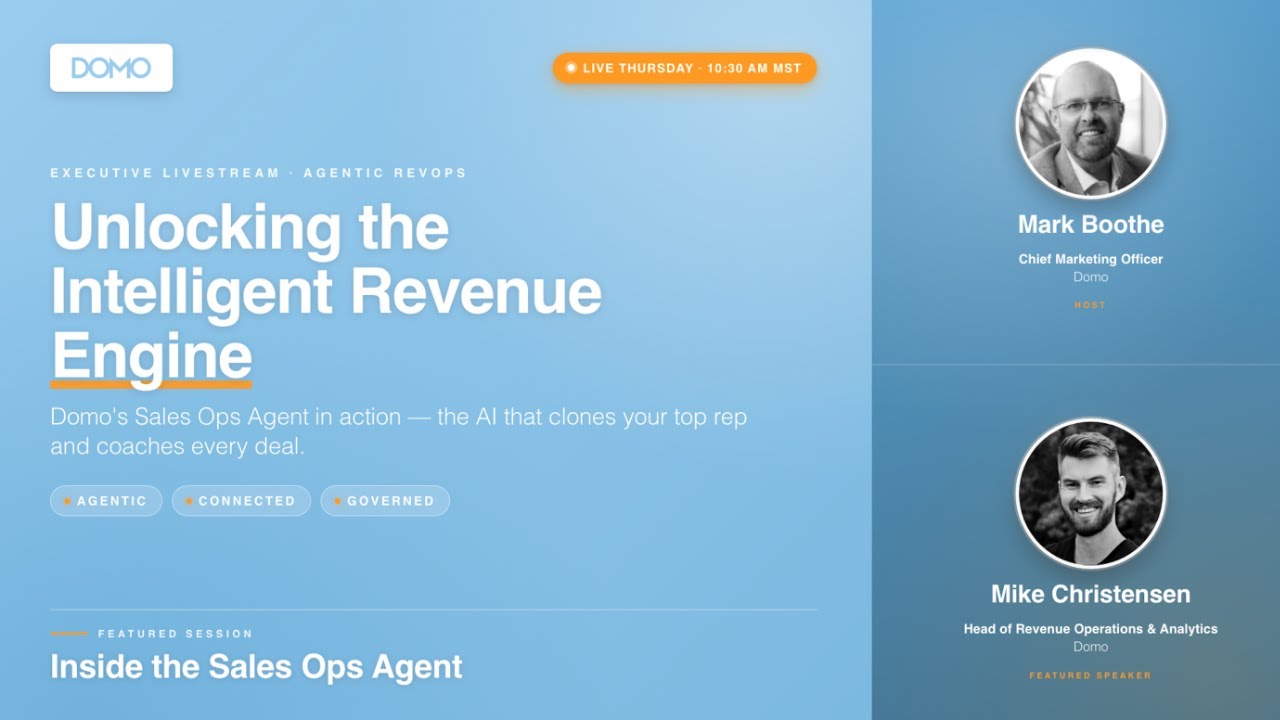
Join Domo CMO Mark Boothe and Mike Christensen, Domo's Head of Revenue Operations & Analytics, as they pull back the curtain on the AI agent his team built—and that Domo's own CRO and sales team run every single day. Mike will walk through how the agent clones your top sellers, severity-ranks the risks hiding in your pipeline, drafts the follow-ups and stakeholder plans your reps would otherwise write by hand, and writes back to Salesforce the moment a rep approves. Live in hours, not quarters. No new warehouse. No new vendor. Zero added license cost for existing Domo customers.
What You Will See:
• It's Agentic: The agent doesn't just report—it reads call transcripts, emails, and CRM activity, then recommends the next move for every deal and every rep.
• It's Connected: One agent, every system. Salesforce, Gong, SalesLoft, Clari, Slack, and HubSpot—natively integrated, reading where it should and writing where it matters.
• It's Governed: Human-in-the-loop on every critical step. No autonomous CRM updates without rep approval. No new vendor, no new warehouse, no surprises.
Mike is going to show you how to build a modern revenue engine. Join us Thursday and see what happens when every rep, every deal, and every forecast runs on agentic AI.
Domo transforms the way these companies manage business.