Partecipa all'AI + Data Tour per una formazione pratica, storie di clienti reali e incontri con gli esperti di prodotto Domo vicino a te.
Registrati ora
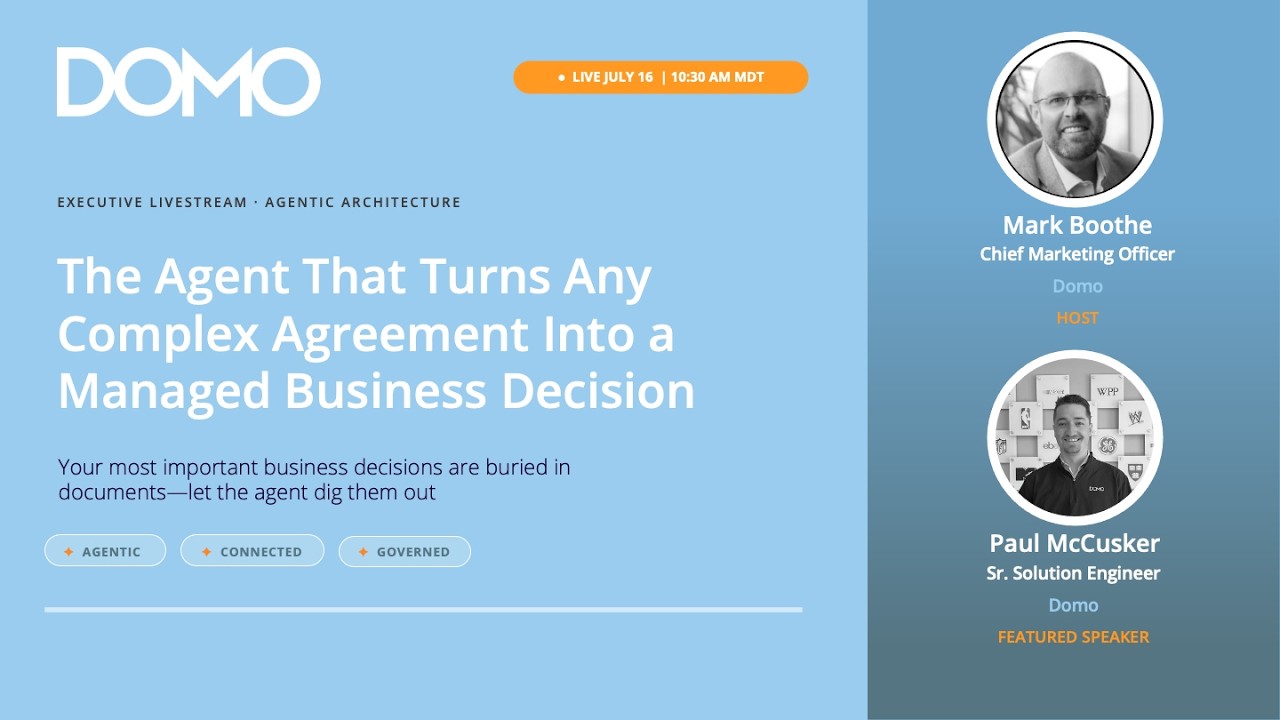

Mark: What is up everybody? We're coming at you live on a Thursday morning. I'm here with my good friend Paul McCusker, who is one of our forward-deployed engineers and is doing amazing things at Domo. Paul, how you doing today?
Paul: I'm doing great, Mark. Thanks for having me.
Mark: Good to hear. Good to hear. So, we're talking about some fun stuff today. Most people in business have some kind of document that they have to deal with. Paper, sign it—what do we do next? You're talking structured and unstructured data. Paul is going to show us some magic today about how he built an agent that solves so many of your problems. Paul, take it away, my friend.
Paul: Awesome. Awesome. Today what we're going to be looking at here is really the whole process. And I like to start with this kind of architecture view. It's my five-layer architecture where we have data in systems—whether that's normalized data or that unstructured PDF and PowerPoint data—and then that has to go through a process to get clean and ready to use for analytics, and then really put agents and the power behind it.
This app and this agent, the Nexus agent, specifically takes, for this example, contracts related to sports jersey sales and contracts with different athletes. The agent takes all the relevant information from those contracts, parses it all out, and then gives you good, clean data to do analytics on while also leveraging all of your other data. You'll see some sales data, marketing analytics, sentiment, social reach, and things like that.
It brings that all together into one view where it can sit and say, "Hey, this is what a well-performing contract looks like. This is what an underperforming one looks like." Or even look at benchmark things like: "This has 90 days before it expires, and it has been doing really, really well. It might be time to re-engage with this client, supplier, or distributor." Whatever kind of relationship you might have, it brings that to the forefront and also leverages a lot of the work that you might have already put in.
This one specifically sits on top of a Cortex agent inside of Snowflake. So all of the different questions—if you're having a live chat with your data or you're asking it to find what contract is doing the best in the last 180 days—that's all going to your Cortex agent sitting on top of those semantic views to build out that kind of knowledge base to answer those questions.
Again, from a high level, it's about connecting to your data sources, extracting and getting all that good data, bringing that into the AI machine engine, and then presenting it in a way that the team or an executive can use. They can actually come in, make decisions, and interact with the data as a data product, as opposed to just looking at and analyzing it. And then that final step is: Let's send action items to people. Let's push out emails. Let's change the data in the system. Let's actually update the view that we're looking at. So the agent goes through the entire process.
Mark: So Paul, before you jump in right there, when I think of this... This is built specifically for a sports agent, but this same kind of idea could be used for literally anyone who is dealing with structured and unstructured data, right?
Paul: Exactly. There is a beautiful part of this that pulls data from a PDF, which is a pain for a lot of people. When you're trying to learn what to pull, it's great to use an agent to say, "Hey, look at this data and pull everything that you think is important." But if you do that hundreds of times with the same document, it becomes more expensive to use those AI tokens to process the same things over and over again. So the agent actually takes it from, "Hey, once you've agreed that this is the important stuff, we'll actually put that in a Python script inside of Domo in a Jupyter workspace." That way, it runs the same way every single time for significantly less cost.
But that is just for this kind of unstructured data. This could work the exact same way. You could put the agent on top of marketing campaigns and say, "Hey, which ones of my marketing campaigns are performing the best?" Benchmark them against all of your other things, and then have action items to go and rerun campaigns that were performant. So you're not using all of the pieces, but it is all included in this agent solution.
Mark: I love it. Okay, Paul, keep us going.
Paul: Awesome. I'm just going to quickly run through what the front-end user experience feels like. Really, it's data and information at different levels, and then specific agent responses around what you're looking at.
This is your executive look: your total portfolio, your contracts that are out, and how well they're performing. You'll see a bunch of athlete names here, and then quick insights from that Cortex Analyst coming back to say, "Hey, this is your health. This is how you're doing." If you want to dive directly into a contract, you have ones that are close to needing a decision, ones that are at risk with a lower ROI on an agreement, versus ones that are expiring and the AI has come back and said, "Hey, you should probably extend these early. These are performing really, really well." This player might have items on their contract where if you want to extend them before they happen, now might be the time to look. So this is your, "Hey, I want to look at this on my phone and get my quick insights here."
Then we hop into the specific contracts and engagements with different businesses or, in this case, athletes. In the sports industry, a lot of contracts have escalators or covenants. If these things happen, we then owe additional money, and so on. We have the same kind of experience here with a different kind of agent that goes in and says, "Specifically for this contract, what are we looking at? What is our exposure risk? What is our worst-case versus what our guarantee is based on the things that have happened?" This player only had one line item, and it was already hit—they won the Super Bowl MVP. Fantastic. They're already at their worst case here, so they know there's no more overhead on this. If they can sell enough jerseys and sports cards, they know their ROI will be great on this player.
A really large part of this industry is sentiment. In sports, something happens—a post is put up, or someone does something off the field. This next one is a great example because I think we all know that Travis Kelce and Taylor Swift are either getting married shortly or are married.
Mark: Oh, they're married. They're married, my friend.
Paul: They're married now. There you go. Travis Kelce's sentiment skyrocketed. If you have that in an agent, the agent is going, "Well, all of a sudden everything Travis Kelce-related is getting millions and millions of views, so I'm going to weigh that way heavier." You have to know how that ties back to sales. I can come in and look and say, "Okay, the Eras Tour caused a massive impression jump. Let's get an advisory based on the sentiment around social media for this player," as opposed to just looking at our sales. What is the data outside of our organization telling us?
Paul: It's probably under pressure. That makes a lot of sense because it really spiked during the Taylor Swift tour, bringing Travis Kelce out on stage, and so on. This gives you a specific insight directly into how one player is doing.
Then we hop over to this action area. This is where the agent really plays a part. You'll see it says "governed" up here. The great thing is, Mark, if you had access to different players or different contracts, you would only see the things you are supposed to see. If I come in today and I'm supposed to manage a couple of these players, I can quickly get a read on what's happening with their contract. If I want to extend a contract early, I can send that out into our system and have workflows trigger that extension, or I can flag it for review. The way this agent works, it actually sends an email to the person who is supposed to make that decision, or fires a task off to a team member to do a deep dive into the contract. This is that automated action area where you can present and make decisions.
Another large piece of this industry is looking at external data. We have great athletes, partners, and suppliers, but how can we find a fit with what we're already doing? How do we extend our business? The agent pulls from external sources—like ESPN metrics, TikTok, or Instagram metrics—to say, "Hey, this is a footprint we've seen before. Potentially, these are stars to reach out to and have a conversation."
Mark: Hey Paul, let me pause you really quick. Let's think of a company like Creative Artists Agency (CAA). It's one of the most powerful, influential talent and sports agencies around. They represent a massive amount of top actors, musicians, and athletes. I think they have thousands of athletes they're managing. When you think back on the governance side—because what everybody says today is, "Oh, yeah, I could just go and vibe-code that really quickly and we're ready to roll."
Paul: Oh, yeah.
Mark: Talk a little bit deeper—you went into it, but we only skimmed the surface. Talk a little bit deeper for me about, okay, let's say you are a big organization that needs to have an audit trail and needs to be safe and secure, like CAA, where reps only see the information that specific rep needs to know. Talk a little bit about the importance of that governance here.
Paul: Yeah, and that's just a fundamental pillar of Domo. We have customers across the board who are building the coolest stuff, and the question is: How do we deploy that at scale safely, so that we don't have a hundred people in our organization talking to CoCo, ChatGPT, or Claude asking the same questions over and over, and they actually get what they are supposed to see?
The way Domo was built is that when you bring data inside the platform, you put row-level security directly on that data. If you and I are not supposed to see the same stuff, Domo protects what I can see and what you can see. From an agent perspective, which is incredible, that security goes all the way across the board. If you're using the front end to show a nice chart, I will only see what I'm supposed to see. But then, if I ask a question about that data, the agent also respects my personalized data permissions and only answers based on what I can see. You don't have to manage massive, complex lists of users. It's top-to-bottom; anywhere you interact with data on the platform, it's going to have that security. Just like you're talking about, with thousands of clients and hundreds of people looking at data, you need to have things locked down to make sure there's no wire-crossing or incorrect metrics.
Mark: I love it, Paul. Before we jump back into the demo, as people have heard us talk about on the show before, when you look at what Domo really is, we help you do a few really interesting things. We help you with your data foundation wherever it lies—whether that's in Snowflake, Databricks, or GCP. We don't want to move the data at all; we want it to live right in there, helping you get the right data sources connected so you can make magic from there. Then we help you actually take action on that data. We help you build beautiful things like what Paul is showing here, and we help you deploy them to a safe, secure, and governed place. This is 100% the story of how we help with your data foundation, taking action, and then delivering and deploying it safely. Paul, amazing job showing the key functionality of what Domo does. Keep going.
Paul: Yeah, and I'll even show you the next level of this as we look at the chat. If I ask, "Rank my portfolios," this request goes out to Snowflake. Domo brings all of those security permissions in-house, so even when people are asking questions of a model living in Snowflake, it respects all of those security rules. We respect the security that you've already taken the time to architect and build. This agent goes out and looks at the data directly on your semantic model inside of Snowflake. Even if some of the data isn't present in Domo, the agent will look across your cloud warehouse deployment and come back with the full insights you're looking for, leveraging the knowledge you've already curated inside of your data. It's going to walk through and give us that answer for a large question like, "Give me the portfolios that are most underpriced and most overpriced."
Paul: What's really interesting is that if I come over into Snowflake where this Nexus contract agent is running and refresh, I can see the most recent question that Domo pushed over to the agent. This is the exact same agent that we would be interacting with if we were just having a conversation inside Snowflake. You are using agents that you've already spent time developing and building, or you are augmenting them with Domo's AI service layer, which is AI-agnostic and plugs directly into your systems anyway.
Paul: From an industry perspective, it's great to look at a single player, but maybe you're looking at a line of business or different kinds of revenue to see how each of them is performing.
We already looked at the architecture, but another place where the agent really shines is scenario analysis: "What might happen?" Let's defend ourselves against bad markets or invest if it's a good market. I can come in and do analysis on my players, contracts, or unstructured data. For example, if Connor McDavid hits a milestone on his contract where we owe him $400,000 more because he wins league MVP and gets a spike in social media popularity, the agent can model what that scenario looks like for us. If you are in a meeting with your team and want to move these dials to see what a future state might look like, the agent handles that live and allows you to interact with your data to make those decisions.
Paul: Mark, any questions?
Mark: This is amazing. This is amazing. Wrap us up. Tell us: Why is it so important that Domo be involved to help you do this? Because again, you hear it all the time, "Oh yeah, I can just do that today in Lovable, I can just do it in Replit." Walk us through why it's so important to have Domo involved in this piece.
Paul: I think we've already touched on a bunch of those key points. Domo is that ingestion layer; you get your data in, put it where it needs to be, and apply your full security layer directly inside of Domo, with the ability to extend and share those front-end apps.
But it is also about the pieces behind the scenes. If you are building things in Lovable or Replit, you are building things all over the place. If you and I have the same problem, we are both asking AI to solve it, and then the next person asks, and so on. Domo is the place where, once you get the answer to your question and say, "Hey, this is great, I would love to be able to come back to this in two days," you can actually deploy it and have it live.
In this scenario, for example, I have PDF files of all of my contracts. I now have a script that goes and pulls all of the things I care about out of them. It didn't start like this; it started as an agent where I said, "Hey, use this tool to pull the important stuff out." It pulled the information, and then I went and built that into an actual pipeline. Instead of the agent running a heavy process every single time, I've productionalized it so it retrieves it the exact same way every time for every single user. It brings those pieces that you might have vibe-coded into a platform that builds the entire production pipeline, helps you scale it, and shares it with the users who need it, without them having to recreate the logic every time. Domo is definitely the spot where those quickly built ideas can be deployed and shared safely with the permissions you already have on top of your data.
Mark: Paul, I don't even have anything to add. This is what perfect looks like, everyone. Ladies and gentlemen, Mr. Paul McCusker—he is that good. Elliot is wondering if that's Excalibur behind you.
Paul: Oh, no, that's Frostmourne from World of Warcraft. You have to have the nerd office, for sure.
Mark: Sorry, Elliot, you lost on that one. We're back, everybody, on Tuesday of next week. Paul was a rock star; we'll see him again soon, I'm sure. Paul, thanks for your time today.
Paul: Thanks, Mark. Appreciate it.
Mark: See everybody next week.

Mark brings over 15 years of diverse marketing experience and is passionate about driving Domo’s business growth through marketing initiatives. His mission is to empower all Domo customers and prospects with the insights and tools they need to make better business decisions and achieve their goals. In his previous role as VP of Community, Partner, and Field Marketing, Mark and his teams established new and strengthened existing programs to address customer pain points and create a greater sense of community. They also executed campaigns, programs and events that showcased the value of the Domo platform. Before joining Domo, Mark spent more than 10 years working in customer relations and marketing at Adobe, and worked at Instructure as its senior director of customer marketing. He received his MBA from Utah State University and a bachelor’s degree from Brigham Young University. Outside of work, Mark enjoys spending time with his family and traveling.

Paul McCusker is a Senior Consumption Solutions Consultant at Domo with over 10 years of experience in data strategy and business intelligence. He played a key role in leading Domo’s major transition from seat-based to consumption pricing, architecting the new model and guiding cross-functional teams through the transformation. Paul combines deep platform expertise with exceptional customer trust and a track record of driving commercial innovation. He holds a degree in Information Technology and Systems from Marist College and is passionate about creating clear, compelling narratives that help customers maximize the value of their data investments.
Most organizations have critical relationships—vendor contracts, partnership agreements, investment portfolios—buried in PDFs, spreadsheets, and tribal knowledge. The intelligence that should drive decisions is hidden, and nobody has time to extract, normalize, and compare it against actual business outcomes.
That's the problem we built against.
At Domo, we're engineering agentic workflows that begin where the data actually lives: unstructured documents, scanned PDFs, and disparate systems. The agent reads the document, extracts what matters, normalizes it against a common schema, and performs the analysis your analysts would do by hand in seconds, across every record simultaneously. The result is a living intelligence layer that benchmarks every investment against the portfolio, surfaces underperformers before the window to act closes, and routes the decision to the right person with the rationale already written.
Featured Session: The Agent That Turns Any Complex Agreement Into a Managed Business Decision
Join Domo CMO Mark Boothe and Paul McCusker, Forward Deployed Engineer at Domo, as they walk through a purpose-built agentic application for a document-heavy investment management use case and explain the architecture that applies across industries. The demo uses athlete licensing contracts for a global sports merchandise leader, but the architecture works for vendor contracts, real estate leases, insurance policies, or any domain where decisions live inside documents your systems can't read.
What You’ll See:
• Document Intelligence at scale: The agent reads PDFs, scans, and handwritten terms, extracts what matters, normalizes into a common structure, and makes them immediately queryable.
• Portfolio benchmarking: Every agreement is scored against every other—a ranked priority list of which relationships generate returns above cost, which are underwater, and which are approaching a decision window your team is about to miss.
• Action routing with rationale: The agent writes the business case: what the data shows, the recommended action, and what changes if you wait. Every decision arrives in an approval queue with the work already done.
• Human-in-the-loop governance: No autonomous renegotiations, no autonomous commitments. The agent recommends; the decision-maker approves. Governance is built into the architecture.
• A conversation with your portfolio: Executives and analysts can ask natural-language questions grounded in actual contract and performance data. These are grounded answers with the numbers behind them.
Paul will show you what it looks like when an agent handles extraction, normalization, benchmarking, and triage, and your team focuses entirely on the decisions.
Domo transforms the way these companies manage business.