Join the AI + Data Tour for hands-on training, real customer stories, and time with Domo product experts near you.
Register now
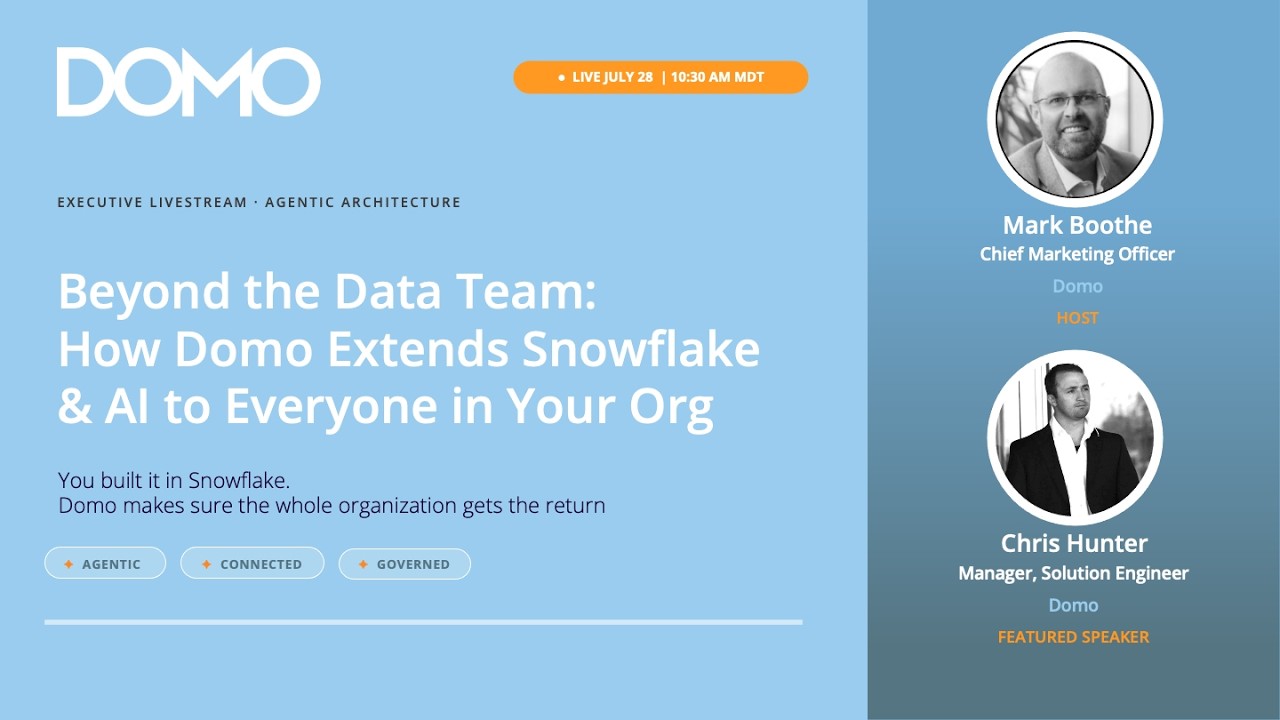

Mark: What's going on, everybody? Another day, another live stream. Today I am here with my good friend Chris Hunter, who is one of the managers on our solution engineering team. Chris, how we doing?
Chris: We're doing great, Mark. Good to see you.
Mark: You too. So, we're talking today all about one of our favorite partners, Snowflake. So, let's say you're building all your pipelines. You've got all your data in Snowflake. As you know, Domo helps you build that data foundation in Snowflake or wherever it is that you have your data located. But then we want to make sure that Domo can help your whole organization get the return that you're expecting from Snowflake. So what Chris is going to do today is walk through how we're helping other companies do that. He's going to show you a real solution, and he's going to show you the framework. So with that, Chris, take it away.
Chris: All right. Yeah, Mark, you and I spent a little over a month where we were both at Snowflake Summit. We got to hang out a little bit and we chatted with a lot of amazing companies at Snowflake. We learned a lot about what they're doing. And, you know, a common theme was we have this incredible investment by the data team where they've built out these really robust solutions that are using everything from the core platform in Snowflake to more advanced stuff with like Cortex Analyst and CoCo, etc.
The next logical step in that process that they're coming to is: Now, how do we take that investment from the data team and really extend it out to everybody else in the organization or potentially even our customers, right? But doing it in a way that is consistent, repeatable, scalable, has governance, and is interactive—so there's kind of a back-and-forth component there. And so that's really what we wanted to showcase or highlight today—examples of how that looks.
This is the only slide I'm going to show, but I think it really just reframes everything that I just said and does it visually. So kind of over here on the left, we see that Snowflake component. This is what the data team has invested in—core platform stuff with Medallion architecture, gold tables, Snowflake ML, semantic views, and then kind of the next stuff with AI where we're using CoCo, Cortex Search, Analyst, or even agents that are actually running behind the scenes doing really powerful things. And it's then taking that investment and delivering it to the line of business and our customers through a variety of methods—additional agents that they can interact with, dashboards, Procode apps, etc. And so today, we're going to highlight an example of one of these solutions actually working. So I'm going to jump over, and we're going to start here with an example of the architecture.
Chris: Similar to the slide I just showed, but now this is actually the solution. What's working? We see over here on the left-hand side, this is Snowflake. This is everything that our data team has put together, complete with governance, RBAC, gold views, agents that are running behind the scenes, and really focused on things like retention risk, etc.—machine learning, Cortex Search, etc.
And then it's taking this and once again providing it to business users, the line of business, and potentially customers. And here in the middle is this interoperability layer. So how is Domo actually making that possible? We're doing it via a couple of different technologies: our Cloud Amplifier, which allows us to federate to Snowflake without making any copies or moving the data; we're doing it with Code Engine, which is really powerful inside of our business process automation tool; MCP servers; and then that shared identity across the different platforms.
So then the user experience, which we'll jump into in a second, is going to have all these different components where I've got that AI readiness that's coming from Snowflake, I've got Domo business process automation workflows, approvals, and I'm consuming all of this inside of like an app or a dashboard, etc. And then these systems are going back and forth with each other, so it's really a complete loop on what this looks like.
Chris: So, now let's jump in and kind of take a peek. I think where we're landing on this—and this Revenue Command Center is going to be very familiar to anybody that's been inside of BI. Here we just have a lot of core KPIs that I want to look at when I'm trying to understand how my business is doing, etc. You'll notice up here in the top right corner, I've got this persona. So there are different people that I could log in as from a demo perspective, but in real life, we would be integrating here with Snowflake. So whenever somebody logs in, we're doing it via OAuth, and so it's automatically like subsetting down the KPIs and the numbers so they're just applicable to the user that is consuming this information.
High level, I'm seeing things like net revenue, my revenue at risk, projected revenue, and my forecast versus my actuals. But as I dig down deeper into this particular dashboard, we start to see where some of these other components that we've done inside of Snowflake start to kind of rear their head and provide a lot of value and insight.
This one right here is regional renewal risk, where we have an ML model behind the scenes that's actually surfacing up revenue that we feel like is at risk for this particular quarter. And so this is alarming, right? I might want to dig into this and figure out why the West is spiking so much. So over here on the right, we have this insight rail where I can do things like dig into that and ask Cortex why or what's happening, or even tinker around with the model that's running this projection score.
Let's kind of dig into that and show examples of this. So here, we actually have Cortex Analyst inside of Domo. And the reason this is very important is that we want to know that whatever questions a user asks the chat inside of Domo, it should get an answer that's the exact same as the data team would get if they were inside of Snowflake. For example, I could come in and say, "How much revenue is at risk because of SLA breaches?" Now, I could ask any question I wanted to—these are just some that are kind of pre-populated.
And here, I'm actually showcasing how we're actually connecting to Snowflake. We're interacting with Cortex Analyst, the SQL that's actually being generated behind the scenes, and the result that is being returned. So this is the revenue that is at risk because of the SLA breaches. And I'm going to jump over into Snowflake now because, once again, I'm trying to show that the experience is very consistent and we're extending that to the line of business. So here, I asked that exact same question, and you're going to see that the results are exactly the same. So what the data team would see when they dig into this inside of Snowflake is the same thing that our business users are seeing when they ask questions inside of Domo as well.
Mark: It's heaven is what that is, Chris. That's heaven.
Chris: That's heaven. That's me not losing out on the investment that my data team has put in place. We're ensuring that that experience is trickling down to everybody else in the organization; it's amazing, right? And now, I can come in and then even interact with the model. So, this machine learning model that's running behind the scenes is actually determining where our revenue at risk is coming from. We can come in and analyze this on the account level. I can run this prediction out of the box.
But if I know something—like I'm on the customer success team, and maybe I have information that isn't in the data at this point, and I can come in and say, "You know what, we're able to reduce a bunch of these support cases," or "Our SLA breaches have been minimized significantly," or "Our usage is up," whatever that might look like—I can rerun that prediction, get a much better score, and then I can actually accept that.
This is me now taking the ML work that the data team has done in Snowflake, interacting with it as a business user. I'm able to adjust stuff, and then I actually click accept. And what this is doing is it's now taking that and writing it back to Snowflake. So now that data inside of Snowflake is being updated, and I can actually review this, right? So this is what I just accepted, and it's now kicking over into this Snowflake table. So I could come in and look at this, and here's that new prediction that I just made, and it just got pushed into Snowflake.
Now the data team has that, and they can update the model if they need to, etc., or they can kind of determine how to use that data. But once again, the key point there, Mark, is this is going back and forth. It's the merging of the data team, the business users, etc., all governed, safe, secure, and auditable so that IT isn't saying, "What in the world is that business user doing over there?"
Mark: Yep. Exactly.
Chris: You know, we just kind of showed that we know exactly who ran that, who did that model, what the outcome was of it, etc. And this doesn't have to be immediately put into production or anything. This could just be something that we're either tinkering with here to see what it looks like, and then the data team can take that and put it into production, or it can go through an approval process. And when I say approval process, this is kind of an example of what that could look like.
As we go further down here on this page, now we're starting to get into where we have agents that are doing really valuable work for us. So, these are accounts that are at risk, and I've got this Cortex agent—this Revenue CC agent—that is analyzing these accounts, and it's building a technical success plan on how we can mitigate the churn of those accounts, right?
So, I'm going to go through this process of clicking "approve and execute" just so you can see what happens behind the scenes. Initially, like Cortex recommended this play, started this Domo workflow. What the Domo workflow is doing is it's then interacting with Cortex, bringing back that data, and then it's surfacing it to a human for approval, right? So that we can fact-check that, make sure it's accurate, make sure it looks the way it should, etc. And I'll just show you real quick. This is that Domo workflow. So here we see it actually going through the process. It started off, it kicked off, it reached out to Snowflake, it's returning that information from that agent that we have there, it's building that retention action plan, and then it's going to surface it up to a user.
So, I'm going to be the user in this situation. I'm going to click on approvals. And here down at the bottom, this most recent one, this is that plan we just clicked on. It's what the Cortex agent recommended as a retention approval plan, right? So, here's the account—that's the one that we were just looking at. Here are the actions that are recommended: success plan reset, 90-day reliability proof program. We're not going to read this whole thing, but it's a very comprehensive plan about what we can do to engage different people in the company, minimize SLAs, etc.
And ultimately, as the person that's in charge of approving or rejecting this, I can come in and approve it. I could look at the history, I can provide additional comments, whatever I needed to do here. But then I'm going to click save and submit, and you'll notice that that gets wiped out of my queue. It's going to get wiped out of this spot as well. And when I come back up here to this homepage, this is going to go through this process and ultimately go all the way through here.
Mark: Hey Chris, we've talked a lot about human-in-the-loop over the past. How important for something like this is having a human in the loop?
Chris: It's very important. I mean, not always. There are certain situations where we might be able to give our Cortex agent full autonomy and say, "You know what, when this thing takes place, send out an email or do something like that." But when we're talking technical success plans that are, you know, they're maybe very robust, they have a lot of moving pieces, we want eyes on that sort of stuff just so that we can make sure that we agree, make any adjustments necessary, or even if it's just having visibility into how this stuff is thinking, right? We all know that hallucination is a possibility when it comes to AI. So, it's very important to have that, especially depending on the steps that are actually being taken there.
Mark: Love it. What else, Chris? What else do you have to show us here?
Chris: Yeah, so this is kind of it in a nutshell, Mark. It's once again showing you every different component of how this is working, and then these new action plans that have been approved—we've written that back to Snowflake as well.
So in a nutshell, what I've shown you is everything from taking the investment from the data team, providing that to business users, potentially providing it to customers, and then the consistency across that—whether it's in how we're interacting with those models, how we're interacting with the Cortex agents, or even the chat experience, how it's just going to be the same type of thing from beginning to end, regardless of the type of persona you are. Whether you're on the data team and this is comfortable and familiar, or you're more like you and I where we're used to interacting with BI in a way that's dashboards, KPIs, and UIs that make sense to us as a user.
Mark: Chris, close us out with this. Why is Domo a key capability, a key solution to be able to help people get the most out of their Snowflake investment?
Chris: Yeah, Mark, we've always been geared very much toward the line of business and enabling the most people in an organization to leverage data as possible. So, we are an obvious complement here to what Snowflake is doing because we're meeting everybody where they're at. We're meeting the data team by integrating with everything that they've done up to this point, and we're meeting the business user where they're at in a UI that's very familiar to them, in a way that they can interact with the data and leverage it as well.
Mark: I love it. You heard it here, everybody. We are back again on Thursday. We will see you then. Chris, thanks for joining us. Everyone, go get even more out of the amazing Snowflake investment that you've already made, and bring Domo in to be able to help you push that to your business users and others to help really get the most value possible. Have a great day.

Mark brings over 15 years of diverse marketing experience and is passionate about driving Domo’s business growth through marketing initiatives. His mission is to empower all Domo customers and prospects with the insights and tools they need to make better business decisions and achieve their goals. In his previous role as VP of Community, Partner, and Field Marketing, Mark and his teams established new and strengthened existing programs to address customer pain points and create a greater sense of community. They also executed campaigns, programs and events that showcased the value of the Domo platform. Before joining Domo, Mark spent more than 10 years working in customer relations and marketing at Adobe, and worked at Instructure as its senior director of customer marketing. He received his MBA from Utah State University and a bachelor’s degree from Brigham Young University. Outside of work, Mark enjoys spending time with his family and traveling.

Chris Hunter is a seasoned Solutions Engineering leader at Domo, with over 11 years of experience helping clients leverage data and AI platforms to drive business transformation. Currently managing the solutions consulting team, Chris combines deep technical expertise with a passion for understanding business requirements and data management strategies. Prior to Domo, he worked in sales engineering roles, delivering technical consultations and training to enterprise customers. A Brigham Young University graduate in Information Technology, Chris is known for his leadership, customer focus, and ability to bridge the gap between complex technology and actionable business outcomes.
Your data team has built something powerful in Snowflake: Iceberg tables, medallion architecture, ML models, Semantic Views, and Cortex Agents. But the real return comes when that work reaches everyone who makes decisions, not just the people who built it. In this live session, we’ll walk through a complete enterprise implementation and show how Domo extends it across your organization: Cloud Amplifier with governed pushdown to Snowflake, Domo AI agents working step-in-step with Cortex Agents, workflows that turn insight into action, and data products delivered through dashboards and pro-code apps.
Domo transforms the way these companies manage business.