Hai risparmiato centinaia di ore di processi manuali per la previsione del numero di visualizzazioni del gioco utilizzando il motore di flusso di dati automatizzato di Domo.
Guarda il video

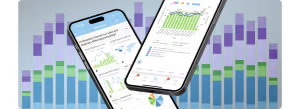
Smart business decisions depend on fresh data. Real-time business intelligence (RTBI) delivers exactly that, processing live operational data as events occur. Unlike traditional BI that relies on batch updates, RTBI uses streaming architectures to provide insights measured in seconds rather than hours. This guide walks through what RTBI is, how it compares to traditional approaches, the technology stack behind it, and practical steps for implementation.
Real-time business intelligence is the practice of delivering insights from live operational data as events occur, with end-to-end latency measured in seconds to minutes rather than hours or days. Processes and tools harness this data and uncover insights that inform business decisions and strategy development. Interactive visualizations and dashboards provide context and make these insights actionable.
What separates RTBI from traditional business intelligence is measurable freshness. Rather than vague claims about being "instant" or "up-to-the-minute," genuine real-time capability means the data reflects what is happening in the business right now. Not what happened during last night's batch processing run.
A practical definition of RTBI includes four characteristics:
People in BI discussions use the term "real-time" loosely. Different use cases require different latency targets. Understanding this spectrum helps set realistic expectations.
Sub-second latency (under one second) is necessary for use cases where milliseconds matter. Fraud scoring during payment authorization, high-frequency trading signals, and real-time bidding in advertising all require decisions before a transaction completes. These systems typically use in-memory processing and specialized real-time online analytical processing (OLAP) engines.
Seconds to low minutes (1-60 seconds) covers most operational RTBI use cases. Inventory alerts when stock drops below reorder points, customer experience triggers based on website behavior, dynamic pricing adjustments based on competitor changes. This latency tier balances speed with cost-effective infrastructure.
Minutes to near-real-time (1-15 minutes) works well for dashboards and operational reporting where decisions happen on a slightly longer cycle. Campaign performance monitoring, shift-level operational metrics, supply chain visibility. Many organizations find this tier delivers most of the value of RTBI at significantly lower infrastructure complexity.
The key question is not "how fast can this go?" but "how fast does it need to go for this decision to matter?" A fraud detection system that takes 10 minutes is useless. A marketing dashboard that updates every 10 minutes instead of every second saves significant infrastructure cost with minimal business impact. Teams often over-engineer latency requirements early on. Define your actual decision timeline before committing to sub-second infrastructure.
The distinction between RTBI and traditional BI goes deeper than speed. These approaches serve different purposes and require different architectures.
Traditional BI operates on batch processing cycles. Teams extract data from source systems on a schedule (nightly, hourly, or at defined intervals), transform it through extract, transform, and load (ETL) pipelines, load it into a data warehouse, and then make it available for reporting and analysis. This approach works well for historical analysis, trend identification, and strategic planning where decisions happen on longer time horizons.
Real-time business intelligence operates on event-driven architectures. Data flows continuously from source systems through streaming pipelines, which process and aggregate it in flight before it lands in serving layers designed for low-latency queries. This approach enables operational decisions that need to happen before conditions change.
The following comparison highlights the key differences:
A related distinction: real-time analytics is a broader category that includes machine learning inference, predictive modeling, and data science workloads operating on streaming data. RTBI specifically focuses on business intelligence outputs like dashboards, key performance indicators (KPIs), alerts, and reports. Streaming analytics refers to the infrastructure layer (tools like Kafka and Flink) that processes data in motion.
Not every use case requires real-time data. Overinvesting in streaming infrastructure for batch-appropriate workloads wastes resources.
Traditional BI remains the right choice for monthly financial close processes where data needs reconciliation and validation before reporting. Annual planning cycles that synthesize historical trends do not benefit from minute-by-minute updates. Compliance reporting with defined submission windows operates on batch timelines by design. Retrospective analysis asking "what happened last quarter?" needs complete, validated datasets rather than partial streaming data.
The decision framework is straightforward: if the decision being informed happens on a daily or longer cycle, traditional BI is likely sufficient. If the decision needs to happen within the same hour or shift as the triggering event, real-time becomes valuable.
Real-time business intelligence becomes essential when the cost of latency exceeds the cost of the infrastructure required to eliminate it.
Fraud detection illustrates this clearly. A credit card transaction flagged as suspicious 10 minutes after approval is useless. The fraudster has already completed the purchase and disappeared. The same flag delivered in 500 milliseconds can block the transaction before it completes. The value of that speed is measured in avoided chargebacks and fraud losses.
Dynamic pricing operates on similar logic. If a competitor drops their price and your system takes six hours to detect and respond, you've lost sales during that window. Real-time competitor monitoring and automated price adjustments capture revenue that batch processing would miss.
Supply chain visibility demonstrates the operational impact. When a shipment delay occurs, knowing about it in real-time allows rerouting, customer notification, and contingency planning before downstream commitments are missed. Learning about the delay in tomorrow's report means the damage is already done.
Customer experience triggers follow the same pattern. A customer abandoning a shopping cart can be re-engaged with a targeted offer within minutes. The same offer sent the next day? It competes with dozens of other marketing messages and has far lower conversion rates.
RTBI systems follow a common architectural pattern: data flows from sources through ingestion, processing, and serving layers before reaching people through dashboards and alerts.
Real-time data enters the RTBI pipeline through several mechanisms depending on the source system.
Event streams capture discrete occurrences as they happen. Website clickstreams, Internet of Things (IoT) sensor readings, transaction logs, and application events all generate continuous streams of data. These typically flow through message brokers like Apache Kafka or cloud equivalents (Amazon Kinesis, Google Pub/Sub, Azure Event Hubs) that provide durable, ordered delivery.
Change data capture (CDC) extracts changes from operational databases in near-real-time. Rather than querying the entire database on a schedule, CDC tools monitor transaction logs and emit events for each insert, update, or delete. This approach minimizes load on source systems while providing fresh data.
Micro-batching offers a middle ground between true streaming and traditional batch. Tools like Snowpipe ingest data in small, frequent batches (every few minutes) rather than continuous streams. This approach simplifies architecture while still delivering data freshness measured in minutes rather than hours. Micro-batching introduces small gaps in data continuity, so if your use case requires truly continuous visibility, you will need full streaming ingestion.
Application programming interface (API) feeds pull data from external systems on short intervals. Competitor pricing data, social media metrics, and third-party market data often arrive through scheduled API calls rather than push-based streams.
Once data enters the pipeline, stream processing engines transform, enrich, and aggregate it in flight.
Stream processing platforms like Apache Flink, Apache Spark Streaming, and cloud-managed equivalents (AWS Kinesis Data Analytics, Azure Stream Analytics, Google Dataflow) handle continuous data transformation. These systems can join streaming data with reference data, calculate running aggregations, apply business rules, and route data to multiple destinations.
The processing layer handles several critical functions. Filtering removes irrelevant events before they consume downstream resources. Enrichment adds context by joining streaming events with dimension data (customer attributes, product details, geographic information). Aggregation calculates metrics like counts, sums, and averages over time windows. Scoring applies business rules or machine learning models to classify events, things like fraud risk scores, churn probability, and lead quality.
For sub-second query latency on aggregated data, specialized real-time OLAP engines like ClickHouse, Apache Druid, or Apache Pinot provide fast analytical queries on streaming data. These systems sacrifice some query flexibility for dramatic speed improvements on common dashboard and alerting patterns.
The final mile of RTBI delivers insights to people in formats that enable action.
Live dashboards display current metrics with automatic refresh. Unlike traditional reports that show point-in-time snapshots, real-time dashboards update continuously as new data arrives. Freshness indicators (timestamps showing when data was last updated) help people trust that they're seeing current information.
Reporting dashboards allow business leaders to see how their business is performing at any given moment.
Threshold-based alerts notify people when metrics cross defined boundaries. When inventory drops below reorder points, when error rates spike, when sales velocity changes significantly. Alerts push notifications through email, SMS, Slack, or mobile apps.
Embedded analytics integrate insights directly into operational tools. Rather than requiring people to switch to a separate BI application, embedded dashboards and metrics appear within customer relationship management (CRM) systems, operational consoles, and workflow tools where decisions happen.
Role-based views ensure different people see relevant information. Executives see high-level KPIs. Managers see departmental metrics. Front-line workers see operational details.
Real-time business intelligence allows you to spot changes in your market and adapt your strategies accordingly. If you're a retailer and you notice that sales are trending down, you can quickly make changes to your inventory or pricing strategy. By reacting swiftly to changing trends, you can avoid major losses in revenue.
Real-time business intelligence also helps drive an organization to become more data-centric. Businesses that rely on their data to make critical operational decisions end up making more informed decisions because they are not just guessing. They are using data to predict future outcomes and analyze previous trends.
As your company adopts real-time business intelligence, you can expect several benefits.
Businesses today often have massive amounts of data to analyze. Not all data is created equal, though. Over time, data degrades in value. Data around customer behavior on your website from a month ago may not represent how customers are behaving on your site at this very moment.
By relying on real-time business intelligence, businesses can assure they have the most valuable data possible at their fingertips. They can respond swiftly to changes. Prepare for what is coming.
Real-time business intelligence can also help you make more informed decisions about where to allocate resources. If you have real-time information about all aspects of your business, then you know exactly where to focus your time and energy. You can double down on efforts that are producing results and pull back on less successful initiatives.
A great example: having real-time access to the point of sale data in your retail stores. By collecting and analyzing this transaction data in real-time, your store leaders can make more informed judgment calls when it comes to sales, stocking and ordering products, and labor allocation.
Having access to data instantly allows you to create unique alerting systems when exceptions occur within the business. Modern BI tools offer alert systems that can text, email, or send push notifications to a mobile device whenever irregularities occur in the data.
A specific example: sending alerts to sales reps whenever a potential prospect has signed a contract. As soon as the contract is signed, the BI tool can receive that data and fire off alerts to any number of people. The system notifies the appropriate contacts so they can begin preparing for a new client.
Notifications help business people take action when it is required, and the timely delivery of those notifications is absolutely essential to good business.
One of the biggest benefits of real-time business intelligence is that it can help you identify trends as they're happening. With access to up-to-date data, you can perform trend analysis the very same day the data is occurring. This can be quite powerful, as most traditional tools require a lag, meaning you can only analyze historical data. You might notice a product line is more popular at a specific time of year. This information will allow you to plan for peak demand and ensure that you can meet customer orders.
Real-time business intelligence delivers significant value. But implementation comes with challenges that organizations should anticipate and plan for.
Building and maintaining real-time data pipelines requires different skills and infrastructure than traditional batch BI. Streaming architectures introduce complexity at every layer.
Latency accumulates across the pipeline. Data collection adds delay at the source. Network transport introduces latency between systems. Processing time depends on transformation complexity and cluster capacity. Storage writes take time. Semantic layer queries add overhead. Dashboard rendering contributes final milliseconds. Understanding where latency is introduced helps identify optimization opportunities.
Integration challenges multiply with streaming data. Source systems may not support real-time extraction. Schema changes in upstream systems can break streaming pipelines. Coordinating deployments across interconnected systems requires careful orchestration.
Operational complexity increases with real-time systems. Monitoring streaming pipelines requires different tools and practices than batch jobs. Debugging issues in distributed streaming systems demands specialized expertise.
Data observability becomes critical for maintaining trust in real-time data. Freshness monitoring tracks whether data is arriving on schedule. Quality checks validate that incoming data meets expectations. Service level indicators (SLIs) and service level objectives (SLOs) define acceptable performance thresholds. Incident playbooks guide response when issues occur.
Streaming data introduces quality challenges that batch processing handles more gracefully.
Late-arriving events complicate aggregations. When calculating hourly metrics, what happens when an event from the previous hour arrives after the window closes? Watermarking strategies define how long to wait for late data before finalizing results. This creates a tradeoff between completeness and latency.
Out-of-order events require careful handling. Network delays, distributed systems, and varying processing speeds mean events don't always arrive in the order they occurred. Windowing strategies and event-time processing help, but add complexity.
Duplicate records appear more frequently in streaming systems. At-least-once delivery guarantees (common in streaming platforms for reliability) mean the same event may arrive multiple times. Idempotent processing and deduplication logic prevent duplicates from corrupting metrics.
Schema evolution creates breaking changes. When upstream systems modify their data structures, streaming pipelines can fail or produce incorrect results.
Consistent KPI definitions become harder to maintain. Revenue "as of now" may differ from revenue "finalized after returns and adjustments." Real-time metrics and batch-reconciled metrics may not match exactly, requiring clear documentation of what each number represents. Many teams stumble here by assuming real-time and batch numbers should always align. They won't. And that's expected behavior when you're comparing incomplete streaming data against fully reconciled historical records.
Real-time infrastructure costs more than batch processing, and organizations need to justify the investment.
Streaming compute runs continuously rather than on-demand. Flink clusters, Kafka brokers, and real-time OLAP engines consume resources around the clock. Hot storage tiers for low-latency access cost more per gigabyte than cold storage. Data transfer fees accumulate as data moves between systems. Query concurrency (many dashboard people hitting the same data) drives additional compute costs.
The ROI calculation weighs these costs against the value of faster decisions. Fraud detection that saves millions in chargebacks easily justifies streaming infrastructure. Marketing dashboards that update every 10 minutes instead of every hour may not warrant the same investment.
Organizational readiness matters as much as technology. Teams need skills to build and operate streaming systems. People across the business need training to interpret real-time data appropriately. Processes need adjustment to take advantage of faster insights.
Real-time business intelligence applies across industries and departments. The following examples illustrate how organizations use RTBI to drive operational decisions.
Retail operations benefit from real-time visibility into sales and inventory across locations.
Consider a stockout scenario: a point-of-sale transaction reduces inventory for a popular item below the reorder threshold. Within seconds, the RTBI system detects the threshold breach, calculates optimal reorder quantity based on current sales velocity, and triggers an alert to the inventory manager. Simultaneously, an automated purchase order routes to the supplier. The entire sequence from sale to reorder happens in minutes rather than waiting for the next day's inventory report.
Dynamic pricing adjustments follow similar patterns. When competitor prices change (detected through automated monitoring), the system calculates margin impact, applies pricing rules, and either adjusts prices automatically or alerts pricing analysts for review.
Marketing dashboards with real-time business intelligence enable mid-flight campaign adjustments.
Monitor KPIs such as click-through rate, cost-per-click, engagement rate, conversion rate, and return on ad spend. Track these metrics by campaign, time period, and target audience. When a campaign underperforms against threshold (conversion rate drops below target, cost per acquisition exceeds budget), the system alerts the marketing team within minutes rather than surfacing the issue in tomorrow's report.
This speed enables budget reallocation while campaigns are still running.
For companies with a customer service department, a dashboard with real-time business intelligence is incredibly useful. Track calls, chats, resolution time, retention rate, customer satisfaction, and similar key performance indicators (KPIs).
Real-time queue monitoring prevents service level breaches before they affect customers. When wait times exceed threshold or ticket volume spikes unexpectedly, supervisor alerts fire immediately. The team can reallocate agents, activate overflow capacity, or adjust routing rules before customer satisfaction scores suffer.
This information is critical to have access to in real-time to avoid problems escalating.
Fraud detection represents one of the highest-value RTBI applications because the cost of latency is measured in direct financial losses.
The pattern follows a clear sequence: a transaction event arrives containing amount, merchant, location, and customer identifiers. Within milliseconds, the system enriches the event with customer history and calculates a fraud risk score based on factors like geographic anomalies, spending pattern deviations, and merchant risk profiles. When the score exceeds threshold, the system either blocks the transaction automatically or routes it to a fraud analyst for review.
The difference between sub-second fraud detection and batch processing (reviewing transactions the next morning) can represent millions of dollars in avoided chargebacks for large financial institutions.
Supply chain visibility demonstrates RTBI's operational impact on complex, time-sensitive processes.
When a shipment delay event occurs (the carrier feed reports an updated estimated time of arrival, or ETA), the system immediately recalculates downstream impact. Which customer orders are affected? Which production schedules depend on this shipment? What alternative routing options exist? Alerts notify relevant stakeholders with specific impact assessments and recommended actions.
Real-time supply chain monitoring enables proactive customer communication (notifying customers of delays before they notice), contingency activation (switching to backup suppliers or alternate shipping routes), and production schedule adjustments (resequencing work orders based on material availability).
Helping your business become more data-minded is by no means an easy task. It often requires additional training, adopting new mindsets, and adapting to new technologies. Real-time business intelligence can serve as the engine to drive data-driven decision-making across your organization. Here are a few suggestions on how to get started.
Any large project starts with just a few small tasks. By identifying certain departments or business processes where real-time business intelligence can be beneficial, you can begin to plan a more full rollout within the organization.
Good pilot use cases share several characteristics:
Focus on the areas or departments that have the greatest potential ROI with real-time business intelligence. Early successes will make it easier to consider wider adoption across the organization.
Data professionals exist within all departments of an organization, and many of them are just waiting to get their hands on the data. By identifying and working with these champions, you will start to see the overall desire of the organization to increase when it comes to real-time business intelligence.
Champions serve multiple roles beyond advocacy. They run the first dashboard reviews with their teams, surface feedback about which metrics actually drive decisions, and help the data team understand business context that improves data quality and relevance. Cross-functional dashboard reviews where champions from different departments share how they use real-time data accelerate adoption and surface integration opportunities.
As you identify champions, make sure you get buy-in from leadership. People are more likely to respond positively to a change when they see that leadership is behind the initiative.
Following an iterative approach when it comes to real-time business intelligence is the best way to produce a scalable and durable solution for your business. Iteration is the process of constant improvement and change, meaning you're never actually done with the project. As you become more familiar with the BI tool, you will naturally find more and more innovative solutions to test out. Through experimentation and time, you will better understand what data and insights are valuable to your organization.
Do not develop in a vacuum. Always be asking questions and gathering feedback from people in every department. Real-time business intelligence can benefit any job function, so gather feedback from individual contributors, managers, and executives. It may be useful to consider having a regular meeting time to take in this feedback and make plans for improvement. You can also use surveys to generate feedback in asynchronous fashion.
Selecting the right platform for real-time business intelligence requires evaluating several dimensions in addition to basic feature checklists.
Data integration capabilities determine how easily you can connect to your existing data sources. Look for native connectors to your critical systems, support for streaming ingestion (not just batch), and the ability to blend real-time and historical data in the same analysis.
Latency and refresh rates should match your use case requirements. Some platforms offer true streaming with sub-second updates. Others provide configurable refresh intervals measured in minutes. Understand what your use cases actually require before paying for capabilities you won't use.
Semantic layer and governance features ensure consistent metric definitions across the organization. Certified metrics, role-based access controls, and data lineage tracking become increasingly important as real-time data reaches more people.
Self-service capabilities determine whether people across the business can explore data independently or require analyst support for every question. Natural language querying, drag-and-drop visualization, and guided analytics reduce bottlenecks.
Alerting and workflow integration connect insights to action. Evaluate how easily you can configure threshold-based alerts, route notifications to the right people, and integrate with operational tools where decisions happen.
Scalability and performance matter as adoption grows. How does the platform handle increasing data volumes, more concurrent people, and more complex queries? Reference architectures and customer case studies provide evidence beyond vendor claims.
Total cost of ownership includes infrastructure costs, licensing, implementation effort, and ongoing operational overhead.
If you need RTBI, choose a BI vendor that can connect to streaming sources, show data freshness clearly, and route alerts to the right people. This gives business leaders current dashboards, alerts, and metrics they can use to make operational decisions each day.
BI tools help teams monitor fresh data, spot changes quickly, and act on what the data shows. When employees can explore current and historical data, they can spot issues earlier and adjust operations with more confidence.
If your team still relies on yesterday's reports for time-sensitive decisions, start with one RTBI use case now. Compare platforms based on latency, data integration, governance, and cost so you can choose one that fits your needs. See how your team works when current BI data is available inside the tools they already use.
Domo transforms the way these companies manage business.