Hai risparmiato centinaia di ore di processi manuali per la previsione del numero di visualizzazioni del gioco utilizzando il motore di flusso di dati automatizzato di Domo.
Guarda il video

Data has become one of the most valuable assets for organizations of all sizes. To turn raw information into strategic intelligence you can use, your data has to move reliably from source systems into analytics platforms and business applications. But not all data movement is the same.
Two foundational concepts in the modern data stack—data ingestion and data integration—are often confused or used interchangeably. In reality, they represent distinct steps in the data journey, each with a unique purpose, challenges, and value.
This guide explains what data ingestion and data integration are, how they differ, why they matter, and how they fit together in building scalable, reliable, and insight-ready data pipelines.
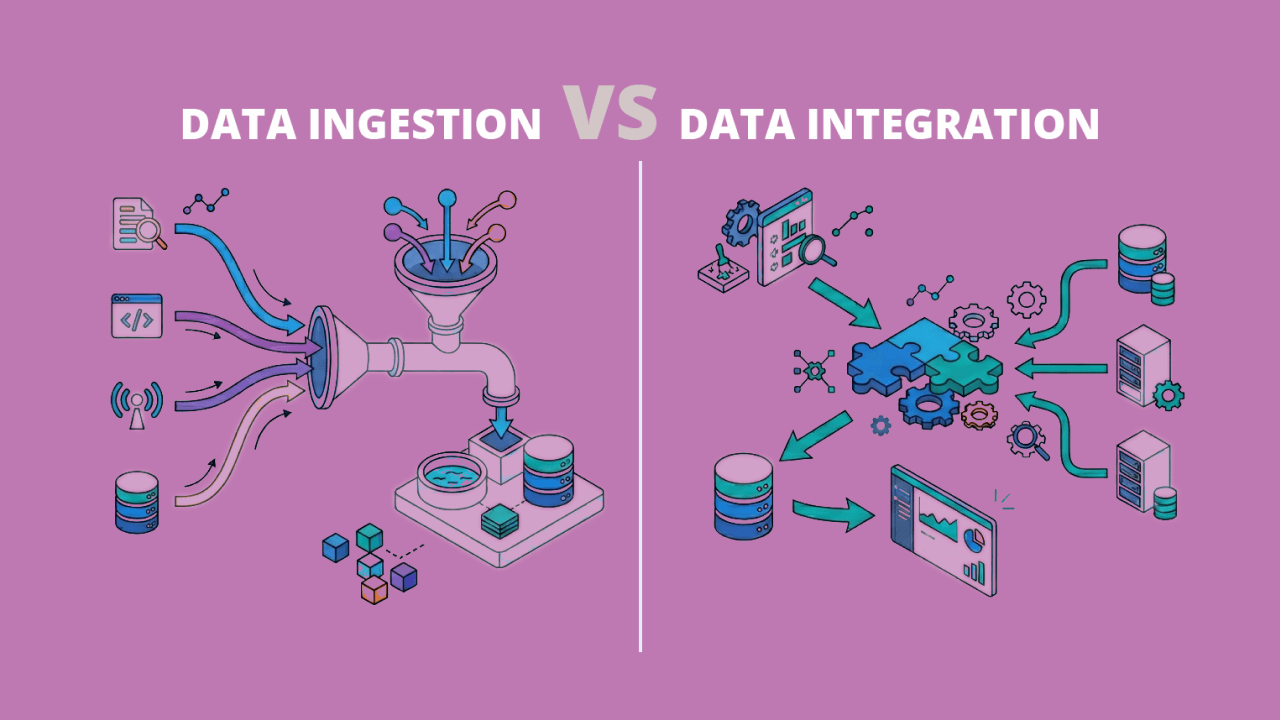
Data ingestion is the process of collecting data from various source systems and moving it into a central location for storage or further processing.
The primary goal of data ingestion is to get data into the system, uninterrupted and reliably. Ingestion doesn’t require deep transformation or business logic. Instead, it focuses on transporting data in its raw form from point A to point B.
Ingestion must handle this diversity and maintain data flow even in the face of network issues, schema variations, or latency problems.
It’s important to emphasize what ingestion does not inherently do: It doesn’t transform or harmonize data for analytics use. That function comes later in the pipeline. Ingestion’s job is to centralize data and ensure it’s available for downstream systems.
For example, you may ingest web server logs, application events, CRM records, and sensor data into a data lake. At this stage, these data sets remain in their original format—the priority is making them accessible, not immediately analytics-ready.
Where ingestion brings data into a system, data integration makes that data usable for analytics and business processes.
Data integration is the process of combining, cleansing, transforming, and unifying data from multiple sources so that it can support reporting, dashboards, business intelligence (BI), and machine learning. It ensures that the data consumers see is consistent, accurate, and meaningful.
This means integrating data isn’t just about movement, but about context and quality. Typical tasks in integration include:
Two established patterns for data integration are:
These patterns represent how data integration engines process data, but the goal remains consistent: prepare data that’s clean, harmonized, and ready for analysis.
After data ingestion has brought diverse data sets into a central store, integration tools run pipelines that:
For example, data integration brings together customer data from multiple sales systems, normalizing fields like date formats, and resolving duplicate customer records to ensure a single 360-degree view for analytics.
Understanding how these two processes relate and differ is critical for designing effective data pipelines.
The key takeaway: ingestion gets data where you need it; integration gets it into the right shape.
In most modern architectures, ingestion and integration are sequential and complementary rather than competitive.
In ELT architectures common to modern data stacks, the ingestion step may simply load raw data into a data lake, and transformation (integration) happens downstream using analytics engine compute.
Understanding the difference between data ingestion and data integration isn’t just academic—it directly impacts how scalable, reliable, and useful your data environment becomes over time. When these concepts are blurred, teams often over-engineer early pipelines or under-invest in data quality downstream.
Ingestion and integration place very different demands on infrastructure. Ingestion pipelines are typically optimized for speed, throughput, and reliability—especially in environments handling high-volume event data, SaaS application feeds, or streaming sources. Integration workloads, on the other hand, are compute-intensive and often require complex joins, aggregations, and transformations.
By separating ingestion from integration, organizations can scale each layer independently. This prevents ingestion bottlenecks from slowing analytics and avoids wasting compute resources transforming data before it’s actually needed. As data volumes grow, this architectural clarity becomes critical to maintaining performance without runaway costs.
Ingestion focuses on availability; integration is where trust is established. This distinction matters because analytics, reporting, and AI models are only as reliable as the data behind them. If transformation logic, validation rules, and business definitions are applied inconsistently or too late, stakeholders quickly lose confidence in insights.
Clear integration processes allow teams to enforce standardized metrics, apply governance policies, and document lineage—all of which are essential for auditability and regulatory compliance. Over time, this consistency enables organizations to shift from reactive reporting to proactive, decision-grade analytics.
Modern data use cases evolve quickly. New questions, models, and dashboards often require re-thinking how data is structured. When raw data is ingested and retained separately from transformed outputs, teams can adapt without rebuilding pipelines from scratch.
This flexibility is especially important for AI and advanced analytics. Machine learning models frequently need access to raw or semi-processed data, while executives want curated metrics. Treating ingestion and integration as distinct layers ensures both objectives are met without compromise.
While many modern platforms combine ingestion and integration capabilities, understanding their functional differences helps teams choose the right tools and design resilient data pipelines.
Data ingestion tools are designed to connect to a wide range of sources and move data reliably into centralized storage. Their strengths lie in connectivity, throughput, and fault tolerance rather than transformation logic.
These tools are especially valuable in environments where data freshness matters or where source systems change frequently.
Data integration platforms focus on preparing data for consumption. They apply business logic, standardize formats, and create unified data sets that support analytics and reporting.
Integration platforms sit closer to analytics consumers, ensuring data aligns with business definitions and reporting requirements.
In modern cloud data stacks, ingestion and integration often operate within a unified ecosystem. Raw data may be ingested into cloud storage or a data lake, then transformed using scalable compute engines as analytics needs evolve. Even when tools overlap, maintaining conceptual separation helps teams optimize cost, performance, and agility.
To design effective data architecture, it helps to know when your priority should be ingestion or integration.
The best data architectures optimize both, focusing on ingestion first to get data flowing, then integration to shape it into value.
Even with a clear conceptual separation, teams often stumble on these issues:
Awareness and tooling strategy help avoid these common challenges.
Data ingestion and data integration serve different, but equally essential, roles in the modern data lifecycle. Ingestion keeps data flows reliable from source systems into a centralized environment. Integration transforms that raw data into trusted, analytics-ready assets that power reporting, forecasting, and AI-driven decisions.
Organizations that clearly distinguish between these stages gain more than technical efficiency. They gain flexibility to support new use cases, confidence in their metrics, and the ability to scale analytics without constant rework. As data volumes and complexity increase, this clarity becomes a competitive advantage.
Platforms like Domo help bridge ingestion and integration by providing a unified environment where data can be connected, transformed, governed, and analyzed in one place. By bringing together data movement, transformation, visualization, and AI-powered insights, Domo enables teams to move beyond managing pipelines and focus instead on turning data into decisions.
Ready to simplify your data stack and accelerate insight? Contact Domo to see how a unified, cloud-native platform can help your organization connect data faster, trust it more, and act on it with confidence.
Domo transforms the way these companies manage business.