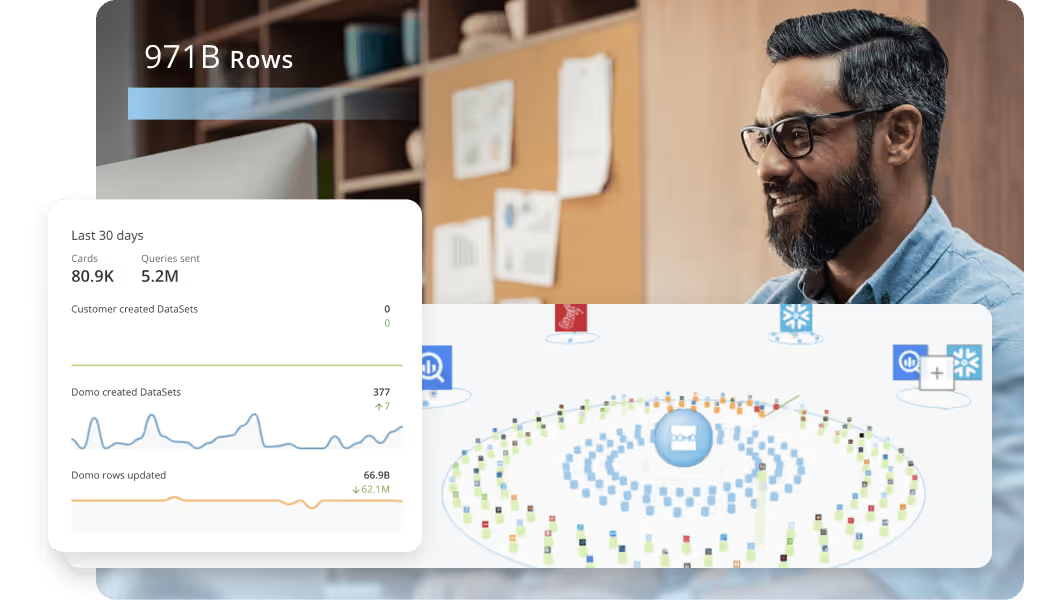
Hai risparmiato centinaia di ore di processi manuali per la previsione del numero di visualizzazioni del gioco utilizzando il motore di flusso di dati automatizzato di Domo.
Guarda il video


Unstructured data represents roughly 90 percent of all enterprise information. Most organizations lack the tools to analyze it effectively. This article explores how AI technologies like natural language processing (NLP) and computer vision are changing that equation, what challenges you need to address around storage and governance, and how to get started with implementation.
Here are the main points to keep in mind:
Emails pile up. Documents accumulate. Audio recordings from customer calls gather digital dust. Most enterprise information sits untouched because traditional analytics tools simply cannot process these formats. That's where AI changes the game.
While structured data fits neatly into databases and spreadsheets, the vast majority of enterprise information exists in formats that resist conventional analysis. Emails, documents, images, audio recordings, and social media content all contain valuable insights that remained locked away until recent advances in artificial intelligence made large-scale analysis possible.
This shift matters because unstructured data represents roughly 90 percent of all enterprise data. Organizations that ignore it are making decisions with only a fraction of available information. Those who can effectively analyze this information gain competitive advantages in customer understanding, operational efficiency, and strategic decision-making.
Unstructured data is information that lacks a predefined data model or organizational schema, meaning it cannot be stored in traditional rows and columns. This includes formats like emails, PDFs, images, audio files, videos, and social media posts. Traditional relational databases struggle with this data because there are no consistent fields to index or query against, leaving the vast majority of enterprise information effectively invisible to conventional analytics tools.
The main difference between structured and unstructured data lies in how they're stored and processed. Structured data is organized and easily searchable, typically stored in Structured Query Language (SQL) databases where each data point has a clear label and value. Unstructured data, on the other hand, is raw and unpredictable. You might have folders of PDFs or hours of customer support recordings with no consistent format.
While structured data is easier to process with traditional analytics, unstructured data often provides richer context and deeper insights when parsed with more advanced tools like natural language processing (NLP) or machine learning (ML).
Understanding the distinction between structured and unstructured data helps clarify why different tools and approaches are needed for each. The following table summarizes the core differences across several dimensions.
| Aspect | Structured data | Unstructured data |
|---|---|---|
| Format | Rows and columns with defined fields | Text, images, audio, video, mixed formats |
| Storage | Structured Query Language (SQL) databases, data warehouses | Data lakes, object storage, cloud repositories |
| Analysis tools | Traditional BI, SQL queries, spreadsheets | AI and machine learning (ML), natural language processing (NLP), computer vision |
| Examples | Transaction records, customer relationship management (CRM) entries, inventory data | Emails, social posts, call recordings, contracts |
| Searchability | Easily queryable with exact matches | Requires indexing, embeddings, or AI processing |
Here's something that surprises a lot of teams: while AI excels at processing unstructured data, large language models can actually struggle with certain structured data operations. Tasks like precise arithmetic, complex joins across tables, and enforcing schema constraints are areas where LLMs may produce unreliable results because they are probabilistic models, not deterministic query engines. Teams sometimes assume an LLM can replace a SQL database for calculations. It can't. And the errors can be subtle enough to miss without validation.
The practical solution is a hybrid approach. Use SQL databases and BI tools for precise calculations and structured queries, then use LLMs for semantic analysis, summarization, and working with unstructured content. Many organizations combine both by having an LLM generate SQL queries that a database engine executes, then having the LLM interpret and explain the results.
Unstructured data makes up the majority of the world's data and includes information that doesn't follow a predefined model or organizational framework. Unlike structured data (which fits neatly into tables and databases), unstructured data is messy, diverse, and rich in context. It can come from a variety of sources and formats, making it incredibly valuable for insights but also more difficult to manage and analyze.
Below are common types of unstructured data organizations deal with every day. Each of these unstructured data types holds untapped potential.
This includes everything from emails and PDFs to Word documents, wikis, and reports. Text documents are one of the most common forms of unstructured data and often contain valuable information hidden in plain sight. While they may follow formatting conventions, their content does not fit into traditional rows and columns.
Posts, comments, likes, hashtags, and user-generated content from platforms like Facebook and LinkedIn are prime examples of unstructured data. They're rich in sentiment, behavior, and trend data but difficult to analyze due to their informal language and fast-changing context.
Multimedia files such as photos, videos, and graphics contain valuable visual information that can't be captured through traditional data structures. Image recognition and video analytics tools are often used to extract meaning and metadata from this type of data.
Call center conversations, voicemails, and podcast episodes all fall into this category. Audio data requires transcription and natural language processing to support analysis and insight.
Content from the web, including news articles, blogs, and website text, is highly unstructured. It often combines text, images, links, and scripts, making it challenging to standardize for analysis.
While some sensor outputs are structured, many devices produce streams of data in log files or unconventional formats that don't conform to typical schemas. This kind of machine-generated data requires contextual interpretation to be meaningful.
Machine logs, server logs, and application logs record actions and events in formats that vary widely across systems. While technically structured in some cases, they're often treated as unstructured due to their complexity and inconsistency.
Though they may contain some structured fields (like sender or timestamp), the body content of emails and chats is unstructured. These messages can reveal workflows, decision-making patterns, and customer sentiment if analyzed correctly.
Working with unstructured data offers immense potential for insights, but it also introduces a number of challenges that businesses and data teams must overcome. Because unstructured data does not conform to traditional models, it can be messy, complex, and difficult to process at scale.
Unstructured data is produced in massive volumes. Video footage, emails, social media feeds. Storing this data requires a scalable infrastructure that can accommodate diverse file types and sizes. Traditional relational databases are not suited for unstructured formats, so organizations often invest in data lakes, distributed storage systems, or cloud-based object storage solutions that can handle the variety and scale required.
Because unstructured data comes from a wide range of sources, it often lacks consistency. The same type of information may be expressed in different formats, tones, or languages, making it harder to compare or analyze. Errors, noise, and irrelevant content also make it difficult to maintain high data quality.
Unlike structured data, unstructured data lacks predefined fields or labels, making it difficult to organize and retrieve specific information. Searching through documents, emails, or images requires robust indexing techniques and sometimes advanced tools like natural language processing or image recognition.
Unstructured data does not lend itself easily to traditional analytics or reporting tools. Analyzing this data often requires machine learning, artificial intelligence, or specialized text mining techniques. Even with these tools, extracting actionable insights can be time-consuming and resource-intensive.
Combining unstructured data with existing structured data sets poses technical and strategic challenges. It requires data transformation and contextual alignment to ensure the two data types complement each other in analysis. Otherwise, organizations risk drawing incomplete or misleading conclusions.
Unstructured data often contains sensitive or personally identifiable information, but because it's not stored in uniform formats, it's more difficult to secure or audit. Organizations face risks related to data breaches, regulatory noncompliance, and data misuse if proper controls aren't in place.
When working with AI systems, certain types of data should never be shared without appropriate safeguards. This includes:
For situations where sensitive data must be processed, organizations can use safe alternatives. Redaction replaces sensitive values with masked versions (SSN becomes XXX-XX-1234). Tokenization substitutes payment card numbers with secure tokens. De-identification removes identifying information from health records following HIPAA Safe Harbor guidelines. Private deployment options, such as on-premises LLMs or models running in your own cloud environment, keep data from ever leaving your infrastructure.
Operational governance controls should include role-based access control (RBAC), document-level permissions in retrieval systems, data loss prevention (DLP) scanning, prompt and response logging policies, and clear data retention schedules. For more on establishing AI governance frameworks, see Domo's AI governance resources.
Managing unstructured data demands advanced tools and skill sets, which many organizations may not yet have. From data scientists trained in natural language processing to engineers who can manage unstructured data lakes, the talent and technology required can be expensive or hard to find.
Artificial intelligence is rapidly changing how organizations manage, analyze, and extract value from unstructured data. From emails and social media to audio recordings and satellite images, AI introduces new levels of automation, accuracy, and speed that were previously impossible with traditional methods.
Before diving into specific techniques, it helps to understand the general workflow that AI systems follow when processing unstructured data. While implementations vary, most pipelines follow a similar pattern: ingest data from various sources, parse and extract content (using optical character recognition (OCR) for scanned documents), chunk content into manageable pieces, convert chunks into embeddings, store embeddings in a vector database, retrieve relevant content based on queries, generate outputs using a large language model (LLM), and evaluate results for quality.
AI-driven NLP tools enable machines to understand, interpret, and generate human language. NLP is the primary technique for analyzing unstructured text, making it possible to process emails, customer reviews, support tickets, and documents at scale.
NLP extracts sentiment, topics, keywords, and intent with high precision. It also powers capabilities like named entity recognition (NER), which identifies specific entities such as people, organizations, locations, and products within text, and intent classification, which determines what action a person is trying to take.
Machine learning models can categorize massive volumes of text (such as news articles, product feedback, or legal documents) into relevant topics or classifications. Sentiment analysis adds another layer by gauging emotional tone, helping businesses understand customer perceptions or public opinion in real time.
Beyond basic positive/negative scoring, aspect-based sentiment analysis (ABSA) identifies sentiment toward specific features or attributes within the same text. A product review might express positive sentiment about battery life but negative sentiment about screen quality. ABSA captures these distinctions, providing more actionable insights than general sentiment scores alone.
What exactly is an embedding? It's a numerical representation (vector) of text, images, or other data, where semantically similar items have similar vectors. The words "dog" and "puppy" will have closer vectors than "dog" and "car." This enables AI to find meaning, not just exact keyword matches.
Here is how semantic search works in practice. A person submits a query like "customer complaint about slow shipping." The system converts this query into an embedding, a series of numbers representing its meaning. It then compares this embedding against stored document embeddings using a similarity measure called cosine similarity. The closest matches are returned as retrieved passages, which might include phrases like "order delayed five days" or "package took forever," even though those exact words weren't in the original query.
This approach differs significantly from traditional keyword search. A keyword search for "slow shipping" would miss documents containing "delayed," "forever," or "took too long." Semantic search finds conceptually related content regardless of the specific words used.
Different types of unstructured data require different embedding models. Text embeddings use models like sentence transformers or OpenAI's ada-002. Image embeddings use models like CLIP or ResNet. Audio embeddings use models like Wav2Vec.
Key terms to understand include:
Computer vision, a branch of AI, enables automated recognition and analysis of images and videos. It can detect objects, faces, scenes, or even actions, making it invaluable for applications like security monitoring, medical diagnostics, manufacturing quality control, and social media content analysis.
Intelligent document processing (IDP) handles complex documents that simple text extraction cannot manage effectively. Multi-column PDFs. Scanned forms. Invoices, contracts, documents containing handwritten content.
IDP systems use layout-aware models that understand document structure, not just the text within them. These models can identify headers, footers, tables, and form fields, then extract information while preserving the relationships between elements.
Consider an invoice processing workflow as an example. The system receives a scanned PDF invoice and applies OCR to convert the image to text. Layout detection identifies the document structure, including the header area, line item table, and footer with totals. Field extraction pulls specific values: vendor name, invoice number, date, line items with descriptions and prices, subtotal, tax, and total. Each extracted field receives a confidence score from 0 to 100 percent. Fields scoring below a threshold (often 90 percent) get flagged for human review. Validation rules check that the total equals the sum of line items. Finally, the verified data exports to an enterprise resource planning (ERP) system.
Common challenges in document processing include multi-column layouts (solved by layout-aware models rather than naive OCR), nested tables (requiring recursive parsing with hierarchy preservation), spanning cells (needing cell-merge detection), and handwritten annotations (requiring hybrid OCR with separate models for printed and handwritten text, typically with lower confidence thresholds for handwriting).
AI can transcribe spoken language from audio recordings and identify specific sounds or speakers. This technology supports use cases like call center monitoring, virtual assistants, podcast indexing, and accessibility enhancements through automated captioning.
AI can automatically assign tags and generate metadata for unstructured files like PDFs, videos, and images. This makes them easier to store, retrieve, and organize, especially in large content libraries or digital asset management systems.
Instead of sifting through long documents, AI can generate concise summaries of unstructured content such as research papers, reports, or legal filings. This improves efficiency for analysts, legal teams, and knowledge workers who want quick insights without having to read entire documents. A word of caution: summaries can omit critical nuances or misrepresent complex arguments, so high-stakes documents still warrant human review.
AI excels at identifying hidden patterns in unstructured data sets, such as fraud signals in financial documents or irregularities in medical images.
AI helps bridge unstructured and structured data by recognizing relationships, filling in missing context, and aligning information across formats. This integration is crucial for building unified views of customers, operations, or markets, enabling deeper analytics and strategic planning.
The embeddings discussed earlier make this contextualization possible. By converting both structured metadata and unstructured content into vector representations, AI systems can retrieve contextually relevant information across disparate sources based on meaning rather than just keyword matches. This enables capabilities like driver analysis, which links themes discovered in unstructured feedback to measurable business outcomes such as customer churn rates or satisfaction scores.
AI is transforming the world of data analytics, especially when it comes to unstructured data. Traditional methods struggle to keep up with the volume and complexity of these data types, but AI brings a powerful toolkit that can extract meaning, identify patterns, and automate decisions in ways that were previously impossible.
Retailers, hospitality brands, and service providers use AI to mine customer reviews, social media posts, and support tickets to gauge sentiment. The workflow typically follows this pattern:
Inputs include support tickets, product reviews, survey responses, and call transcripts. Processing applies NLP techniques including aspect-based sentiment analysis, topic clustering, and intent classification. Outputs include sentiment scores by topic, theme summaries, and churn risk flags. Key performance indicators (KPIs) to track include customer satisfaction (CSAT) improvement, ticket deflection rate, and response time reduction.
Natural language processing helps determine whether customers are satisfied, frustrated, or delighted, while driver analysis links identified themes to downstream outcomes. For example, discovering that mentions of "shipping delays" correlate strongly with customer churn allows companies to prioritize logistics improvements with clear business justification.
In healthcare, AI-powered computer vision tools analyze medical images like X-rays, MRIs, and CT scans to detect anomalies such as tumors, fractures, or organ damage. These tools help radiologists identify patterns more quickly and more accurately, improving diagnostic outcomes and patient care.
Law firms and corporate legal departments use AI to scan, categorize, and summarize contracts, court rulings, and case files. NLP and machine learning streamline the document review process, reduce human error, and accelerate due diligence during litigation or mergers.
Banks and fintech companies apply AI to unstructured data like transaction logs, call transcripts, and chat records to detect suspicious behavior or anomalies. AI models help flag potentially fraudulent activities in real time, reducing risk and enhancing compliance.
Human resources teams use AI to parse resumes, cover letters, and LinkedIn profiles to identify top candidates. NLP algorithms assess experience, skills, and keywords to match applicants with job descriptions, shortening the hiring process and reducing bias.
Streaming platforms and social networks use AI to analyze audio, video, and image files. AI tools can tag content by category, detect inappropriate material, auto-caption video, and recommend similar content to people.
AI systems process unstructured sensor data, maintenance logs, and technician notes to predict when machinery is likely to fail. By interpreting freeform input from various sources, AI helps manufacturers schedule maintenance, reduce downtime, and extend equipment lifespan.
Several emerging developments are shaping how organizations will work with unstructured data in the coming years.
Multimodal AI systems that can process text, images, audio, and video simultaneously are becoming more capable. Rather than running separate models for each data type, these systems understand relationships across modalities (such as connecting what someone says in a video to the slides they're presenting).
Generative AI is increasingly being used not just to analyze unstructured data but to synthesize it. Organizations use these capabilities to create training data, generate documentation, and produce summaries that combine insights from multiple sources.
Agentic AI represents a significant shift in how unstructured data gets processed. Instead of pre-formatting all data into structured pipelines, AI agents can connect directly to document repositories on demand, parse relevant content, execute specific tasks like converting a PDF to structured JavaScript Object Notation (JSON), and log their actions for audit purposes. This agent-plus-retrieval pattern offers flexibility for ad-hoc queries while maintaining the traceability that enterprise environments require.
Edge processing is bringing AI capabilities closer to where unstructured data is generated. Manufacturing sensors, security cameras, and IoT devices can now run lightweight AI models locally, reducing latency and bandwidth requirements while enabling real-time analysis.
Automated governance tools are emerging to help organizations manage the compliance and security challenges of AI-processed unstructured data.
Organizations looking to apply AI to their unstructured data should consider several factors before diving into implementation.
Start by assessing your data landscape. Identify where unstructured data lives across your organization, what formats it takes, and which sources hold the most potential business value. Common high-value targets include customer support interactions, sales call recordings, contract repositories, and product feedback channels.
Three common patterns offer different tradeoffs when choosing an implementation approach:
Most organizations benefit from starting with a focused pilot project. Select a specific use case with clear success metrics (such as reducing contract review time or improving customer feedback categorization accuracy). Build a small test dataset with ground-truth labels so you can measure performance objectively.
Establish governance frameworks early. And honestly, this is the part most guides skip over. Define who can access what data, how AI outputs will be reviewed, and what audit trails need to be maintained. These decisions are much harder to retrofit than to build in from the start.
Measuring the quality of AI systems working with unstructured data requires specific metrics tailored to different tasks.
For retrieval systems (like RAG), track precision at k (the percentage of top-k retrieved chunks that are actually relevant to the query), recall at k (the percentage of all relevant chunks that appear in the top-k results), and mean reciprocal rank (MRR) (how high the first relevant result appears). Aim for precision at five above 80 percent and MRR above 0.7 as starting benchmarks. These thresholds indicate your system is surfacing relevant content consistently enough for production use.
For generation quality, measure groundedness (the percentage of answer claims supported by retrieved text), hallucination rate (the percentage of claims not found in source documents), and relevance (whether the answer actually addresses the query). Target groundedness above 90 percent and hallucination rate below five percent. Exceeding these thresholds signals that your AI is generating unreliable outputs that could mislead decision-makers.
For extraction tasks like IDP, use field-level precision (percentage of extracted fields that are correct), field-level recall (percentage of true fields that were extracted), and F1 score (the harmonic mean of precision and recall). Aim for F1 above 85 percent per field for production use. Below this threshold, manual review overhead typically outweighs automation benefits.
Track human-in-the-loop metrics including review rate (percentage of outputs requiring human review) and correction rate (percentage of reviews resulting in changes). If correction rates exceed 10 percent, investigate whether model improvements or additional training data could help.
Set up monitoring dashboards to track these metrics over time. Alert on degradation (such as precision dropping below 75 percent) and investigate causes including data drift, model changes, or broken parsers.
Artificial intelligence is fundamentally reshaping how organizations handle unstructured data, from accelerating analysis to uncovering insights that were previously out of reach. By applying AI technologies like natural language processing, computer vision, and machine learning, businesses can organize and analyze complex data, turning massive volumes of unstructured content into actionable intelligence.
Domo is at the forefront of this shift. With an advanced AI-powered platform, Domo enables organizations to unify, analyze, and act on unstructured data alongside traditional data sources within a secure, scalable environment. Whether you're working with social media data, video content, customer feedback, or sensor streams, Domo helps translate complexity into clarity.
Ready to see how Domo can help you make more informed decisions with your unstructured data? Explore Domo's AI and data solutions.
Domo transforms the way these companies manage business.