Join the AI + Data Tour for hands-on training, real customer stories, and time with Domo product experts near you.
Register now
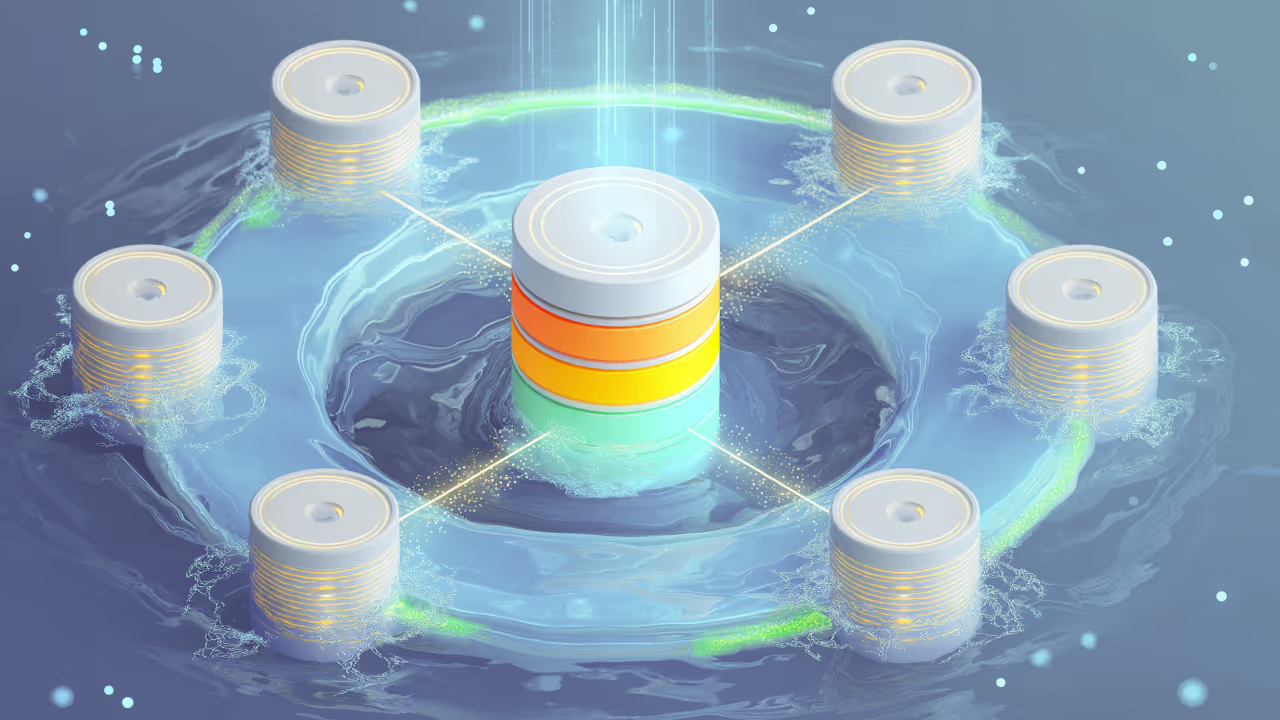

Getting data into a data lake sounds simple enough. It's not. The difference between a well-architected ingestion layer and a chaotic data swamp comes down to method, governance, and design. This guide explains the core components of data lake ingestion, compares batch, streaming, and change data capture (CDC) approaches, and walks through the best practices that keep pipelines scalable and trustworthy as data volumes grow.
Here are the main points to keep in mind:
Raw data does not become usable information on its own. For analytics, AI, or machine learning to work, data has to flow from multiple sources into a centralized environment that can handle massive scale.
That's where data lake ingestion comes in.
Data lake ingestion collects data from multiple sources and loads it into a data lake (typically cloud-based platforms like Amazon S3, Azure Data Lake, or Google Cloud Storage). Unlike traditional extract, transform, load (ETL) pipelines that transform data before loading, ingestion prioritizes speed and scale: get data in first, then prepare and model it later as needed.
Done well, data lake ingestion gives organizations a single, flexible foundation for analytics, combining structured, semi-structured, and unstructured data from across the enterprise. Done poorly? Duplication, latency, and governance headaches that ripple across every downstream process.
A modern ingestion layer must handle a growing variety of data, including structured data from relational databases and applications, semi-structured data like JSON, XML, or log files, and unstructured data such as images, video, or internet of things (IoT) sensor readings.
The data lake ingestion process follows a predictable sequence, though the specifics vary by organization. A typical flow moves through these stages:
This sequence serves as a reference architecture rather than a rigid checklist. Teams adapt it based on their data stack, governance requirements, and business needs.
Whether you're a data engineer building ingestion jobs or a CIO overseeing enterprise data modernization, understanding the mechanics and best practices of data lake ingestion is critical for long-term analytics success.
Understanding the distinction between ingestion, ETL, and ELT helps teams choose the right approach for different scenarios. Ingestion focuses on getting data into a central repository quickly. ETL transforms data before loading, enforcing structure upfront. ELT loads raw data first, then transforms it within the destination system using its compute power.
Ingestion is the front door to your data ecosystem. It feeds downstream ETL, transformation, and analytics processes.Data lake architectures typically combine ingestion with ELT patterns, loading raw data first and applying transformations as needed for specific use cases.
{{custom-cta-1}}
Organizations invest in data lake ingestion because it solves fundamental problems that traditional data integration approaches struggle with.
The following advantages explain why data lake ingestion has become central to modern data architectures:
A successful data lake ingestion architecture isn't just about moving data. It's about making sure every piece of the process is optimized for scale, reliability, and visibility. Each component plays a distinct role in turning raw, fragmented data from dozens (or hundreds) of sources into a unified, governed asset that's ready for analytics.
These components map to a zone-based architecture where data progresses from raw landing zones through validation and enrichment stages. From data collection to governance, the following layers form the foundation of any modern data lake ingestion framework:
Metadata ingestion is the automated capture and registration of information about data assets as they enter the lake. While data ingestion moves the actual records, metadata ingestion captures everything needed to understand, find, and govern those records.
Three types of metadata are typically captured during ingestion:
Metadata can be captured through several mechanisms. Automated crawlers scan storage locations on a schedule to detect new or changed assets. Event-driven hooks trigger at pipeline completion to register assets immediately. Lineage emitters compatible with standards like OpenLineage capture the relationships between datasets as pipelines execute.
Without metadata ingestion, data assets become undiscoverable and ungovernable. That is a primary cause of data lakes becoming data swamps (not because of the data itself, but because no one knows what's in it or whether it can be trusted).
Different data sources have different velocity, volume, and consistency requirements. A nightly batch extract from an enterprise resource planning (ERP) system looks nothing like a continuous stream of clickstream events or a CDC feed from a transactional database.
Batch ingestion collects data in discrete chunks on a scheduled basis: hourly, daily, or weekly. The pipeline extracts a full or incremental snapshot from the source, transforms it if needed, and loads it to the lake as a single operation.
Choose batch ingestion when:
Batch ingestion remains the workhorse for many enterprise data sources, particularly legacy systems and applications that expose data through file exports or scheduled database queries. Teams sometimes default to full-table refreshes when incremental loads would suffice, creating unnecessary load on source systems and inflating storage costs. That detail often gets overlooked.
Streaming ingestion captures data continuously as events occur. Records flow from source to lake in near-real-time, typically through message queues or event streaming platforms.
Choose streaming ingestion when:
Streaming pipelines require careful design around two concepts. Idempotency ensures that reprocessing duplicate events does not corrupt downstream data. If the same event arrives twice, the result should be the same as if it arrived once. Checkpointing allows pipelines to resume from the last confirmed position after a failure, preventing data loss without requiring a full replay.
CDC captures row-level changes (inserts, updates, deletes) from source databases in near-real-time without requiring full table scans. Rather than extracting entire tables on a schedule, CDC reads the database's transaction log to identify what changed since the last extraction.
Choose CDC when:
CDC sits between batch and streaming in terms of latency. It's faster than nightly batch extracts but doesn't require the source application to emit events explicitly. For transactional databases with high change rates, CDC often provides the best balance of freshness, efficiency, and source system impact. However, CDC requires database-level permissions and transaction log access that some database administrators (DBAs) are reluctant to grant. Plan for those conversations early.
Most organizations need multiple ingestion methods working together.
A hybrid architecture might use batch ingestion for historical backfills, CDC for transactional databases, and streaming for event-driven sources. All feeding the same lake. The key to making hybrid work is a consistent zone-based architecture. Regardless of how data arrives, it lands in a raw or landing zone first. From there, validation pipelines promote data through bronze (validated), silver (conformed), and gold (business-ready) zones. The ingestion method determines how quickly data reaches the landing zone; the zone progression determines how quickly it becomes trustworthy and usable.
This separation means teams can change ingestion methods without disrupting downstream consumers.
A retail data engineer consolidating sales data from 50 store systems uses batch ingestion. Each store's point-of-sale system exports daily transaction files overnight. The ingestion pipeline collects these files, validates record counts against source system totals, and loads them to the lake partitioned by date and store. Latency tolerance is 24 hours, and the stores' legacy systems can't support real-time extraction.
A fintech platform syncing transactional records to a lake without disrupting source database performance uses CDC. The core banking system handles thousands of transactions per second, and full table extracts during business hours would degrade application performance. CDC reads the database transaction log to capture inserts, updates, and deletes as they occur, maintaining a complete audit trail while keeping source system load minimal.
An IoT operations team capturing sensor telemetry from manufacturing equipment uses streaming ingestion. Sensors emit readings every second, and the operations team needs to detect anomalies within minutes to prevent equipment failures. The streaming pipeline ingests events through Kafka, applies lightweight validation, and lands data in the lake partitioned by equipment ID and timestamp.
A healthcare analytics team building a patient data platform uses a hybrid approach. Claims data arrives in nightly batch files from payers. Electronic health records sync via CDC from the clinical system. Patient-reported outcomes flow through a streaming pipeline from mobile applications. All three sources land in the same lake, progressing through shared validation and governance gates before reaching the gold zone where analysts build reports.
Building a resilient data lake starts with how data enters it. Effective ingestion determines whether your analytics are fast, accurate, and scalable, or plagued by inconsistencies.
Most organizations need a hybrid approach. Batch ingestion handles periodic bulk loads (like nightly ERP extracts), while streaming ingestion captures real-time events (like clickstreams or IoT telemetry). Architect pipelines that support both modes using tools such as Apache Kafka, AWS Kinesis, or Domo connectors to ensure flexibility as data velocity increases.
Use event-driven microservices or triggers to minimize latency without overloading systems.
Unlike traditional warehouses that require rigid schema definitions upfront, data lakes thrive on schema-on-read. You can ingest raw data as-is and apply structure later when querying. This reduces ingestion friction and supports future analytical needs without frequent redesigns.
Store metadata separately using a catalog like AWS Glue or Domo's data governance tools to make schema discovery easy. A word of caution: schema-on-read doesn't mean schema-never. Teams that skip schema documentation entirely often find their lakes become unusable within months because no one remembers what each field means.
A consistent naming convention and partition strategy improve both discoverability and performance. Organize files by key dimensions, like date, region, or source system, to optimize query performance and lifecycle management.
Example:
s3://company-data-lake/sales/year=2025/month=10/region=us/
Partition pruning allows engines like Spark or Domo's Magic ETL to scan only the data needed, reducing costs and speeding results.
Catching issues early prevents downstream failures. Add validation steps that check for nulls, duplicates, out-of-range values, or schema mismatches before data lands in the lake.
Use lightweight checks like record counts vs. source system, hash totals for numeric validation, and schema conformity verification. Domo's AI-powered quality checks can automatically detect anomalies or pattern shifts during ingestion and route findings to people for review within governed controls.
When records fail validation, route them to a quarantine zone or dead letter queue rather than silently dropping them or aborting the entire pipeline. This approach preserves the good data while flagging problems for investigation. Deduplication keys prevent duplicate events from corrupting downstream aggregations (particularly important for streaming pipelines where the same event might arrive multiple times). Idempotent pipeline design ensures that replaying a failed job produces the same result as running it once.
Every ingestion job should automatically register metadata: source, timestamp, schema, owner, and transformation steps. This ensures traceability and simplifies governance audits.
Automated lineage visualization, such as Domo's integrated data governance layer, helps teams understand dependencies and assess the impact of schema or pipeline changes instantly.
Schema evolution handling deserves particular attention. When a source schema changes (a new column appears, a field is renamed, a data type shifts) the pipeline needs a defined response. Soft enforcement logs the change and continues processing, allowing downstream systems to adapt gradually. Hard enforcement halts the pipeline and routes the job to a review queue, preventing unexpected schema changes from propagating.
As data volumes grow, even efficient pipelines can strain budgets. Use compression formats (Parquet, ORC) and lifecycle policies to tier older data to cheaper storage.
Best practices include storing raw data in compressed columnar formats, using object storage versioning for rollback capability, and using serverless compute (AWS Lambda, BigQuery, Domo Cloud) for elasticity.
Avoid creating one-off ingestion scripts for every source. Instead, use reusable templates or parameterized pipelines with configurable variables like table name, frequency, and credentials.
Advantages include faster onboarding of new sources, easier maintenance and updates, and lower operational risk. Tools like Domo's reusable connectors and APIs make it easy to extend ingestion logic across hundreds of sources without custom coding.
Even the best pipelines fail occasionally. Continuous monitoring ensures reliability. Set up alerts for failed loads, data drift, or performance degradation, and maintain audit logs for each ingestion event.
A well-instrumented ingestion pipeline tracks specific metrics that indicate health and reliability:
Domo provides unified monitoring dashboards that display ingestion job status, performance metrics, and lineage in one view.
Even the most well-designed data lake ingestion frameworks face challenges. Many ingestion challenges are governance challenges in disguise: schema drift, duplicate data, and ungoverned raw zones all become harder to fix the longer they go undetected.
You'll notice that most of these problems compound over time. A schema drift issue that goes undetected for a week creates far more downstream damage than one caught on day one.
{{custom-cta-2}}
While ingestion establishes the foundation, true insight comes from integration and transformation. As data ecosystems expand, manual ingestion scripts often struggle to keep pace with changing sources and governance demands. That's when automation, AI, and no-code orchestration become critical.
Domo works on top of existing cloud data platforms to orchestrate ingestion, automation, and governed outcomes across business workflows.
Capabilities that extend beyond ingestion include:
Domo integrates with major cloud data lakes while adding layers of automation, governance, and collaboration that traditional ingestion pipelines can't match.
Domo helps you:
Data lake ingestion is the engine that fuels analytics, machine learning, and BI. When pipelines are designed with scalability, governance, and automation in mind, they transform raw data chaos into a continuously updated asset that supports more informed decisions.
Ready to modernize your data lake ingestion? Contact Domo to see how the unified platform helps teams ingest, manage, and analyze data with less complexity and compromise.