Partecipa all'AI + Data Tour per una formazione pratica, storie di clienti reali e incontri con gli esperti di prodotto Domo vicino a te.
Registrati ora
Every operations team knows the feeling. Budget says one thing, the field rep says another, and finance (of course) has its own version. You end up with several numbers for the same customer, same month, and someone has to figure out which one is right before the forecast goes out the door.
That reconciliation process eats hours and buries analysts in spreadsheets. And, even still, that process leaves room for the kind of surprises nobody caught in time, the ones that surface two weeks after the forecast went out.
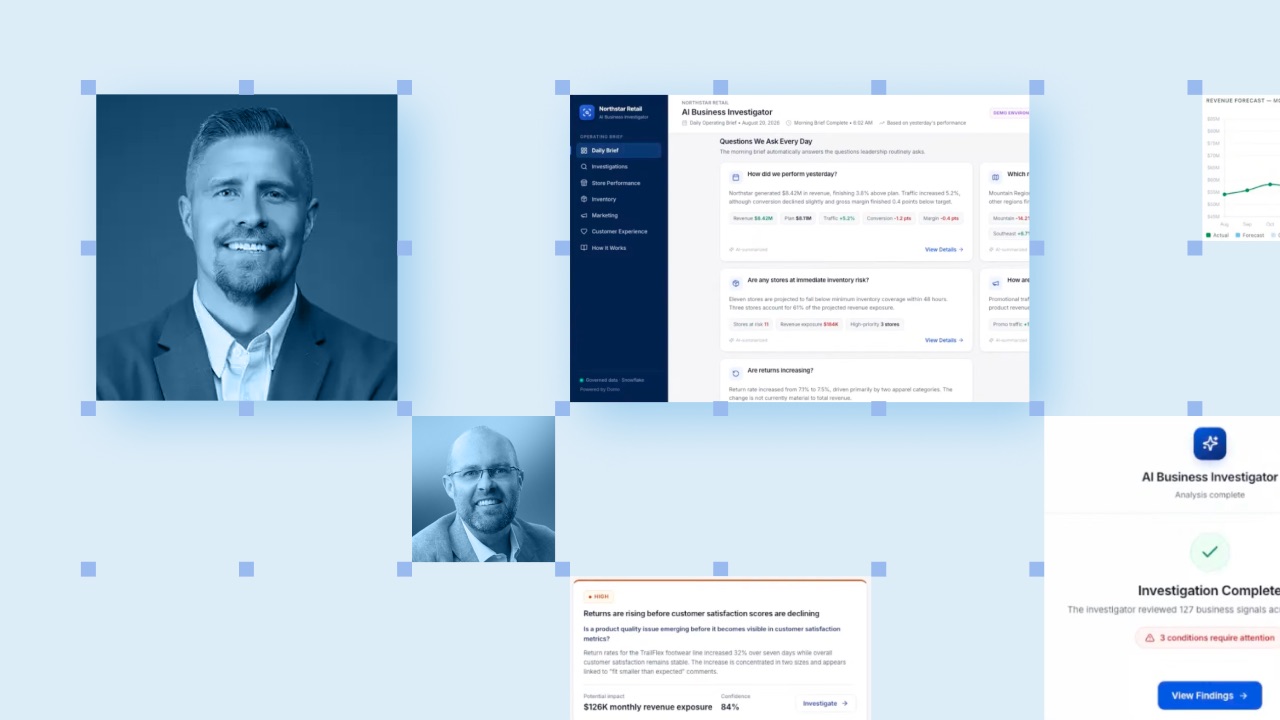
In a recent Domo AI livestream, Heather Dilts, sales engineer at Domo, walked me through a framework that changes this math entirely. Using a national industrial distributor's data, Heather demonstrated how an AI agent can layer all three forecasting perspectives into a single, reconciled view, with anomalies already flagged and explanations already written.
The result is a structured process any operations team can adopt, as long as you have her three-perspective forecasting framework.
The first perspective is the simplest and the most static: the annual budget, broken down by customer and month.
This is the number the organization committed to at the start of the fiscal year. It reflects planned targets, historical averages, and the assumptions leadership made before conditions shifted. An AI agent pulls this baseline automatically for every customer in every period. No one has to look it up or ask finance to re-export a file.
The key here is treating the budget as context, not as the final answer. Budgets age quickly, and market conditions change. The baseline tells you where the organization expected to be, but it cannot tell you where things actually stand.
The second perspective comes from the people closest to the customer: field sales reps.
Reps submit their own forecasts based on conversations, order patterns, and on-the-ground signals that never make it into a planning model. A rep might know that a major customer is ramping up a new facility, or that a long-standing account is pulling back due to a leadership change. Those signals carry real weight.
The agent compares each rep's submission against the budget baseline and flags significant gaps. If a rep forecasts 40 percent above budget for a given customer, the system checks that number against seasonality patterns, recent order trends, and customer health indicators to determine whether the deviation makes sense.
When something looks unusual, the agent generates a written explanation. Not a red/yellow/green status dot, but actual language describing what looks off and why.
Then, that explanation stays attached to the number, so anyone reviewing the forecast later can see the reasoning without scheduling a follow-up call.
The third perspective belongs to the finance team, which applies its own lens to the data.
Finance reviewers look at margins, payment history, credit risk, and portfolio-level trends that individual reps may not see. Their adjustments often reflect organizational priorities (reallocating targets across regions, for example) or corrections based on patterns visible only at scale.
The agent treats the finance review as another input, not as an override. All three numbers sit side by side for every customer and every month: budget baseline, field submission, and finance adjustment. Each one carries a tag showing its source, so the final reconciled forecast has full attribution.
This is where the framework gets its real power. Instead of a single number that obscures who contributed what, the reconciled forecast is transparent. A regional VP can see that the budget expected $120,000, the rep submitted $145,000 based on a new contract, and finance adjusted to $138,000 after factoring payment history. All three perspectives are visible, and all three have context.
Reconciling three perspectives is only half the job. The other half is catching the patterns that humans tend to miss when they are moving fast.
The agent that Heather shared compares each reconciled forecast against several reference points, including:
When a pattern breaks, the agent does not just flag it. It writes an explanation. "Customer X's June forecast is 35 percent above the three-year seasonal average for this period. The field rep's submission cites a new facility buildout, which is consistent with the 22 percent increase in order frequency over the past 90 days." That narrative turns a data point into a decision.
Obviously, forecasts don't exist in a vacuum. When revenue projections shift, labor requirements shift with them.
The agent translates the reconciled forecast into predicted labor hours by location and skill category. If the numbers suggest a 20 percent volume increase at a distribution center next month, the system calculates the additional staffing needed and presents it as a one-click decision, rather than waiting for a separate workforce planning cycle to catch up.
The important distinction here is bounded autonomy. The agent predicts and recommends, then a human approves. Every action carries a clear audit trail showing what the agent calculated, what data it used, and who made the final call.
Every final number in the reconciled forecast carries a tag showing where it came from and how the system derived it. This builds trust (reviewers can trace any surprising number back to its origin) and creates an audit trail that satisfies governance requirements in regulated industries or organizations with strict financial controls.
This three-perspective framework turns forecasting from a negotiation into a structured, transparent process. Budget provides the plan. Field reps provide the signal. Finance provides the guardrails. Lastly, an AI agent handles the comparison, the writing, and the surfacing of what matters, so human operators can focus on judgment calls instead of data wrangling.
This framework is just one piece of what the livestream covered. Heather also demonstrated cross-industry templates showing how the same agentic pattern applies to healthcare, manufacturing, and utilities.
So, watch the full session to see the framework in action and explore how agentic operations can fit into the forecasting workflows your team already runs.






.png)

.jpeg)