What Is Enterprise Application Integration (EAI)?
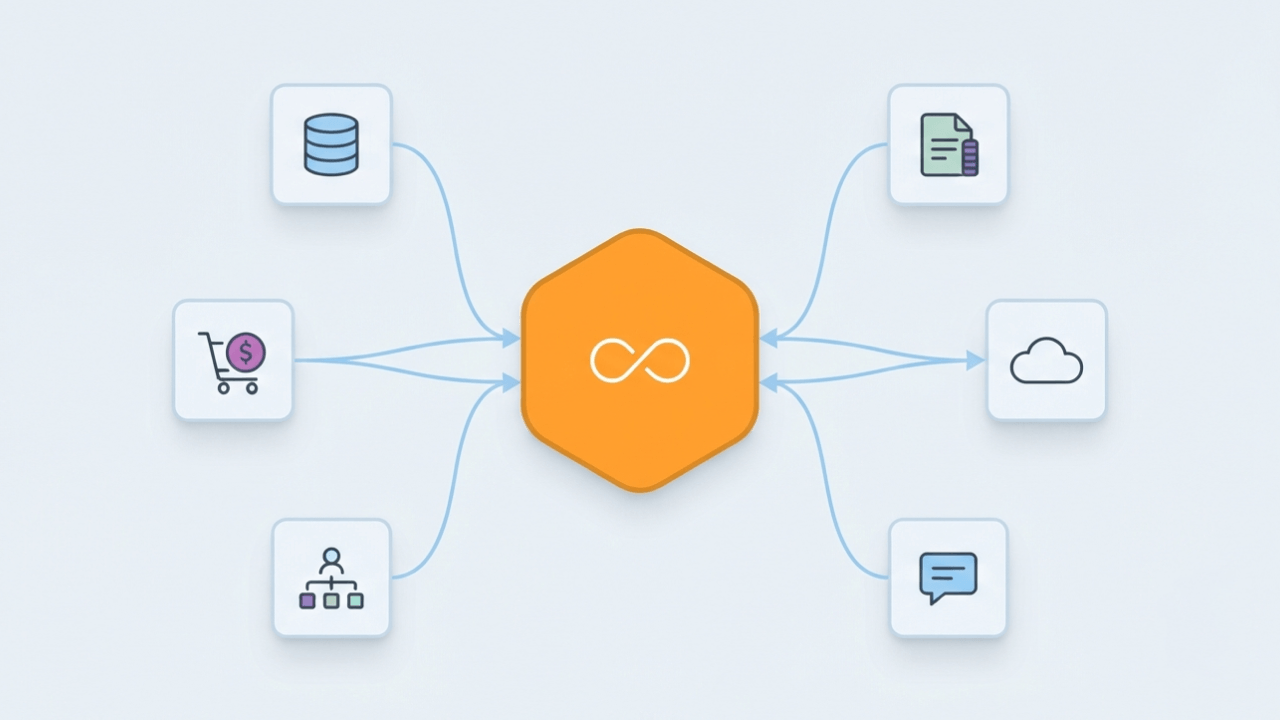

Enterprise application integration (EAI) is what keeps orders, inventory, billing, and support systems from drifting out of sync. When it works, processes move forward automatically and teams stop playing "human middleware."
Key takeaways
Here are the main points to keep in mind:
- Definition: Enterprise application integration (EAI) connects business applications so data and processes flow automatically between systems without manual intervention.
- Stack position: EAI sits between your applications and your automation or orchestration layer, enabling transactional processes rather than just analytical reporting.
- Not the same as ETL: EAI focuses on application-to-application process continuity in near-real-time, while ETL moves data in batches to warehouses for analysis.
- AI dependency: AI agents and automated workflows often rely on EAI as a foundation. Without it, they may not be able to pull current data from multiple systems when decisions need to happen quickly.
What is enterprise application integration?
Enterprise application integration (EAI) connects separate business applications so they share data and trigger actions automatically. Your CRM, ERP, inventory system, and other tools work together without someone manually exporting files or copying information between screens.
Consider what happens when a customer places an order. Without EAI, someone has to take that order from the sales system and manually enter it into the warehouse system. The inventory count doesn't update until hours later. Meanwhile, another salesperson might promise stock that's already committed elsewhere.
EAI eliminates that gap. The order lands in the CRM, the integration automatically notifies the warehouse, updates inventory, and triggers fulfillment. No human intervention required.
Unlike batch data integration that moves information to a warehouse overnight for reporting, EAI typically operates in near-real-time. It supports transactional processes like order fulfillment, customer onboarding, and payment processing where delays create real problems.
| Approach | Primary purpose | Typical latency | Example |
|---|---|---|---|
| EAI | Application-to-application process flow | Real-time to near-real-time | Order in CRM triggers fulfillment in ERP |
| ETL/ELT | Data consolidation for analytics | Batch (hourly/daily) | Sales data loaded to warehouse nightly |
| iPaaS | Cloud-native integration platform | Varies | SaaS-to-SaaS connectors |
| API management | Expose and govern APIs | Real-time | Rate limiting for public APIs |
A quick way to know which you need: ask what happens if the integration goes down for five minutes. Dashboard gets slightly stale? You're building analytical integration. Customers can't complete purchases? That's EAI.
Why enterprise application integration matters
Disconnected systems force people to become the middleware. Teams spend hours reconciling spreadsheets, chasing down data mismatches, and manually moving information between applications. No wonder so many organizations struggle to get a unified view of their operations. Teams spend hours reconciling spreadsheets, chasing down data mismatches, and manually moving information between applications.
When EAI works well, those manual handoffs disappear. Operations teams stop spending their mornings reconciling yesterday's orders. Inventory stays accurate across channels. Customer service reps see the same information regardless of which system they check.
The operational improvements show up in specific ways:
- Eliminates manual data transfer: Integrations handle order-to-fulfillment handoffs automatically, freeing operations teams from spreadsheet reconciliation.
- Enables current visibility: Inventory, customer status, and financial data stays synchronized across systems.
- Reduces connection sprawl: A coherent integration approach prevents the multiplication of point-to-point connections that become impossible to maintain.
- Supports compliance: Centralized integration creates one place to log data movement and enforce access controls.
AI is raising the stakes here. AI agents need to act on data from multiple systems. Approving a credit application, recommending inventory reorders, flagging fraud. They depend on EAI to access current, accurate information. Organizations investing in AI without solid integration infrastructure discover their agents can't get the data they need, or worse, they act on stale information.
Enterprise application integration architectures and patterns
The architecture you choose determines your flexibility, reliability, and maintenance burden. A pattern that works for three stable systems becomes unmanageable at scale. One designed for enterprise complexity might be overkill for simpler needs.
Point-to-point integration
Each application connects directly to every other application it needs to communicate with. Simple for two or three systems with stable interfaces.
The math works against you quickly. Ten applications? You're looking at potentially 45 individual integrations to build and maintain. Any change to one system's API cascades across multiple connections. Use this only for small-scale integrations between a handful of systems that rarely change.
Hub-and-spoke integration
All applications connect to a central hub that routes messages and transforms data. Each application needs only one integration to the hub, which dramatically reduces the number of connections.
The hub becomes your single point of control. Great for governance and audit trails, since all data movement flows through one location. But it's also a single point of failure. Organizations with strict compliance requirements often prefer this model. High-throughput scenarios? The hub becomes a bottleneck.
ESB bus integration
An Enterprise Service Bus extends hub-and-spoke with protocol mediation, content-based routing, and multi-step orchestration (see an example of workflow orchestration). The ESB acts as intelligent middleware that can transform messages and coordinate complex processes.
ESBs require specialized skills to configure and maintain. Many organizations that adopted them in the 2000s are now migrating to lighter-weight approaches. They still make sense for complex enterprise environments with heterogeneous protocols and teams with ESB expertise.
Event-driven architecture
Applications publish events to a message broker, and other applications subscribe to relevant events. The publishing application doesn't need to know who's listening.
This pattern supports real-time processing and scales horizontally. It's well-suited to cloud environments and microservices. But event-driven systems require careful design around event schemas, ordering guarantees, and failure handling. Without attention to idempotency (ensuring the same event processed twice doesn't cause errors) you'll introduce hard-to-debug issues. Teams often underestimate the complexity of event ordering; two events that arrive out of sequence can corrupt downstream state if your handlers assume chronological delivery.
Enterprise application integration vs related concepts
Vendors use EAI, iPaaS, ESB, and API management interchangeably. These terms describe different things, and choosing the wrong approach wastes budget.
EAI vs iPaaS
iPaaS (Integration Platform as a Service) is a cloud-hosted platform that provides EAI capabilities as a managed service. EAI is the practice; iPaaS is one way to implement it.
Teams with strong integration expertise and specific requirements might build custom EAI. Teams that want managed infrastructure and pre-built connectors often choose iPaaS. The mistake here is assuming iPaaS eliminates the need for integration strategy. It handles infrastructure, not architecture decisions.
EAI vs ESB
ESB is one architectural pattern for implementing EAI. Saying "EAI vs ESB" is like saying "transportation vs car." Focus on capabilities (routing, transformation, orchestration) rather than category labels.
EAI vs ETL
EAI connects applications to support business processes. ETL moves data to warehouses for analytics. EAI operates in real-time or near-real-time; ETL typically runs in batches.
Some platforms offer both. The distinction matters when latency requirements differ. A nightly batch works fine for analytics dashboards but fails for order processing.
EAI vs API management
API management focuses on exposing, securing, and monitoring APIs. Rate limiting, authentication, usage analytics. EAI focuses on the integration logic itself: transforming data, routing messages, orchestrating workflows.
Many organizations use API management as the external interface and EAI as the internal plumbing. A customer-facing API might be governed by an API management layer, which routes requests to an EAI layer that coordinates across backend systems.
Enterprise application integration challenges
An integration that works in testing often breaks in production because it can't handle the volume. Or it passes data that violates compliance requirements. Or it fails silently for days before anyone notices.
Security and compliance
Every integration point needs explicit access controls. Use OAuth 2.0 for API-based integrations and mutual TLS for service-to-service communication. Role-based access limits what each integration can touch.
Integrations should pass only the data needed for the downstream process. Not entire records. This reduces exposure if an integration is compromised. Store API keys and credentials in a secrets manager, not in config files. Log integration activity, but log metadata rather than sensitive payload content.
Regulated industries face specific requirements that shape architecture decisions from the start, not as an afterthought.
Scalability and performance
How many messages per second does the integration need to handle? A hub-and-spoke model that works for hundreds of messages per hour may bottleneck at thousands per minute.
What's the acceptable delay? Real-time order processing has different requirements than nightly data sync. Can the integration handle traffic spikes during end-of-quarter reporting or sales events?
Architectures that scale well often require more operational complexity.
Reliability and observability
When an integration fails at 2am, how long until someone notices? How do they diagnose the problem? How do they recover the data that didn't make it through?
Design integrations so processing the same message twice doesn't cause errors. Duplicate orders. Double charges. This idempotency is essential for retry logic. Failed messages need somewhere to go for review and reprocessing, not silent discard. Track success rates, latency, and error rates. Alert on anomalies before they become outages.
Governance and lifecycle
Without governance, integrations proliferate without documentation, ownership, or maintenance plans. Teams build point-to-point connections to solve immediate problems, then leave the organization when those connections become critical infrastructure no one understands. This pattern shows up often, especially when point-to-point fixes become business-critical over time.
Every integration needs an owner responsible for maintenance and updates. Document what data flows, between which systems, on what schedule, with what error handling. Define how changes are tested, deployed, and rolled back. Plan for what happens when a source or target system is deprecated.
How Domo supports enterprise application integration
Many organizations treat EAI and analytics as separate problems, which often leads to duplicated work and inconsistent governance.
Domo supports EAI-adjacent integration needs through three layers:
- Foundation: Connect, prepare, and govern data so it's AI-ready, with lineage and access controls that carry through.
- Activation: Turn governed data into action with human-in-the-loop AI agents, apps, and workflows. People set objectives and constraints, and automation executes within those boundaries.
- Distribution: Deliver outcomes into the tools and workflows teams already use, including embedded experiences, alerts, and workflow steps (dashboards are one option, not the only one).
The platform offers a large library of pre-built connectors to cloud applications, databases, APIs, and on-premises systems. Drag-and-drop and SQL-based tools let teams clean, join, and model data as it flows through. Role-based access controls, audit trails, and data lineage persist from ingestion through AI agents to final delivery.
Domo's AI agents operate with bounded autonomy and human-in-the-loop control. People set objectives, permissions, and constraints, and agents execute workflows and coordinate next steps on governed data.
The platform is unified by design and composable by adoption. You can start with data integration to solve a specific problem and expand as needs grow. Governance persists across all compositions.
Domo excels when the goal is unified data access for analytics, automation, and AI-driven workflows. Organizations whose primary need is high-volume, low-latency transactional integration between operational systems may need specialized EAI middleware alongside Domo's capabilities.
Final thoughts
Enterprise application integration isn't a technology decision. It's an architectural commitment that shapes how data flows, how processes connect, and how quickly you can adapt when systems change.
The organizations that get EAI right treat it as infrastructure, not a project. They invest in governance, plan for failure, and choose architectures that match their actual scale and complexity. Increasingly, they recognize that integration isn't just about connecting systems. It's about creating the foundation for AI and automation to deliver outcomes.
If you're ready to turn "connected systems" into workflows and AI-ready action, get a demo and see how Domo brings integration, governance, and automation together in one place.