What Is AI Agent Orchestration? Examples & Benefits

As organizations scale from single AI agents to multi-agent systems, orchestration becomes the coordination layer that determines whether those agents produce coherent results or chaos. This article explains what AI agent orchestration is, how it differs from traditional automation, the architectural patterns available, and what to look for when selecting an orchestration platform for enterprise deployment.
Key takeaways
Here are the key points to know:
- AI agent orchestration coordinates multiple autonomous AI agents to work together on complex tasks, acting as the conductor that ensures agents communicate, share data, and execute in harmony.
- Organizations can choose from five orchestration types (centralized, decentralized, hierarchical, event-driven, federated) based on their control requirements and operational complexity.
- Effective orchestration breaks down silos, improves governance, accelerates decision-making, and enables AI systems to scale without fragmenting.
- Implementation challenges include integration with legacy systems, data quality requirements, governance complexity, and organizational readiness.
- Successful AI agent orchestration requires a platform that provides governed data access, flexible agent coordination, and distribution of outcomes into existing workflows.
What is AI agent orchestration?
About 50 percent of companies using generative AI will launch agentic AI pilots by 2027, according to Deloitte. That number signals something bigger than adoption trends. It marks a fundamental shift in how businesses approach artificial intelligence, moving beyond single-model applications to systems where multiple AI agents collaborate to solve problems, automate workflows, and generate insights.
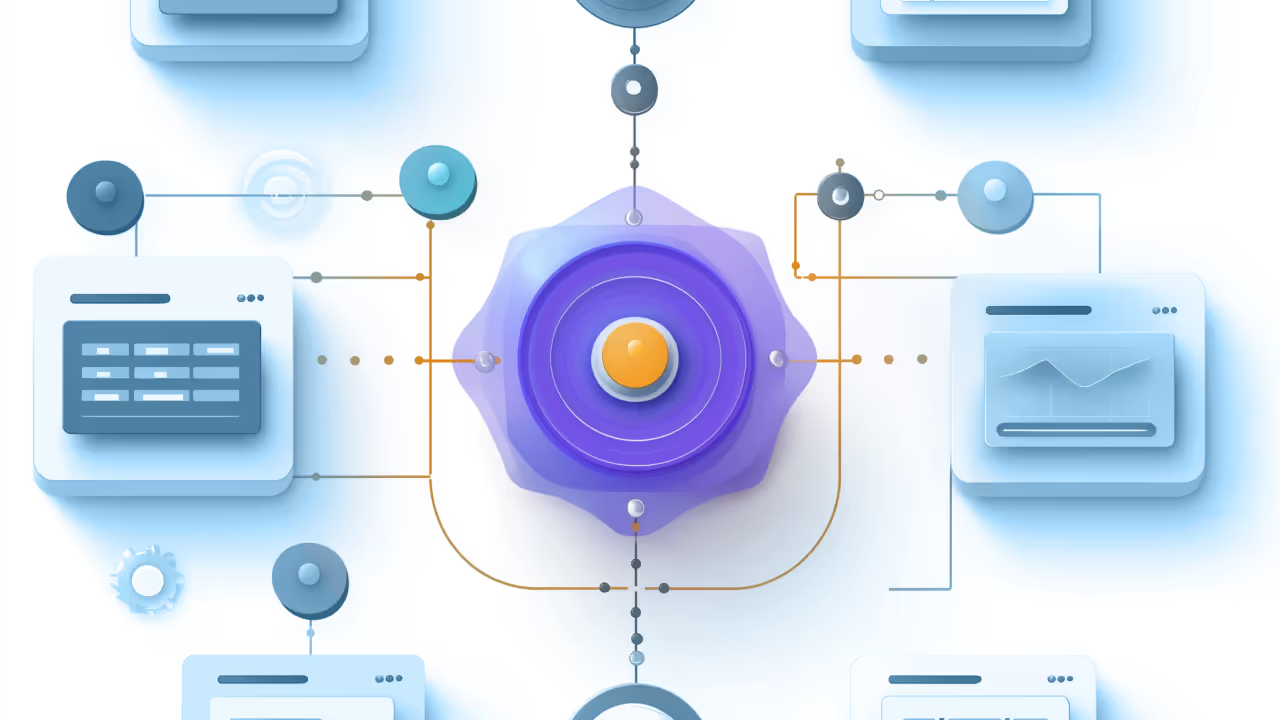
AI agent orchestration is the coordination layer that manages how multiple autonomous AI agents communicate, share data, and execute tasks together to achieve a common goal. Think of it as the conductor of an orchestra: individual agents are skilled musicians, but without coordination, they produce noise rather than music. The orchestrator ensures each agent knows when to act, what information to use, and how to hand off work to the next agent in the workflow.
This is distinct from generic IT orchestration or data pipeline orchestration. AI agent orchestration specifically coordinates agents that can plan, reason, use tools, and adapt their behavior based on context. These agents are not following rigid scripts. They're making decisions within defined boundaries, which makes coordination both more powerful and more complex.
What is an AI agent?
An AI agent is a software program designed to act autonomously within a defined environment to achieve specific goals. Unlike traditional scripts or models that only execute when prompted, AI agents can perceive inputs, make decisions based on rules or learned patterns, and take actions that influence outcomes. They're often powered by large language models, machine learning algorithms, or a combination of both, and can interact with data, systems, or even other agents to complete tasks.
How orchestration differs from single-agent AI
Running a single AI agent is relatively straightforward. You give it a task, it executes, and you get a result. But as organizations scale their AI initiatives, they quickly discover that one agent cannot handle the complexity of enterprise operations. Different tasks require different capabilities. Attempting to build a single agent that does everything leads to bloated, brittle systems.
AI agent orchestration solves this by treating agents as specialized team members rather than all-purpose tools. One agent might excel at data extraction, another at pattern recognition, and a third at generating human-readable summaries. Orchestration coordinates these specialists so their combined output is greater than what any single agent could achieve alone.
To clarify what AI agent orchestration is and is not:
- AI agent orchestration is the coordination of autonomous agents that plan, reason, and use tools to complete complex tasks collaboratively.
- AI agent orchestration is not traditional workflow automation, which follows predefined rules without adaptation.
- AI agent orchestration is not data orchestration, which focuses on moving and transforming data through pipelines.
- AI agent orchestration is not container orchestration, which manages infrastructure resources rather than intelligent decision-making.
This is the foundation of agentic AI in the enterprise: systems where multiple autonomous agents collaborate under governance to deliver business outcomes.
{{custom-cta-1}}
AI agent orchestration vs traditional automation
Why does the distinction matter? Because choosing the wrong approach for your use case leads to either unnecessary complexity or insufficient capability.
Traditional automation follows predefined rules. Robotic process automation (RPA), for example, executes the same sequence of steps every time, regardless of context. If the input format changes or an unexpected condition arises, the automation breaks. Workflow orchestration tools like Apache Airflow or Prefect add more sophistication by managing dependencies between tasks and handling failures gracefully, but the logic remains static.
AI agent orchestration introduces intelligence and adaptability. Agents can interpret ambiguous inputs, adjust their approach based on intermediate results, and collaborate with other agents to handle situations they weren't explicitly programmed for. The orchestration layer manages this collaboration while maintaining governance and accountability. However, this adaptability creates its own challenge: without clear boundaries, agents may interpret their scope too broadly or make decisions that conflict with business rules. Defining explicit guardrails upfront prevents agents from drifting outside their intended domain.
The following table summarizes the key differences:
Organizations often use all three approaches in combination.
How AI agent orchestration works
While AI agent orchestration involves a high level of automation, it begins with careful planning and design by people (AI engineers, developers, and business leaders). Once the orchestration framework is in place, it acts as the conductor, coordinating tasks among agents, streamlining workflows, and enabling collaboration.
At a mechanical level, orchestration coordinates several core components working together:
- Planner: Breaks down complex goals into subtasks and determines the sequence of agent actions
- Router: Directs each task or query to the most appropriate agent based on capabilities and context
- Tool executor: Manages how agents interact with external systems, application programming interfaces (APIs), and data sources
- State store: Maintains context and intermediate results across multi-step workflows
- Policy engine: Enforces governance rules, permissions, and guardrails on agent behavior
- Observability layer: Tracks agent actions, performance metrics, and outcomes for debugging and optimization
The orchestration process can be understood as a series of structured steps.
Assessment and planning
Organizations start by identifying goals, use cases, and requirements for the orchestration system. This step ensures clarity on what the orchestrated agents are expected to achieve and how success will be measured. Skipping this phase (or treating it as a formality) often results in agents that technically function but fail to align with business priorities.
Choosing specialized AI agents
Next, the right mix of agents is selected, each designed for a particular task, such as data analysis, decision-making, or communications. Having specialized agents ensures that the overall system can address complex workflows with precision.
Building the orchestration framework
Developers then implement the orchestration platform or framework. This is the backbone that governs how agents interact, setting rules for coordination, communication, and accountability.
Assigning agents to tasks
The orchestrator assigns roles and responsibilities to the agents based on their capabilities. Each part of the workflow gets handled by the most suitable agent.
Coordinating workflows and execution
Once tasks are assigned, the orchestrator directs the sequence of actions, manages dependencies, and ensures that tasks are completed in the right order without conflict or duplication.
Managing data sharing and context
Orchestration also handles how agents access and share data, ensuring consistency and context across the system. This step is especially important when dealing with big data or sensitive information.
Continuous optimization and learning
Finally, the orchestration system adapts over time, learning from past outcomes to improve efficiency and accuracy. Continuous optimization allows the system to handle evolving requirements and more complex scenarios.
The following table provides a quick reference for these steps:
{{custom-cta-2}}
Core orchestration capabilities
Effective AI agent orchestration requires specific capabilities that go beyond traditional workflow management. Understanding these capabilities helps organizations evaluate platforms and design systems that can handle the unique challenges of coordinating intelligent agents.
The following capabilities form the foundation of agent orchestration:
- Routing: Directs incoming requests or tasks to the appropriate agent based on intent, context, and agent capabilities. For example, a customer inquiry about billing routes to a billing specialist agent rather than a general support agent.
- Planning: Decomposes complex goals into subtasks and determines the optimal sequence of agent actions. A research task might be planned as: gather sources, extract key facts, synthesize findings, generate summary.
- Memory and state management: Maintains context across multi-turn interactions and multi-step workflows. This allows agents to reference earlier results, avoid redundant work, and build on previous outputs.
- Tool execution: Manages how agents invoke external tools, APIs, and data sources. This includes handling authentication, rate limiting, error handling, and result parsing.
- Retries and timeouts: Handles transient failures gracefully by retrying failed operations with appropriate backoff strategies and enforcing time limits to prevent runaway processes.
- Caching: Stores and reuses results from expensive operations (like calls to large language models or database queries) to improve performance and reduce costs.
- Policy enforcement: Applies governance rules that define what agents can access, what actions require approval, and what boundaries cannot be crossed.
- Observability and tracing: Provides visibility into agent behavior through logging, metrics, and distributed tracing. This enables debugging, performance optimization, and compliance auditing.
Routing ensures the right agent handles each task. Planning enables complex multi-step workflows. Memory prevents agents from losing context. Tool execution connects agents to the systems they need. Retries and caching improve reliability and efficiency. Policy enforcement maintains governance. Observability enables troubleshooting and continuous improvement.
Orchestration architectures and patterns
Choosing the right orchestration architecture depends on your use case complexity, latency requirements, and governance needs. Two fundamental approaches exist: single-agent with tools and multi-agent systems.
Single-agent with tools uses one primary agent that can invoke various tools and capabilities as needed. This approach works well for straightforward tasks where one agent can handle the full workflow by calling different tools sequentially. Simpler to implement and debug. But it can become unwieldy as task complexity grows.
Multi-agent systems distribute work across specialized agents that collaborate to complete complex tasks. This approach handles sophisticated workflows more effectively but requires more careful coordination and introduces communication overhead.
Several common patterns have emerged for multi-agent orchestration:
- Supervisor-worker: A supervisor agent receives requests, delegates subtasks to worker agents, and aggregates their results. This pattern provides clear accountability and works well when tasks can be cleanly decomposed. The supervisor maintains overall context while workers focus on their specialties.
- Debate or critic: Multiple agents approach the same problem independently, then critique each other's outputs to arrive at a stronger answer. This pattern improves quality for tasks where verification matters, such as code review or fact-checking.
- Hierarchical planner: A high-level planner agent creates an execution plan, then delegates to mid-level coordinators who manage teams of specialized agents. This pattern scales to complex enterprise workflows with many moving parts.
- Graph-based workflows: Agents are nodes in a directed graph, with edges representing possible transitions based on conditions or outputs. This pattern offers maximum flexibility for dynamic workflows where the path depends on intermediate results.
When deciding between architectures, consider these factors:
- Task parallelism: If subtasks can run simultaneously, multi-agent systems offer performance benefits
- Domain separation: If tasks require distinct expertise (legal, technical, creative), specialized agents reduce complexity per agent
- Latency budgets: Single-agent approaches have lower coordination overhead for time-sensitive applications
- Evaluation confidence: If you need high confidence in outputs, debate patterns or human-in-the-loop checkpoints add verification layers
Most organizations start with single-agent approaches for initial use cases, then evolve to multi-agent patterns as they gain experience.
Benefits of AI agent orchestration
Coordinating AI agents through orchestration is what turns individual autonomous programs into a cohesive, scalable system. Instead of agents working in isolation, orchestration allows them to operate as part of a larger, connected framework.
Breaking down silos for agile growth
AI Business described AI agent orchestration as a driver of enterprise efficiency and growth. When AI agents are orchestrated, they can share information and collaborate across departments, functions, or platforms. This breaks down data and process silos, making it easier for organizations to scale quickly without duplicating work or losing visibility. The result is a more agile environment where innovation can happen sooner and with greater alignment.
Improved reliability, consistency, and governance
Orchestration provides guardrails that help ensure AI agents perform tasks in the right order and in a predictable way. This reduces the risk of errors, overlaps, or gaps in workflows and establishes a framework for accountability. By coordinating actions within clear AI governance structures, organizations can maintain oversight of how agents operate, ensuring compliance with policies and regulations. Human oversight remains central to this process. Agents operate with bounded autonomy, meaning humans set the objectives and constraints while machines execute and coordinate.
Scalability and flexibility
As the number of AI agents grows, orchestration helps manage the complexity. It provides a framework to add, remove, or reassign agents without disrupting the overall system. This is the part that separates pilots from production-ready deployments. Without it, you're just running a collection of disconnected experiments.
Optimized resource use
By coordinating when and how AI agents work, orchestration ensures that resources such as computing power, time, and data are used efficiently. Tasks are distributed intelligently, preventing bottlenecks and maximizing productivity across the system.
Shorter decision cycles
With orchestrated agents working in tandem, data can be processed, analyzed, and acted on more quickly. This accelerates decision-making by eliminating delays that often occur when tasks are handled in isolation, giving organizations a competitive edge in fast-moving environments. It also improves planning and forecasting to help you make decisions that keep your organization on the right trajectory.
Integration with existing systems
AI agent orchestration makes it easier to connect autonomous agents with legacy software, integrate enterprise platforms such as customer relationship management (CRM) systems and BI tools, and bring in external data sources. This smooth integration reduces friction and ensures that agents enhance, rather than disrupt, the systems businesses already rely on.
Orchestration also improves data integration by streamlining the way data flows across systems, departments, and platforms. By coordinating how agents interact with different data sources, orchestration ensures that information is collected, transformed, and shared in a consistent and reliable way.
Types of AI agent orchestration
AI agent orchestration can take different forms depending on how agents are managed, coordinated, and aligned to business goals. The choice of approach depends on the complexity of the environment, the number of agents involved, and the level of control or autonomy required.
Centralized orchestration
In this model, a central controller directs all AI agents, assigning tasks and managing their interactions. This provides strong oversight and ensures that workflows are executed in a structured, predictable way. Centralized orchestration is often used when compliance, auditability, or strict coordination is a top priority.
Decentralized orchestration
Here, AI agents coordinate with one another directly without relying on a single controller. Agents share information and make decisions collectively, which allows for more flexibility and resilience. Decentralized orchestration is useful for complex or dynamic environments where agents need to adapt quickly without waiting for central approval. Debugging becomes harder when no single component has full visibility into the workflow.
Hierarchical orchestration
This hybrid approach combines elements of centralized and decentralized orchestration. A central layer may assign broad goals or constraints, while subsets of agents collaborate more autonomously to carry out specific tasks. Hierarchical orchestration balances control with flexibility, making it suitable for large-scale systems with diverse functions.
Event-driven orchestration
In an event-driven model, orchestration is triggered by specific conditions or signals (a change in data, a system alert, or the completion of another task). Agents respond dynamically to these events, which makes this type of orchestration well-suited for operations where agility is critical.
Federated orchestration
Federated orchestration allows different groups of AI agents, often across separate organizations or data environments, to collaborate without sharing all of their underlying data. Each group maintains control over its own systems while contributing to a broader, coordinated outcome. This model is especially valuable in industries like healthcare or finance, where strict data privacy and regulatory requirements limit the ability to centralize information.
Multi-agent orchestration patterns
As AI adoption grows, the focus is shifting from individual agents to multi-agent systems that work together to solve complex problems. In these environments, agents specialize in different roles (gathering data, analyzing patterns, or generating recommendations) and their collaboration is orchestrated to produce cohesive results.
Collaboration between agents is especially powerful in the context of big data and augmented analytics. One agent might be responsible for combing through massive datasets, while another applies advanced analytics techniques, and a third translates insights into clear, human-friendly outputs. Together, these agents create a system that not only processes vast amounts of information but also provides actionable intelligence that decision-makers can trust.
When selecting an orchestration type, consider your governance requirements, the complexity of your workflows, and how much autonomy your agents need.
Key components of an AI agent orchestration platform
Evaluating AI agent orchestration solutions requires understanding what capabilities a platform should provide. Not every organization needs every feature, but the following components form the foundation of effective orchestration:
- Agent registry and lifecycle management: A central catalog of available agents with their capabilities, versions, and status. This enables the orchestrator to select the right agent for each task and manage updates without disrupting operations.
- Task scheduler and workflow engine: The mechanism that assigns work to agents, manages dependencies between tasks, and handles sequencing. This is the core of orchestration, determining what happens when and in what order.
- Communication and messaging layer: The infrastructure that enables agents to exchange information, share intermediate results, and coordinate their actions. Reliable messaging is essential for multi-agent collaboration.
- Data access and context management: Controls for how agents access data sources, what data they can see, and how context is maintained across a workflow. This layer ensures agents work with consistent, governed information.
- Governance and policy enforcement: Rules that define what agents can and cannot do, including approval workflows, audit logging, and compliance controls. Governance is what makes autonomous agents safe for enterprise use.
- Monitoring and observability: Dashboards and alerts that show what agents are doing, how they're performing, and where problems arise. Visibility into agent behavior is essential for troubleshooting and optimization.
- Integration connectors: Pre-built connections to enterprise systems, data platforms, and external services. The easier it is to connect agents to existing infrastructure, the faster organizations can realize value.
- Human oversight mechanisms: Interfaces that allow people to review agent decisions, approve sensitive actions, and intervene when needed. Human-in-the-loop capabilities are not optional for enterprise AI.
AI agent orchestration use cases
AI agent orchestration is being applied across industries to improve efficiency, uncover insights, and drive innovation.
Financial fraud detection
Banks and financial institutions use orchestrated agents to monitor transactions, flag unusual activity, and apply predictive analytics to assess the likelihood of fraud. By coordinating detection, analysis, and alerting agents, orchestration enables rapid responses that protect both businesses and customers.
Marketing analytics
Marketing teams rely on orchestrated agents to pull marketing analytics data from ad platforms, social media, and CRM systems. These agents transform raw inputs into insights that drive campaign decisions. When combined with AI reporting tools and dynamic reporting, teams can quickly spot trends, adjust strategies, and demonstrate ROI with precision.
Supply chain optimization
In manufacturing and logistics, orchestrated agents track inventory levels, monitor shipping conditions, and forecast demand. This coordination reduces bottlenecks and ensures materials arrive on time. Integrated with visual analytics, the results are displayed in dashboards that give supply chain managers visibility into operations.
Healthcare diagnostics
Multiple agents collaborate to review patient histories, lab results, and imaging data. Orchestration ensures that insights are combined into a comprehensive assessment, helping clinicians make timely, more accurate decisions while maintaining compliance with strict data governance rules.
Customer service automation
Contact centers use orchestrated AI agents to manage chatbots, route tickets, and analyze sentiment from conversations. Orchestration ensures that inquiries are handled consistently, whether by virtual assistants or escalated to human agents.
Business intelligence and reporting
Enterprises use AI agent orchestration to bring together data from multiple departments into a unified BI ecosystem. Agents handle extraction, transformation, and reporting, feeding AI reporting tools that generate automated dashboards. These systems support not only static reports but also dynamic reporting, giving leaders the ability to drill into insights and make decisions more quickly.
Worked example: customer support triage
To illustrate how AI agent orchestration works in practice, consider a customer support triage system that coordinates multiple specialized agents to handle incoming inquiries.
The workflow begins when a customer submits a support request through chat, email, or a web form. The orchestrator receives this request and initiates a multi-agent workflow.
Step 1: The router agent analyzes the incoming message to determine intent and urgency. It classifies the request (billing question, technical issue, account change, general inquiry) and assigns a priority level based on keywords, customer history, and sentiment analysis.
Step 2: Based on the classification, the orchestrator routes the request to the appropriate specialist agent. A billing question goes to the billing agent, which has access to payment systems and invoice history. A technical issue routes to the technical support agent, which can query product documentation and known issue databases.
Step 3: The specialist agent gathers relevant context by calling tools. The billing agent might retrieve the customer's recent invoices, payment status, and subscription tier. It uses this information to formulate a response or identify the specific issue.
Step 4: If the specialist agent determines the issue requires escalation (high-value customer, complex problem, or low confidence in the answer), it signals the orchestrator. The orchestrator then routes to a human review queue with all gathered context attached.
Step 5: For issues the agent can resolve, it generates a response and passes it to a quality check agent. This agent reviews the response for accuracy, tone, and completeness before delivery.
Step 6: The orchestrator logs the entire interaction, including agent decisions, tool calls, and outcomes. This data feeds back into continuous improvement, helping identify patterns in customer issues and opportunities to improve agent performance.
Throughout this workflow, the orchestrator maintains state, ensuring each agent has access to the context it needs without redundant data gathering. Policy enforcement ensures agents only access customer data relevant to their role, and human oversight mechanisms allow support managers to review agent decisions and intervene when needed.
How to choose an AI agent orchestration solution
Selecting the right orchestration solution requires balancing technical capabilities with organizational realities.
- Governance and compliance capabilities: Can the platform enforce policies, maintain audit trails, and support human oversight? For regulated industries, this is non-negotiable.
- Integration with existing data infrastructure: Does the solution connect to your data warehouse, cloud platform, and enterprise applications? Orchestration that requires rebuilding your data foundation creates unnecessary friction.
- Flexibility in orchestration patterns: Can you implement centralized, decentralized, or hybrid approaches as your needs evolve? Avoid platforms that lock you into a single model.
- Scalability and performance: Will the platform handle your current agent count and grow with you? Test with realistic workloads before committing.
- Developer experience and tooling: How easy is it to build, test, and deploy orchestrated workflows? Platforms with strong developer tools accelerate time to value.
- Vendor ecosystem and support: Does the vendor have a track record with enterprise customers? Are there partners and integrators who can help with implementation?
- Total cost of ownership: Consider not just licensing costs but also implementation effort, ongoing maintenance, and the cost of integration with your existing systems.
The build vs buy decision also matters. Building custom orchestration gives you maximum flexibility but requires significant engineering investment and ongoing maintenance. Buying a platform accelerates deployment and shifts maintenance burden to the vendor, but may constrain how you can customize agent behavior.
Operational reliability for agent orchestration
AI agents introduce unique operational challenges that traditional automation does not face. LLMs are nondeterministic. Tools can fail. Agents can get stuck in loops or produce unexpected outputs. Effective orchestration must account for these failure modes.
Common failure modes in agent orchestration include:
- Nondeterminism: The same input may produce different outputs across runs, making debugging and testing more complex
- Tool failures: External APIs may be unavailable, rate-limited, or return unexpected responses
- Loops: Agents may get stuck repeating the same action without making progress
- Hallucinated tool calls: Agents may attempt to call tools that don't exist or pass invalid parameters
- Partial execution: Workflows may fail midway, leaving state in an inconsistent condition
Mitigation strategies address each failure mode:
- Bounded planning: Limit the number of steps an agent can take before requiring human review or termination
- Max-iteration guards: Set hard limits on loops to prevent runaway processes
- Typed tool schemas: Define strict input/output schemas for tools to catch invalid calls before execution
- Idempotent tools: Design tools so repeated calls with the same input produce the same result without side effects
- Retry with backoff: Automatically retry failed operations with increasing delays to handle transient failures
- Human-in-the-loop escalation: Route uncertain or high-stakes decisions to human reviewers
- Caching: Store results from expensive operations to improve reliability and reduce costs
- Deterministic replays: Log all inputs and random seeds to enable reproducible debugging
- Regression evaluations: Maintain test suites that verify agent behavior against known-good outputs
Key agent observability metrics include task success rate, cost per task, latency distribution, tool error rates, escalation rate, hallucination incidence, and quality scores from automated or human evaluation.
Governance and security for agent orchestration
With autonomous agents making decisions and taking actions, enterprise AI governance becomes critical for deployment. Organizations must establish clear controls for oversight, transparency, and auditability.
Security risks specific to agent orchestration include:
- Prompt injection: Malicious inputs that manipulate agent behavior by embedding instructions in user data
- Tool injection: Attempts to trick agents into calling unauthorized tools or passing harmful parameters
- Data leakage: Agents inadvertently exposing sensitive information in responses or logs
- Unauthorized tool access: Agents accessing systems or data beyond their intended scope
An enterprise control model for agent orchestration should include:
- Least-privilege tool permissions: Agents should only have access to the tools and data required for their specific role
- Policy-as-code: Governance rules should be codified and enforced by the platform, not just documented in procedures
- Sandboxed execution: Agent actions should run in isolated environments that limit blast radius if something goes wrong
- Data classification boundaries: Retrieval and context should respect data sensitivity levels, preventing agents from accessing information above their clearance
- Audit logging: All agent actions, decisions, tool calls, and data access should be logged in tamper-evident records
- Red-teaming prompts: Regular adversarial testing should probe for vulnerabilities in agent behavior
- Defenses against injection: Input validation, output filtering, and separation of instructions from data reduce injection risks
Effective governance for orchestrated agents also requires clear ownership (every workflow and agent should have a designated owner), escalation paths (agents should route to human reviewers when encountering situations outside their defined scope), and regular compliance reviews that verify agent behavior aligns with organizational policies and regulatory requirements.
Challenges in implementing AI agent orchestration
While AI agent orchestration offers powerful opportunities, bringing it into practice can be complex.
Integration with legacy systems
Many companies still rely on legacy platforms and infrastructure. Orchestrating AI agents across these older systems can be difficult, requiring custom connectors, middleware, or extensive upgrades to ensure compatibility. Without careful planning, integration can slow down projects and inflate costs.
Data quality and consistency
AI agents rely on high-quality, well-structured data. If the underlying data is inconsistent, incomplete, or siloed, orchestration efforts may amplify these problems rather than solve them. Ensuring clean, enriched data flows is a prerequisite for reliable outcomes. Orchestration will not fix your data quality issues. It will scale them. Poor data in means poor decisions out, now happening across more systems than before.
Scalability and performance
As the number of agents and workflows grows, managing performance becomes a challenge. Orchestration systems must scale to handle increased demands without bottlenecks, while still coordinating agents efficiently.
Governance and accountability
With multiple autonomous agents making decisions and taking actions, governance is critical. Companies must establish clear rules for oversight, transparency, and auditability to ensure compliance and trust. Without strong governance, the risk of errors or misaligned actions increases significantly.
This is where the concept of bounded autonomy becomes essential. AI agents in enterprise environments should not operate without constraints. Humans set the objectives, define the AI guardrails, and retain the ability to intervene. The orchestration platform must support this human-in-the-loop model, providing visibility into what agents are doing and mechanisms to pause, adjust, or override their actions when needed.
Effective governance for orchestrated agents includes several key elements:
- Clear ownership: Every workflow and agent should have a designated owner responsible for its behavior and outcomes.
- Policy enforcement: Rules about what agents can access, what actions require approval, and what data boundaries exist should be codified and enforced by the platform, not just documented.
- Audit logging: All agent actions, decisions, and data access should be logged in a way that supports compliance reviews and incident investigation.
- Escalation paths: When agents encounter situations outside their defined scope or confidence thresholds, they should route to human reviewers rather than proceeding autonomously.
Skill gaps and organizational readiness
Implementing AI agent orchestration requires expertise in AI engineering, data science, and workflow automation. Many organizations lack in-house skills or underestimate the cultural shift needed to manage these systems effectively. Training, reskilling, and change management are often essential for success.
Security and privacy concerns
Orchestrated agents often exchange sensitive information and interact with external systems. This opens up new attack surfaces and raises compliance concerns, especially in regulated industries.
The future of AI agent orchestration
The evolution of AI agent orchestration is well underway, and it's poised to transform how businesses harness artificial intelligence. As organizations increasingly manage big data at scale, orchestration becomes essential for coordinating complex operations. The next few years will likely bring a surge in multi-agent orchestration, where interconnected intelligent agents collaborate to solve problems. These agentic systems will act autonomously yet cohesively, with governance frameworks ensuring they remain aligned with business objectives.
As orchestration matures, data enrichment capabilities will also grow. Orchestrated agents will not just move or analyze data. They'll enhance it by adding context, cross-referencing sources, and applying transformations. This enriched data will drive sharper decision-making and deeper insights. Organizations embracing this trend will rely on orchestration to deliver clean, reliable, and enriched datasets that fuel AI across their environments.
Looking further ahead, expect orchestration systems to become more autonomous and context-aware. Platforms will shift from merely sequencing tasks to dynamically adapting agents based on runtime conditions, integrating with legacy systems, enforcing governance, and overseeing continuous optimization through feedback loops.
Orchestrating AI agents for business impact with Domo
AI agent orchestration is quickly becoming the backbone of modern AI strategies, turning individual autonomous programs into cohesive systems that can scale, adapt, and deliver value. By coordinating workflows, managing data flows, and ensuring governance, orchestration makes it possible to harness the full potential of multi-agent collaboration. For organizations looking to stay competitive, embracing orchestration is not just about efficiency. It's about creating a foundation for more informed, more timely, and more agile decision-making.
Domo is an agentic platform for the intelligent enterprise, organized across three layers: Foundation, which makes data AI-ready; Activation, which turns AI into action through agents and apps on governed data; and Distribution, which delivers outcomes into the workflows people already use. This framework ensures orchestrated agents work together on governed data with human-in-the-loop oversight, so people keep control while agents execute within bounded autonomy.
Ready to see how Domo can help you orchestrate your AI agents for maximum impact? Explore Domo's AI and data integration solutions here.