Join the AI + Data Tour for hands-on training, real customer stories, and time with Domo product experts near you.
Register now
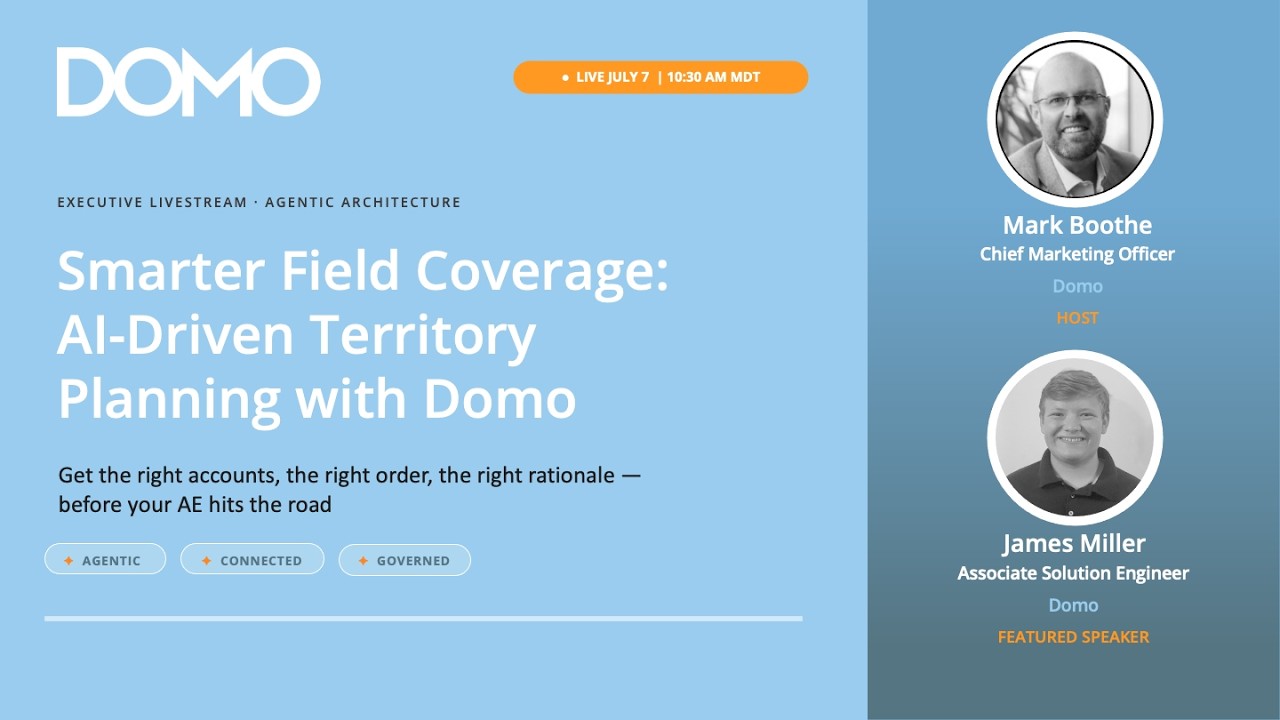

Mark: What's up everyone? We are here and we're live again. I'm here this time with my good friend James Miller, who's one of our associate solution engineers. He works in a group where, every single day, they're working with prospects who are evaluating and looking at Domo, building really cool solutions for them to help them understand the power of what Domo is.
Today, James, you're going to talk all about managing a book of business or a group of AEs that you work with. And chances are—keep me honest—but they have a territory and a group of accounts that they are working with, and keeping that book of business moving in the right direction is a challenge. Right?
James Miller: Exactly. It all started when my account executive asked me for a solution where he could see all of his different accounts. Then it expanded to more internal account executives asking for the exact same thing. So I had to build the entire framework to do that, and then I had customers ask for the same thing too. So now it has really expanded into making a demo as well.
Mark: That's so intriguing. So James, walk me through that a little bit more. Your account executive comes to you and is like, "Hey, I'm having struggles with this." Walk me through that story.
James Miller: My account executive came to me and said he wanted to be able to see all his different accounts. He wanted to have a good overview and knowledge of how those accounts are using Domo internally, but also externally as a SaaS product. He also asked, "What if I want to plan a trip out to that account? How can I do that in an easy way using all the CRM data we have, call transcript data, emails, usage, and even LinkedIn for social media?" We have all that data internally, so I wanted to combine it.
Mark: So awesome. James, walk us through how did you actually build this?
James Miller: Yeah. So first step, I will share my screen to have something visual to show.
How I built this was around the idea that you have a bunch of different CRM data that usually has billing addresses and billing information. I would then go to Google Maps in this use case. Funny enough, CRM data does not translate well between the two, especially Google addresses. So I had to use Google's API information as a translation layer to get pins that are more latitude and longitude-based to map it all out.
Afterward, let's say I want to look at a specific account. I have Evergreen Partners here in Dallas. I'm an admin in this app, but let's say you're an account executive that only works with Texas. All the same governance still applies. An AE that only works with Texas will only be able to see Texas, so that's the only pin that will be on this map.
I can go in and see a breakdown of how much that customer is paying us: one million three hundred and sixty-four thousand dollars. Okay, so they're kind of important. Then I can go in and see when that next renewal is, along with some health scoring—which I'll go into later—the industry they are in, and some other metrics.
For call transcripts, I can see a breakdown of some one-liners that are really important from that transcript, who was on it, and other key information. I can also see open opportunities coming directly from the CRM, and I can easily make sure that this is real data by clicking right into it to go to the dataset it's coming from. It's a way to check but verify.
Next, let's say we have emails. I can even go through the drafts and all these different email sources. Domo has so many different connectors, so we can go into Outlook emails and pull all that information in using our connector framework.
Next is usage data. I can see all the different usage for this individual and this account as a whole, and I can see that breakdown. Every single part of this is interchangeable because every organization has different metrics. The idea is that since it's using datasets inside Domo, you just change the dataset and tell the app what it needs to look at.
Mark: Love it.
James Miller: We also have health information. Now that we have all the information, we want to start making insights on how well this account is actually doing. I'm seeing that this is not rated very well; a school grade of a D is not good. That does not get diplomas.
Mark: I always heard D was for degrees, you know.
James Miller: Oh, I said the same thing to my parents!
Here, I can go in and see the adoption weight is at twenty-five percent, which is a C. Why is that a C? I can go in and see that breakdown. License user activation is at eighty-one point seven percent, but our benchmark goal is eighty-two percent, so we're below that. Our weekly login is at thirty-seven, but the target is fifty-eight. No wonder we're at a C. It does that for every single value, so you can easily break that down.
It also gives you actions—the agentic components where you can start getting suggestions on what to do based on real data. Even for a customer success manager or an AE, it will show those recommended actions based on those individuals.
Every single account has this type of information. For people, we have CRM data, usage data, and LinkedIn data. I want to know how every single user is using Domo, a CRM, or a SaaS product. Here I have Taylor Nelson, who is their CTO and their top user and influencer. Fantastic. That is a great sign right there, despite everything else, that we have executives using the product. We have links to their email and their LinkedIn, and we can see exactly how much they are using us. Any questions on the data?
Mark: Yeah. Walk me through, even before this, how did you build this? Did you build this in Domo? Did you build it using Claude, Cursor, Retool, or something like that?
James Miller: I am very passionate about using Cursor. I love Cursor, and I think it's a fantastic tool. So I used Cursor and mixed it with Domo's basic MCP and a skill library that we're developing. It can handle every single component in Domo. It can build the Magic ETL and the data manipulation to make sure that data is gold standard, and it builds the visualizations and the backend.
It took me about twenty hours to build this full solution. Without Cursor and the Domo MCP, I would never have been able to build this. The lines of code alone would have taken me away from my day job, so that's how powerful this was.
Mark: Walk me through, James. Say I'm the rep and I'm visiting Evergreen Partners. Will it give me recommendations like, "Okay, if you're going to go out and take a trip to Dallas, here are some other accounts that you should plan on visiting, and this is why"? Can you show us that?
James Miller: That next part is if you want to plan a trip. Let's say you want to go to Dallas for Evergreen Partners. I can go to "Plan the Trip" and select the days I'm going. Let's say in two weeks, from the twenty-seventh to the twenty-ninth. I'm going to grab this text right here and say I want to go to Evergreen Partners in Dallas.
I'm telling the app exactly where I want to go, who else I should visit in the area, and if there are any upcoming renewals. I can just click continue, and now it's going to pull up the whole Dallas area.
Mark: Oh, that was fast.
James Miller: Yes, it was. Sometimes when you're doing live demos, you're like, "Oh goodness, oh goodness, come on, let's work."
Mark: Exactly.
James Miller: And the best part is that none of this is hardcoded in the backend. That's just how fast it does it because I'm using Domo's tooling in the backend that helps store the data that already exists. It's not doing anything revolutionary as a result.
Mark: Very cool.
James Miller: Now it's going through the itinerary. Since I am leaving on July twenty-eighth, I'm going to mark that as a travel day. It says, "Great, I have Evergreen Partners," and then it gave me Catalyst Partners. Why? It has a full breakdown showing that there are open opportunities with that account, and the renewal is in fourteen days. We need to get in front of these people. The last snippet from the last call we had was that pilot users love it, but we need help getting them to turn on the SSO for the rollout. Great! Now the AE can bring their solution engineer in to help talk about SSO for that rollout.
Next, it will actually build out that itinerary. It shows that Evergreen Partners and Catalyst Partners are really close to one another. I can say I want to get dinner with Evergreen Partners as well, and it will pull some restaurants in the local area using Google.
Since I'm originally from Texas, I love barbecue. I can go to this barbecue restaurant, and who do I want to invite? I've talked to Gloria, Taylor, and Sam. Taylor Nelson is the top user, so I want to bring them in. I want to copy this curated invite, and let's go to my emails. It created a subject line, populated the emails of all the individuals, and created a pre-made email inviting them out to dinner to Pecan Lodge for barbecue.
Mark: That is amazing.
James Miller: I can do the exact same thing here for Catalyst Partners. I'm traveling on July twenty-eighth, but actually I have an afternoon flight, so I want to try to get breakfast with Vertex Corp while I'm out there to maximize my time. I can select Monarch Restaurants with them and book those times.
Lastly, an account executive has a manager or an RVP they are going to need to justify this trip to. I can go to "Manager Justification" and it will show that based on open opportunities, we have five hundred thousand dollars in pipeline at play. It gives a summary of the trip, even a map, and I can now submit for approval.
The manager can go in and approve, disapprove, or request changes. This is what they'll see as an email. They would receive the request and the "why" for each and every single one of these accounts, see the breakdown, and then they can approve, make notes, or request changes.
Mark: That's amazing. So James, what you've done is make AEs' jobs much easier.
James Miller: Yes. I want to get rid of all that empty research time to make it easier for them. Having all those different systems is really good if you want to research in-depth, but what about just getting a quick overview? Having that all in one place has been fantastic for me internally. It allows me to see the data and be able to ask questions to my account executive, like, "Hey, have we contacted this account yet about this issue?" That really opens up opportunities and has helped my account executive and me plan trips out to our customers.
Mark: I love it. James, wrap us up. Why is Domo so important to making all of this happen?
James Miller: I couldn't make this at all without Domo. The reason is the governance. Going back and making sure people can only see what you allow them to see, having the data all in one place, and being able to get that strong data foundation. When I'm talking to prospects, there's a phrase I always say: "You can't build a house without a strong foundation, and data is that strong foundation."
Mark: On that point, James, whether your data lives in Snowflake, BigQuery, Databricks, or anywhere else, that's fantastic. We want you to leave that data right in Snowflake or Databricks, and we want to help make that data accessible to create these really cool, action-oriented apps and agents that will help you be more effective. Wherever your data foundation lives, we want to help you be more successful by using Domo. Is that fair to say?
James Miller: That's completely fair to say.
Mark: I love it. Okay, everyone. You saw it here. There's going to be more of these coming up. Remember, every Tuesday and Thursday, we're showcasing really cool solutions that have been built to help you be more successful in this era of AI. James, thanks for joining us. Thanks, everybody, for viewing with us, and we'll see you on Thursday.
James Miller: Thanks, Mark. See you.

Mark brings over 15 years of diverse marketing experience and is passionate about driving Domo’s business growth through marketing initiatives. His mission is to empower all Domo customers and prospects with the insights and tools they need to make better business decisions and achieve their goals. In his previous role as VP of Community, Partner, and Field Marketing, Mark and his teams established new and strengthened existing programs to address customer pain points and create a greater sense of community. They also executed campaigns, programs and events that showcased the value of the Domo platform. Before joining Domo, Mark spent more than 10 years working in customer relations and marketing at Adobe, and worked at Instructure as its senior director of customer marketing. He received his MBA from Utah State University and a bachelor’s degree from Brigham Young University. Outside of work, Mark enjoys spending time with his family and traveling.

James Miller is a Solutions Engineer at Domo with over three years of experience helping clients unlock the full potential of their data through tailored analytics, AI agents, and workflow automation solutions. Having started as an Analytics Intern at Domo, James brings strong skills in problem-solving, data management, and customer collaboration to translate technical requirements into impactful business outcomes. A recent graduate from the University of Oregon with a Bachelor’s in Applied Economics and a minor in Computer Information Technology, he is passionate about continuous learning and innovation in the field of business solutions.
What if every account executive walked into the field already knowing which customers to see, why it matters, and how to justify the trip? Welcome to the age of the Intelligent Territory Engine.
At Domo, we're building agentic solutions that do more than map accounts. They read account health, rank the right customers to visit, build the itinerary, and route every plan through human approval. The Territory Strategist reads where your customer reality lives—cloud data warehouse datasets spanning health grades, product adoption, open pipeline, and renewal risk—and turns that data into a defensible field plan.
Every account is scored for risk, adoption, and revenue opportunity. Every visit recommendation is grounded in the data with rationale attached, every itinerary optimized for the AE's days on the ground, every plan teed up for one-click manager justification. With this engine, every AE can plan territory like your best strategist, and your team spends their travel budget on the accounts that move the business.
Featured Session:
Join Domo CMO Mark Boothe and James Miller, Sales Engineer at Domo, as they pull back the curtain on a pro-code application built on Domo. James will walk through how the agent plots every customer on a live map colored by credit pacing and health, segments accounts into at-risk, declining, and growth opportunities, generates next-best accounts to visit grounded in real consumption and engagement data, drafts the itinerary, talking points, and manager justification AEs would otherwise build by hand, and writes the plan back to a governed data source the moment a manager signs off. You can get it live in just hours without moving for your data, because it’s built end-to-end as a Domo app with data at rest in Snowflake and Domo.
What You Will See:
• It's Agentic: The agent scores account health and credit pacing, ranks who to visit, generates the day-by-day itinerary, drafts the business justification with reasoning attached, and routes the whole plan through a workflow to a manager in the loop.
• It's Connected: One application, every layer: A React front end, Domo AI calling foundation models to interpret goals and write trip rationale, Code Engine functions guarding external data and budget, AppDB for persistence, Google Maps and live events data enriching every stop, and governed datasets as the source of truth.
• It's Governed: There’s a human-in-the-loop on every plan. The AE confirms accounts, the manager approves the trip, and cost guardrails cap every external API call. No autonomous spend, no new vendor, no surprises.
Join us and see what happens when every account, every itinerary, and every approval runs on agentic AI.
Domo transforms the way these companies manage business.