Se ahorraron cientos de horas de procesos manuales al predecir la audiencia de juegos al usar el motor de flujo de datos automatizado de Domo.
Ver el vídeo

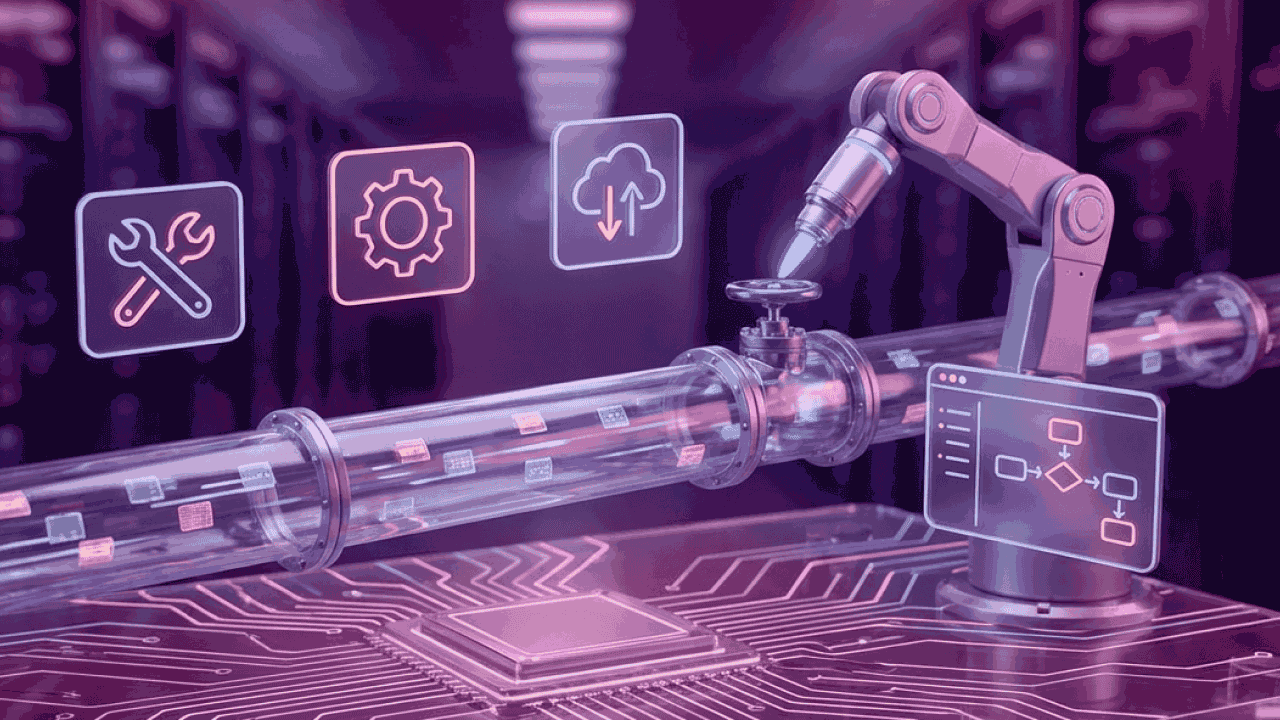
Every day, the world generates around 402.74 million terabytes of data. Organizations create and gather this massive amount of information from applications, devices, customers, and systems across the business.
This constant flow of information holds enormous potential, but only if it’s collected, processed, and delivered in a usable way. Without the right infrastructure, data quickly becomes fragmented, outdated, or overwhelming. Data pipeline tools help solve this challenge by automating how data moves from source systems into analytics platforms, so it arrives reliably, consistently, and on time.
By streamlining ingestion, transformation, and delivery, these tools make it possible to turn growing volumes of raw data into insights teams trust. In this blog, we’ll explore what data pipeline tools are, the benefits they provide, the key features to look for, and the top platforms to consider as you build a modern, scalable data pipeline strategy.
A data pipeline tool is software that helps organizations move data from one system to another in a reliable, automated way. These tools manage the flow of data from source systems, such as databases, applications, or APIs, through processing steps, and into destinations like data warehouses, analytics platforms, or reporting tools. The goal is for data to arrive accurately, on time, and in a format that’s ready for analysis and decision-making.
Data pipeline tools play a critical role in modern analytics and BI environments. They handle tasks such as data ingestion, transformation, scheduling, error handling, and monitoring, which would otherwise require significant human effort. By automating these processes, teams focus less on maintaining pipelines and more on using data to drive discovery.
Strong data pipeline design is essential for scalability and performance, and pipeline tools help enforce best practices in how data flows are structured. They support batch and real-time processing, manage dependencies between data jobs, and provide visibility into pipeline health. Together, these capabilities make data pipeline tools foundational to delivering trustworthy, analytics-ready data across the organization.
Data pipeline tools do far more than move data from point A to point B. When designed and used well, they become a core enabler of reliable analytics, scalable operations, and confident decision-making across the organization.
A data pipeline tool provides a real-time data pipeline, allowing organizations to process and deliver data as it’s generated rather than waiting for scheduled batch jobs. This immediacy supports use cases like operational monitoring, live dashboards, and time-sensitive analysis for teams to react quickly to changing conditions instead of working with outdated information.
Modern pipeline tools make data integration significantly easier by offering prebuilt connectors, standardized ingestion patterns, and consistent handling of schemas and updates. This reduces reliance on custom code and minimizes the friction involved in bringing together data from many different systems, especially as new sources are added over time.
Pipeline tools improve overall data management by providing built-in observability. Centralized monitoring, logging, and alerting make it easier to detect failures, diagnose issues, and resolve problems before they impact people or reporting downstream. Automated retries and dependency management further increase reliability.
By orchestrating each ETL pipeline in a consistent way, data pipeline tools help teams scale processing as data volumes grow. Pipelines can be imrproved, run at the same time, or extended without reengineering the entire workflow, supporting long-term growth with less operational strain.
Data pipeline tools reinforce a clean and modular data architecture by clearly separating ingestion, processing, and delivery layers. This structure makes systems easier to evolve, maintain, and govern as business requirements and analytics use cases change.
Automation replaces many manual tasks involved in maintaining pipelines, from scheduling jobs to handling failures. This frees data teams from constant firefighting and allows them to focus on more valuable work like modeling, analysis, and collaboration with business stakeholders.
Reliable, continuously updated pipelines ensure that analytics teams have access to high-quality data when they need it. This consistency is especially important for forecasting, experimentation, and more advanced analytical use cases that depend on timely and accurate inputs.
When pipelines are well-managed and transparent, business people gain confidence in the data they rely on. Clear lineage, predictable refreshes, and consistent definitions help build trust, which ultimately leads to broader adoption of analytics and better decision-making across the organization.
According to the MIT Sloan School of Management, trust—in both processes and coworkers—is essential for improving data democracy in organizations. Social networks, which facilitate peer-to-peer knowledge sharing, help employees understand available data assets and how to use them.
Choosing the right data pipeline tool requires looking beyond basic connectivity and focusing on features that support scale, flexibility, and long-term analytics needs. As data environments grow more complex, pipeline tools must do more than move data. They should adapt, automate, and support a wide range of use cases.
Modern data teams need tools that can handle increasing volume, complexity, and speed of data flows. The following platforms stand out in 2026 for their flexibility, scalability, and ability to support both traditional and real-time pipelines, making them excellent choices for organizations building reliable data architectures. Each tool brings unique strengths, from low-code integration to powerful orchestration and cloud-native scalability.
Domo is a unified data platform that combines ingestion, transformation, orchestration, and visualization in one place. Its low-code environment makes it easy for data engineers and analysts to build strong pipelines without heavy engineering overhead.
Domo excels at connecting to a wide variety of sources, automating workflows, and delivering analytics directly to business people. The platform also includes real-time data alerts, governance controls, and built-in dashboards that help organizations act quickly on insights.
By managing the entire pipeline and delivering analytics in one interface, Domo reduces complexity and accelerates time to value for teams of all sizes.
Fivetran specializes in automated data integration with its managed connectors that sync data from source systems into warehouses or lakes. Its focus on simplicity and reliability means engineers spend less time maintaining custom pipelines and more time on analytics. Fivetran automatically adjusts to schema changes, reducing breakages and monitoring effort.
While it primarily handles extraction and loading, it integrates easily with transformation tools and orchestration layers to complete the pipeline. Its automated maintenance, wide range of connectors, and strong support for cloud data warehouses make it a top choice for teams prioritizing stability and speed.
Talend is an open, enterprise-grade data integration platform that supports batch and real-time pipelines. It offers a visual development environment and strong transformation capabilities, making it suitable for complex workflows. Talend’s platform includes data quality, governance, and security features that ensure pipelines are reliable and compliant.
With support for cloud and hybrid deployments, Talend can operate across diverse environments. Its ecosystem includes connectors for multiple source systems and built-in components for cleansing, enrichment, and orchestration. For organizations seeking a comprehensive, governed approach to data integration, Talend remains a competitive option.
Apache Airflow is a popular open-source workflow orchestrator that has become a standard for complex data pipelines. Instead of moving data itself, Airflow defines and automates the workflow logic that coordinates extraction, transformation, and loading tasks.
Its Python-based configuration offers strong flexibility, allowing engineers to build dynamic, parameterized pipelines. Airflow’s scheduling, dependency management, and monitoring capabilities make it ideal for teams needing granular control over pipeline execution.
As an open-source platform, Airflow benefits from a large community and integration options. However, it requires engineering expertise to deploy and maintain effectively.
Dagster is another open-source orchestrator focused on improving the developer experience for data pipelines. It emphasizes type safety and modular pipeline design, encouraging engineers to build reliable, testable workflows.
Dagster’s interface provides visibility into pipeline structure and execution, helping teams catch errors early and maintain pipelines as they grow. It integrates with a wide range of data systems and orchestration backends and supports both batch and incremental processing.
For organizations that want an orchestration tool designed for modern engineering practices, Dagster offers a compelling alternative to more traditional solutions.
AWS Glue is a fully managed data integration service within the AWS ecosystem. It automates discovery, cataloging, transformation, and job scheduling, making it easier to build and run ETL jobs at scale. Glue works easily with AWS data stores like S3, Redshift, and Athena and supports both serverless and provisioned compute models.
Its integrated Data Catalog ensures consistent metadata management, and automated schema discovery simplifies onboarding new data sources. Glue’s ability to scale on demand and tight integration with AWS services make it a strong choice for organizations invested in the AWS cloud.
Databricks provides a unified analytics platform built on Apache Spark, combining data engineering, data science, and analytics. Its pipeline capabilities support batch and streaming workloads with high performance and scalability.
Using notebooks, jobs, and Delta Lake, teams can build reliable, ACID-compliant pipelines that handle transformations and quality checks. Databricks’ integration with ML workflows, collaboration features, and performance optimization make it attractive for organizations pursuing advanced analytics and machine learning use cases.
While not a traditional ETL tool, its strength in processing large data sets makes it a go-to platform for complex pipelines.
Snowflake is a cloud data platform that supports scalable storage and compute for analytics. While Snowflake itself isn’t an ETL engine, its native capabilities, like Snowpipe for continuous ingestion and Streams and tasks for incremental processing, allow it to play a central role in modern pipelines.
Teams often use Snowflake as the destination for consolidated data and integrate it with orchestration and transformation tools. Its performance, concurrency, and separation of storage and compute make it highly reliable for large analytical workloads. Snowflake’s ecosystem also supports integrating real-time data flows and automation.
Informatica has long been a leader in enterprise data integration, offering a comprehensive suite that covers ETL, data quality, governance, and master data management. Its platform provides advanced transformation capabilities, strong connectivity, and fine-grained control over data flows. Informatica supports both on-premises and cloud deployments, serving complex enterprise environments with stringent compliance requirements.
With features for monitoring, lineage, and metadata management, Informatica helps organizations maintain reliable pipelines at scale. Its breadth of capabilities makes it particularly suitable for large enterprises with diverse data needs.
Azure Data Factory (ADF) is Microsoft’s cloud-native integration service that orchestrates data movement and transformation across on-premises and cloud systems. ADF supports a wide range of connectors and allows engineers to design pipelines visually or with code. With built-in scheduling, monitoring, and integration with Azure Synapse, Data Lake, and Databricks, ADF enables end-to-end data workflows.
Its ability to handle both batch and streaming ingestion, along with native integration with the broader Azure ecosystem, makes it a popular choice for organizations invested in Microsoft’s cloud platform.
Building reliable, scalable data pipelines is no longer optional for organizations that want to compete in a data-driven world. The right data pipeline tool can simplify integration and improve data quality so teams get access to new information as soon as it becomes available.
Modern data pipelines are the backbone of effective analytics, but managing them doesn’t have to be complex. As data sources multiply and demands for speed increase, organizations need tools that handle ingestion, transformation, orchestration, and analytics together.
Domo stands out by bringing the entire data pipeline into a single, intuitive platform, allowing your to connect sources quickly, automate workflows, and deliver trusted insights to your business. By reducing fragmented tools and manual maintenance, Domo helps your move faster from raw data to decisions.
When you’re ready to simplify your data pipelines and discover more value from your data, explore Domo or watch a demo to see it in action.
Domo transforms the way these companies manage business.