So, you gave your sales team an AI chat agent. A junior sales rep opens the chatbox, types in "What's our biggest client's contract worth?" and gets a crisp, confident answer about an account that was never theirs to see.
The agent did its job. Governance did not.
That tension sat at the center of a Domo AI livestream with Paul McCusker, a forward deployed engineer at Domo. The session followed the single idea that governance should follow your data all the way to the AI agent.
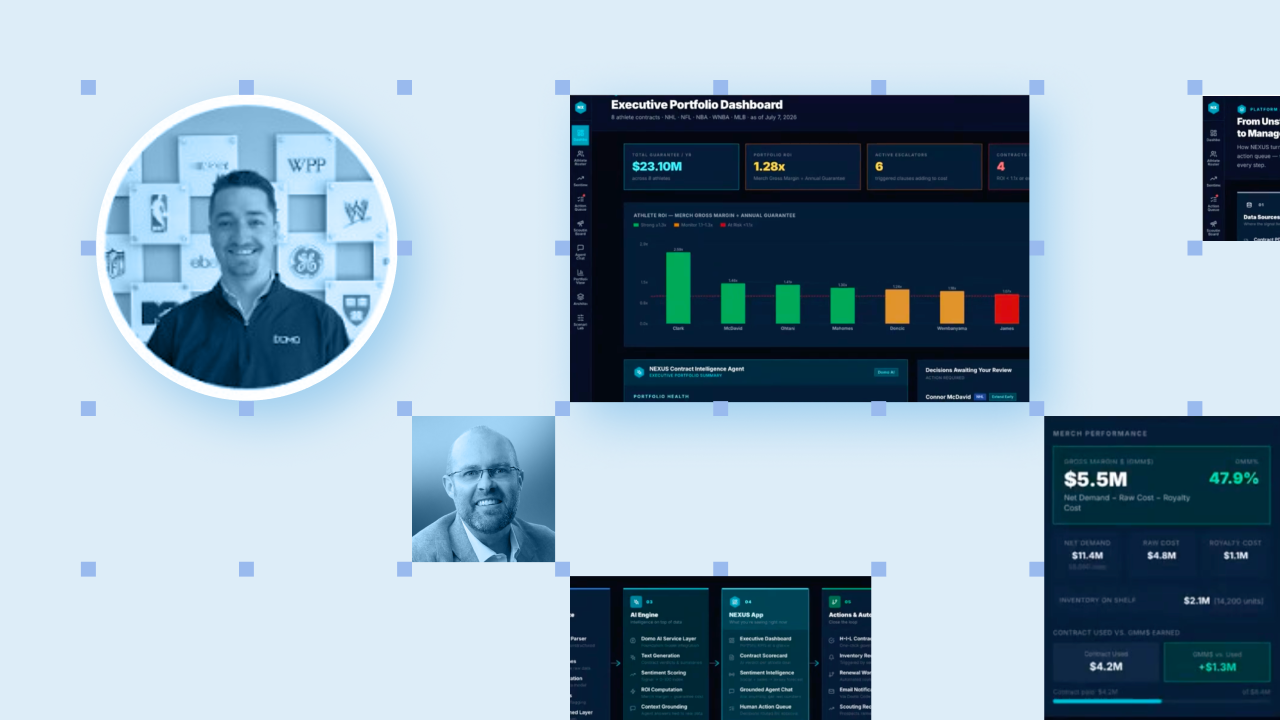
In the livestream, Paul walked through athlete licensing contracts for a fictional sports merchandise company. But for any business working with complex and confidential documents, we're sharing a practical checklist for rolling out AI agents that stay governed, stay safe, and still feel genuinely helpful at scale.
Start with the relationships buried in your documents
Every company runs on relationships it can barely see. Vendor contracts, partnership terms, and investment details tend to live in PDFs, scattered spreadsheets, and the memory of one person who knows where everything is.
That tribal knowledge is fragile. When that person is out, the answers leave with them.
An AI agent can read those documents and make them answerable. The catch is that a document full of sensitive terms should not become a document everyone can suddenly query. So the first step is naming what is sensitive before you point an agent at it.
Map which contracts, clients, and figures each role should ever see. That map becomes the backbone of everything that follows.
Put the security on the data, not the chatbot
Consider where permission actually lives in your business. If you merely bolt access rules onto a chatbot, you're back to managing endless per-person allow-lists, one exception at a time.
Domo takes a different route, applying row-level security to the data itself, so governance travels with the data.
That means a person sees only what they're permitted to in a chart or dashboard. Ask the same question through an AI agent, and the agent answers using that exact permission. Nothing extra leaks through.
As Paul explained during the demo, one rule set governs the whole experience. You skip the separate allow-list for every person who logs in.
Let your connected systems keep the rules they already have
Your permissions don't all live in one place, and they don't need to. Plenty of teams have already architected security inside their cloud data platform. Rebuilding it somewhere else would waste months and invite mistakes.
Governance in Domo extends to those connected systems. When an agent queries a semantic model living in Snowflake, Domo respects the role-based access control (RBAC) already set up there. The security you invested in stays intact, and Domo honors it rather than asking you to recreate it.
That's why we always say that Snowflake and Domo work better together: The warehouse stays the governed foundation, and Domo is how more people safely put it to work.
Keep a person in the loop with bounded autonomy
An agent that acts on its own is a liability. An agent that surfaces a decision and waits for a person is an asset. This is bounded autonomy: humans set the objectives and the guardrails, and the agent executes and routes within them.
Imagine a contract expiring in 90 days that happens to be performing well. The agent flags it and hands a person real choices:
- Approve it and move on
- Extend the agreement
- Flag it for review, which sends an email to the right teammate for a deeper look
That last option matters. The agent doesn't quietly decide; rather, it pulls in a human and routes the work to whoever should own it. People stay in control of the calls that count.
Leave an audit trail you can follow
Scale changes the stakes of poor governance. A talent agency managing thousands of clients needs every representative to see only their own roster, and needs proof of who saw what. An audit trail turns "trust us" into "here's the record."
Before you deploy widely, confirm three things:
- Each person's access reflects their actual role, not a broad default
- Every agent answer traces back to governed, permissioned data
- The agent logs every action it takes for later review
If you get those three in place, you can hand an agent to 100 people, or 10,000, without holding your breath.
Watch the full livestream
This checklist covers the governance backbone, though the livestream goes further. Paul also walks through Domo's five-layer architecture. Then he shows a neat progression: prototype an idea with an agent, then turn it into a cheaper, consistent Python pipeline. Paul also runs what-if scenario analysis directly on contract data, testing outcomes before committing to them.
If you're planning an AI rollout your whole organization can trust, that hour is worth your time. Watch the full session and see how governance, human oversight, and bounded autonomy hold up under a live demo.