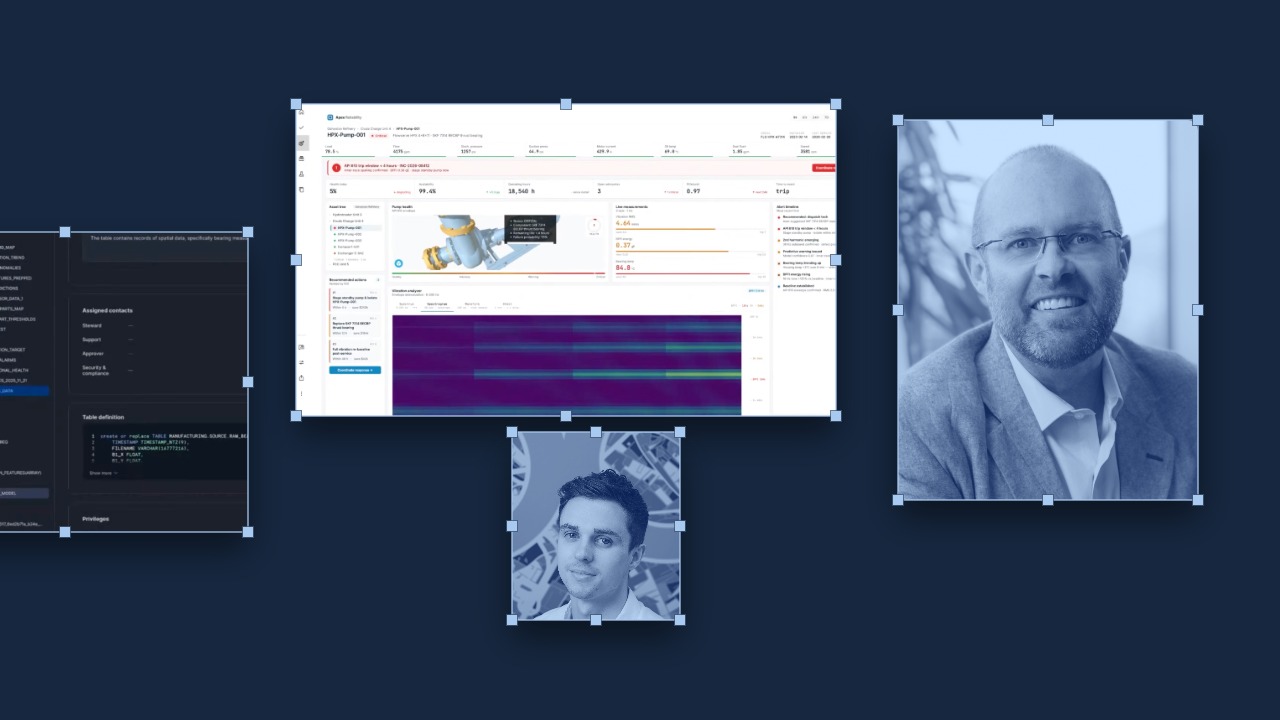
A sensor flags a critical bearing anomaly on the production floor. The AI agent identifies the part, pulls the manufacturer spec, and drafts a work order. And then...nothing happens. The plant manager overrides it, calls a technician directly, and handles it the old way.
This didn't happen because the AI was wrong, necessarily. The agent's output wasn't used because nobody trusted it enough to act on it.
That gap between what AI can do and what teams actually let it do surfaced as a central theme in the Domo AI livestream, "From Sensor Signal to Service Action." I caught up with Jamie Morrison, field CTO for Domo's EMEA team, who walked through a live predictive maintenance demo and broke down exactly where trust breaks down in manufacturing AI. Plus, how to build it back.
What follows is a practical checklist distilled from that conversation. Whether you watch the full session or not, these six principles give operations teams a blueprint for engineering trust into AI-powered maintenance workflows.
6 ways to engineer trust into AI-powered maintenance
Manufacturing is not the place for "move fast and break things" AI. When the stakes involve stopped production lines, misrouted parts, and wasted vendor spend, trust has to be designed into every step. Here are six principles that emerged from Jamie's demo and discussion.
1. Name the stakes gap out loud
Before rolling out any AI-powered workflow, acknowledge the obvious: manufacturing AI carries higher consequences than a chatbot drafting emails. As Jamie put it during the session, "If you use AI in your everyday work [as an analyst], and it gives you a bad response, you get a badly worded email. In a manufacturing environment, if you get a bad response, the wrong part gets ordered or the line stops."
Teams that skip this conversation end up with technically impressive tools that nobody uses. Start every AI initiative by mapping what happens when the system gets it wrong, and design safeguards around those failure points.
2. Build human checkpoints into every decision
The fastest way to lose trust is to let an AI agent act without oversight. The demo showed multiple built-in review gates: a plant manager reviews and can edit AI-generated recommendations before dispatch, a technician reviews the work order before acting on it, and results feed back into the system for continuous improvement. A human signs off on every work order, every spend decision, and every vendor selection before anything moves forward. That structure is the reason people actually use the system.
3. Make the AI cite its sources
Jamie demonstrated how the AI agent surfaces the exact documentation behind every suggestion, down to the page number. "Axial clamping force must not exceed 25 percent of the base static load coefficient, page 6," Jamie noted, referencing a manufacturer spec the AI pulled and displayed alongside its recommendation. When a technician can trace a recommendation back to the source PDF, trust stops being a leap of faith and becomes a verification step.
4. Let humans edit AI recommendations before they ship
Plant managers can change any AI recommendation before a work order ships. In the demo, Jamie showed how a manager switched the AI's suggestion from "replace bearing" to "inspect only," and the system adapted all downstream steps accordingly. That edit capability signals something important to the team: the AI is a tool that suggests, not an authority that decides.
5. Connect the data before connecting the AI
AI agents are only as trustworthy as the data feeding them. Jamie emphasized that trust starts well before the AI layer, with connecting the siloed systems that most manufacturers already have: sensor historians, parts catalogs, maintenance records, and manufacturer PDFs. Without that unified data foundation, AI recommendations are guesses dressed up in confidence. The data work is not glamorous, but it is the prerequisite for every other item on this list.
6. Close the feedback loop
Trust compounds over time, but only if outcomes flow back into the system. The workflow Jamie demonstrated captures what actually happened after a technician completed a work order: what they found, what they did, and whether the AI's diagnosis was correct. That feedback trains better recommendations on the next alert. Teams that skip this step get an AI that never improves, and trust that never grows.
Catch the demo in the full livestream
This checklist captures the trust-engineering framework from the session, but the full livestream goes deeper. Jamie walks through a live demo with 44 million sensor records integrated through Snowflake, shows how technicians receive and act on AI-generated work orders from their phones, and breaks down the architecture behind governed AI agents in physical operations.