Yum! Brands’ Ben McClave on AI-First BI
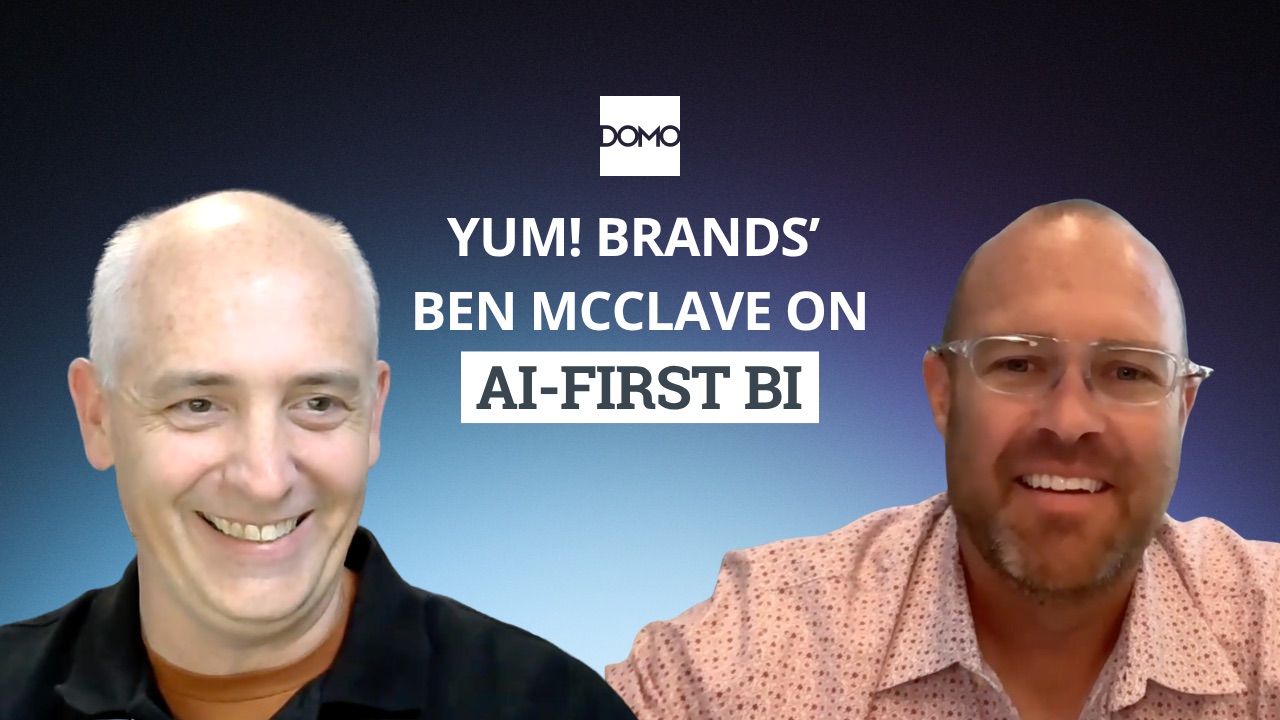

Mark: Everybody, we're back again and this time I have maybe the most special guest in the history of the show, Mr. Ben McClave, who is a principal business intelligence analyst. He does all things BI for a monster of a company who happens to be one of my favorites, Yum Brands.
Ben, first things first, let's talk about the important stuff. You go to Taco Bell. What is your order?
Ben: Oh my goodness. Well, the Cinnabon Delights with some Freezes is a good go-to when you need a little pick-me-up. But I originally came up through the KFC side, so I have to get the actual substance from KFC.
Mark: Okay, that's fair. KFC has some wonderful stuff. If you give me a five-layer beefy burrito, I'll be a happy man for the rest of the day, without question.
Ben, welcome. Tell me a little bit about Yum Brands. Who are you? What do you do?
Ben: Yeah, so we're the largest restaurant company in the world. We have KFCs, for example, in 150 countries. We have several brands: KFC, Taco Bell, and The Habit Burger Grill. We operate restaurants all around the world. As you can imagine, that's a pretty big undertaking.
My role in that is for Yum itself and then also working directly with the brands on taking the massive amounts of data coming from tens of thousands of restaurants, bringing it together, and getting it out to help inform decisions. It's been a great place to be. It's an exciting industry and a great place to be today.
Mark: Just in case everyone didn't pick up on what Ben just said, he said 150 countries. Now, 150 stores when you talk about scale would be like, "Wow, that's a big job." We're talking thousands and thousands, probably tens of thousands of actual locations, right?
Ben: Oh, for sure. KFC alone has upwards of 30,000 locations when you include China. Taco Bell is another big juggernaut of stores, with just over 9,000 in the US alone, I believe. It's hard to keep track—we're building every day.
Mark: That's amazing. So Ben's job is pretty big. He's got to make sure that the data with all of these organizations works the way that it should. Ben's been a long-time Domo customer, and he's doing some really cool things with AI that I thought it was important he tell you a little bit about.
So Ben, walk us through. What are you doing? What has the "aha" light bulb moment been for you?
Ben: I think with AI, there's a lot you can do with it. A lot of people tend to think about it in terms of the day-to-day: summarize my email, get me a PowerPoint, or whatever. But the way that we have been using it more and more is as a way to help accelerate bottlenecks in our workflow.
As a BI practitioner, one of those big bottlenecks for us is getting the requirements locked down up front. It takes a lot of engineering work to get all this data collected and curated in a way that works for the need. The longer that takes, the more the scope can creep and the more people want additional stuff. If you don't do the diligence up front, it's going to be a nightmare down the road. But that diligence takes time.
With the advent of Claude, ChatGPT, and even Copilot, a lot of that gets a lot easier. It started off pretty similar to how a lot of people use it today: we had a meeting about the design requirements, and we used AI to summarize what came out of the meeting. But that's still a person reading the summary and trying to put it into practice. You still have to go build the wireframe and do everything else.
What we started to do instead was gather all those materials, put them together into a project, and run that through AI to create a wireframe in something that's universal, like a React app or HTML that is self-contained. The benefit of that is you can iterate super fast, and you can base it on dummy data that you didn't have to take time to create. You don't have to get the real data pulled together to show a proof of concept.
We will take a one-hour meeting recording, along with some examples of things they liked and didn't like from the meeting, drop it all in there, vibe code a dashboard, and get it out to them as HTML the very next day. From there, we can iterate back and forth a lot faster.
What's great is that because it's all in a React app, at the end of the day when they want their final product, we can produce it pixel-for-pixel in Domo by dropping it right into the Procode editor and just wiring it to a real dataset. The thing they've signed off on doesn't go to a builder to sit there and try to drag and drop all the things to make it work with the interface. Instead, we can just take it exactly how they wanted it, wire it up how they need it, and get it right back out to them.
Mark: Ben, walk me through for a minute. I'm still just so enamored with this idea of 150 countries and tens of thousands of restaurants. What would happen if a business user comes to you and says, "Hey, I need to understand this region of what's happening with KFC, for example"?
Walk me through that story because, with the scale of 150 countries, we would have to assume you have 30,000 BI people on your team.
Ben: Exactly. My team is small and mighty, that's for sure. There are four or five of us doing these things every day.
It all starts with the backend, of course. Everything should be done upstream. In our stack, we have Snowflake as our backend. Markets and franchises will send their data in, we will have pipelines that clean it all up, and then they apply transformations to get it into a global model. That work is traditionally just a typical star schema where you have all the transactions you care about and all the ways of describing those transactions, like regions, dates, and products.
Then you have calculations built on top of that. This is where it often starts to splinter and get problematic for BI folks, because you have to get it out of that tool and into the hands of end users. We support both PowerBI and Domo in our stack. In the past, that meant taking some sort of connection to Snowflake, rebuilding some of those measures and relationships in the BI tool, and then displaying them. Ideally, we do it all that way, rather than creating extra stuff inside of the BI tool that doesn't even live upstream.
In a world of AI, if you want the AI to give you the same answer to a question as the BI tool, it has to know the same context. It has to have the same definitions. So, we're pushing everything up into that Snowflake layer in their semantic views, and we're working on bringing that directly into the tools.
We have set up a way with a code engine to read the semantic model, and I can't wait until the actual semantic model connection to Snowflake goes live later this year with Domo, because it will make life much easier. That vibe-coded dashboard we publish in React still had to be connected to a dataset in today's world. But in our proof of concept that we've done with your partnership, we've been able to point it directly at the semantic view without having to create a dataset. We didn't have to write a single beast mode. It knew the definitions, the relationships, and everything, and it just brought it straight in. If you were to ask the AI the same question, you would get the same answer because it's based on the same set of facts.
Mark: Context is king. So Ben, talk me through your work with one of our FDEs, with Will. I want people to hear a little bit about what it is that you're so excited about there.
Ben: One of the great things about working with a partner like Will is that he has a really sharp mind about the way things are going, and he has been a great thought partner. We have both learned things from each other.
What I love about Will is that when I mentioned the use case where we had success—taking an operations team's request for a scorecard, producing it in a wireframe, wiring it to Domo, and turning it around in three to four weeks when it would have taken a quarter or longer in the past—the thing that stood out to us was that it still required a meeting and manual effort.
As we talked about it with Will, we wondered if we could bring that requirements discussion right into an app that could help guide people towards the best practices for BI. I'm not a marketing analyst, for example, but I know a lot about how to visualize data. A marketing analyst knows a lot about marketing but might not know as much about visualizing data.
So, we built our design book best practices into the app as guidance for how to build a Yum-like report. Will built an app that creates a conversation. Instead of just telling it, "I need a dashboard to measure this," it says, "Tell me your story. What are you trying to do, and for whom? What are they going to do with it?" It asks questions to get you thinking about your audience, the content, the intent, and the story you're trying to drive.
It helps create a better prompt for you, plugs it into templates, lets you play with it using real data, and then tells you why it chose every single thing it put on the page. For example, it might explain, "We used a bar chart here instead of a pie chart because..." Once you have it all set, you can save it as a template, export it as a requirements document to send to my team, or publish it as an app if you wired it to real data.
The future, as Will envisioned it and we've been testing it, is an app that can build other apps. It will make life so much easier. I've already seen how much easier it is when a stakeholder comes to us with their vibe-coded app. In one case, they took an HTML file we produced, ran it through Claude, and came up with their own iteration of it to tweak some things, but it was already in our design language. It is much easier to adapt that than to take a PowerPoint that somebody worked up on their own.
Mark: Totally. Ben, you've been around Domo for a while and you've been a great user and member of the community, but there is a lot of stuff with AI and the semantic view specifically that has you pretty excited. Talk to us about the Domo of the past versus the Domo of the future. What are you excited about?
Ben: One of the great things about the Domo of the past was how easy it made some of the engineering work, like the ETL pipelines, datasets, and cards. It already fit onto a dashboard nice and easy, and you didn't have to think about design. Before AI made it a thing for everybody, Domo made it easy for people to build attractive dashboards quickly using their own data.
What is exciting about the direction it is going now is the work on the OSI with Snowflake and the semantic layer, where once again we don't end up having to do a lot of those ETLs in Domo. We still could, and we could push it back up into Snowflake and wire it in, using it for what it's best at.
What I love is that it's now set up for the way BI is evolving. The ability to take a React dashboard, drop it into the Procode editor, and point it to the semantic layer or datasets is already leaps and bounds above what you could do in the past. It's very exciting to think about the possibilities from here.
Mark: Ben, you've been in this space for a little while. You might hear the thought every so often that BI is dead. Give me your response to that.
Ben: At its core, business intelligence is about helping people make better decisions faster. I don't think there is ever going to not be a need for that. AI can definitely help, but I don't think it's going to supplant BI. At the end of the day, you have to know the questions to ask, and you have to know how the business works. As we evolve as BI practitioners, it is incumbent on us to think about how AI can inform our ultimate goal of helping people get to a better answer quicker.
Mark: Brilliant. Absolutely brilliant. Everyone, you heard it here. BI is not a function that is just going to be replaced by AI. It is going to evolve, and it has evolved. But the end goal is we have to know what questions to ask so we can drive the kinds of business outcomes we are trying to achieve. Is that fair?
Ben: Yeah, absolutely.
Mark: That's amazing. Well, Ben, thank you for being an amazing customer. Thank you for so often going on the record for us and talking about the cool things you're doing. We want to see more Bens out there—Ben is the person everyone needs to try to be like. He's doing amazing things across 150 countries with amazing brands, and we are grateful for the partnership. Ben, thanks for being with us today.
Ben: Thanks, Mark. It's been a pleasure to be with you, and I appreciate the partnership from our end as well. It has been a lot of fun. Thank you.
Mark: Of course. Have a good day everybody. See you soon.

Mark brings over 15 years of diverse marketing experience and is passionate about driving Domo’s business growth through marketing initiatives. His mission is to empower all Domo customers and prospects with the insights and tools they need to make better business decisions and achieve their goals. In his previous role as VP of Community, Partner, and Field Marketing, Mark and his teams established new and strengthened existing programs to address customer pain points and create a greater sense of community. They also executed campaigns, programs and events that showcased the value of the Domo platform. Before joining Domo, Mark spent more than 10 years working in customer relations and marketing at Adobe, and worked at Instructure as its senior director of customer marketing. He received his MBA from Utah State University and a bachelor’s degree from Brigham Young University. Outside of work, Mark enjoys spending time with his family and traveling.

Benjamin McClave is a Principal Business Intelligence Architect at Yum! Brands, where he leverages his deep expertise in finance and data to drive strategic insights. His career at Yum! spans over a decade, during which he has held key positions in field finance and franchise development strategy for KFC, focusing on financial planning, analysis, and growth strategies.Before joining Yum!, Benjamin built a strong foundation in finance as a Financial Analyst with Extell Financial Services and as an Associate Acquisitions Analyst at PNC Bank, where he was involved in underwriting debt and equity for real estate transactions.Demonstrating a unique blend of analytical and creative talent, Benjamin has also had a distinguished 36-year freelance career as a professional trumpet performer and music instructor. This dual passion is reflected in his education, which includes an MBA from Indiana University Southeast, where he was an Outstanding MBA Graduate, and a Bachelor of Music in Trumpet Performance from Indiana University Bloomington.
The world's largest restaurant company runs on data from tens of thousands of locations across 150 countries. The small but mighty BI team at Yum! Brands—which supports Taco Bell, KFC, Pizza Hut, and more—is rethinking how that data turns into decisions. Domo CMO Mark Boothe sits down with Ben McClave, Principal Business Intelligence Analyst at Yum! Brands, to unpack an AI-first approach to business intelligence: turning a requirements meeting into a working, vibe-coded dashboard in days instead of a quarter, then dropping it straight into Domo's Pro Code Editor wired to a Snowflake Semantic Layer. Ben walks through the "app that builds apps" he is piloting with Domo, explains why context is king for AI you can trust, and makes the case that BI is evolving, not dead. This is a candid look at how to move fast without breaking trust, at massive scale.
Domo transforms the way these companies manage business.