Streamline RFP and Security Questionnaire Responses with Domo AI

Mark: What's up, everybody? Good morning. I am back again, this time with my good friend, Mr. Scott Pulley, who happens to be one of our solutions engineers working with customers and prospects regularly to build really amazing AI solutions. Scott, how are you doing?
Scott: Doing great.
Mark: You're just ready to show off your Domo skills today, aren't you?
Scott: Yeah, I'm chomping at the bit here.
Mark: Okay, so any software B2B people are going to love this solution. If you're anything like a B2B buyer, you have had to deal with some kind of security questionnaire or RFP in the past, and you know that can be pretty tedious. There's a whole lot of things you've got to fill out.
Scott happened to build a solution to help solve that challenge. Scott, why don't you first of all tell us how you got to this? Why did you decide to build a security questionnaire and RFP app or agent to solve this?
Scott: Yeah, so as some of you who have been following along know, we've been having this webinar series where we've been showcasing different apps and use cases that you can use the Domo platform and Domo AI to solve for.
I actually had my friend Claude analyze all of our livestream topics to see what hasn't been done, and it gave me a list of about ten ideas. I've been there; I've filled out an RFP or a security questionnaire, and it can be a slog. We have an internal tool that we used to use that would help you select answers, but now we can do that inside of Domo with document collections and an agent.
Mark: Scott, tell us what you did. What did you build, where are we at, what did you pull in, and what are the data sources? I want to hear it all.
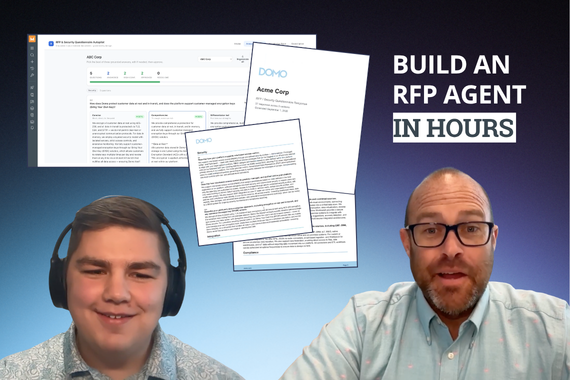
Scott: Yeah, so I'll share my screen here. I built an agent where you can just upload the RFP. I'll say that it's for ABC Corp, and then I'll select these five questions because we don't want to go through 50 to 100 today. We only have a few.
But I did generate it in a way that is going to answer the questions with three different voices. It's going to propose a concise answer, a comprehensive answer, and then it's going to do a differentiator. You can actually tweak the voice that you want to answer these questions with. Depending on the discovery that you do with your customers and what you know is important to them, you can go with as detailed of an answer or as short of an answer as you think makes sense for the audience.
Mark: And Scott, back up even a little bit more. Walk us through what you have connected here. What are the data sources that it's pulling from to actually generate those answers?
Scott: Yeah, so there are three that I'm using. I've pulled some of our knowledge-base articles, and I've pulled winning RFPs that have done well in the past—where we not only passed the RFP stage, but also closed the deal and won the customer.
And then at the bottom, we also have our security white papers. These are documents that talk about all of our certifications, the way we encrypt data, and things we share with our customers and prospects when they are evaluating Domo. So, it's pulling not only from the platform knowledge base but also from other types of documentation and winning solutions.
From there, you can choose which answer you think works best for that situation. If I know that this customer cares a lot about encryption, I might choose a more comprehensive answer.
I also have the ability to come in here and edit. It is a human-in-the-loop workflow. We're using AI and we've loaded all of these sources into Domo document collections, and it's using AI search to generate these responses. But if I want to add my own personal touch, I can do that here. Once I have decided that it meets our standard of quality, I can approve that answer and have it selected.
Mark: For anybody who writes content, in this case, it's a little bit different because it's specifically for security and RFPs, but everyone is a better editor than they are a creator.
What you've done here is taken the very best sources of information that give you all you need from a security and product perspective. You could upload and include community responses or some kind of messaging brain for your company. It gives you an initial response based on that data, and then says, "Okay, now make it yours." We know that as a writer or creator, you are much better as an editor than starting with a blank page. So, that's essentially what you've done here, correct?
Scott: Yeah, you have the final say to tweak it, get it to respond in your own voice, and make it a little more human. But like you said, we've done the heavy lifting of gathering the relevant pieces from that documentation. For each answer, you can see which documents or pieces were included for that final version and what we're pulling from to make those answers.
Mark: From an AI perspective, it's so easy to feel like AI is a bit of a black box. What Domo is really good at is helping you see the sources of where that data originated. How did we get to these answers? That is incredibly powerful. No longer do you have to worry about whether you can really trust that answer, because Domo will show you exactly where it came from and you can figure out if it is legitimate or not.
Scott: Yeah, exactly. When you're sending the response back to a customer or client, you're going to export it to a PDF. I can hit "Download PDF," and it will open another tab for me where I have that download accessible.
I'll share my other screen here with the other tab where we can look at a sample of one of these generated RFP documents. You can see that we can have that report match your branding. I just uploaded the Domo logo and the Domo blue, and then it takes in and formats those responses exactly how I've selected them just to streamline the process. Then you can send this out to your customer.
Mark: Massive time savings. What are the big things that we are creating here, Scott? I mean, mostly it feels like you can get the product out faster than you could before, you know now that the answers are coming from a reliable source, and you're not starting from ground zero. Those are the big wins here, right?
Scott: Yeah, it's time savings, and there's a consolidation play. A lot of customers that I work with have their own point solution just for RFPs. But you already have Domo as a tool, and on our consumption model, you get access to all of our AI features. We can help streamline this process for you, just like any other business use case we're looking to solve.
Mark: I love it. Scott, you talked a little bit about some of the Domo components, like workflows. I think there's some AI service layer stuff in there to talk through. What are the different Domo components or features that you used to build this solution?
Scott: Yeah, so the backbone is definitely Domo Documents. That's our vector database where we are indexing the content from this unstructured data. Structured data is your table format with rows and columns, and unstructured data is really everything else.
We are piecing together the content from this unstructured data and enabling it for AI search. That way, when you type a question, it's going to find the chunks of this unstructured data, assign a confidence score that it's relevant, and then pass all of that to our text generation endpoint with the prompt that we provide it to give it the flavor of that voice. So, it is really retrieval-augmented generation where we are grounding our responses in your actual documentation.
Mark: I love it. So Scott, what you're telling me is that for any kind of document, whether it's an RFP or an invoice, we could take that unstructured data and put it in a format that AI can search and leverage.
Scott: Yeah.
Mark: That's pretty amazing. I love that. Okay, Scott, close us out. Why is Domo so important to helping make this happen?
Scott: We make it easy. I got this whole agent built out in a couple of hours of work because we are already handling a lot of the heavy lifting in the backend for you.
A lot of our customers already have their data foundation in Domo, or through whatever cloud data warehouse or cloud data platform of their choice. Since Domo has access to the data, we have a vector database for you, we have the resources set up, and you can just plug it into whatever your business use case is.
Mark: I love it. So, remember for anyone who hasn't been tuning in: Domo helps you build that data foundation wherever it is. If that's in Snowflake, Databricks, or Google—fantastic. Keep it right there; it shouldn't leave. What we then help you do is make sure that it is connected and in a place where you can transform it. We help you take action on that data by building these kinds of apps, agents, and workflows that help you actually drive business outcomes. And, of course, we help you distribute it in a safe, secure, and governed way.
That's the power of Domo. This is yet another example of taking a challenge or a problem like, "How do I fill out these RFP documents in a faster, more complete, and better way?" Well, Domo can do that for you.
Scott, thanks for joining us today. Everyone, we are back again on Thursday and excited to show and highlight some other solutions that have been built. We will see you again then. Have a good day.
Scott: Awesome. Thanks, everybody.

Mark brings over 15 years of diverse marketing experience and is passionate about driving Domo’s business growth through marketing initiatives. His mission is to empower all Domo customers and prospects with the insights and tools they need to make better business decisions and achieve their goals. In his previous role as VP of Community, Partner, and Field Marketing, Mark and his teams established new and strengthened existing programs to address customer pain points and create a greater sense of community. They also executed campaigns, programs and events that showcased the value of the Domo platform. Before joining Domo, Mark spent more than 10 years working in customer relations and marketing at Adobe, and worked at Instructure as its senior director of customer marketing. He received his MBA from Utah State University and a bachelor’s degree from Brigham Young University. Outside of work, Mark enjoys spending time with his family and traveling.
What if every security questionnaire and RFP arrived already answered, in your company's own words, with the source document attached? Welcome to the era of the Intelligent Response Engine.
At Domo, we are building agentic solutions that do more than store documents, they retrieve the right passage, draft the answer, and cite where it came from. The RFP Response Agent reads where your institutional knowledge actually lives, security documentation, knowledge base articles, and every RFP your team has already answered, and turns it into a draft response in seconds. Every question is matched against the documents that actually address it. Every generated answer is grounded in retrieved content, not invented, with the source passage attached. Every response is teed up for a human to review, edit, and approve before it leaves the building. The result? Your team stops rewriting answers it has already written three times, subject matter experts stop being the bottleneck on every deal, and the response that goes out is consistent with what you have said before.
Featured Session: Inside the RFP Response Agent
Join Domo CMO Mark Boothe and Scott Pulley, Solution Engineer at Domo, as they pull back the curtain on a retrieval-augmented generation application built with Domo Documents as the backbone, a tailored solution purpose-built to address the unique realities of high-volume security and procurement response. Scott will walk through how the app indexes your security documentation, knowledge base articles, and historical RFP responses, retrieves the passages that answer each incoming question, generates a draft in your organization's voice, and shows the reviewer exactly which source it drew from before anyone approves a word. No new vector database to stand up. No data movement. Live in hours, not quarters. Engineered end to end on the Domo App Platform with your documents governed where they already sit.
What You Will See:
• It's Agentic: The app doesn't just search; it interprets the question, retrieves the relevant passages across your document corpus, drafts a complete answer, and explains which sources it used and why.
• It's Connected: It's one application, with every layer: a modern React front end, Domo Documents as the governed document backbone, Domo AI calling foundation models for retrieval and generation, and your existing security and knowledge base content as the source of truth. It's all natively integrated with no separate stack to maintain.
• It's Governed: Human-in-the-loop are on every response. Answers are grounded in your own documentation and traceable to it, reviewed before submission, and never sent autonomously. There are no hallucinated commitments, no new vendor, no surprises.
Scott is going to show you how to turn the documentation you already have into a response engine. Come see what happens when every question, every citation, and every approval runs on agentic AI.
Domo transforms the way these companies manage business.