From Requisition to Hire: Inside Domo's AI Recruiting Agent

Mark: What's up everybody and welcome back. I am here with a Domo legend, Mr. Kenny Scott. I gotta tell you a little story about Kenny Scott.
Kenny Scott started in one of my favorite organizations in all of Domo. He started dialing on the phones like an absolute magician. This guy about five years ago came in, became one of our account development managers, and just absolutely lit it up. You go talk to some of our leaders and Kenny is literally an ADM legend who then went on, learned the product while he was doing that, figured out how good he could really be at this, and has now become a technical expert.
Kenny, what did I mess up about your bio there?
Kenny: Nothing. I think you nailed it. Spot on.
Mark: Nice. Okay, first things first. How did ADM world prepare you to be a technical solution consultant?
Kenny: Yeah. So, as an ADM, I got to talk to a lot of different prospects—we'll say annoy a lot of different prospects—but through there, I kind of learned how each company and business was different. I think from a technical standpoint that really sparked my curiosity. It's kind of like solving a puzzle every day.
Mark: That's awesome. Okay. Well, today we're going to solve a problem, a challenge, and a puzzle, as Kenny said, for every customer, prospect, and individual who is listening in.
Every person who's listening has one challenge, that challenge being we got to find and retain the very best talent. If we want to be the best company, we got to have the best people. Well, in order to do that, you got to find them. You got to take them through a process that is not terrible and annoying. You got to get them to agree, and then you got to keep them in seat and keep them happy. Without question, those employees are the most important asset that you have as a company.
So, Kenny, walk us through it. How'd you solve this problem?
Kenny: Yeah, doing a little bit of research, I started to understand some of the major challenges when it comes to the recruiting process and understanding your requisition velocity, which is just a lack of information in terms of where those candidates might be slipping through the cracks. How are you actually pacing towards your budget? Is it just a reckless spend issue going on as well?
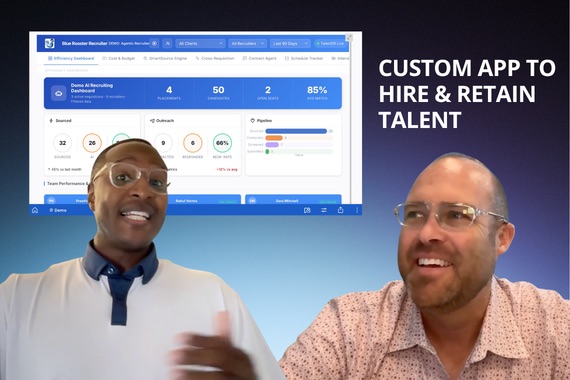
Looking at the efficiency dashboard here, you can see that we can start to parse out those metrics. And again, this is done after all of the data prep. Maybe this is coming from an ATS database, something like LinkedIn, as well as just maybe a repository where you're storing all of your candidate information. But we can see here, from placements, candidates, as well as open seats, we can start to view those metrics and get that average match score.
Even scrolling down, we can see our source, outreach, and pipeline metrics all side by side with conditional formatting so you know exactly where you need to focus your energy and time.
Then we can get into team performance from an efficiency standpoint, where maybe we want to not only understand how their capacity is looking, but who is our most efficient rep or recruiter. We can stack rank them against each other and sort of gamify the system a little bit. And I know in any competition, that breeds champions.
We'll jump into the next page here to the smart source engine. Using Domo's AI tooling, we can start to match these candidates to the right role on more attributes than just, "Hey, are they a good fit and are they interested in the job?" We can look at preferential factors like salary, location, the type of manager that they like, or a preferred regional location, and start to factor all of those into our assessment.
Scrolling down, you can see again some high-level metrics, but we can start to really tackle the matching score, whether we are turning this up and finding that best fit over 90% or adjusting it down based on this role. When we find a good candidate like Priya here, we can actually come in, scroll down, and see that she has the matching skills that we need. Here is a target requisition that we're going for, as well as some generated match summary scoring.
Mark: Kenny, back up for me just for a second. So, you were showing me that list of people and the score that you would give them, the 94% match or whatever. Walk me through the data on the back end. How do we even give them a score like that? What are the data sources that are coming in? Is this based on their resume? What's happening there?
Kenny: Yeah. So, we can use Domo tooling to not only read their resume and strip information in an OCR—or optical character recognition—process, but we can also take in user accounts. That could be collecting notes from the recruiter themselves, an interviewer, or looking at LinkedIn conversations as well as email conversations. It really just depends on where that data resides within that current recruiting process, but we can pull that into the platform and start to parse that out.
Mark: Kenny, just like Domo, one of Domo's superpowers is we are really good at taking data from a whole bunch of different sources and making it make sense so you can then take action on it. It is no different in this case. No matter whether they've had an interview, whether they've sent in a resume, or whether they've posted things on LinkedIn about it, we're going to do the very same process of taking that data and combining it so that we can then, in this case, give it a score to see how likely they are to be a good fit. Is that right?
Kenny: Absolutely. And that score can be as custom as you like. It really again just depends on what attributes you are measuring internally for that role.
Mark: Love it. Okay, keep going. Sorry.
Kenny: Yeah, no problem. Looking at the match summary, if we like Priya's description or summary here, we can either reroute them to another position that might be a better fit or submit that to the client. That will interact with our funnel to see exactly how we're sourcing our candidates.
Scrolling back to the cross-requisition page here again, we can start to understand those silver medalist candidates. Marcus Johnson is a good fit for the cloud infrastructure lead, but maybe there are other jobs within our client's patch that they're looking to fill that he might be a better fit for. This one, however, is still an 89, but it did pull up a senior Java developer as well as a Salesforce solution architect. If Marcus's preference was to actually be more of a Java developer, we could reroute him within his current hiring process. That way, he wouldn't necessarily have to start over again because we still have those data points from earlier calls and emails.
Scrolling back up to the top, once we've identified a good candidate like Priya here, we can start to come in and do some outreach. If I scroll down to this section here, you'll see these three tabs: email, LinkedIn, or SMS. We can start to have our AI tooling draft outreach messages for them.
One thing I do want to call out is while it is drafting this message, it is not going to send it automatically. What it will do, especially for emails, is once you like this email and submit it, it will land in that recruiter's draft inbox. This still allows a human in the loop to verify that what our AI outputted is correct and accurate. If they like it, they can go ahead and send that on. From there, we can send it to our draft email box, or do our LinkedIn outreach and SMS text messaging from here in a copy-paste procedure.
Mark: Very cool.
Kenny: And then another one I want to cover is just the schedule tracker. Again, we've reached out to Priya, maybe she has accepted an interview, and we need to go ahead and get that set up.
We can take her preferential preference for when she wants to do that interview, but we can also use our AI to suggest potential slots where all of our recruiters might be available. We can select that 9:00 a.m. slot, and you can see here on the interview board, Priya is now scheduled to go. This is a good way to track those next steps.
We can open this up and see that if we needed to leave notes or star this candidate, we can do that. That's all going to go into factoring for approvals for next steps or eliminating that candidate from consideration.
Mark: Kenny, why is Domo the best platform to be able to do this in?
Kenny: Yeah, I think Domo really steps up when it comes to ease of use. I myself, like Mark mentioned, started as an account development manager, so I didn't have a lot of technical background. But understanding the Domo tool and honestly trying to break it, I was able to learn rather quickly how to build my own reports to manage my book of business.
If you're a non-technical or a least-technical business user, being able to have data right at your fingertips, transform it in a drag-and-drop interface that allows you to get to that end-stage report, and then extend that further with our AI capabilities—again, without having a vast knowledge of AI or structured RAG operations—I think you can go out and build your own rich applications to manage your book of business. You can sit outside of the platform, take care of the business, and work on your business while Domo handles the heavy lifting.
Mark: I love that. Kenny, anything else to share with us here on what you built?
Kenny: No, I think from this standpoint, this is 100% customizable. I'm happy to connect with anybody out there if you need more understanding. But thank you again for your time today.
Mark: I love it, everybody. You saw it here. Everyone has a challenge of finding and retaining the best talent. Kenny has solved that problem for you with Domo. Don't forget it. Help us help you. If there's a problem or a challenge you're having issues with right now, come to us. We promise you we can solve it. We will talk to you again shortly. Have a great day.

Mark brings over 15 years of diverse marketing experience and is passionate about driving Domo’s business growth through marketing initiatives. His mission is to empower all Domo customers and prospects with the insights and tools they need to make better business decisions and achieve their goals. In his previous role as VP of Community, Partner, and Field Marketing, Mark and his teams established new and strengthened existing programs to address customer pain points and create a greater sense of community. They also executed campaigns, programs and events that showcased the value of the Domo platform. Before joining Domo, Mark spent more than 10 years working in customer relations and marketing at Adobe, and worked at Instructure as its senior director of customer marketing. He received his MBA from Utah State University and a bachelor’s degree from Brigham Young University. Outside of work, Mark enjoys spending time with his family and traveling.
Every recruiting team has a backlog. Open reqs aging past SLA, hot jobs buried in spreadsheets, and recruiters spending their best hours building the briefs that should already be in front of them. What if your data could do that work instead?
At Domo, we built an AI Recruiting Agent that doesn't just surface the problem — it tells you what to do about it. The agent reads your Workday data, scores every open requisition for time-to-fill risk, segments your pipeline into Critical, At-Risk, and Healthy, and generates a recommended next action for each one — with the rationale built in. When a recruiter agrees, one click routes the decision through a governed workflow, logs it to AppDB, and sends a confirmation. Your best strategic thinking, automated. Your team's judgment, preserved.
Featured Session
Join Domo CMO Mark Boothe and Kenny Scott, Solution Engineer at Domo, as they walk through a live build of the Domo AI Recruiting Agent — end to end, on the Domo platform. You'll see how App Studio, Workflows, Code Engine, and Domo AI work together as a single connected system; the agent analyzing your pipeline in real time, generating recommendations your recruiters would have spent hours writing, and routing every decision through a human before anything moves. No autonomous action. No black box. Just your data, your judgment, and AI doing the heavy lift.
What You Will See:
• It's Agentic: Risk scoring, next-best-action generation, rationale writing — the agent works the pipeline so your team works the offers.
• It's Connected: App Studio front end, Domo Workflows for orchestration, Code Engine for the AI logic, AppDB for persistence, and Workday as the source of truth — one platform, every layer.
• It's Governed: Every recommendation goes through recruiter approval. No autonomous offers, no autonomous closes, no surprises.
Join Mark and Kenny and see what a modern recruiting engine looks like when it runs on agentic AI.
Domo transforms the way these companies manage business.