From Forecasts to Action: Inside Domo's Agentic Operations Engine
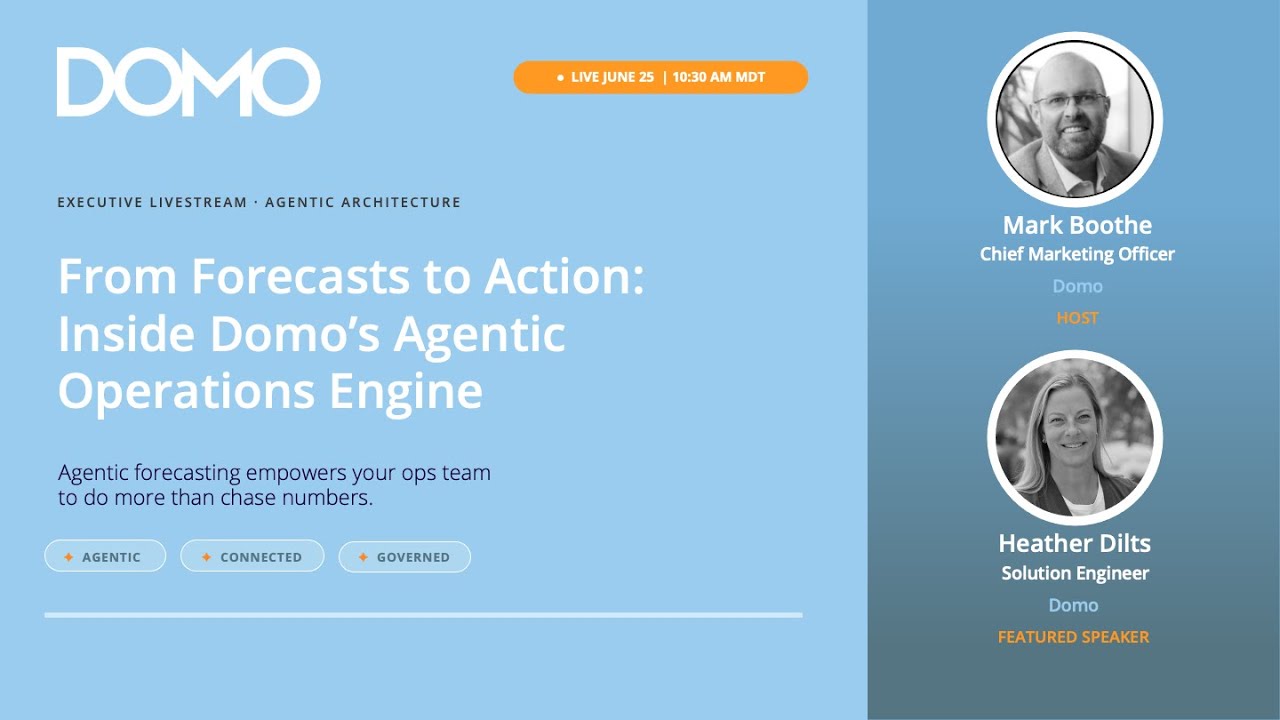

Mark: What's up everybody? Good morning. I am here with the infamous Heather Dilts. Heather, how are you?
Heather: I'm doing great. Looking forward to this.
Mark: Well, I'm looking forward to it, too. What you guys don't know is that Heather had to do a little magic in the back end a second ago to make sure she was ready to go live. We're not going to go into that, but just know she did some superhuman stuff to get ready for this.
Heather: It's part of the role as a sales engineer. Just have to figure things out. Be ready.
Mark: Think on your feet. So Heather has an interesting story. Heather, keep me honest, has been at Domo for four plus years. But before being a Domo Sapiens, you were actually a Domo customer, right?
Heather: Indeed.
Mark: Walk us through that. Where were you at? What were you doing?
Heather: I was at a company called Dodge, formerly the Blue Book, which was acquired by Dodge. I was in commercial construction software tools and services. I was in marketing all of my career, so I got really good at doing math so I could prove ROI, spend more money, and have an impact on the business. That turned into us needing a better solution; Excel wasn't cutting it. A lot of our customers have a similar story. Our marketing use case with Domo was kind of a superstar. That was fun, thanks to Domo. It then expanded across all different areas within the organization. I laid a good foundation with my marketing background, but then working with finance, sales, and operations to expand into those other areas of the business set me up to have those conversations with our customers.
Mark: I love that. So Heather, walk me through, when you were building things five years ago in Domo, what would it have taken for you to build something like what you're going to show us five years ago?
Heather: I can tell you six months ago was about the same as it was five years ago. I needed to establish connections to all different data sources, I would have to manually build out an ETL, I would need to manually create a whole bunch of cards in Analyzer, and I would need to tap on other departments to execute on machine learning and data science because that's not a skillset I run deep in. I would also need to tap on our front-end designers if I wanted any pro-code apps with HTML, CSS, and JavaScript. Again, I know enough to be dangerous, but not to build it from scratch. That's what it would have taken even six months ago.
Mark: Okay. So, what did this one take?
Heather: This one probably took about an hour.
Mark: No, it did not. Stop it.
Heather: Yeah. I'm making it sound a little easier than it was. I put in a lot of effort. It was more than an hour when we take planning into account. We hear from a lot of people that they've tested AI, but it didn't work, it wasn't reliable, or it didn't actually create impact. They question: "It looks cool, but what do we actually do with it? Are we better off?"
We talk to people a lot about how planning is important, and next to planning is ensuring that you have a great data foundation. It's the good old "garbage in, garbage out." Just putting AI on top of poorly structured, ill-formatted data, or data without context isn't a magic button. So there was time and effort that went into that outside of the one hour of actual building that I did for this, and that's what everybody else should be doing as well.
Mark: But the actual build you built using MCP, Claude, and Domo, and you brought in pro-code. You didn't have to bring in front-end devs. You did it.
Heather: Claude and I did it all.
Mark: That's amazing. Okay.
Heather: It's so amazing, yeah.
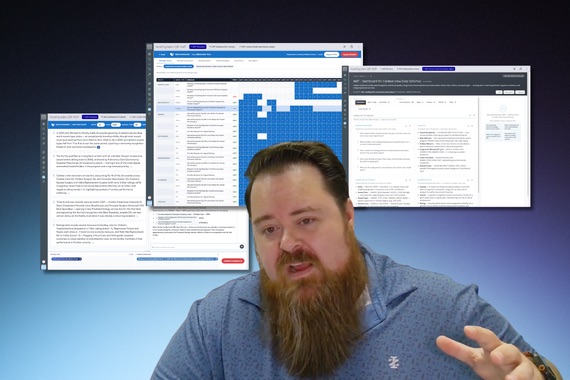
Mark: Okay, so Heather, I pulled up the screen and we're looking right now at this solution overview. Walk us through what it is you built. Show us what the magic is.
Heather: Perfect. We hear this a lot. We're going to walk through an operations forecasting agent. It's modeled on something that we built for a national distributor, but it's a pattern we see across all different industries. Distributed teams submit forward-looking information, finance has to review them, and operations translates that into staffing.
Let's pause for a second so people can resonate with that and think about how that is done now: emails, Excel sheets going back and forth, making phone calls to people. You lose an audit trail, it's disjointed, and it's cumbersome. We're going to show you today how you can solve all of that. The question that changes is: what happens when AI does the watching, the comparing, and the writing it up?
Mark: Heather, it's so intriguing you bring that up. We just had Domo Build just a couple of days ago, and Amanda, CFO at Massman, made a statement when she was presenting: "Automate what you hate," which I thought was pretty brilliant. Essentially, what you're doing here is automating a lot of work to help the humans go do the stuff that humans are really good at. Is that fair?
Heather: One hundred percent. Let humans spend more time where they can add more value, and less time chasing down numbers or defending obvious numbers. Let AI surface anomalies and changes instead of having finance stare at Excel sheets until their eyes cross, trying to figure out what changed. Let AI do that work and surface it for you, so you and your employees can spend more time adding value to the business.
Mark: I love that. Okay, Heather, keep us going.
Heather: Perfect. With that, in this example—which is based on a real use case, though Meridian is a fictitious company and the actual data you see is obfuscated—we talked about saving time and reallocating people to more valuable efforts. On top of that, there is five hundred and eighty thousand dollars in revenue upside identified by AI, which translates to one hundred and twenty-four hours returned between finance and ops. In this scenario, thirty-eight person-labor hours were redirected to where they are needed, reducing missing delivery times. What is that worth to businesses?
Mark: Yeah, it's amazing. Okay, show us what you built. I want to see it.
Heather: Perfect. I knew you would. It's why we are going to start with an executive overview. I'm going to start at the end with the executive overview because this brings it all together. This is one of the most common asks we receive from executives and heads of departments: "Show me what's important. Show me what changed. Show me what matters. Give me the highlights." It's great that we have all these different reports and dashboards, but how do we level them up? How do we make them more actionable and surface what's important, instead of just saying, "Here is everything, good luck finding it"?
Mark: Okay, Heather, get ready for this one. Is the dashboard dead?
Heather: I'm going to have a bit of an unpopular opinion, probably.
Mark: Let's hear it.
Heather: The dashboard's not totally dead. KPIs, metrics, and trends are still important. I think we're just at the next level: how do we augment dashboards to better surface insights and show what's important?
Mark: I'll take that answer. The actual information provided on a dashboard has never been the endgame. The endgame has always been: how do I get information that I can then use to take action and create more value? Whether it's in a dashboard, via an agent, a workflow, or in an app, who really cares? What matters is: are you using that information to make positive change for the organization?
Heather: Exactly. What's impactful is less dashboards for the sake of dashboards.
Mark: Love it.
Heather: With this, we have those top-level KPIs, but we also have forecast staffing anomalies and the agentic summary right here. This is the destination. Now, how do we get there?
Mark: Before you do it, Heather, walk me through. You had sent me some information about how this could apply to a whole bunch of different companies, not just a manufacturing company. Maybe talk for just a little bit about how this can apply to any business, no matter the industry.
Heather: Absolutely. We see this a lot in retail, HR, and the medical field—anywhere where data is entered by multiple dispersed people, and that data needs to be reviewed by another department. It's often finance, but maybe it's things like staffing, or evaluating orders against inventory. We're not demonstrating all of that today, but this pattern and solution are repeatable across so many different use cases.
Mark: I love it. So really, if you have any kind of staffing or inventory to deal with, this solution could be retrofitted for your organization.
Heather: Yep, exactly.
Mark: Love it. Okay, I promise not to interrupt for at least five seconds.
Heather: Okay, great. Let's start jumping into how it actually happens. What we're seeing on the screen now is what your sales team or the people currently entering information see. We have different sales rep views, leveraging Domo governance and PDP for who sees what, without having to manually create separate assets for different people. We have the actuals, the budget, and the forecast loaded in.
In this case, we know that this sales rep, Priya, met with Costwise and knows they have an adjustment they need to make. They're increasing their volume and their dollars. Priya is going to save her forecast change. Once this forecast is changed, the agent reads that signal and presents it in a consolidated fashion.
I'll switch to the finance review now. A person submits something, and the next team needs to review it. It's important to call out that Priya didn't email anyone, didn't update spreadsheets, and didn't have to remember to tell anybody. The submission is the signal, and everything flows downstream from there.
Mark: And Heather, my five seconds of being in timeout are over, so I'm going to jump in now. For Priya specifically, she is only seeing the accounts that matter to her. She's not seeing what John, Stephanie, or whomever else has in their pipeline. Priya is only seeing what she is supposed to see, right?
Heather: Exactly. Although I was able to see a dropdown with multiple sales reps there, I am impersonating a finance user.
Mark: Right, because you have the permission to do it. This is not a situation where I have to create a separate spreadsheet for Priya by herself, for Anderson by himself, and for Stephanie by herself, and then somehow collate all of these different spreadsheets together. That doesn't make any sense, it doesn't scale, and it doesn't work. This is one place, one app, and one agent to rule them all, keeping track of each individual sales rep's pipeline and information. This is the one place a finance or operations person can go to manage the whole thing.
Heather: Exactly. And with that, if we're talking about Excel sheets and finance compiling all of those together—well, we know how sales reps can be. They may change the format, which creates a nightmare. All of that goes away; it is not a thing anymore. Not only that, but we can highlight what has changed and what needs attention right in your face.
On top of that, we know Priya submitted an adjustment. This red callout is not just decoration; it's the AI anomaly detection. Priya made that submission, and it's flagged as a change, but the "why" is also called out.
Mark: Love it.
Heather: In this view, we have the actuals from the past, what sales entered, and then we have the option for finance to accept or deny that override and save the changes.
Mark: So cool.
Heather: I know I'm starting to run a little bit long, but I want to keep getting to the good stuff. While many people appreciate and like that tabular format because it feels familiar, we're hearing more and more that people just want an anomaly feed. Just show me what's important, and let the rest of it ride. So, that's why we also built this anomaly feed.
As I mentioned, this is set up on an automated nightly batch process, but if there were entries throughout the day or you wanted to re-evaluate on demand, it can trigger that as well. It's about keeping a human in the loop. We recommend having humans keep eyes on this, surfacing what's important, and letting a human take action to close the loop.
Here we have the AI rationale of what changed, and then we built in different options to accept it or adjust the anomaly. We also have a notification channel here, configured based on what is submitted, who submitted it, and who might be impacted by these decisions. All of that is already built in so the appropriate people are notified at the appropriate time.
Mark: So cool.
Heather: We went ahead and accepted that and submitted it through.
Mark: Where do we go next, Heather?
Heather: So, that's not enough.
Mark: I think we've already solved a lot of people's problems already and made their lives easier. Hopefully, we have more people saying, "I didn't know I could do this in Domo, take away my Excel."
Heather: People are saying that, yep.
Mark: So, the "what's next" part is that it all compiles, right? We have the rep entry, we have the forecast, we have the sales, and we have the upcoming incoming pipeline that impacts downstream staffing. How is that currently done? It's usually handled across a number of different disjointed systems, with a couple of people looking at a lot of different reports to figure out who is going to staff what, often scrambling at the last minute to pull in people for overtime.
Heather: So, let's stop that and get ahead of it. We already have all of the information we need. There's a second agent for our staffing outlook and staffing recommendations. Based on the changes to the input, the agent runs in the background to identify where we are short-staffed or over-staffed across multiple distribution centers. It also gives us a recommendation for how to solve it, rather than just pointing out the shortage.
We can modify the plan. If we think we know better than the AI agent, we can verify and adjust it. We can "trust but verify," and then go ahead and submit or approve the plan.
Mark: This is amazing.
Heather: I think so. That's why I wanted to share it with everybody.
Mark: Yeah, it's cool. It's real cool.
Heather: Definitely. So, that's what I had for the demo. To close the loop on it, we talked about the pattern being the same across retail, healthcare, manufacturing, or utilities: the field submits, AI flags it, operations acts, and the human approves. Domo connects it all. AppDB captures the field entries, Magic ETL builds the gold layers, Code Engine runs the agents, and every decision writes back where it needs to be—all with the sources flagged.
Mark: That was a slow clap, Heather, for you. That was a slow clap because it's just that good. So, Heather, what would you tell any customer or prospect who is sitting out there thinking, "Our problems are too big, we can't solve them with Domo"? This is a solution that handles inventory, staffing, pipeline, and more, solving the real problems customers deal with every day. What's your challenge to them? Bring us your challenge. Let's go, I want to hear it.
Heather: Bring it, let's go. Our customers have the data, but one of the struggles is simply figure out how to access and connect to it to automate. That's what Domo has done forever, and we can land it in your cloud data platform of choice. We can structure that data. At the beginning, we talked about planning and having a good data architecture and foundation. That's where the bulk of the work really is, and that's what Domo has always done really well for people. Now, we can do it even more efficiently by leveraging agents to help speed up some of that build process. That's where the fun happens, and that's how this build took only an hour.
Mark: So amazing. You heard it here, everybody. Heather is literally challenging you: whatever the challenge or problem is, bring it to us. Whether it's a staffing, inventory, or pipeline problem, bring it to us, and we promise we'll find a solution with Domo and your cloud data platform of choice. We help you build that data foundation, and that data does not have to leave Snowflake, Databricks, Dremio, or GCP. We make sure it's connected and put in a good place, and then we help you activate it like this amazing agentic experience Heather put together—which she built in an hour with her dear friend, Claude—because the data was in a place where it was malleable and ready to make value-added decisions for the organization. Heather, close us out. What else do you want to say to the group?
Heather: I would just double down on this: if your operating rhythm depends on people submitting numbers, this is what comes next. Let's go.
Mark: I love it. You heard it here, everyone. We will see you again next week. Next Tuesday, we're back for another one. Heather, thank you for joining us, and have a great day.
Heather: Thanks, everyone.

Mark brings over 15 years of diverse marketing experience and is passionate about driving Domo’s business growth through marketing initiatives. His mission is to empower all Domo customers and prospects with the insights and tools they need to make better business decisions and achieve their goals. In his previous role as VP of Community, Partner, and Field Marketing, Mark and his teams established new and strengthened existing programs to address customer pain points and create a greater sense of community. They also executed campaigns, programs and events that showcased the value of the Domo platform. Before joining Domo, Mark spent more than 10 years working in customer relations and marketing at Adobe, and worked at Instructure as its senior director of customer marketing. He received his MBA from Utah State University and a bachelor’s degree from Brigham Young University. Outside of work, Mark enjoys spending time with his family and traveling.

Heather Dilts is a Sales Engineer at Domo with over four years of experience helping organizations translate complex business challenges into practical data and AI-driven solutions. Based in Bluffton, South Carolina, Heather combines her background in business, analytics, and technology to bridge the gap between technical teams and business leaders. She specializes in pre-sales discovery, data platform integration, and designing AI-driven workflows that drive measurable business outcomes. Prior to Domo, Heather held key analytics and marketing roles, which continue to shape her customer-focused approach to data strategy and solution implementation.
What if every monthly forecast came with the anomalies already flagged, every staffing decision started with the predicted hours, and every adjustment carried the explanation written by the AI that reviewed it? Welcome to agentic forecasting in Domo.
At Domo, we’re building AI agents that do more than visualize the past. They read what is actually happening across your business, flag what doesn’t fit, predict what comes next, and route every recommendation through the right human approval. In this livestream, you’ll see an Operations Forecasting Agent built on a national industrial distributor’s data: orders history, customer accounts, weekly submissions from sales reps, finance adjustments, and the labor schedule. For every customer, in every month, the agent assembles three perspectives: budget baseline, field rep’s submission, and the finance review. Each result is compared against seasonality, customer health, and recent trends. Every unusual pattern is surfaced with a written explanation. Every predicted labor shortfall is teed up for a one-click staffing decision. Every final number is tagged with where it came from.
This pattern applies across industries:
- Retail and CPG: Store managers submit sales forecasts, AI flags unusual sell-through vs. seasonal baseline, the labor model converts units to shelf-stocking and checkout hours per location.
- Healthcare and hospital systems: Department heads submit patient volume forecasts, AI flags census anomalies vs. historical admissions, the staffing model converts predicted volume to nursing hours per unit.
- Manufacturing: Plant schedulers submit production plans, AI flags deviations from run-rate and material consumption norms, the capacity model converts units to machine-hours and shift coverage gaps.
- Utilities and energy: Regional ops submit demand forecasts, AI flags consumption anomalies (weather-adjusted), the crew model converts predicted load to line technician hours per substation area.
- Construction and field services: Project managers submit milestone completion forecasts, AI flags schedule slippage, the labor model converts forecasted work to crew-day requirements per site.
This is what becomes possible when real agentic capability sits behind the operational rituals your teams already run. The math, the agents, and the human approval loop are running on Domo, with data shaped like the operations you live in.
You’ll come away with an answer to one question: when an agent does the boring parts (the watching, the comparing, the writing-it-up), what changes about how your operations team spends its day?
Domo transforms the way these companies manage business.