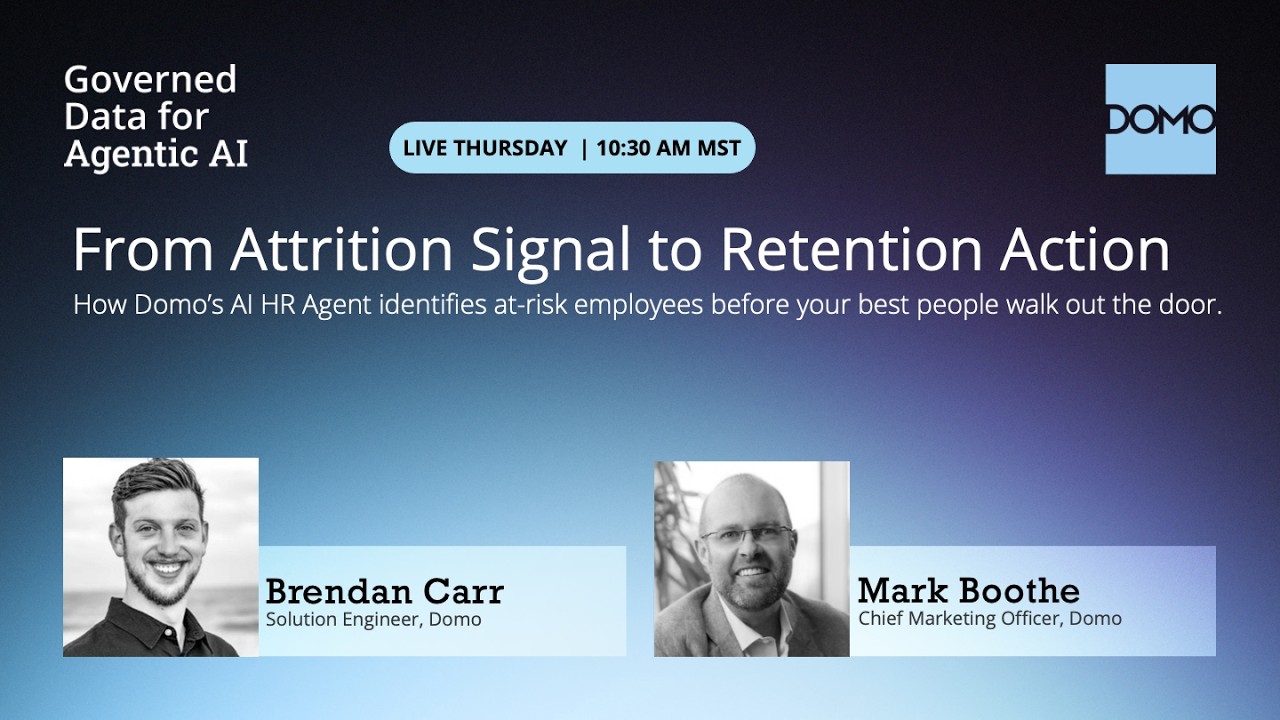
From Attrition Signal to Retention Action: Inside Domo’s AI HR Agent

Mark: What's up, everybody? We are back again, and I'm here with my good friend Brendan Carr, who is one of our solutions engineers at Domo. Brendan, how are we doing today?
Brendan: Doing well. Mark, how you doing?
Mark: Good. So, we've got some interesting stuff to talk about. For essentially every business, individual, or leader who is tuning in today, your number one asset is your employee base. How do you make sure you onboard them, you take care of them, you help them, you support them, and you create a really good environment so they want to stay with you for a really long time? Brendan has created something—thank you, Domo, thank you, AI—that is going to make this whole process easier. Brendan, tell us about what you built and why you built it.
Brendan: Yeah, as you mentioned, employees or people are the most valued asset of any company. They don't just do a task; they contain a wealth of knowledge around the product, the customer base, whatever it may be. When an employee leaves an organization, it leaves more than just a seat empty—they take that knowledge with them. On average, companies lose 18% of their employees year-over-year. That is not just the intangibles of knowledge leaving, it is also costly to replace those individuals. It costs money to put someone back in that seat, and then it takes more time and effort to get them up to the standard that the prior employee was achieving.
So, what I built is essentially what I'm terming a "talent retention engine." It's a way in which frontline managers can monitor their direct reports, see how they're doing from a productivity standpoint, from a career development standpoint, compensation—essentially anything that could affect an employee's desire to continue working at a company. We want to get ahead of it. HR is an underserved department in many organizations, especially in today's new AI and BI ecosystem that we live in. Their efforts and how they can affect employees and how they feel about working at an organization directly impacts the bottom line. So, although it's not sales and it's not finance, it does have an effect that we can get in front of with the amount of data that most companies are collecting.
Mark: Brendan, what's that stat that you shared with me earlier? I think it was double the yearly salary to get somebody back on if they leave? It was something like that.
Brendan: Yeah. On average, it costs about 1.5 to 2x the annual salary of the position you're trying to fill to replace that position.
Mark: That's crazy. Okay, Brendan. Well, I'm excited. Let's show everybody this cool thing you built.
Brendan: Yeah, absolutely. Can you see my screen?
Mark: Yep.
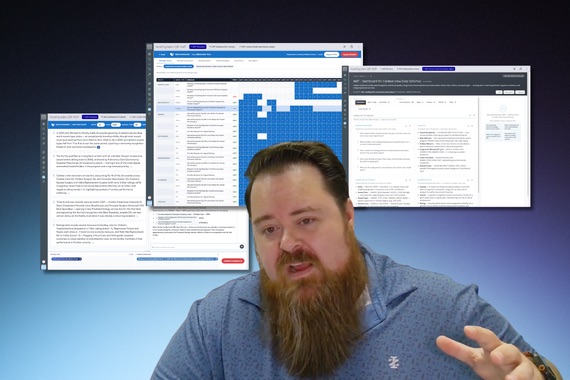
Brendan: Perfect. So again, as I mentioned, this is the talent retention engine. I think the beauty of it is not necessarily just the use case that we're trying to solve for, but this utilizes every aspect of Domo. It takes data from HRIS, employment surveys, and payroll. It uses workflows, code engine functions, and AI integration, and wraps it all into one ecosystem. This allows managers and the head of HR to go to one centralized location and communicate symbiotically around the employees they are ultimately trying to bolster and take care of day in and day out.
To walk you through the perspective of a frontline manager to start: as a frontline manager, I can jump in off the bat and see some of my direct reports, ranked by the likelihood that they may leave the organization, so I know who I might want to sit down and have a conversation with on any given day.
I can also drill into my dashboard here. We're looking at David Park as the engineering manager example. I can see all of the direct reports on the engineering team and how they're being scored against the model we've created based on those data points. Taking Amara Brown as an example, she has an attrition score of 95. It's not great; there is a high likelihood that she is going to leave. Being a Software Engineer Tier 2, that's going to be quite costly to replace. The model is essentially saying that based on these given risk factors, this is why we feel that score is appropriate: she is slightly underpaid (46% below the peer median), her engagement has gone down over the last handful of months, she hasn't been promoted in nearly three years, and there is a flag indicating she needs improvement from a performance standpoint.
Mark: Brendan, before you keep going there, talk a little bit more. You talked high level, but dig into all the different kinds of data sources that make up that score of 95.
Brendan: Yeah, that's a great question. You could take Domo as the example: we are constantly on calls and in meetings. They're recorded, and we have transcripts, so we can see how often we're engaging in those calls and what that engagement looks like.
There are other factors too: how often have they been promoted? This heavily affects the longevity of an employee at an organization. How many manager changes have they experienced in their tenure? That also affects the day-to-day. Compensation is a clear one—are they feeling like they're valued within the organization? And then also work-life balance: how many days have they taken off in a given period of time? Are they taking the time to ensure they're not feeling burnout and can continue to give the same level of effort day in and day out? Those are the kinds of data points we're grabbing. Whether it's Workday, employee surveys that are emailed out, how we track PTO, or HR systems, all of those are funneling into this retention engine.
Mark: Love it.
Brendan: Yeah. Just to dive deeper into the example here of Amara: as a manager, I can see the high-level attrition risk score very quickly, but I can also come in and really start to glean some of those details. At the top, I can quickly see when an employee was hired, how often they've been promoted, and if there have been any prior cases escalated to HR. Those cases don't always mean a bad thing; it could be they are performing impeccably and we want to give them a raise or recognize them.
In this case, it does seem like we're experiencing some decline in performance and engagement. What the app is doing, with the assistance of Claude in this example, is providing the manager with clear natural language around the risk that is being felt and why it's being ranked the way it is. It's laying out very clearly where the compensation gap is, why we're calling it declining engagement, and low team morale. It makes these specific callouts for the manager and then retains a history down here of all the actions we have taken with this given employee to try to solve the issue.
We can see here we currently have a plan in place to try to bring them up to a higher level in compensation. We've addressed some of that declining engagement—we resolved it back in March, but there was another blip in May. Having this breadth of information at your fingertips is invaluable. We can't remember every conversation we've ever had with our employees, but having this overarching roadmap of what their tenure looks like allows us to have very poignant, strategic conversations with them going forward.
Mark: That's awesome. Where do we go next?
Brendan: Yeah. I just want to close the loop on what it looks like from a manager perspective and how we get from the manager up to HR. At the top here, there are a couple of different buttons. One is that "log-in" or check-in with our employees. We can retain that history. Those conversations aren't always recorded, and sometimes we don't transcribe our notes, but as a manager, I can quickly come in, jot down a few notes, and log that engagement so we have that history.
We also have the "create plan" button, which is a very similar concept. If we want to get them on some sort of development, performance, or compensation plan, I can use Claude to help me draft it. This draft is 100% editable. I can come in, put my own twist on it, and adjust it—for example, indicating I'd like to see growth in the next 30 days. I use the AI to help me dig through all the data and keep those points front and center, and then I can send it directly to HR. This then routes to HR, where they can take the necessary steps to help the employee going forward.
Mark: Very cool.
Brendan: Flipping over, let's imagine now that we are the HR manager. It's the same environment and cockpit, but we use Domo's governance layer to ensure HR only sees the components they should, and managers only see what they're supposed to see, whether it's specific pages or just their direct reports.
From an HR perspective, I can come in and see all the different plans that have been submitted to the team from management. I can see there are eight in review, seven pending manager approval, and seven resolved cases. For example, we can see Derek Hall's case has since been resolved because we reviewed it as an HR team and updated the status. I can pick who was running the review, change the resolution, hit save, and it will go off the docket.
If we jump down, we can look at Amara Rodriguez. HR doesn't always have the full context; they often hear about situations through word of mouth from managers. But because we've centralized this wealth of information and used AI to help us digest it, HR can also utilize these tools to get more insight. They can jump into the detailed view of an employee and see an AI summarization that allows them to best address whatever issue we're trying to solve.
Mark: Brendan, why Domo? Why build this in Domo?
Brendan: It's a great question. When you look at all the pieces that went into this project, it requires a connector framework to ingest data from multiple different sources, as well as some ETL work to mesh those data points together. Ultimately, we wanted to build a front-end application like this. Domo, with its MCP servers and the ability to pick any AI model we want to utilize for analysis, allows for seamless development.
But most importantly, it's the governance component. I'm trying to build a one-stop shop, an ecosystem for a number of individuals, without having to duplicate my work. I don't want to build six different dashboards because I have six different managers, and a seventh one for HR. I want to build one cohesive unit that is tied together. It speaks to itself cohesively, but I can give that access to everyone without having to worry about security issues or data slippage.
Mark: So amazing. We often tell the story that Domo helps you build your data foundation no matter where it lives. If that's in Snowflake, Databricks, or GCP, fantastic—we help you get the data into those places so your foundation lives there and doesn't have to move. But then, what we help you do is create and activate that data by building agents, apps, and things like what Brendan just showed you. You can then distribute that safely, securely, and in a governed way. You don't have to worry about whether HR is seeing things they shouldn't, or if sales reps or managers are accessing sensitive data. That is the power of Domo. What else, Brendan?
Brendan: No, I think you nailed it right there. It's incredibly important because we're disclosing some pretty sensitive information around promotions and salaries—things we don't want slipping. So, as you mentioned, that governance layer is the most important aspect. An engine like this can be extremely helpful in ensuring organizations retain their top talent, making sure employees feel valued and that their careers can grow with the company they're at.
Mark: I love it. Can you imagine everyone listening in being able to know which of your employees are at risk of churning way before they actually churn, so you can go and fix that problem? You can get them situated and put them in a good place so they don't feel like they have to leave. That is the power of Domo. Give us a call, and we will see you here next time. Thanks for joining us today!

Mark brings over 15 years of diverse marketing experience and is passionate about driving Domo’s business growth through marketing initiatives. His mission is to empower all Domo customers and prospects with the insights and tools they need to make better business decisions and achieve their goals. In his previous role as VP of Community, Partner, and Field Marketing, Mark and his teams established new and strengthened existing programs to address customer pain points and create a greater sense of community. They also executed campaigns, programs and events that showcased the value of the Domo platform. Before joining Domo, Mark spent more than 10 years working in customer relations and marketing at Adobe, and worked at Instructure as its senior director of customer marketing. He received his MBA from Utah State University and a bachelor’s degree from Brigham Young University. Outside of work, Mark enjoys spending time with his family and traveling.

Brendan Carr is a Solutions Consultant at Domo with a strong background in enterprise SaaS, analytics, and AI-driven solutions. With over four years at Domo and prior experience in data analytics and visualization, Brendan partners with sales teams and executive stakeholders to translate complex technical capabilities into measurable business value. He has supported major transformation initiatives across industries, helping clients modernize their analytics and improve operational decision-making. Brendan holds a Bachelor of Science degree in Finance from Siena University and is known for his strategic approach and ability to drive impactful outcomes.
What if you could identify which employees are at risk of leaving before they start sending resumes?
Domo’s AI-native Employee Retention Intelligence Agent turns disconnected workforce data into a proactive retention system. It connects information from HRIS platforms, compensation history, engagement surveys, and performance reviews to score employee flight risk daily and explain the factors behind each signal.
When elevated risk is detected, the solution generates AI-assisted context and a recommended retention plan, then routes it to the appropriate manager or HR partner for review and action. Each intervention is logged, tracked, and measured to HR leaders can see whether managers are responding and which actions are improving retention.
The result is a more consistent, informed approach to employee retention – helping managers address concerns earlier and allowing HR teams to focus on the conversations and actions that keep valuable employees engaged.
Featured Session: Inside the Employee Retention Intelligence Agent
Join Brendan Carr, Solution Engineer at Domo, for a demonstration of how Domo can turn employee data into a proactive retention operating system for a fast-growing tech company.
The session will show how the agent:
Unifies signals from HRIS, compensation, engagement, and performance systems
Scores employees daily using explainable risk factors
Generates personalized retention plans and manager talking points
Routes escalations to HR with full context attached
Tracks manager accountability from the initial signal through resolution
Built end to end on the Domo App Platform, the solution can be deployed in weeks without replacing existing HR systems. Personalized data permissions ensure managers see only their direct report, while HR maintains appropriate oversight.
Why It Matters
It’s Agentic: The solution goes beyond dashboards by identifying risk, explaining contributing factors, recommending interventions, and routing actions to the right person with human approval at critical steps.
It’s Connected: App Studio, Domo Workflows, Magic ETL, Python-based modeling, and existing HR data work together in one application.
It’s Governed: Access is restricted by role, HR reviews escalations, and every retention action is logged and measured. There are no autonomous employment decisions and no unnecessary exposure of employee data.
See what happens when employee data stops being a report and becomes a governed, measurable retention system."
Domo transforms the way these companies manage business.