AI Without a Data Foundation Is Just a Confident Guess
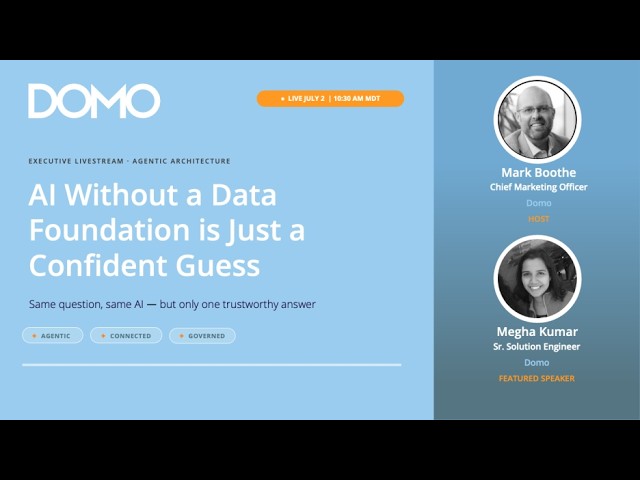

Mark: What's up everyone? I am pretty excited today because it's not every day you get to be in the presence of Domo royalty. And if you've been to any sales kickoffs or anything, it seems like Mega is up there almost every single time as one of our top solutions engineers. True or false, Mega? True or false?
Mega: I don't know.
Mark: It's very true. And yet Mega is such a good human. She's like, "I don't like bringing that much attention to myself." But everyone, please know Mega Kumar. She's one of our senior solutions engineers and she is awesome. You get to work with Mega and your life is going to be better. Patented, trademarked, do all of it because she's that good. Mega, what are we talking about today?
Mega: Oh, Mark, we get this question a lot. Why can't I just use Claude or ChatGPT or Gemini? I've got Copilot, can't I just use that? Why Domo? I don't need a BI platform. I don't need anything. I've just got my Excel sheets and I've got AI and I'm good to go.
I think today we're just going to talk about this with simple examples, just kind of talking through why it's a Domo plus AI conversation, why you need that data foundation, and why that's so important now more than ever.
Mark: Mega, is this—I mean, a top five thing you get asked these days?
Mega: All the time. All the time. People are definitely asking that in their top five. All day long it is just like, "Hey, I already have Claude, I don't need anything."
Mark: Yep. And then we do a quick trial. We go through a simple exercise, and usually the flip side of that ends up being, "Oh, aha, I see. I see now why." That's awesome. Well, Mega, where do you want to start? Do you want to start demoing? Where do you want to go?
Mega: Yeah, let me show a quick, very simple example just to highlight. I took simple orders and a simple refunds file, which I think a lot of people across different industries can understand. So what I'm about to show is not just for a specific industry; it's just overall in general what we're talking about. Let me just share my screen and we'll go from there.
Mark: Love it.
Mega: Mark, can you confirm you can see my screen?
Mark: Yep, we got it.
Mega: Wonderful. All right. I have two simple files, like I was saying: orders and refunds. I asked it a very simple question: "Can you give me net revenue for June?" When you look at this, Mark, does this look right to you? It's telling me it's got my eligible order revenue, it has not excluded your refunds, it has removed internal orders, and it is doing a couple of additional things. If you were to come in here, you would say this is accurate. You see thirty-seven thousand dollars roughly as your net revenue for June.
Mark: Yeah. So, Mega, I'm an AI lover, but I'm also a bit of an AI skeptic. Luckily, I don't have to worry quite as much because all of the context for AI for me comes from Domo. But if I saw it, I'd be like, okay, it depends on where it came from. Knowing where it's coming from right now, I'd be like, let's check the math. But yes, a normal person in their normal day job would say, "Yeah, it's good," because Domo is helping with the foundation.
Mega: Exactly. Now, here's me asking similar questions in Claude. Again, I love Claude. I use Claude for building content in Domo all the time, and I'm looking at Domo through the Claude lens all the time. Right here, it has given me a different amount because it confidently told me that this is the amount.
I then went in and asked, "Hey, what definition did you use?" and it's like, "Oh, well, not exactly. That's not what I did." It changed the approach. It's a small, subtle difference, but every organization has multiple AI tools, even within the same company.
Imagine somebody coming in and asking a question here, and then asking a question in ChatGPT. I almost feel—maybe this is a little naive on my part—but I feel like we were at this same juncture when we were talking about, "Hey, I can use Excel for my analytics, I don't need a data foundation." We ended up with the same situation where everyone has their own definition, you go to a meeting with different numbers for the same thing, and then the conversation becomes all about why the data is so different, instead of focusing on taking action and truly becoming a data-driven company.
Since AI is so new—only in the last year or so, or even earlier than that—I think we're in that same spot. But now with AI tools, it's different.
Mark: It's intriguing, Mega, that you bring that up because it feels so similar to those early conversations that were like, "Oh, well, how come marketing has that number, and sales has this number, and finance has a completely different number?" because they were all doing it based on their own different spreadsheets. AI is no different. It's using its own formula and its own logic. It's the same challenge, just with a different wrapper on top of it.
Mega: Exactly. A much more intelligent wrapper. So, thank goodness we're heading in that direction. But exactly to your point, they are very similar challenges.
Right here I am in our Domo demo environment. Try saying that fast! I'm basically asking what is the net revenue for June off of a certified dataset in Domo. Right here, it gives me a thirty-two thousand eight hundred dollar amount, and I'm going, "Hmm, that's totally different than what we saw in the standalone AI."
Now it's telling me what logic has been applied here. There were lots of things: there were duplicates in the data. Even though this was such a simple example, these are things that happen all the time. You get duplicates in your data. It had to remove a whole bunch of different order types and order statuses because let's say I was part of this organization and I used to be a customer of Domo.
This is not just a made-up thing; this is very real. You have all these different types of orders in your system and you define them a specific way within your organization. This is telling me it has actually looked at the data, and because it's governed, you can trust the data. You can trust what it's telling you, which is good.
Right here, I can then ask multiple additional questions off of that. I even took it a step further and asked it to tell me what was the revenue tied to all the cancel—well, all the orders you excluded as part of the net revenue. It is coming in and explaining the differences.
The point being, this dataset that I asked the question off of was governed, and all the business rules were applied. I'll even take it a step further here and go back to Claude, because this is not just a "you have to use Domo" conversation. This is a "you've got to use AI—absolutely use AI, but on top of Domo" conversation. That's what we're trying to talk about here.
You can go, "Hey, let me look at my datasets, let me connect to my Domo environment, and now we can basically ask the questions using Claude." That's awesome. At the end of the day, what I'm trying to highlight here is whether you use Domo's LLM to ask the question, or whether you bring your own LLM to this, it doesn't matter. You cannot skip the foundation.
Mark: When you say foundation, it's intriguing that you bring that up because it's one of the things we've been talking about quite a bit. Whether you are building your data foundation on Google Cloud, on a GCP, on a Snowflake, on a Databricks, or on a Dremio, that's fantastic. We play very nice with all of those companies; they're good partners.
But what we are saying is your data needs to be in a place where it is safe, secure, and governed, so that you can actually ask questions of AI that get you the answers you need, not the answers the AI just decides are right, because oftentimes those are not right.
Mega: Yeah, so here's that example where I'm pointing Claude to my Domo environment, where it's giving me the same responses. If you like Claude, go for it. You want to use Gemini? Great. But to your point, you're looking at data that you can trust.
Now, why is that? If I come in here, here is where I've applied the business logic to it. When you query the output—this is Domo's drag-and-drop ETL tool, and by ETL I mean data transformation layer—it's renaming columns, removing duplicates, filtering some of the data out, and doing your joins.
The biggest piece that you're seeing here is I have applied my logic once. I have set it up so that not everybody needs to know that they need to apply this logic. That's too much detail. You just want to be able to ask the question and let the data team, or the person in charge of building the reports, get this done once in one single spot. Now, when I come and ask my questions over here, we're looking at good data.
Mark: So Mega, we've got the really smart individual in Mega here, and then you've got Mark who's not quite at the level of Mega. So when I ask you this question, feel free to dumb it down for me, but I want you to go a little bit deep. Like, Mega, I can already just throw a spreadsheet into ChatGPT. What's the risk of uploading the spreadsheets and not having something like what you're showing me right now?
Mega: You can definitely upload the spreadsheet. You can also provide the rules, sometimes like definitions like this, to any of the LLMs out there. You absolutely can. But a lot of the time, it's all dependent on how you prompt and how you ask the question.
If you upload something else on top of what you've given as a company-wide context, it is all tied to how you're asking the question and what additional information you're providing. Many times we might give something that is conflicting. You end up in a situation where not everyone is looking at the same single pane of glass, even when it comes to AI.
At the end of the day, you can't prompt your way out of a data foundation; you've got to have the data all together. So yes, while you can do ad-hoc analysis a little bit here and there, you don't want to be relying on everybody doing exactly the same thing. I'm glad you asked me this because let's talk about all the different things from an AI perspective.
Step one: let's talk about the data that feeds your AI. This actually ties into what you were talking about. You want to have your data live. You don't want to end up asking a question off of data that was a week old while somebody else looks at a more up-to-date spreadsheet and is looking at yesterday's data. With Domo, your data is live. Or maybe everybody consistently within the organization has refreshed their data from different places at eight a.m. in the morning. When you look at an answer, you know where it's coming from. You can trust the formula and everything. You have to get that data live so that you're not working off of stale data. It is as simple as that.
Mark: Mega, how often—I mean, for so many years it has felt like we talk about governance, and sometimes it's like, "Oh, governance, that's so five years ago," but it's really the pinnacle. It is the most important part of being successful with AI, right?
Mega: Yep, absolutely. Imagine if I had given that spreadsheet—that was just orders and refunds, but imagine if it was something sensitive, and that information went over to someone who was not supposed to see it. With Domo, all activities—who's logging into what, what questions they have asked—you have an audit trail of everything.
When I pulled up the Domo screen, or even if it was through a Claude interface sitting on top of Domo, if I had asked a question and I didn't have access to that data, it would tell me I don't have access. Going back to your governance, you don't want somebody seeing very sensitive information. All the things that we know and love about Domo—PDP, row-level security, column-level masking, making sure that the finance group can see their finance data, HR can see HR data but maybe not salary information—all of that continues to live on. Why should that be any different when we're talking about AI? When we're layering AI on top, now more than ever, governance is so important.
Mark: Yeah, I mean, I think of your statement, which is: if every team defines revenue differently, AI just scales that inconsistency faster. Why did we walk into rooms years ago and marketing would have one number, and finance a different one, and sales a different one? Because they were all defining things differently. And so you'd go into a room and it's like, "Well, that's not what my number shows."
Mega: Yeah, exactly, exactly. And how many times have you heard Claude or ChatGPT say, "You're right to call me out on that. Oops, I made a mistake." I'm like, "Thank you, AI, for acknowledging that. I feel wonderful. However, if this is a business decision we're starting to want to take action on," that's a very expensive mistake. We can't afford something like that. That confidence where it just gives you an answer because it is a reasoning tool is what it does. So use AI, absolutely use AI, just always have that solid foundation underneath.
Mark: So, Mega, what makes—what makes the Domo answer better?
Mega: In Domo, you can define your business rules ahead of time. Not everything is AI; there are parts of it that you can be very deterministic about. There are things that you can control and validate and make sure everything is okay. You can add things like playbooks for your company, you can add a knowledge base, and you can basically schema-ground it. Meaning, I'm going to prevent hallucinations, so let me only provide columns that AI would use, and I can provide definitions for them.
If I come back here, I can provide—this is our AI readiness section, for example. I can come here and provide a definition. I can say, "Hey, if somebody asks for my revenue for the territory, the column is called region, but this is the same thing." You're not making a guess; you're telling it exactly: these are the acceptable terms that somebody uses when they're just asking a question. So that's what really makes it better.
Also, sometimes it does get it wrong, I will tell you that. AI in general does get things wrong. The difference is, in Domo, you can inspect the data, you can inspect the logic, you can inspect that lineage, and whatever assumptions you've made. You can look at the logs of what question was asked, who asked it, what was the response, and iterate on it and get better. So that's what really makes Domo better in the long run.
Mark: I love it. Mega, what else do you have? This is amazing stuff.
Mega: Perfect. Here's something that we want to talk about after the fact: you've used AI, we've talked consistently about the importance of the data foundation, and then there's this box right here—the output side. We don't want the answers to just end in a chat window. We've got to take action.
With Domo, whether that's kicking off a workflow—maybe you want to look at your refund codes and set up a review process based on something like that—sending out an automated alert to somebody, sending out a report to the CRO, or sending out a report to your product team. Being able to take action on things, whether that's adding a human in the loop, or agentic solutions that tune in. I mean, you have wonderful sessions that you are running every week, Mark, where you're seeing the wonderful solutions you can build in Domo. None of that is possible if we're just going back to a chat window, because then, what do you do with that? So this piece is extremely important: the action layer.
If you think about it holistically, you've got a live connection, data is trusted, you've got the reasoning layer with AI, and then you've got the action layer. That's the whole piece.
A couple of things in addition to that is token costs. We're hearing this over and over again. Larger organizations are fast to adopt technology, so we get to learn from their mistakes, their learnings, and their lessons. The biggest thing that we see is that token costs are exponential. It's so difficult to predict. With Domo, if you see that multiple people are asking the same question, well, put that on a dashboard so that they can just look at it. If everybody's asking the same thing, well, just feed that information to them so you're starting to save on costs. Standalone AI is super smart, but it's only as smart as the data that you give it. With Domo, you're getting grounded, governed, transparent, actionable data at the end of the day.
Mark: There is a reason Mega stands up on that stage, it seems like every year, as the queen, czar, or king of solutions engineering. She is amazing, and you just saw it. I was going to ask something like, "Hey, wrap it up, Mega, show us why Domo is," and then you just did it. I didn't even ask you.
So everyone, you heard it here. Make sure your data foundation is clean, prepared, and ready, and that the context is there so that you can start making these action-oriented things like agents, apps, or workflows that actually help you drive your business. And please make sure that it's governed and auditable so that when someone comes back and says, "You gave access to what?" you can say, "Oh no, it's all safe, secure. This is important data that we wouldn't ever put in a place that's bad for the organization." Domo helps you with that challenge. Anything you'd add, Mega?
Mega: No, I think that was a beautiful summary. Thank you, Mark.
Mark: I love it. So good to see everybody. We will be back again next week. Talk to you soon. Have a good one.

Mark brings over 15 years of diverse marketing experience and is passionate about driving Domo’s business growth through marketing initiatives. His mission is to empower all Domo customers and prospects with the insights and tools they need to make better business decisions and achieve their goals. In his previous role as VP of Community, Partner, and Field Marketing, Mark and his teams established new and strengthened existing programs to address customer pain points and create a greater sense of community. They also executed campaigns, programs and events that showcased the value of the Domo platform. Before joining Domo, Mark spent more than 10 years working in customer relations and marketing at Adobe, and worked at Instructure as its senior director of customer marketing. He received his MBA from Utah State University and a bachelor’s degree from Brigham Young University. Outside of work, Mark enjoys spending time with his family and traveling.

Megha Kumar is a seasoned Solution Consultant at Domo with over four years of experience helping clients harness the power of data to drive strategic business outcomes. With a strong technical background rooted in her Master’s in Computer Science from the University at Buffalo, Megha has a proven track record in big data integration, analytics development, and designing tailored data solutions. Prior to Domo, she held key roles in data analytics and application development across industries, including healthcare and homecare. Known for her customer-centric approach and technical expertise, Megha is passionate about empowering organizations to unlock the full potential of their data assets.
Everyone’s asking the same question: “Why do I need Domo? Can’t I just use Claude, ChatGPT, or Copilot?” It’s a fair question, one best answered live. AI tools are remarkable. They summarize, analyze, explain, and generate answers in seconds. But AI is only as smart as the data and context behind it.
Many teams are already feeding these tools partial, stale data from spreadsheet exports with unclear business definitions, then acting on whatever comes back. That’s fine for a grocery list, but when the questions affect revenue, customers, operations, or executive decisions, a confident answer isn’t enough.
FEATURED SESSION: Join Domo CMO Mark Boothe and Solution Engineer Megha Kumar for a live, side-by-side proof that tackles one of the most common AI objections in the market today: "Why do I need a data platform if I can just ask AI?" They'll demonstrate the importance of the data layer by asking the same revenue question two ways: first to a standalone LLM using exported spreadsheets and raw data, then to a Domo AI Agent grounded in governed, connected business data.
The result is a clear contrast between a confident answer and a trusted, explainable path to action. No stale numbers. No mystery calculations. No answers trapped in a chat window.
What you’ll see:
It’s Grounded: The agent answers from governed, connected, refreshable business data, not a spreadsheet someone exported last Friday.
It’s Transparent: We’ll show how raw AI analysis can produce a confident answer without clearly exposing the calculation, assumptions, or business rules behind it.
It’s Governed: Domo applies the approved business logic before AI answers the question, helping ensure that metrics are calculated consistently across the organization.
It’s Agentic: This isn’t just a chatbot on top of a dashboard. The agent analyzes the data, explains the reasoning, recommends the next step, and routes decisions for human approval.
It’s Accountable: AI usage can grow quickly across an organization. Domo gives teams a governed place to connect AI to trusted data, workflows, decisions, and measurable business outcomes.
The question isn’t if your team should use AI. They already are. The question is whether that AI is grounded in data you can trust, whether the logic is clear, and whether the insight can become action. That’s what Domo makes possible.
Domo transforms the way these companies manage business.