AI-Powered Law Firm: Revolutionizing Litigation Prep and Execution with Domo
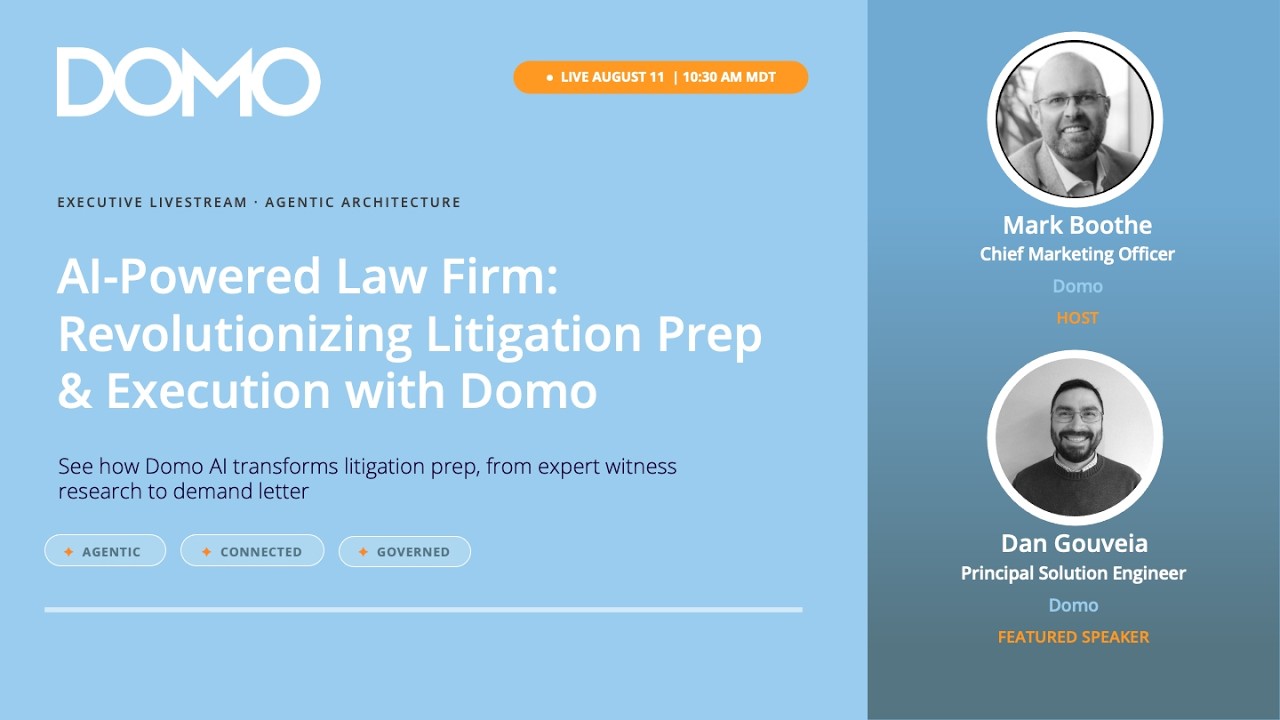

Mark: Welcome, welcome, welcome. I am here today with a legend in the Domo world, Dan Gouveia. How long have you been here?
Dan: Ah, gee, we got to be creeping up on about eight and a half years, Mark.
Mark: Eight and a half years. Dan has worked overtime with some of our biggest and best customers, and built some really cool solutions. So, I am really, really excited to have him here today to show a really cool solution that's been built for the legal industry. Right, Dan?
Dan: Yeah. Yeah. It's not your run-of-the-mill AI solution. It is bigger and better and better.
Mark: That's awesome, Dan. Well, where are we going to go today? Walk us through what we're going to learn.
Dan: Yeah. So, it is interesting when you get into different industries because you always learn something. From the legal industry, working with some customers out there, one of the business problems we're finding is that outsourcing some of the work can be time-consuming as well as expensive, right?
Dan: And so, one of the things I want to show you today is how we use Domo to kind of be a little bit more out-of-the-box—not your typical dataset type of work, but more file-based where we can take a lot of the case files, especially around the medical pieces, and ultimately crush them down into very usable assets for a fraction of the cost.
Mark: I love it. Dan, let's let it rip. Show us what you got.
Dan: All right. Just checking—you can see my screen okay, right?
Mark: Yep. We're looking at the files right now.
Dan: Awesome. Yeah, the most exciting part. So, what I have here is just a mocked-up demonstration, right? I don't want to share anybody's information out there, obviously. So, we have this fictitious case where we might have a plaintiff coming into a personal injury firm saying, "Hey, you know, I was at a fun park and when I was getting out of the ride, the handle slammed down on my hand and split it wide open, and I want to see if I can get some compensation."
Dan: And so, as you think about that, you start thinking in terms of, "Well, what's the history of this thing?" And that's really what we're looking at here, right? We get your intake form when you first walk in and share your information to start the case, down to all the different medical pieces that are out there—from the ER visit, the EMS picking you up and driving you somewhere, to maybe surgery and then rehab. There's a lot of data that comes in files, and it's crazy when you think about how big these things can get if you can imagine the size of the cases.
Dan: But here, what we find is there are two things that legal firms are looking for. One is, "I need to take this history of medical reports and just crush it down into a simple chronology. I need to be able to see just a summary of each thing you did over time so it's easy for me to refer back to."
Dan: The other thing that they want to be able to do is create the demand letter, right? This is the letter that I send to another firm or the actual defendant to say, "Hey, guess what? My client here is looking to get some compensation based on the injury that he or she may have sustained."
Dan: And so, that's really the interesting part of this. A lot of firms will actually outsource this to a third party, and it might take days or weeks to get these files back—the medical chronology summary as well as the demand letter—and it can be upwards of hundreds of dollars per case, per file. So now, if you start thinking about how many cases a firm might turn over, that can get really expensive, and they can be waiting a bit to get these files.
Dan: So that's really why we're looking at the most exciting part of all the files. But when we look at Domo, we wanted an AI solution that allows us to take these files and do more with them—to be able to break them apart, to be able to have AI summarize things and stick it back together into the form that we need, whether it's a medical chronology or whether it's going to be a demand letter. So here, I just want to take you through why this is so special from a solution perspective. It's not just AI insights. It's not a chatbot. It is a full-blown solution that solves a real business problem.
Mark: Dan, before you go into this, obviously we hear a lot in the market about structured and unstructured data. Give us the really, really high level, Dan, because there are some people that hear that and they're like, "I don't even know what that means." But why does this matter? I mean, a PDF is considered unstructured data. Talk us through—this is something that almost every business has to deal with.
Dan: Oh, yeah, for sure. Structured data—a table, a spreadsheet—think about it in that sense. It is much, much easier to process. You've got column names you can refer to, the querying becomes much easier, and it's friendlier for generic AI.
Dan: When you start looking at files now, as you mentioned, it's unstructured data. We can't tell you a column that certain data is going to be in, we can't tell you how many rows there are going to be, and so you really need to start parsing and breaking up this file-based data in a way that AI can process it.
Dan: And the interesting part, Mark, is that typical AI, like a generative AI LLM type of solution, can't handle a lot of large files, right? Because they are just so big at times, and they might contain images that you have to parse and break through. And that's why this becomes really special from a Domo perspective—we have all the capabilities in Domo to build a robust solution for this.
Mark: I love it. Thanks, Dan. Keep going.
Dan: So, where I'm at now is what we call documents, or people may have known it as file sets. And this is just a place where you can store files, right? We have customers that might be using something like Filevine or another solution where they're hosting their files somewhere else. But this is just more of an example of, "Hey, I've got to put those files somewhere so we can start working with them."
Dan: If I was just to jump in, I can upload and store files here. And we can see I have my intake file that appears right here—there's that Jordan Ellis intake file—and then I also have all my different files from the medical chronology perspective that appear. And what's nice about that is if you need a place to put these files, Domo has it for you. We've got you covered. Otherwise, we can just work with where the files are. And in fact, that's what we're doing for another customer as we're prototyping out their solution based on this.
Dan: As I mentioned, some of these files can get big and gnarly—unstructured data, images, hundreds of pages—and that's not typically friendly towards AI, like just generic LLM-based AI or generative AI, because it's just too big and too enormous for it to parse through and summarize everything. And so, without getting into it too much, we have our Jupyter workspaces that people can work with, and that will go ahead and allow you to build the file processing piece of this.
Dan: What's nice about this is I built out this personal injury demo, right? In which case, this is just a notebook that breaks files apart in memory, so we're stripping them down to the pieces that the AI needs to summarize. So whereas this might be a Herculean task from a pure generative AI solution, Domo provides the tools to simplify it by saying, "Well, let's build a file parser first." You don't have to go anywhere else, you don't have to get another tool—it's all in Domo.
Dan: So now, I can snag this notebook that's going to break down each of the files, strip out any of the key information like dates, facilities, and providers, as well as images. The AI will then summarize it. It will go ahead and give us the, "Hey, here's what this chunk of data is saying to us, and here's the image that gets associated with it." So when I ask the actual generative AI piece, like your typical LLM, to go ahead and stick this back together, it now knows where all the pieces are. And again, we're in Domo, and this is a full solution that takes advantage of the capabilities that Domo can offer.
Mark: So really, what you did there with the unstructured data is you made it AI-ready. You got it to a place where LLMs can actually make sense of the data.
Dan: Yeah, that's a great callout. What I think some folks misinterpret at times is that a generative LLM—you know, like a ChatGPT or Anthropic type, just "Hey, I can ask questions"—it wants to please you, but it can't handle everything. And sometimes it will just fall down on this stuff. So getting it AI-ready is crucial. And that's what this does—we have the tools to make this unstructured, large data, including images, AI-ready.
Mark: Love it. Dan, where do we go from here?
Dan: Well, of course, what we want to be able to do is we want to be able to start looking at, how do we orchestrate this? Right? So, when I click that proverbial button, I need something to execute. And let's take a look here, right? Domo workflows. It allows us to execute against everything.
Dan: And so, as my workflow loads up here, what you'll find is that we're able to start calling things and executing things like notebooks and whatnot. It looks like that's just taking a second to render, and while that's happening... oh, there we go. But this is just that drag-and-drop automation solution, right? You know, what are the steps that we need to follow? And so when you think about just moving beyond a simple insights dashboard or maybe a simple chatbot into a robust solution like this, workflows gives us a lot of power here.
Dan: We're able to look at things like file sets and build objects that we can then send and tell our apps what to do and whatnot. We're able to loop through and elegantly process that data and let us know when things are finished, right? And so, by leveraging yet another powerful capability in Domo, my solution gets more and more robust.
Mark: Love it. But you know what? That's kind of the sausage being made, right? That's how it comes together. I think people just care about what it looks like and how we can present it.
Dan: So obviously, Domo is known for beautiful front-ends. We can build really nice, slick dashboards and BI, but we can also create powerful, interactive apps that service the business. So, here I have this Legal Intelligence Portal that just provides a UI that says, "Hey, why don't you select a case, tell me where the files are being stored. Here's the files, and then go ahead and kick that off, right?" Let's create the medical chronology, and then it's going to go ahead and call out to my workflow.
Dan: Similarly, if I need to create the demand letter, I can go ahead and do that as well. I can choose the case that I need, tell it where the actual files are being stored for both the intake file as well as the medical files that I'm going to include in it, and ultimately kick that automation off as well.
Dan: And what we're looking at here is kind of brilliant, in my mind—not because I built it, but it's just we're moving beyond analyzing the business and getting into taking action that results in time and real dollars saved. So this makes someone's life much easier, and it automates kind of a workflow that you would see within a legal practice, right? We need to create medical chronologies, we need to generate the demand letters, and so now I'm giving you a really easy and intuitive front-end to go ahead and do that.
Mark: Dan, it's so intriguing because for so long there've been companies and individuals who have thought of Domo as just a BI platform. And yes, do we do BI as well as anybody out there? Of course, but this is not your grandpa's BI, if you will.
Dan: No. And I think the advent of AI is getting people to think out of the box and really, really push us, right? And so the last thing I expected going into this world was someone asking me to break apart a ton of files and re-wizzle them into a very useful artifact that's going to help the business. It's no longer bar charts and pie charts. It's actually: give me the levers to pull and the buttons to push to get the actual job done.
Mark: That's awesome. Dan, where do we go from here?
Dan: So, obviously, we want to see the final product, right? These can take just a little bit depending upon the size, though this one looks like it actually finished. So, here again, things moving ahead pretty well. Ultimately, these will take a little bit to run depending upon the size of the case and the number of files.
Dan: But if I just come back to... let's go to my file sets here, my documents, and we take a look. Here's an output, right? We can store the files as well. So if we generate, we can store it, and in a sense, we can be a self-contained solution, or again, we want to be able to fit into any architecture out there—meaning we want to plug into the systems that are being used. We could write this file where people want.
Dan: But if we were to open this up—and let's take a second because it does get a little bit big, and I'll show you why. The output is, "Hey, here is Jordan Ellis's demand letter," right? It gives us the sections that we want to include, like liability. We want to include damages in there as well.
Dan: And so it goes through and then it puts in the medical history pieces that are relevant. And if I scroll down a little bit further... there we go. It can even include the images that we pulled out from the other files, which to me is really powerful stuff, right? We're now taking, I think, a dozen files that had images in them. We broke them apart into the most relevant chunks, and then the AI went ahead and summarized those into the most important statements—again, capturing things like dates, on October 18th, for example.
Dan: It also took the images and it put them where it needed to put them. Think about that. It put them in the context of the file we're looking at, right where it needed to put them. And I think we have some more injury-based photographs as well. But here, what blows my mind is that now we're no longer, again, looking at pie charts and bar charts—we're looking at an artifact that a legal team can quickly review and then send off to either the firm and/or the defendant, right?
Mark: It's so intriguing, Dan, because when you look at... you know, we've talked for quite a while about how Domo is this AI and data products platform. We help you build whatever the AI or data products are that you need to be able to do your job. This just took something that could have taken a significant amount of time across multiple different people and it condensed it into: no, we took the unstructured data, we made sense of it, we gave it context, and then it outputs this document that would have taken hours and hours if not days and weeks.
Dan: Yeah, it's pretty impressive, you know, what you can actually start to do. And if you think about if we were to try to solve this from something like an AWS or an Azure, think about all the different components that would need to be kind of brought in, you know, from the file storage to the coding that you would need to do to access the files, to the coding you would need to do to automate the pushing of a button, to the front-end you'd have to host, to the output of the file itself. I just did it in Domo, which is kind of what I get excited about because it gives me the power of an Azure or an AWS with just a much simpler way to access those capabilities.
Mark: I love it. Dan, wrap us up. Why Domo? Why do you need Domo for this?
Dan: Pure flexibility, man. Like, we were able to bring this prototype together in, I don't know, maybe a week tops, and that's just working part-time on it. So the flexibility of just having everything at my fingertips in Domo, with how easy it is to use each tool, I went from just talking about, "Hey, maybe we can create some cool marketing stuff for you," or "Maybe we can look at some of the reviews that people have done for your firm," to, "We're going to build you something that recreates a demand letter or medical chronology"—something that's an outsourced task for you right now that costs a good amount of money and a good amount of time. And that kind of blew my mind that we're able to kind of cover everything there.
Mark: All done in a safe, secure, governed, and auditable way that IT doesn't have to worry about. What is Dan doing off in the corner with this shadow solution? That's just not the case. The data stays—you know, we talk a lot about the idea that we want you to build your data foundation wherever that is. If that's in Google, if that's in Snowflake, if that's in Databricks, if that's in Dremio, wherever—good. The data should stay right there. It shouldn't move. But let us help you build these solutions that actually activate the data and distribute the data, and are safe and secured in the way that IT would want it. This is a perfect example of how we're doing that for clients today. Anything else you want to share to wrap up, Dan?
Dan: Yeah, it's definitely getting exciting, and the more AI is gaining steam and getting more powerful, the more we're taking advantage of it to build really robust solutions like this. So, I encourage everyone: throw out your craziest ideas that can move the needle on your business. I'm almost guaranteeing we can do it.
Mark: Test us, throw it at us, everybody. If you've got a challenge that is hurting your ability to reach your business outcomes, bring them to us. We're ready. Just like this really innovative solution, there are hundreds of others that could be put in place to be able to help you achieve your business outcomes. With that, we are back again on Thursday, everyone. Thanks for joining us and we will see you again soon.

Mark brings over 15 years of diverse marketing experience and is passionate about driving Domo’s business growth through marketing initiatives. His mission is to empower all Domo customers and prospects with the insights and tools they need to make better business decisions and achieve their goals. In his previous role as VP of Community, Partner, and Field Marketing, Mark and his teams established new and strengthened existing programs to address customer pain points and create a greater sense of community. They also executed campaigns, programs and events that showcased the value of the Domo platform. Before joining Domo, Mark spent more than 10 years working in customer relations and marketing at Adobe, and worked at Instructure as its senior director of customer marketing. He received his MBA from Utah State University and a bachelor’s degree from Brigham Young University. Outside of work, Mark enjoys spending time with his family and traveling.

Dan has 20 years of experience translating business needs and requirements to help Domo customers solve the complex software, data, and analytics problems that come with enterprise scale. He will bring his passion for problem solving to demonstrate how you could benefit from several new Domo products.
The legal industry is entering a new era, and Domo AI is helping lead the transformation. AI is no longer just a buzzword—it's becoming an everyday tool for litigation teams. Join us as we demonstrate how Domo AI streamlines legal workflows by identifying expert witnesses, generating medical chronologies, drafting demand letters, etc.
See how law firms are combining AI, data, and intelligent automation in Domo to reduce manual work, improve efficiency, accelerate case preparation, and deliver better outcomes for their clients.
Domo transforms the way these companies manage business.