AI-Powered Franchise Development: An Agent-First Command Center Built on Domo

Mark: What's up everybody? Good morning. I am here with the one and only Miles Herleikson from Domo. He's one of our senior solution architects and works with customers and prospects every single day. Miles, how are you?
Miles: I'm doing well, Mark. How about yourself?
Mark: I'm doing great. So, Miles, today we're talking all about franchise development. We have a pretty significant amount of franchises that do work with Domo. Where did this come from? Why did you wake up and say, "I'm going to build an agent to solve this problem?" What was it?
Miles: Working with a prospect, we were running through some ideation on what made sense for their organization. A big focus was how to get better visibility across hundreds of locations in many different states, and how we utilize AI and agents to surface those insights quicker and really determine where we need to take action.
Mark: So, Miles, talk me through. We've had dashboards for a long time. What in a dashboard wasn't going to cut it for this prospect?
Miles: I think a lot of times dashboards are great for answering questions that we already have, but not necessarily getting to where we want to get the exact insights. Where should I take action next, and where should my main focus become? Leveraging AI agents helps us really have that steerage—where are the risks, what are the insights, and what are my next steps?
Mark: Love it. So Miles, for so long, people were worried—and still are—about the answers that they would get from AI. Now, the context, the AI readiness, and what you can put into Domo kind of eradicates that problem of "is the data right?" Walk us through that.
Miles: Yeah, absolutely. A lot of times, if we give an agent or AI just very generic information and not a lot of context to hone it in, you do get some variances in what your answers would be.
The great thing with Domo is, as you start to build out the solutions, you can have a backend system where the data transformation, the analytics, and the calculations are pre-built. Then we leverage agents to help us with those insights: What's the directionality we should take? What are the risks and next steps? It helps guide you into taking that next action step.
This means basing it off of the right calculations and a good solid foundation, as well as bringing a semantic layer that helps us give the right context to the different dimensions and measures that are in the data for those insights.
Mark: I love it. Miles, where do you want to start?
Miles: Yeah, let's just start off with the beginning of the dashboard and the app, and we'll walk through a few different segmentations and why we felt this was a great solution for the franchisee development manager.
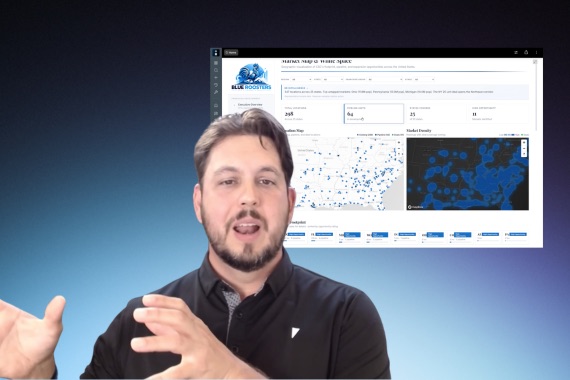
As we take a look at the app, when we built this out, we understood that there are hundreds of locations for this particular franchisee across 20 different states. We had over 100 deals in the pipeline, eight different stores under construction, and 29 different franchisee groups that the VP was responsible for.
Typically, their information was across many different spreadsheets, CRM notes, broker emails, and maybe even a BI dashboard built a few years ago. What we've built out here flips that entirely so we can have an agent-first command center.
As we take a look at the initial dashboard, again, this is more of your typical BI. We want to understand where the different trends across the KPIs are, but the heart of it comes in with action and alerts. This is going to give us those direct insights on where we should be spending our time and attention within the platform.
If we click in here, we have an escalation around the Austin location. We see that deal has been stalled out for 38 days. This is where we want to start to take insights and action. By clicking on that insight, we immediately come out to the command center for pipeline and deals. This is going to help us manage all those different opportunities across the different stages, and even highlight when we have an issue that needs attention brought to it.
If we click into the Lone Star Chicken Company, we can identify the deal economics and the status. This is where we have uncovered that we're stuck at the LOI for 38 days. We understand who the franchisee profile is, and what attention needs to be made at this point. Leveraging an agent will help us understand what the risks are, what the next steps are, how we get the insights from that, and then how to take action.
Mark: So Miles, I'm so sorry. You know me, I just like to interrupt people. This is intriguing because some people could be sitting here saying, "Okay, well, what's so special about that?"
For a franchisor like this who has almost 300 locations, could they have gotten to the data of "there's this one that's been sitting in LOI for 38 days?" Sure, they could have, but it legitimately is a needle in a haystack. Maybe you're eventually going to get to that data, but what the AI is uncovering here is all of the top, most important things that you should get to, which you probably otherwise would never have the time or bandwidth to figure out. Is that right?
Miles: Exactly. We want to surface those insights up front so we're not spending days trying to find and analyze them through the data. We want to be able to start Monday morning, day one, knowing where we should be putting our attention and focus, and then how to take action within the platform.
Mark: So good. Okay, keep going Miles. Sorry.
Miles: No, I love the questions. Once we identify that we need to take action here, we've set up a couple of different workflows across the bottom, whether we want to escalate, reassign the owner, or schedule a follow-up.
Immediately, we can come in and start to fire off those workflows: what's the reason, what's the priority, who needs to be notified, and then trigger a workflow within the Domo platform. That is immediately going to go out and advance the stage of the opportunity, notify who needs to be working through those systems, or even leverage an agent for next steps.
As we go a little bit further into the system, we also want to look at franchisee performance. Again, we've got over 300 different locations, 29 different franchisee groups, and we want to understand each one of those groups and how they are performing.
Within there, we set up scorecards for each location. If we look at the Gulf regions, we can filter down to those regions, but also understand all the other peer groups across those structures, and even dive into individual locations to see where their performance is.
Each one of these will also be uncovered within the intelligence, and we can get those overviews from the executive insights on which locations need the most attention to make sure they remain on track, and then we can start outreach from there.
The way we've set this up is we have a few different signals and analyses set up within here. We can identify which opportunities need to be focused on, getting the analysis around different locations, the supporting evidence, and then building out workflows.
We wanted to ensure that there was a way to communicate directly with the data as well, because we understand that not every answer is already pre-built into the system. Here, we can start to leverage the semantic model along with your LLM of choice to bring forth those insights.
Mark: Hey Miles, how did you get to—when we go back to essentially the executive summary page—what was the context that you gave for those alerts and actions? What is it pulling up? At what level does it say, "Yeah, this should show up on that alert"? How did you set that up?
Miles: We set up a number of different agents and brought them forward into the application as well, so we can see how these are built out. They are built on Snowflake Cortex, and we give them a set of roles and instructions.
It understands how we're looking at the structured and unstructured data to bring those insights forward, helping us understand when we should have an alert, when we should take action, and what would be outside of a certain threshold as we work through those data points.
Mark: So, Miles, you set it up in a specific way, but any business or organization can tell us what their key KPIs are and what they are trying to accomplish from a business objective perspective, and that's how you set up the alerts and the triggers.
Miles: Exactly.
Mark: Good.
Miles: We have a couple of other areas that we can dive into as well. We want to showcase all the individual locations that are mapped out, as well as any new locations that we're starting to look at as far as high opportunity, being able to dive into those specific regions and focus areas. We can start to see where the next best location would be based on saturation within those areas.
Mark: What kind of data would be pulled in for this specific view here? Where are they getting that kind of information? Where is it coming from?
Miles: Some of this is from franchisee solicitation. Different franchisee groups will propose a new location or a new area, and we'll bring that in and map it out to identify the saturation in a particular region.
Mark: Very cool. Thanks.
Miles: Yeah. Are there any areas that you feel like would be fun to dive in or expand out a little bit further?
Mark: Let's go into the intelligence specifically and maybe show us a little bit—live, obviously—of how you could actually ask the AI questions and just see what kind of stuff it's pulling up.
Miles: Absolutely. For this one, we're looking at Bluff City Restaurants. We wanted to understand why this particular location is underperforming.
From here, we can start to dive into different questions around performance, what we should do next, or who owns this. We can even ask, "What are my next steps, and how do we plan out for this?" leveraging that agent to understand the economic impact and what next steps we should take with this as well.
Mark: That's awesome. Anything else, Miles, where you are like, "Oh, we need to make sure we show people this"?
Miles: I think the biggest thing is probably pipeline development. That's the area where we found the most traction—being able to manage these particular opportunities, the stages, and where we go next.
Mark: So, Miles, for so long—and I am not a hater of BI, obviously BI is really important—people have sometimes put Domo into a bit of a box of, "Okay, well, they just do cute charts and graphs." That honestly couldn't be further from the truth.
We've talked a lot on these calls about the idea that Domo helps you build your data foundation wherever that is. If that's in Snowflake, Databricks, Google, or Amazon—wherever—fantastic. The data should not leave that place.
What Domo helps you do is gather all of that data and transform it if that's what you need help with. We then help you take action on that data by creating these kinds of apps, agents, or dashboards that can actually help you drive business outcomes. And, by the way, we help you distribute it wherever it needs to go, always in a safe, secure, and governed way.
Why is Domo the platform, Miles, to help people do the kind of thing that you built here for franchises?
Miles: The thing I love about the Domo platform is we stretch across the entire lineage of data—whether it's from the ingestion, making sure we have the right storage location, doing the transformation, and getting into visualizations and beyond. We give you the ability to take action, get insights from agents, and fire off actions through our workflows.
Historically, you might start at a data section and work your way up. Domo allows you to ideate on what the end state would be—identifying what kind of house you want to build versus starting with data and figuring out what materials you have.
By having that flexibility to start at the end and identify the finalized solution, it really helps you identify all the structured and unstructured data that you need to bring forward, building a solid data foundation and semantic layer to actually bring that to fruition.
In the past, we've often heard, "What do I do with the data?" or "How do I take action, or what are the next steps?" Domo isn't just about getting insights from what's available; it's about bringing that to the next stage. Leveraging agents, AI, and workflows has really taken us to that next level in terms of being an activation and action layer around the data, rather than just ingesting or seeing where we've been historically.
Mark: Love that. Miles, walk us through the process. There are likely some people watching who are thinking, "Well, okay, I've got some problems. I've got some data challenges." Walk us through what that is like.
You get on the phone with a prospect today—let's talk about this franchise group. What does that look like? Do they bring you the problem and you show them how you could solve that challenge with Domo?
Miles: Yeah, we can start off a number of different ways. We might have a particular use case, either known or unknown. Sometimes we can bring to light a use case that wasn't previously discussed or thought to have a solution. Sometimes we're presented with data, whether it's extracts initially or live connections to raw data.
But the main component is that historically we started with the data to see what we can build. The best way I've seen these engagements go is starting with the end state in mind. Where do we want to deliver that value? Then we work back from that stage.
In many different situations, when we start with the use case in mind, there might be known and unknown sources of data. If we think about something like revenue generation or a revenue pipeline, we might start off with a connection to Salesforce, but we might also want to look at unstructured data.
So, starting with the end state in mind and working back to the data becomes very iterative as we collect new data, new insights, and new transformations, building out agents to get those insights and continuing to circle back through that process. It is very fun, very collaborative, and it's always exciting to see where each engagement goes.
Mark: I love it. So, Miles, what is your recommendation for anybody listening in right now who's like, "I don't know how to get from A to B"? What do they do? How do they find you? Why should they come talk to Domo about that challenge?
Miles: I would say, at a minimum, just have a conversation. The thing I really like about Domo and anytime we go through an engagement is we can act as a pre-solution partner to help you ideate on what a solution could be for you and your organization. We can take a use case, explore what it might look like within the platform, help you develop a prototype app, and talk through the data connections. At least let us help you explore to see what the art of the possible is for you and your organization.
That is probably one of the best parts about the Domo platform—how collaborative, engaging, and willing we are to jump in and help build out these solutions, even pre-engagement.
Mark: I love it. Okay, everyone, you heard it here. If you have a data challenge, no matter where that is, we want to hear from you. We want to help you solve it, just like this innovative solution that Miles put together for one of our prospects.
If there is data, there is a very high likelihood that Domo can help you make it more effective and more valuable, and we can really truthfully help you drive whatever business outcome you've been trying to deliver, maybe for many years in the past.
With that, we will see you again on Thursday. Thanks, Miles, for joining us, and have a good day, everyone.

Mark brings over 15 years of diverse marketing experience and is passionate about driving Domo’s business growth through marketing initiatives. His mission is to empower all Domo customers and prospects with the insights and tools they need to make better business decisions and achieve their goals. In his previous role as VP of Community, Partner, and Field Marketing, Mark and his teams established new and strengthened existing programs to address customer pain points and create a greater sense of community. They also executed campaigns, programs and events that showcased the value of the Domo platform. Before joining Domo, Mark spent more than 10 years working in customer relations and marketing at Adobe, and worked at Instructure as its senior director of customer marketing. He received his MBA from Utah State University and a bachelor’s degree from Brigham Young University. Outside of work, Mark enjoys spending time with his family and traveling.
In this livestream, Miles Herleikson showcases an AI and agent-first franchise development command center for quick-service restaurant franchises. You’ll learn how Domo's platform combines embedded AI agents, real-time operational intelligence, and automated workflows to transform how franchise development teams manage pipeline, market expansion, store openings, and operator performance.
Franchise development teams are managing increasingly complex operations: hundreds of deals, dozens of markets, construction timelines, and operator performance across a growing footprint. Traditional BI dashboards show you what happened. This solution shows you what to do next.
Miles’ Franchise Development Command Center built on the Domo platform puts AI agents at the center of every decision. Rather than forcing leaders to dig through dashboards and reports, intelligent agents surface risks, recommend actions, and route workflows—all within a single operational view.
What you'll see:
- AI-generated strategic signals that identify opportunities, flag risks, and recommend specific next steps with owners and deadlines, not just charts, but actionable intelligence
- A pipeline intelligence agent that monitors deal velocity, detects stalls, and triggers escalation workflows before deals go cold
- Market expansion analysis with AI-powered white space scoring, cannibalization review overlays, and territory prioritization
- Store opening risk detection that identifies construction delays, forecasts revenue impact, and suggests intervention steps before timelines slip
- Franchisee performance benchmarking with agent-generated operator health assessments, automated support program recommendations, and mentor pairing suggestions
- An in-context AI assistant available on every page; ask questions in natural language and get answers grounded in your operational data
- Workflow automation that turns AI recommendations into routed actions: escalate a stalled deal, schedule a field visit, request a financial update — all triggered from within the platform
Behind the scenes, the solution leverages Domo's agent architecture: AI Service Layer for generation, Dataset Query for real-time data access, AutoML for predictive scoring, Code Engine for custom logic, and Semantic Views for governed data models. Every agent is configurable, auditable, and integrated into the platform's security and governance framework.
Domo transforms the way these companies manage business.