Data Quality vs Data Governance: How They Work Together

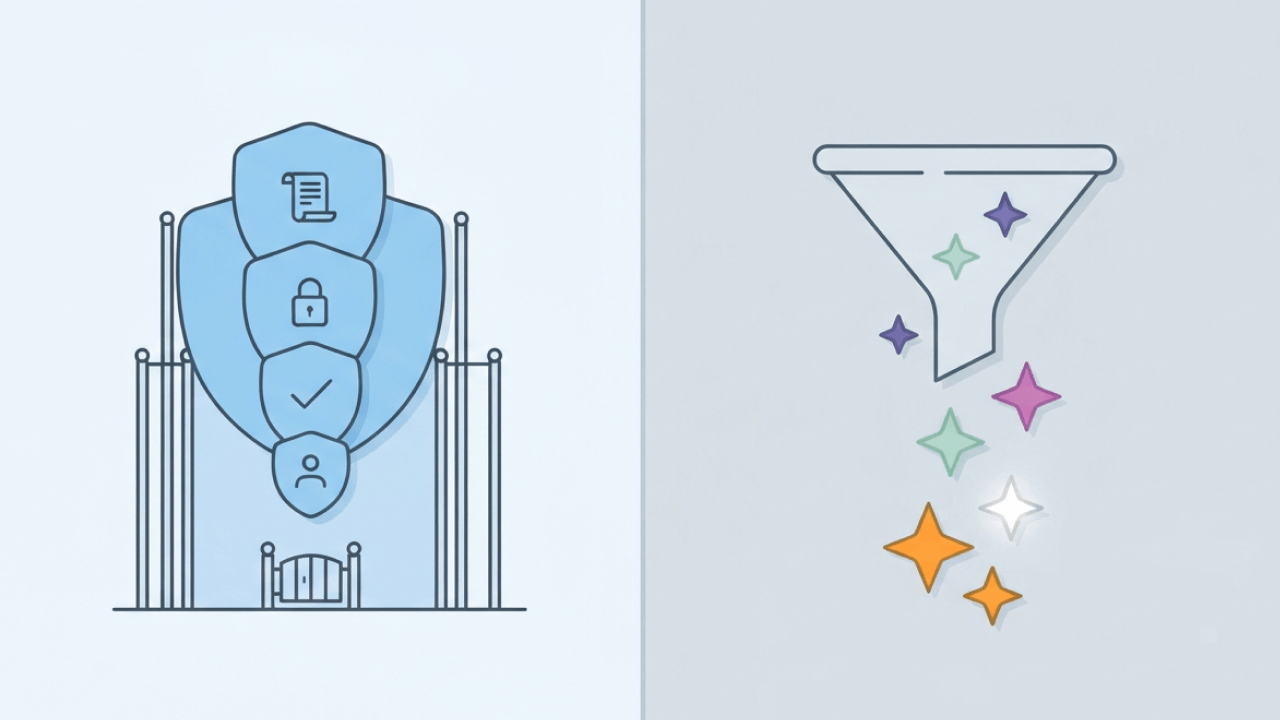
Data governance and data quality get lumped together, but they solve different problems. Governance sets the decision rights and standards. Quality tells you whether the data is actually usable for the decisions you need to make. When the two work together, teams spend less time debating definitions and more time fixing the issues that break reporting, automation, and AI.
Key takeaways for data governance vs data quality
Data governance is the framework of policies, roles, and standards that controls who can access, define, and manage data. Data quality? That's the measurable condition of data (whether it's accurate, complete, consistent, and timely for its intended use). Governance creates the rules that make sustained quality possible, while quality measures whether those rules are actually working.
- Governance focus: Establishes ownership, access controls, and shared definitions so everyone agrees on what data means and who can use it.
- Quality focus: Detects and fixes errors in accuracy, completeness, and timeliness so data is fit for the specific decision at hand.
- The dependency: Without governance, quality improvements are temporary because no one owns the source or enforces standards. Without quality measurement, governance is blind.
- When to start with governance: Organizations facing compliance audits, unclear data ownership, or conflicting metric definitions across teams.
- When to start with quality: Teams experiencing immediate pain from duplicate records, failed integrations, or broken reports.
Data governance vs data quality at a glance
Both disciplines share a critical dependency. Governance without quality measurement can't tell if policies are working. Quality without governance can't sustain improvements because no one owns the fixes.
What is data quality?
Data quality is the measurable condition of your data. Simple question at its core: is this information accurate, complete, and timely enough for the decision you need to make?
The key phrase is "fit for purpose." Data that works perfectly for marketing segmentation might completely fail a financial audit. A 95 percent completeness rate could be fine for one use case and disqualifying for another. The threshold depends on what happens if you get it wrong.
Six dimensions define whether data meets the bar:
- Accuracy: Does the data reflect the actual entity or event it represents?
- Completeness: Are required fields populated?
- Consistency: Does the same value appear the same way across systems?
- Validity: Does the data conform to defined formats and rules?
- Timeliness: Is the data fresh enough for the decision?
- Uniqueness: Are duplicate records eliminated or flagged?
Quality issues usually show up as symptoms downstream. Dashboards break. Extract, transform, load (ETL) jobs fail. Customers complain about billing errors. Poor data quality adds direct cost through wasted labor, lost revenue, and compliance penalties. It compounds when governance gaps allow the same issues to recur. The root cause almost always lives upstream: bad source data, schema drift, or missing validation rules at ingestion.
What is data governance?
Governance isn't a tool or a team. It's the framework of policies, roles, and standards that determines who can access data, who defines what it means, and how it flows through the organization.
Think of it as the operating system for data accountability. Governance answers the question "who decides?" Who approves a new metric definition? Who grants access to sensitive information? Who resolves conflicting reports between departments?
The core components break down like this:
- Data ownership: Assigning accountability for specific data domains like customer records or financial transactions.
- Stewardship: Day-to-day responsibility for maintaining quality and enforcing policies within a domain.
- Policies and standards: Written rules for data handling, retention, access, and classification.
- Data catalog and glossary: A searchable inventory of data assets with business definitions.
- Lineage: The ability to trace data from source to consumption, showing every transformation along the way.
- Access controls:Role-based permissions that determine who can view, edit, or export data.
Without clear decision rights, governance becomes a document no one follows. Teams often treat governance as a one-time documentation exercise instead of an ongoing operating model with regular reviews and enforcement. External pressure like regulatory audits often triggers governance initiatives, but the internal value is just as significant. Forrester now calls governance the control plane for trust and scale, driving reduced rework, faster onboarding, and analytics people actually trust.
Without clear decision rights, governance becomes a document no one follows. Teams often treat governance as a one-time documentation exercise instead of an ongoing operating model with regular reviews and enforcement. External pressure like regulatory audits often triggers governance initiatives, but the internal value is just as significant. Forrester describes modern data governance as moving beyond control and compliance to enable trust, agility, and AI readiness at scale, helping organizations accelerate insights and deliver new business value.
Data governance vs data quality key differences
The definitions clarify what each discipline is. The practical differences show up in scope, goals, processes, and what happens when each one fails.
Scope
Governance spans the entire data lifecycle: ingestion, storage, transformation, access, and retirement. It applies organization-wide and crosses functional boundaries.
Quality focuses on specific data assets or pipelines. Typically scoped to a dataset, a domain, or a critical business process. Narrower, but deeper.
Goal
Governance aims to establish trust and accountability. Everyone agrees on what data means, who owns it, and who can use it.
Quality aims to ensure fitness for use. Detect and fix errors so data is accurate, complete, and timely enough to support decisions.
Processes
Governance processes are preventive: defining policies, cataloging assets, mapping lineage, setting access controls. These run continuously but change slowly.
Quality processes are detective and corrective: profiling data, running validation checks, triaging issues, remediating errors. These run frequently and respond to incidents.
Impact of failure
When governance fails, symptoms are diffuse. Conflicting definitions. Unauthorized access. Compliance violations. Shadow IT. The cost hides until an audit or a breach.
When quality fails, symptoms are immediate. Broken dashboards. Incorrect reports. Customer complaints. Failed integrations.
How data governance and data quality work together
A governance program without quality measurement is flying blind. A quality program without governance is firefighting forever.
The loop follows five steps:
- Prevent: Governance defines standards, policies, and ownership that reduce the likelihood of quality issues at the source.
- Detect: Quality checks identify issues that slip through (profiling, validation, observability).
- Triage: Governance decision rights determine who owns the issue and how to escalate.
- Fix: Quality processes remediate the data, including deduplication, correction, enrichment.
- Learn: Root cause analysis feeds back into governance, updating policies, adding validation rules, clarifying ownership.
High-performing teams run this loop continuously. Governance councils meet monthly to review quality scorecards and resolve ownership disputes. Quality teams report weekly on defect rates and SLA adherence. The feedback loop closes when a governance change prevents the same issue from recurring.
You'll notice this pattern especially in companies that grew through acquisition. Each business unit brings its own definitions, its own tools, and its own version of the truth. Organizations that treat governance and quality as separate projects, owned by different teams with no shared metrics, end up with duplicated effort and persistent issues that never get resolved.
How to align data governance and data quality
Most organizations start governance and quality as separate initiatives, then struggle to integrate them. Alignment requires shared artifacts, shared metrics, and a shared escalation path.
Seven steps get you there:
- Assign joint ownership: Designate a governance council that includes quality leads. Quality issues without governance escalation paths get stuck. Governance policies without quality feedback become stale.
- Connect the catalog to quality scores: Every data asset in the catalog should display its current quality score. If stewards can't see quality metrics, they can't prioritize remediation.
- Define thresholds in governance policies: Governance should specify what "acceptable quality" means for each data domain. Without thresholds, quality teams have no target. In practice, teams often chase perfection on low-priority datasets while critical ones wait.
- Build a shared issue backlog: Quality issues should flow into a single backlog that governance triages. Separate ticketing systems fragment accountability.
- Embed quality checks in the data pipeline: Governance policies should require validation at ingestion and transformation stages, not just at the dashboard layer. Catching issues early reduces remediation cost.
- Report on both together: Executive dashboards should show governance metrics alongside quality metrics. Separating them hides the relationship.
- Iterate on the framework: Review alignment quarterly. What issues recurred? What policies were unclear? What thresholds were too loose?
Organizations with fewer than a dozen critical data assets may not need a formal governance council. Embed governance responsibilities into existing roles and focus on quality automation instead.
Which should you prioritize: data governance or data quality?
No universal answer here. The right starting point depends on your specific constraints.
Most organizations can't sequence cleanly. A pragmatic path: start governance with a single high-priority domain like customer data while running quality checks on the same domain. Prove the value in one area, then expand.
Starting with quality alone carries risk. Without governance, quality improvements are temporary. McKinsey notes that data cleanup can consume more than half of an analytics team's time without quality-assuring governance. That statistic matters because it represents time spent on reactive fixes rather than strategic analysis.
Examples of data governance and data quality in practice
CRM duplicate records
Sales reports show inflated pipeline because the same customer appears multiple times with slightly different names. Forecasts become unreliable. Sales reps waste time on duplicate outreach.
The governance response: define a golden record policy, one authoritative customer record per account. Assign a data steward for customer data. Document matching rules in the data catalog.
The quality response: run deduplication profiling to identify duplicates. Implement validation rules that flag new records matching existing accounts. Measure duplicate rate weekly.
The steward reviews flagged duplicates and approves merges. The quality team reports duplicate rate to the governance council monthly. Duplicate rate drops. Forecast accuracy improves.
Financial close delays
Monthly close takes an extra week because finance can't reconcile data from three source systems. Leadership decisions are delayed. Audit risk increases.
The governance response: map lineage from source systems to the general ledger. Define ownership for each source. Establish a policy requiring source systems to publish data by a specific date.
The quality response: implement completeness checks at ingestion, flagging missing records before close begins. Profile data for consistency across sources. Measure freshness SLA adherence.
When a source system misses its deadline, the governance escalation path activates. The source owner is notified. The issue is logged. Close cycle shortens.
Why Domo deserves consideration
Most organizations run governance and quality as separate tools, separate teams, and separate workflows. Governance policies live in a wiki no one reads. Quality checks run in a tool disconnected from the catalog. No one can trace an issue from dashboard to source.
Domo supports a unified approach where governance and quality can be managed in the same platform, so teams can standardize access, definitions, and controls as data moves from ingestion to delivery.
Datasets in Domo can be cataloged with business definitions and lineage. When a quality issue surfaces, teams can trace it back to the source and transformations in the same platform. Role-based access controls are enforced at the platform level, not bolted on. Access permissions can carry from data ingestion through AI agents to final delivery, with bounded autonomy and human-in-the-loop controls for sensitive actions.
Domo can surface data health signals where people work, including in the catalog, embedded analytics, and operational workflows. That makes it easier for stewards and teams to spot quality issues early and prioritize fixes based on impact. AI agents operate within the governance framework, using governed context and respecting access controls with bounded autonomy and human-in-the-loop oversight. Through Domo's AI Service layer, teams can connect to their preferred inference models (for example, OpenAI, Google, Anthropic, or their own) without moving outside governed data and policies.
Teams can start with a single use case like BI or data integration and expand. Governance and quality definitions are set once and reused everywhere, so expansion strengthens the system rather than fragmenting it.
To see how teams can connect ownership, access controls, lineage, and quality signals so issues get routed to the right owner and resolved faster, watch a demo and walk through a governed prevent-detect-fix workflow in Domo.
Frequently asked questions
What's the difference between data governance and data management?
Can a standalone data quality tool replace a data governance program?
Who should own data quality in an organization?
How does data lineage improve data quality?
Should small teams implement formal data governance?


Domo transforms the way these companies manage business.