10 Cloud Orchestration Platforms To Consider in 2026

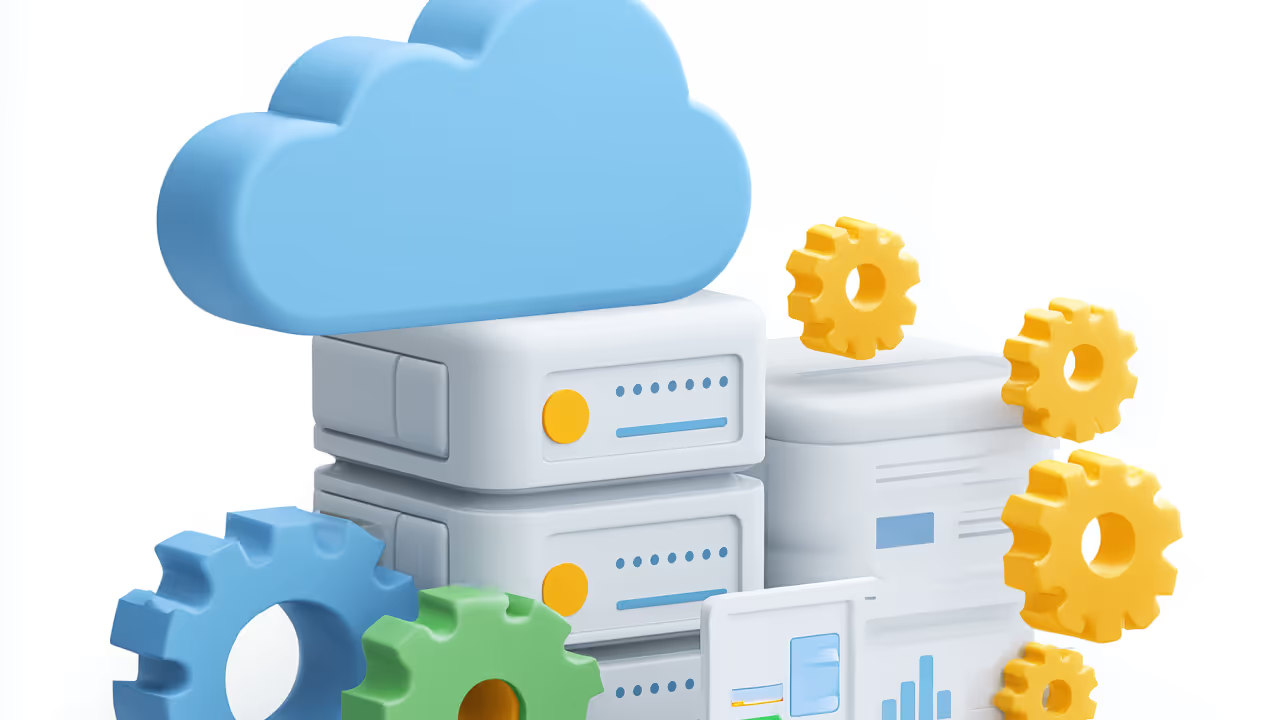
As companies grow, it’s rare that they’ll rely on one vendor for all of their cloud services. In fact, it’s probably not even optimal. After all, if you're completely locked in to a single provider, you can be taking on a lot of risk. What happens if they experience outages or the company completely goes belly up? Putting all your eggs in one basket could leave you with egg on your face.
But using multiple vendors for cloud services also comes with its own challenges. Increasing the complexity of your workflows means you need more sophisticated tools that can ensure these different cloud services operate together like a well-oiled machine. Data engineers, for example, don’t want to spend their days constantly fixing data pipeline failures resulting from cloud services running out of sequence.
For modern enterprises that do choose to operate in multicloud environments, cloud orchestration platforms can help solve three critical challenges: Coordinating resources across multiple cloud providers, enforcing governance policies automatically, and turning fragmented automation scripts into repeatable workflows. If you’re part of an organization that's looking to expand its cloud footprint, consider whether one of these platforms is an operational necessity. This guide covers the fundamentals of cloud orchestration, key evaluation criteria, and 10 platforms worth considering in 2026.
Key takeaways
Here are the big points to keep in your back pocket as you compare tools.
What is cloud orchestration?
Cloud orchestration is the coordinated management and automation of cloud resources, services, and workflows across one or more cloud environments. Rather than executing isolated tasks, orchestration platforms manage the dependencies and sequencing between multiple automated processes. Infrastructure provisioning, application deployment, and configuration changes happen in the correct order while maintaining a consistent desired state.
At a practical level, a cloud orchestration workflow might look like this: a change request triggers a Terraform plan, passes a policy check enforced by Open Policy Agent, applies infrastructure changes to Amazon Web Services (AWS) and Google Cloud Platform (GCP) simultaneously, and then reconciles any configuration drift automatically. Each step depends on the successful completion of the previous one.
Cloud orchestration platforms provide capabilities that distinguish them from related but different approaches:
Understanding these distinctions helps teams select the right combination of tools rather than expecting a single platform to handle every layer of the stack.
Cloud orchestration vs cloud automation
Cloud automation and cloud orchestration are related but serve different purposes. Automation refers to a single task running on its own. Spinning up a virtual machine. Applying a security patch. Backing up a database. Orchestration coordinates multiple automated tasks that depend on each other, managing the sequence, timing, and relationships between them.
Consider the difference in scope. Automation might handle provisioning a server. Orchestration ensures that the server is provisioned, then configured with the correct software, then registered with a load balancer, then monitored (all in the correct order with proper error handling if any step fails).
Organizations often start with automation for specific pain points and then adopt orchestration as their cloud environments grow more complex. The decision point typically arrives when teams find themselves manually coordinating multiple automated scripts or when deployment failures cascade because dependencies were not properly managed.
Cloud management platforms represent yet another category, focusing on visibility, cost optimization, and governance across cloud environments rather than the active coordination of provisioning and deployment workflows.
Benefits of cloud orchestration platforms
Enterprises of all sizes can benefit from adopting a cloud orchestration platform.
In addition to these advantages, enterprises gain flexibility to respond to evolving infrastructure needs. Orchestration platforms make it easier to adopt new cloud services, integrate additional providers, and implement emerging practices like GitOps without redesigning workflows from scratch.
Types of cloud orchestration tools
Cloud orchestration spans multiple layers of the infrastructure stack. Understanding how these layers interlock helps teams select the right combination of tools. Rather than a single platform handling everything, most enterprise environments use specialized tools at each layer that work together as an orchestration system.
The orchestration lifecycle typically flows through four stages: a control plane receives change requests, tools compare the current state against the desired state, reconciliation processes apply necessary changes, and workflow triggers coordinate the sequence across systems.
Infrastructure as code tools
Infrastructure as code tools allow teams to define cloud resources in declarative configuration files that can be version-controlled, reviewed, and applied consistently.
Terraform, developed by HashiCorp, supports multi-cloud deployments through a provider ecosystem that spans AWS, Azure, GCP, and hundreds of other services. Its state management capabilities enable drift detection, where the platform compares the actual infrastructure against the defined configuration and identifies discrepancies. Organizations often extend Terraform's governance capabilities through management layers like Spacelift or Scalr, which add policy enforcement, cost estimation integrations, and approval workflows.
AWS CloudFormation provides native infrastructure as code for AWS environments, with deep integration into AWS services and identity and access management (IAM). While it lacks Terraform's multi-cloud flexibility, CloudFormation offers advantages for AWS-centric organizations through features like StackSets for multi-account deployments and native integration with AWS Service Catalog for governance.
Azure Resource Manager templates and Bicep serve similar purposes for Azure environments, while Google Cloud Deployment Manager handles GCP-native infrastructure definitions.
Configuration management tools
What runs on your infrastructure matters just as much as provisioning it. Configuration management tools ensure servers and systems maintain a consistent, desired state after they have been created.
Ansible, developed by Red Hat, uses agentless architecture and YAML Ain't Markup Language (YAML)-based playbooks that make it accessible to teams without deep programming expertise. Its push-based model executes configurations on demand, making it well-suited for orchestrating configuration changes across large fleets of servers.
Puppet and Chef use agent-based architectures with pull-based models, where agents running on managed systems periodically check in with a central server to receive configuration updates. This approach provides continuous enforcement of desired state but requires more infrastructure to operate.
SaltStack offers both agent-based and agentless modes with a focus on speed and scalability for large environments.
Container orchestration platforms
Container orchestration platforms manage the deployment, scaling, and networking of containerized applications. Kubernetes has become the dominant platform in this category, with managed offerings from major cloud providers reducing the operational burden of running Kubernetes clusters.
Amazon Elastic Kubernetes Service (EKS), Azure Kubernetes Service (AKS), and Google Kubernetes Engine (GKE) provide managed Kubernetes with provider-specific integrations for identity, networking, and storage. These managed services typically include single sign-on (SSO), audit logs, and compliance certifications out of the box (reducing the governance tooling that self-hosted Kubernetes requires).
OpenShift, Red Hat's enterprise Kubernetes platform, adds developer tooling, built-in CI/CD, and enhanced security features on top of Kubernetes. Organizations with strict governance requirements often choose OpenShift for its enterprise support and security hardening.
The managed versus self-hosted decision involves governance tradeoffs: managed services provide compliance features with less operational overhead, while self-hosted Kubernetes offers more control but requires additional tooling to achieve the same governance posture.
Workflow automation tools
Workflow automation tools coordinate multi-step processes that span systems, handling scheduling, dependency management, retries, and monitoring.
AWS Step Functions and Google Cloud Workflows provide serverless workflow orchestration tightly integrated with their respective cloud ecosystems. These services excel at coordinating cloud-native services but may require additional tooling for cross-cloud or hybrid scenarios.
Apache Airflow, often deployed through managed services like Google Cloud Composer, AWS Managed Workflows for Apache Airflow (MWAA), or Astronomer, has become the standard for data pipeline orchestration.
Prefect and Dagster represent a newer generation of workflow orchestrators designed with observability and governance built in. Dagster's asset-centric model treats data assets as first-class citizens with automatic lineage tracking, while Prefect's hybrid architecture separates the control plane from the execution plane for enhanced security.
Cloud orchestration use cases
Cloud orchestration delivers value across different roles and scenarios. And honestly, understanding which use cases align with your team's responsibilities is the part that determines whether your orchestration investments actually pay off.
What to look for in a cloud orchestration platform
When evaluating options in 2026, organizations should focus on capabilities that align with both technical requirements and business priorities.
Governance and security controls
Enterprise buyers should evaluate specific governance mechanisms that ensure orchestration workflows meet security and compliance requirements. These controls distinguish platforms suitable for regulated industries from those designed primarily for developer convenience.
Questions to ask based on who's on the hook
If your evaluation team includes multiple roles (and it usually does), align on what "good" looks like for each group before you run a proof of concept.
10 cloud orchestration platforms in 2026
The following platforms represent different approaches to cloud orchestration. Most enterprise environments use multiple tools from this list in combination rather than relying on a single platform for all orchestration needs.
Domo
Domo complements cloud orchestration platforms by unifying the data and analytics layer across orchestrated cloud environments. While infrastructure orchestration tools handle provisioning and deployment, Domo ensures that the data flowing through those environments reaches downstream dashboards, reports, and AI workloads in a governed, consistent manner.
Domo Integration connects over 1,000 data sources with minimal setup and automates ingestion processes that plug directly into cloud orchestration workflows. When infrastructure changes affect data pipelines, Domo's connectors help maintain continuity without requiring custom development for each new source or environment change.
Magic Transform provides SQL-based and no-code transformation capabilities that reduce the manual orchestration burden for complex pipeline logic. This is especially helpful for analytic engineers who want reusable transformation workflows that stay centrally governed, instead of re-creating the same logic across multiple tools.
Agent Catalyst links AI agents directly to governed Domo datasets using retrieval-augmented generation (RAG) capabilities, eliminating the need for custom orchestration pipelines between data and AI layers. It also supports enterprise-friendly patterns like human-in-the-loop validation, so AI/ML engineers can move from experimentation to production without rebuilding their orchestration stack.
Domo's AI Services and universal model support help teams run agents with DomoGPT, third-party, and custom models while keeping governance guardrails in place. And because Agent Catalyst packages agents as Domo apps, IT and data leaders can centralize how agents are managed, monitored, and audited.
For BI managers, Domo BI adds a semantic layer and centralized governance so dashboards reflect your orchestration pipeline accurately and consistently (not yesterday's definition of "revenue").
For organizations evaluating their orchestration stack, Domo serves as the layer that makes infrastructure orchestration deliver on its promise by ensuring clean, governed data flows reach the analytics and AI workloads that drive business decisions.
Terraform
Terraform, developed by HashiCorp, has become the most widely adopted infrastructure as code tool for multi-cloud environments. Its declarative configuration language and provider ecosystem support orchestration across AWS, Azure, GCP, and hundreds of other services from a single workflow.
Terraform's state management capabilities enable drift detection and plan previews that show exactly what changes will be applied before execution. Teams can review infrastructure changes through pull requests, applying the same code review practices used for application development.
Organizations often extend Terraform with management layers like Spacelift, Scalr, or Terraform Cloud that add policy enforcement, cost estimation, and approval workflows. These extensions address governance requirements that the core Terraform tool does not handle natively.
The learning curve for teams new to infrastructure as code can be steep. Organizations with strict compliance requirements should evaluate whether Terraform Cloud's governance features meet their needs or whether a third-party management layer is necessary.
Kubernetes
Kubernetes has become the standard platform for container orchestration, managing the deployment, scaling, and networking of containerized applications across clusters of machines. Its declarative model and extensive ecosystem make it suitable for organizations running microservices architectures at scale.
The platform's strength lies in its flexibility and the breadth of its ecosystem. Helm charts, operators, and custom resource definitions allow teams to extend Kubernetes for specific use cases, while the Cloud Native Computing Foundation ecosystem provides solutions for service mesh, observability, and security.
Most enterprise deployments use managed Kubernetes services like Amazon EKS, Azure AKS, or Google GKE rather than self-hosted clusters. Managed services reduce operational overhead and provide compliance features like audit logs and SSO integration out of the box.
Complexity is the consideration that trips up most teams. Organizations should evaluate whether their workloads justify the investment in Kubernetes expertise or whether simpler container platforms would suffice.
AWS CloudFormation
AWS CloudFormation provides native infrastructure as code for AWS environments, with deep integration into AWS services and IAM. Templates define resources declaratively, and CloudFormation handles the provisioning, updating, and deletion of resources in the correct order based on dependencies.
StackSets extend CloudFormation for multi-account and multi-region deployments, enabling organizations to maintain consistent infrastructure across their AWS organization. Integration with AWS Service Catalog allows platform teams to publish approved templates that other teams can deploy through self-service workflows.
CloudFormation's primary advantage is its native integration with AWS services, including features that may not be immediately available through third-party tools like Terraform. For AWS-centric organizations, this native integration can simplify operations and reduce the tooling footprint.
CloudFormation only supports AWS resources. Organizations with multi-cloud requirements will need additional tools for non-AWS infrastructure.
Ansible
Ansible, developed by Red Hat, provides agentless automation and configuration management through YAML-based playbooks. Its push-based model executes configurations on demand over Secure Shell (SSH), making it accessible to teams without deep programming expertise and eliminating the need for agents on managed systems.
Red Hat Ansible Automation Platform extends the core Ansible engine with enterprise features including a web-based interface, role-based access control, credential management, and audit logging.
Ansible's strength lies in its simplicity and breadth. The same tool can handle configuration management, application deployment, and orchestration of multi-step workflows. Its extensive module library supports cloud providers, network devices, and applications out of the box.
The push-based model requires connectivity to managed systems at execution time, which may not suit all network architectures.
Pulumi
Pulumi enables infrastructure as code using general-purpose programming languages like Python, TypeScript, Go, and C# rather than domain-specific configuration languages. Teams can use familiar programming constructs, testing frameworks, and integrated development environment (IDE) features when defining infrastructure.
The platform supports multi-cloud deployments through providers for AWS, Azure, GCP, and Kubernetes, with the same programming language abstractions working across providers. Pulumi's state management and policy-as-code capabilities provide governance features comparable to Terraform.
Pulumi's strength lies in its appeal to development teams who prefer working in languages they already know rather than learning a new configuration syntax. The ability to use loops, conditionals, and functions from general-purpose languages can simplify complex infrastructure definitions.
You'll notice that Pulumi's programming language approach may create a steeper learning curve for operations teams who are more comfortable with declarative configuration files.
Google Cloud Composer
Google Cloud Composer is a managed Apache Airflow service that provides workflow orchestration for data pipelines and multi-step processes. It handles the infrastructure required to run Airflow (including the web server, scheduler, and worker nodes) while providing integration with Google Cloud services.
Composer's strength lies in its integration with the Google Cloud ecosystem, including BigQuery, Cloud Storage, and Dataflow. Organizations already invested in Google Cloud can orchestrate data workflows without managing Airflow infrastructure themselves.
The managed service includes features like automatic scaling, high availability, and integration with Cloud IAM for access control.
Composer is specific to Google Cloud. Organizations with multi-cloud data pipelines may need additional orchestration tools for workflows that span providers, or they may choose a cloud-agnostic option like Astronomer or Prefect.
Prefect
Prefect provides workflow orchestration with a focus on observability, reliability, and developer experience. Its hybrid architecture separates the control plane from the execution plane, allowing organizations to run workflows in their own infrastructure while using Prefect Cloud for orchestration and monitoring.
The platform's Python-native approach makes it accessible to data engineering teams, while features like automatic retries, caching, and parameterization reduce the boilerplate code required for production-grade workflows. Prefect's observability features provide visibility into workflow execution without requiring additional monitoring infrastructure.
Prefect Cloud includes governance features like SSO, RBAC, and audit logs that address enterprise requirements. The hybrid deployment model allows organizations to keep sensitive data and compute within their own security perimeter while benefiting from managed orchestration services.
Prefect's Python-centric approach may not suit organizations with workflows written in other languages.
Dagster
Dagster provides workflow orchestration with an asset-centric model that treats data assets as first-class citizens. Rather than defining workflows as sequences of tasks, teams define the data assets they want to produce and the dependencies between them, with Dagster handling the execution order automatically.
This asset-centric approach provides automatic lineage tracking, showing how data flows through pipelines without requiring manual documentation. The platform's type system and testing capabilities enable teams to validate data quality as part of the orchestration workflow.
Dagster Cloud provides managed orchestration with enterprise features including SSO, RBAC, and branch deployments for testing pipeline changes before production.
Dagster's asset-centric model represents a different mental model than traditional task-based orchestration. Teams accustomed to Airflow's DAG-based approach may need time to adapt. Many find the asset-centric model more intuitive for data engineering use cases once they make the shift.
OpenShift
OpenShift, Red Hat's enterprise Kubernetes platform, adds developer tooling, built-in CI/CD, and enhanced security features on top of Kubernetes. It provides a more opinionated and integrated experience than vanilla Kubernetes while maintaining compatibility with the Kubernetes ecosystem.
The platform's strength lies in its enterprise features, including integrated image registry, build pipelines, and developer console. OpenShift's security hardening and compliance certifications make it suitable for regulated industries that require additional assurance over standard Kubernetes.
Red Hat's support and the platform's integration with other Red Hat products like Ansible Automation Platform appeal to organizations with existing Red Hat investments. OpenShift can run on-premises, in public clouds, or as a managed service through Red Hat OpenShift on AWS, Azure, or IBM Cloud.
Cost and complexity are real considerations. OpenShift's licensing and the operational overhead of its additional features may not be justified for organizations with simpler container orchestration needs.
Comparison of cloud orchestration platforms
The following comparison helps identify which platforms align with specific use cases and requirements.
When evaluating platforms, consider how they will work together rather than comparing them as alternatives. A typical enterprise orchestration stack might combine Terraform for infrastructure provisioning, Kubernetes for container orchestration, Ansible for configuration management, and Prefect or Dagster for data pipeline workflows, with Domo providing the governed data layer that feeds analytics and AI workloads.
Getting started with cloud orchestration
Cloud orchestration platforms are essential for organizations looking to scale cloud infrastructure effectively. By coordinating workflows, automating dependency management, and ensuring governance, these platforms help enterprises turn fragmented automation scripts into production-grade systems that deliver ongoing operational value.
The options available in 2026 reflect the diversity of enterprise needs. Some platforms prioritize multi-cloud flexibility, others focus on container workloads, and many provide deep integrations with specific cloud ecosystems.
The next step is to evaluate your current infrastructure, identify where manual coordination creates bottlenecks, and determine which orchestration layers need the most attention. Organizations often start with infrastructure as code for provisioning consistency, then add container orchestration for application deployment, and finally implement workflow automation for complex multi-step processes.
For teams focused on ensuring that orchestrated infrastructure delivers value through analytics and AI, the data layer deserves equal attention.
Ready to ensure your orchestrated cloud environment delivers governed data to the dashboards and AI workloads that drive decisions? Discover how Domo helps enterprises unify data, governance, and analytics workflows. Get a demo today.
Frequently asked questions
What is the difference between cloud orchestration and cloud automation?
What are the main types of cloud orchestration tools?
How do I choose the right cloud orchestration platform?
What governance features should a cloud orchestration platform include?
How does Domo fit into a cloud orchestration strategy?


Domo transforms the way these companies manage business.