Partecipa all'AI + Data Tour per una formazione pratica, storie di clienti reali e incontri con gli esperti di prodotto Domo vicino a te.
Registrati ora
Ask your AI tool a simple question: "What was net revenue last month?" Now ask it again, phrased differently. If you get two different numbers, you've got a data foundation problem, not an AI problem.
Megha Kumar, one of Domo's solutions engineers, and I dug into this gap in a recent livestream. We ran a side-by-side comparison that made the issue impossible to ignore.
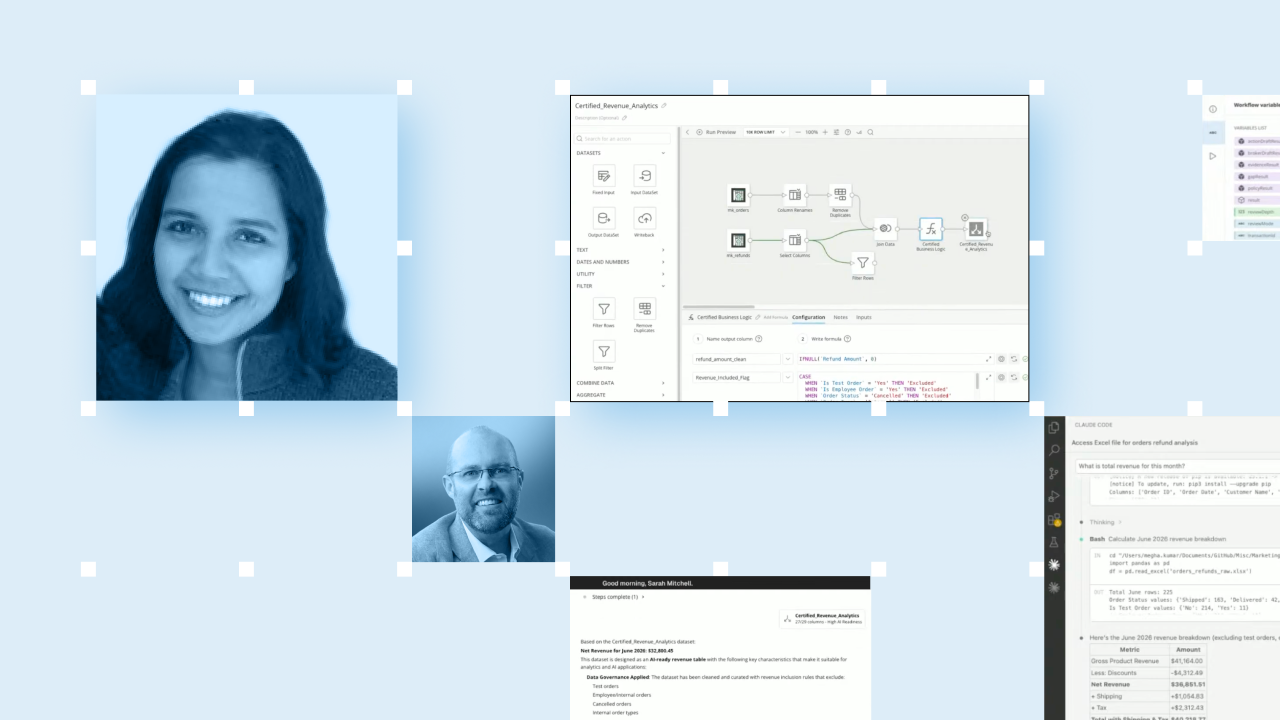
Megha asked a standalone LLM for net revenue using exported spreadsheets. It returned roughly $37,000, confidently. But when she challenged the model on its definitions, it admitted it had changed its approach mid-answer. The same question, directed through Domo's AI Agent on governed and certified data, returned $32,800, with full transparency on the logic applied: duplicates removed, internal orders excluded, audit types filtered, business rules baked in.
The takeaway is that no amount of clever prompting fixes bad data. So, here are five signs your AI is running on a shaky foundation, and what to do about each one.
This is the most visible symptom. You ask for a revenue figure one way, get one number. Rephrase the question, get another. The model isn't broken. Rather, it's interpreting ambiguous data differently each time because there aren't any standardized definitions guiding the response.
The fix starts with certified definitions. When terms like "net revenue" carry a single, governed meaning across the organization, the AI doesn't have room to improvise. Domo's platform applies business rules at the data layer through drag-and-drop ETL, so teams define the logic once and enforce it everywhere, regardless of who asks or which model answers.
If your AI returns a number but can't show the steps behind it, that's a black box, not intelligence. And in a business context, a number you can't defend is a number you shouldn't act on.
Governed AI, on the other hand, shows its work. When Megha queried Domo's AI Agent during our session, the response detailed which filters it applied, which records it excluded, and which business rules it enforced. That kind of transparency is the minimum standard for any answer that will inform a business decision.
So, Megha recommended, build explainability into your data layer. Use schema grounding, metric definitions, and audit trails so that every AI-generated answer comes with a clear lineage from source data to final output.
Exporting data into CSV files and uploading them to a standalone LLM might feel productive. It's also one of the fastest ways to strip away every governance control your organization has in place. The moment data leaves its governed environment, you lose row-level security, column masking, role-based access, and any business logic tied to the source.
We showed this in the livestream. The standalone LLM working from exported spreadsheets had no awareness of which records were internal test orders, which were duplicates, or which business rules should filter them out. It treated every row as equal, and the answer suffered for it.
Keep the AI connected to governed data at the source. Platforms like Domo allow AI agents and external models (including Claude, Gemini, and others) to query data in place, with governance intact. The data never has to leave its controlled environment.
When accurate results depend on one analyst who knows exactly how to phrase a question, your organization has a single point of failure dressed up as a workflow. Prompt engineering skill shouldn't be the difference between a correct answer and a misleading one.
As Megha put it, "At the end of the day, you can't prompt your way out of a data foundation."
The solution is to embed business logic upstream. When the data preparation layer applies transformations, filters, and definitions before any query runs, every question starts from the same governed baseline. A junior analyst and a senior data scientist should get the same answer to the same question, regardless of how they phrase it.
Getting the right answer is only half the value. If that answer sits in a chat thread until someone manually copies it into a report, emails it to a stakeholder, or remembers to act on it, the insight dies on the vine.
AI-generated insights should trigger workflows, route decisions, and drive business outcomes, not just populate a conversation. That's why Domo connects the AI response to downstream actions through automated workflows, alerts, and human-in-the-loop review steps. The goal is to move from answer to outcome without manual handoffs.
Design your AI workflows so that every answer has a destination. Map each insight to an action: a notification, a dashboard update, an approval workflow, or a triggered process. If the answer doesn't connect to a decision, question whether the question was worth asking.
In this recap, we've covered just one angle from a session packed with practical demonstrations. The livestream also walks through how to connect external models like Claude and Gemini directly to Domo's governed data layer, how to manage token costs as AI usage scales, and how Domo's security model (including PDP, role-level security, and column masking) extends through every AI interaction.
For the complete walkthrough, including live demos of each concept covered here, watch the full session.







.jpeg)