Partecipa all'AI + Data Tour per una formazione pratica, storie di clienti reali e incontri con gli esperti di prodotto Domo vicino a te.
Registrati ora
You know that sinking feeling when you pull up a lost deal report and spot a $200,000 account you didn't even realize was at risk? Your fraud systems flag suspicious transactions in milliseconds. Your infrastructure auto-scales before servers crash. But somehow, that high-value recurring revenue account quietly disengaged, and you found out 30, 60, maybe 90 days too late.
That frustrating gap between a customer checking out and you actually knowing about it? That's exactly what predictive AI agents for retention are built to fix. And the good news? You probably already have all the info you need to get one going.
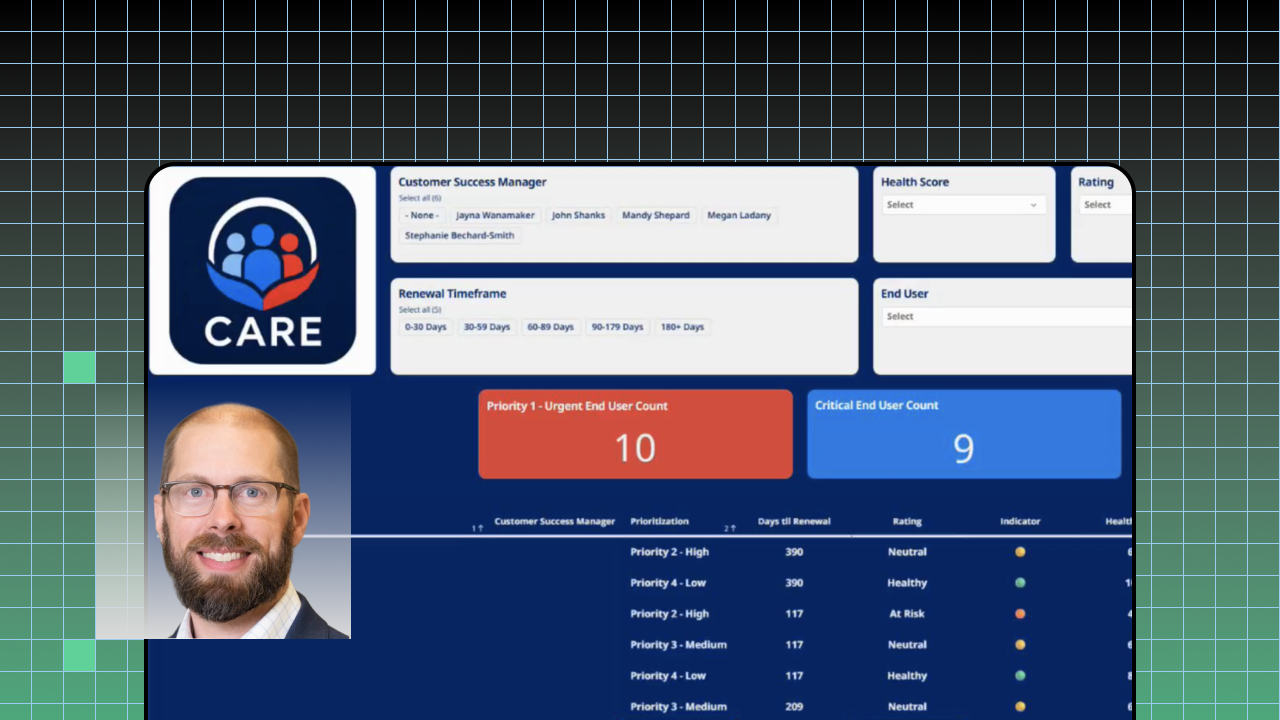
In the Domo BUILD 2026 session Replacing Reactive Retention with Predictive AI Agents, Brian Jacobson, CFO at GeoComm, showed us how his team built an AI agent called CARE (Customer Account Retention Engine) to surface churn risk signals before customers go dark. Brian explained that GeoComm's problem wasn't missing data; it was that all the pieces weren't connected. The warning signs were there, scattered across different systems, but no one had brought them all together into one clear picture.
What follows is a practical framework for building your own retention agent, drawn straight from how GeoComm approached the challenge.
Before you worry about AI models or dashboards, map out where your customer health signals actually live. GeoComm connected four categories of data that, together, painted a complete picture of account health.
The key signal categories to unify include:
Brian noted that the insight came during a hackathon when the team realized, "We had a connection problem. We didn't have a single source of truth bringing together these important aspects into one location." The data existed. It just wasn't connected.
Once your data sources are connected, you need a mechanism to translate raw signals into something your customer success team can act on. GeoComm's approach uses ETL (extract, transform, load) processes to join data and generate a health score from zero to 100 for each account.
That score then feeds into priority segmentation, so CSMs (customer success managers) know which accounts need attention and how urgently. The dashboard lets CSMs filter by health score, rating, priority level, and renewal timeline (from 30 days out to 180 days plus).
Here's what makes this work in practice:
A health score alone isn't enough. Your retention agent needs to operationalize that score by routing actionable summaries directly into CSM workflows. GeoComm's CARE agent analyzes priority accounts, summarizes the reasons behind the prioritization, and recommends specific next steps.
The agent also provides a chat interface so CSMs can dig deeper, asking follow-up questions or drafting outreach emails without switching contexts. The goal is to make the agent a daily tool that replaces the manual process of pulling data from multiple sources and trying to remember when you last checked in on a customer.
This shift compresses time-to-action dramatically. Brian described it as the ability to "execute these targeted actions in minutes, not hours or days," which means CSMs spend less time building reports and more time building relationships.
Here's where governance becomes critical. GeoComm's agent auto-generates triage emails for priority accounts, but the keyword is "generating." The system doesn't automatically send those emails. CSMs review, modify, and decide whether to send.
Brian put it simply: "Automate routing and not judgment." The agent handles the heavy lifting of surfacing risk and drafting responses, but the human owns the relationship and the decision.
This approach serves two purposes. First, it maintains the quality of customer relationships by keeping a human accountable for communication. Second, it builds trust in the system. When CSMs know they're still in control, they're far more likely to adopt the tool and rely on it daily.
GeoComm frames early business impact around three areas that translate directly to the metrics leadership cares about:
That last point is important. When renewal forecasts are based on actual customer behavior, like login frequency, feature adoption, and support sentiment, they become reliable enough to plan around. Wide best-and-worst-case ranges shrink into something actionable.
The framework above gives you a starting point for building your own predictive AI agent for retention. GeoComm also emphasized the value of cross-functional collaboration during the build process, including a dedicated 24-hour hackathon that brought together business, customer success, engineering, and technical teams to align on the solution.
Brian also noted that you don't need a perfect AI strategy to start, just a real problem, the data you already have, and a team willing to build something valuable.
Watch the full session to see how GeoComm brought CARE to life and what they learned along the way.






.jpeg)