Join the AI + Data Tour for hands-on training, real customer stories, and time with Domo product experts near you.
Register now
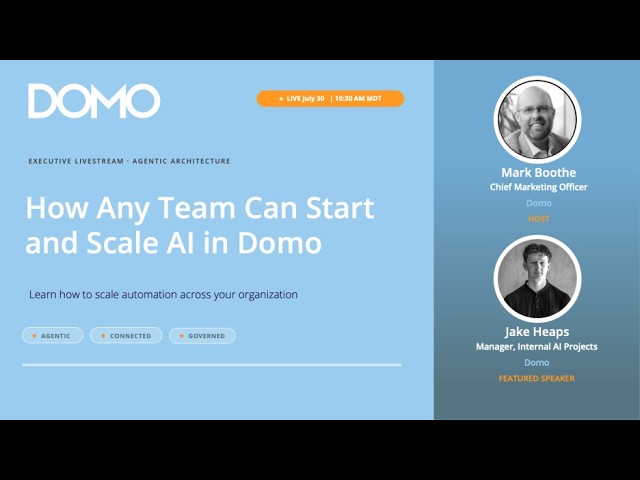

Mark: What is up everybody? I have something kind of fun to share today. So this is my friend Jake Heaps who's joining me today. You might be like, "What are you sharing, Mark?" I'm gonna tell you what I'm sharing. Not my biggest mistake in my life, but definitely a big mistake in my life. September 23rd, 2024, I get this message from an individual named Jake Heaps. Now, anybody who's a BYU fan knows that there was once a quarterback at BYU named Jake Heaps. I do get a fair amount of LinkedIn messages and I am ashamed to say that I didn't respond.
Mark: Here's Jake, he sends this note: "I'm a young learning marketing professional. I've been following you on LinkedIn." He then says some mean things about me, which we'll get over and move on. "Recently made a post about this right now. I'm focused on structuring our systems and strategy at our marketing team. It'd benefit, I'd love to ask you a few questions." Well, I didn't respond. Whoops.
Mark: And then quite a while later—you're talking quite a while later—I get this message from a friend that's like, "Hey, you ought to take a look at this guy." I'm like, "Okay," and I am sent his resume, which was this custom GPT that he's built to answer any and all questions about himself. And it was deep stuff—even to the point of thinking through security and if there was a way they could get around it. I mean, it was like Fort Knox.
Mark: So I get on the phone with this Jake. You can see, "Hey, your name just came up. I'm intrigued by you. Have time to chat today or next week?" "I'd love to chat." He got back to me in three minutes. He's obviously a much better person. Two minutes later: "Let's chat today. What's your number? What time works best for you?"
Mark: So the story goes like this: we talk on the phone, I've played with his custom GPT, and I'm like, "Holy cow, this person is an AI monster." And I really wanted somebody who could come and help us take our marketing organization from the very beginning ideas of what AI could do for marketing to a powerhouse. Jake was the individual who helped me do that. We brought him in—what's it been now, Jake, a year and a half?
Jake: A year and a month, so thirteen months.
Mark: Totally and completely revolutionized the way that we do marketing at Domo and how we use AI to make everybody way more effective and efficient than they can be by themselves. And so, Jake, I'm glad that I made a mistake, I'm glad I recovered from my mistake, I'm glad you're here. And today, we're going to talk all about how to start using AI, no matter where you're at in Domo, how to start using AI to be really effective. Jake, before coming to Domo, were you a Domo super user?
Jake: I was actually just about to say—I actually don't even know if you know this—before I came to Domo, I didn't even know what an API key was. I didn't know what an API key was, didn't know what an App DB was. I came from a marketing world, so I was as far from technical as possible. I just tried to figure things out as much as I could. But really? No, no, I was not, to say the least.
Mark: So, Jake, very quickly, you came in and we started to figure out, okay, what can we do with AI? What do we need to bring on? How do we enable people, all that? But very quickly, you became a bit of a Domo rock star. And the big way that you did that is because you leveraged Domo, AI, and MCP to be able to not only do this much, but to be able to do that much. And that's what we want to walk you through today, everyone, is how you started, what we're doing now, and how people should take a step into AI to make themselves more effective with it. That fair?
Jake: Yep, and I completely agree with that. I think it's always very hard to say, "How am I going to jump into AI? How am I going to start learning this?" And I did it by starting off in the platform, by starting off building a couple of things in some workflows, and some code engine functions, and really just kind of using AI to help me there. And it's really kind of created the foundation of what I know, using AI in operations, and specifically with our data in a secure and governed way.
Mark: I love it. So, Jake, as we've talked about a trillion times at this point for those who are watching, Domo's superpower is we help you build your data foundation wherever that is. If that's in Snowflake, if that's in Databricks, if that's in GCP, fantastic. We help you get the data and help it become actionable in those amazing partner platforms.
Mark: From there, we actually help you take action on that data, whether that's building apps or agents or whatever else to help drive business outcomes. From there, we help you distribute. Anybody today can vibe-code something, that's easy. But being able to distribute it and get it to the right people in a safe, secure, and governed way that's auditable by IT, that's more difficult. And so, Jake, let's go back to the very beginning. You started at Domo about a year and a month ago and you decided, "Okay, I got to figure out how to do this thing. I'm really good at AI, I'm not very good at Domo yet." But you decided, "I'm going to go build a workflow, right?"
Jake: Yeah.
Mark: What that looked like and what you did, and why you did it.
Jake: Okay. So, starting out, my first workflow that I worked into took me about a week to a week and a half to really figure out, like, "Okay, this is how this works, this is how I'm building here." This was our Paid Media Insights and Generation Agent, right? Our paid media director at the time was using it all the time to go and basically say: what keywords are working, what keywords aren't working, what should I be doing, where should I spend more money, what new keywords could we be doing?
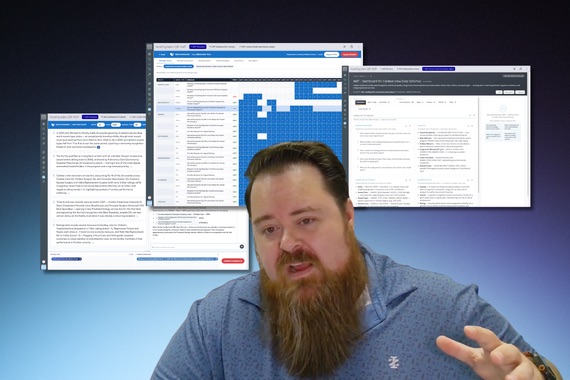
Jake: I think that I had the best of both worlds where I had a leg up because our data was already put all together. We were pulling in all of our data from Google Ads, G2, and SEMrush. So I already had everything set up in a way where I could just say, "Oh, hey, I want to pull from this source, this source, this source," and I could automatically do it. First, there's a couple of technical things that I had to do with connecting it to the front end. This was a little over a year ago, so things have changed quite a bit and it's a lot easier now. But if we look at this, the main part of this is the media buyer task—the media buyer agent tile.
Jake: Really, what I did is I put in here date prompts, the instance ID (which is basically like a thread ID to make sure that we're responding to the right threads), and instructions. Simple things like, "You are a professional media analyst and expert in Google Ads." Put that in there, put in the tools to be able to pull the right data from all these different datasets, and really that was pretty much it. I don't even think this knowledge type existed yet, but that was pretty much it. We went and built that out, it creates the app, we document that so we have a record of it, and created a front-end for us so that our paid media director could use it there. That was it.
Jake: It seriously took me, once I figured out how everything worked, a couple of days to do. If we were to rebuild this now, it would take maybe an hour or two. Now we've got everything down to a science, but it really was just starting up this workflow, setting up the media buyer tile or the agent tile, describing what I want to do, and putting some instructions in there. I used ChatGPT or Claude to write those instructions for me, put them in there, gave it the tools to the datasets, and that was really it. That was all we had to do, and then we had a working agent that has been awesome.
Mark: And this is one example. We have now countless examples of agents or apps that have been built to help individuals in the marketing organization be more effective at their job. This one specifically, we spend a fairly significant amount of money on paid media. And one thing that we know that AI and systems are really good at is digging through deep, deep, deep amounts of data, something that really humans at that kind of scale cannot do. This could look over the past ten years of performance on Google, for example, and give us the ability to say, "This is what will work." You now take that and multiply it by a whole bunch of other agents and apps that have been built to make people more effective, and it's pretty powerful. Talk to me, Jake, a little bit about the power of what you're doing today with Domo and MCP specifically.
Jake: Yeah, the MCP has made it so easy to build inside of Domo. You have that data layer and everything there, and the MCP is really working on that activation side to go and distribute everything that you're doing. I'm pretty sure we're up to like 90% of our marketing team now that has access to the MCP and has it all set up with some sort of agent-to-coding system. They've been able to start using Domo as that platform, wherever they're at.
Jake: For example, our content specialist is using Domo data to decide what blog posts we should write, and our digital marketing team is using it for different things about the website and stats about where we should go. It's used in all the different areas of the marketing team and of the business, really. But that MCP allows us to take that data foundation we have. I can't think of a single member on our team that isn't using AI in a workflow that's pulling data from Domo.
Mark: Okay, Jake, for our wide variety of people who will be listening in on this, some people are hearing the words "MCP" right now and they're like, "I don't even know what that is." Give us the dumb-down version of what MCP is able to help with for any Domo user today.
Jake: MCP is kind of a weird term unless you're technical and come from that side. To understand it simply: you have APIs that you can use to go and connect to a platform. All an MCP really does is wrap those APIs and make it easier for an agent to know exactly what the input should look like, what the output should look like, when they should use it, and what it can do. It's basically taking that API and giving it learnings to give to the agent to be able to use whatever it needs to inside of Domo.
Jake: Rather than having to hit the right API and figure everything out yourself, it tells the agent exactly: "This is what you should put in, this is what you're gonna get back, here's when you should use this, and here's why you should use this."
Mark: Okay Jake, so ninety-ish percent of the marketing organization has access to that, building some really cool things. Give me five to ten examples of what the team has built now that's making them way more efficient.
Jake: Our blog creation now has been sped up exponentially. Everything on our creative side has been influenced by AI to be able to be a lot faster. What used to take us two days to edit now takes us an hour and a half. Our product marketing org built what we call the "Domo Knowledge Brain"—a knowledge graph containing all of our different learnings about how we want to talk about Domo, what we want to say, and how we want to talk to different people. It makes it so we can say the same consistent message across the entire organization. We take that data from all these different areas and use it both inside and outside of Domo.
Mark: Okay, Jake, so I'm a Domo customer. I have access to all of these tools. Where should customers start?
Jake: First and foremost, start messing around inside the platform. Look at the workflows, understand how the AI works, and find where you need to be pulling data from. I wasn't technical, so I did that to understand more of where we want to pull data from, when we want to use structured versus unstructured data, and all of that. If you're from more technical crowd, I would say just hook up the MCP and start exploring. Start saying, "What's going on in my data?" Find the ETLs that are broken and try to fix those. You don't need to boil the ocean; you just have to start somewhere. That's probably the best tip I can give for adopting AI: start where you feel comfortable and spend the time.
Mark: Love it. So I think that the big takeaway for everyone is the tools and capabilities are all there. What you have to do is figure out what are the things that are most important for you to solve right now. For a creative team, a data team, or a blog team, there are key challenges that every single function deals with on a daily basis, and AI specifically should be helping you solve them.
Mark: Make sure you turn on the MCP. Make sure that MCP is set up and working for you, and go test it. Fix an ETL. Build something that's going to make your job easier. I went back and forth with somebody today who was telling me about this company that's hiring a CMO that will have zero reports and will be managing 3,000 agents. I was kind of like, "This is going to fail miserably." Someone asked, "Why are you so sure about that?" I am a massive fan of AI, and we have taken it across our organization to make a huge difference. However, I still believe that humans play a very powerful piece and touch in making AI effective. Had we just said, "Here, everybody, here's a tool, go run," our AI efforts would not be that effective today. Am I wrong on that?
Jake: No, I think you're spot on. When I very first started, my first two weeks here were spent meeting with everybody on the team. One of the questions I asked was just, "Where do you think you shouldn't put AI, but also, what is taking up all your time that we can automate?" And then we tried to automate those things as much as we could inside of Domo. We agreed from the very beginning: AI is not going to take jobs, but people who use AI effectively will. Managing 3,000 agents sounds like a nightmare, especially in an established company, because you lose out on domain knowledge, subtle nuances, and gotchas. That human interaction of making humans ten times more efficient is really what's going to make the difference.
Mark: Jake, as we close things out now, you'll hear people talk about, "Why do I need that tool when I can just do it all in the cloud?" What is the power of Domo plus AI? Why Domo?
Jake: That's a great question. The first part is looking at the data structure and security. With cloud, who knows where that data is going, especially if you're training the models. When we put that data inside of Domo, we have that already connected securely. Second, it builds a foundation of scalability. If I need to rinse and repeat something and use the same sources again, I don't have to connect them every single time. It's as simple as, "Oh, hey, it's this dataset. I'm going to use that in this agent, and this agent." It creates the scalability and foundation that you need to scale.
Mark: I love it. So remember, Domo is expert at helping you build your data foundation, wherever that lives—whether that is in Snowflake, Google, Databricks, or Dremio. The data does not leave; it stays right there. We want that to be your data foundation, and from there we want to help you take action on that amazing data foundation to drive business outcomes. We want it to be safe, secure, and governed, and that's the power of Domo.
Mark: Everyone, learn from my mistake. Luckily, Jake and I hooked up, and we finally got him over here, and he's made a massive impact. Don't run from AI, run to it. But make sure that your data is ready for that, and that you're prepared to make the big impact that you can really make with AI, humans, and everything else that's going to make your business successful. With that, we will see you next Tuesday. Jake, thanks for joining us today, thanks everybody for being a part of it, and we'll see you next week.

Mark brings over 15 years of diverse marketing experience and is passionate about driving Domo’s business growth through marketing initiatives. His mission is to empower all Domo customers and prospects with the insights and tools they need to make better business decisions and achieve their goals. In his previous role as VP of Community, Partner, and Field Marketing, Mark and his teams established new and strengthened existing programs to address customer pain points and create a greater sense of community. They also executed campaigns, programs and events that showcased the value of the Domo platform. Before joining Domo, Mark spent more than 10 years working in customer relations and marketing at Adobe, and worked at Instructure as its senior director of customer marketing. He received his MBA from Utah State University and a bachelor’s degree from Brigham Young University. Outside of work, Mark enjoys spending time with his family and traveling.

Jake Heaps is a results-driven marketing professional with a passion for AI and creative branding. Currently the AI Marketing Operations Manager at Domo, Jake has a knack for building marketing programs from the ground up, most recently helping Adminify AI with a full rebrand and launching a self-serve AI product. Before that, he spent almost two years at Bucked Up, where he managed marketing funnels, led cross-team projects, coordinated national ad campaigns, and helped grow the marketing team—all while driving significant revenue growth. With a background in graphic design and hands-on marketing experience, Jake brings a mix of creativity, strategy, and collaboration to everything he does.
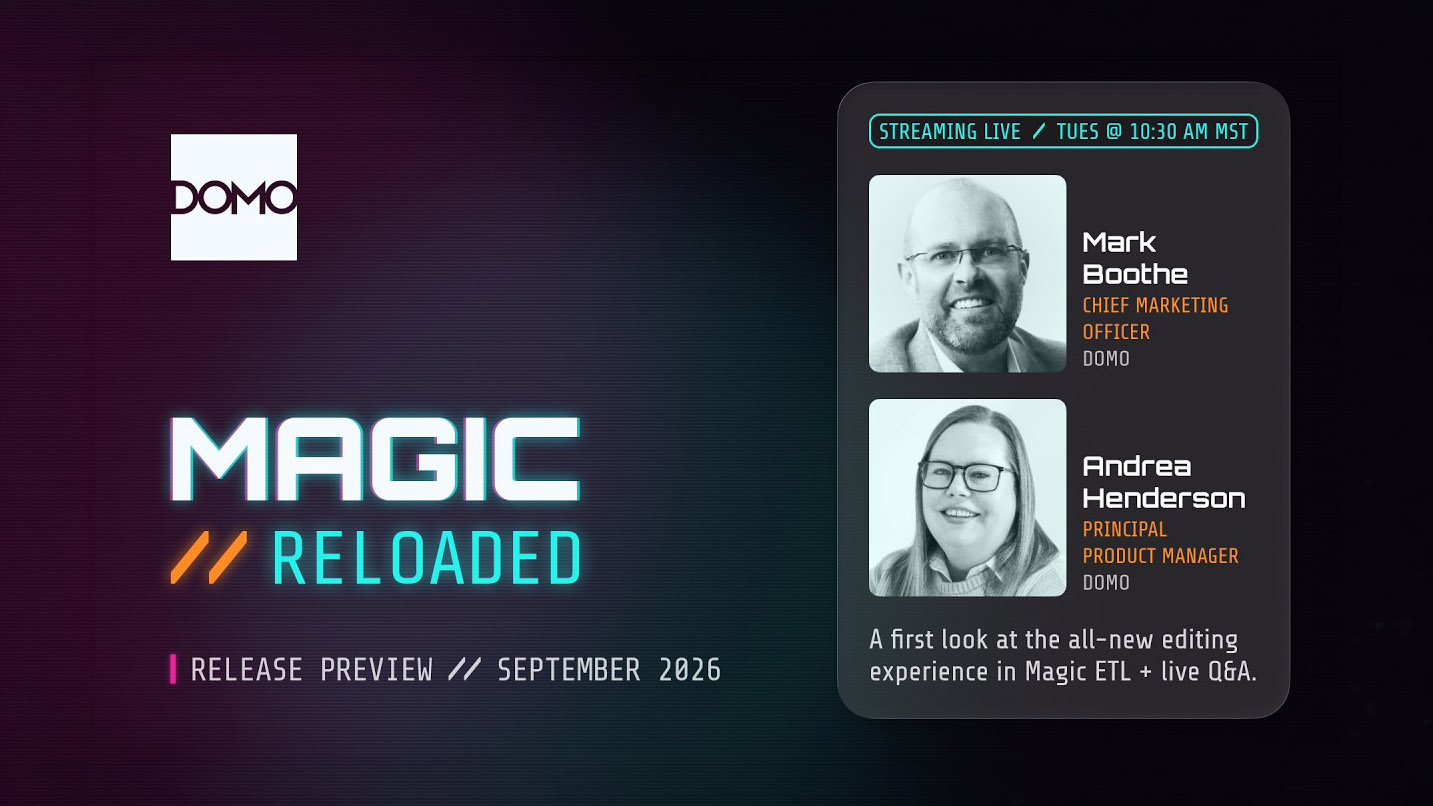
Plenty of teams agree they should use AI, then stall on what to actually do first. This story picks up there: How to start using AI in Domo and grow it across an organization. It works whether or not people write code, and Jake Heaps, employee at Domo, shares how he did it from a marketing seat.
In this livestream, marketers, analysts, and team leaders learn a practical path. Start small with one agent, then use Domo's MCP to activate AI on governed data. Examples shared include a paid-media insights agent and creative work produced in less time, drawn from a shared knowledge base and delivered where teams already work.
The throughline is human oversight. People set the objectives and guardrails, and agents execute within them inside Domo’s secure, governed environment.
Domo transforms the way these companies manage business.