Join the AI + Data Tour for hands-on training, real customer stories, and time with Domo product experts near you.
Register now
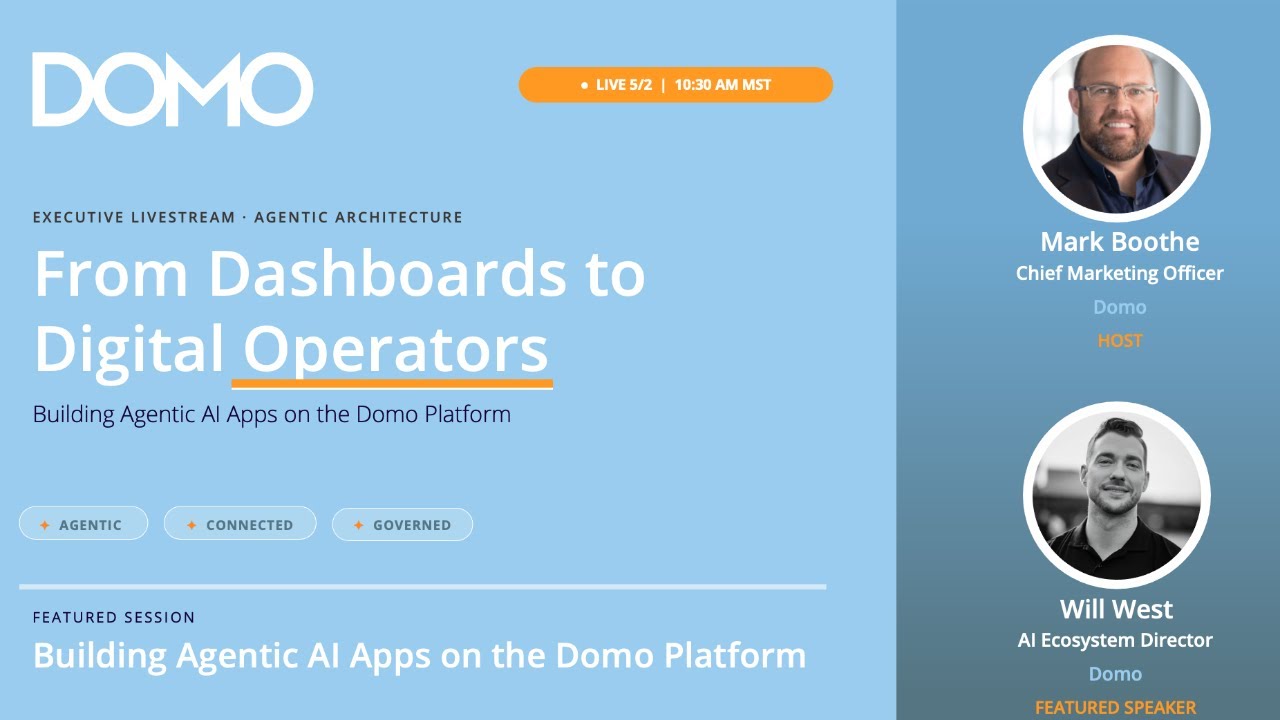

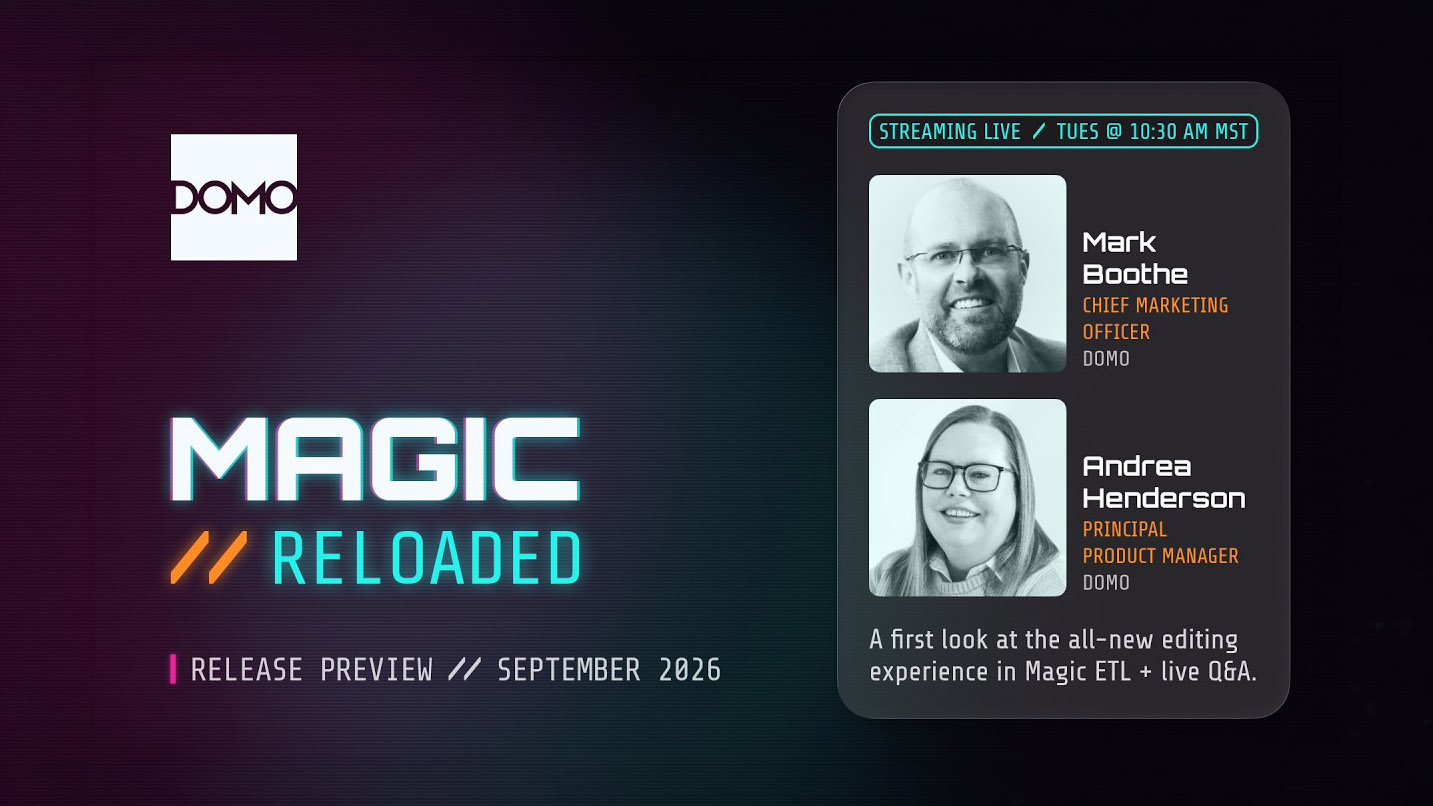
Mark: What's up everybody? We are live. I am coming at you live from out in San Francisco. We are out at Snowflake Summit this week, so I'm in my makeshift studio here in the Marriott Marquis. I apologize if things don't look quite as crisp as we might like, but I'm here. I thought the presidential suite would look a little bit bigger in the background, but that's all. What do we do with this guy? Okay. I'm here with my good friend, Mr. Will West. He's our Director of AI Ecosystem. If you haven't met Will, Will does some crazy stuff, and it's one of my favorite parts of Will. He just goes and uses AI to build incredibly powerful tools for our customers. Today we are talking all about moving from dashboards—still important—to digital operators. We want to focus on how you build AI apps and agents on the Domo platform that can legitimately revolutionize your business. So with that, I am super excited. Will, welcome, my friend. How are you?
Will: I couldn't be better, man. Everyone's talking about how to use AI, and even prior to being at Domo, I was in those rooms when ChatGPT came out and then GPT-4, and it was like we have to do something. You saw Amazon roll out this AI chatbot with a dog in it, and you saw all these boxes being checked so that executives weren't jumping down people's throats. Now we're stepping in and it feels like Domo is grabbing that bull by the horns for our customers. We're doing it internally, we're also going to our customers, and we are at the tip of the spear saying, "Stop checking boxes. Let's actually change your business with AI." It's a great feeling, man.
Mark: I love it. So walk me through, Will. Where do you want to start? Do you want to start sharing right now? Do you want to talk about the shift between dashboard reporting and digital operators acting—dashboarding telling you what happened, and all that kind of stuff—or where do you want to dig in?
Will: Yeah, I'd love to talk just for a half second. I mean, we've been through a lot lately with the 500 apps. Prior to that, Domo has been doing this for a long time. Our platform is built for it, so we've been in the thick of things and there's plenty to unpack there. I'm also building an app in the background right now that we'll pull up, go over, and start to talk about. Not just the things that you and I will discuss, but we'll also go into what that looks like in an app surface, and let's try to manifest it and make sure that it lands with everyone on the call.
Mark: I love it. So Will, talk me through. We're hearing quite a few things right now about the idea of human-in-the-loop, which is still super important. Walk me through how you're thinking about things as you're building tens or hundreds of things for customers and prospects today. Where is it that customers are asking for a human to be in the loop, and where are they feeling more safe and secure with just letting AI handle it?
Will: It's such an important question. Right now, especially when the IT team gets involved, the default is that they don't trust AI. I believe it's part of a phased approach and depends on what you're doing, but human-in-the-loop in the short term is actually part of training AI to get better at making decisions. In the short term, it may just be that we're doing checks along the way. For example, we have AI matching two things, and before we approve and enshrine it, we need a human to verify that what it matched is accurate. Marketing companies that are trying to do fuzzy matching with taxonomy need those to be accurate when coming from different clients. We need a human to check that box.
You will have what's called a confidence threshold, and AI will say, "We are ninety-nine percent sure this is accurate," or "one hundred percent sure this is the same word." But then there are ones where it goes down to seventy, eighty, or sixty percent, and the human is going to sit there and say, "Yeah, you got it, let's go ahead and let this one through." Human-in-the-loop in that moment is like saying, "We believe we're ninety-nine percent sure, but check it anyway." Then you can use that confidence to train the model forward. In the short term, you may have a human in the loop for more of the lift, and then as that model gets smarter as you train it over time, you may find that the human is in the loop significantly less. Does that make sense?
Mark: It totally does. I think the one place I would push back there, Will, is when you mentioned being a little bit reticent or nervous about AI. I don't think that's actually the case. What I think is that most companies and organizations are not governed in a way where they are able to trust everyone to make the right decisions. I think of our IT team, who are master users of AI; what they want is for it to be safe, secure, and governed. Too often, companies are not set up to have that safety, security, and governance that something like Domo offers. Is that fair?
Will: Yeah, I think you're spot on, and it's a great callout. It's more about how every department sees real, solid, meaningful AI leveraging as something valuable to bring to the table, but nobody knows who to trust. The IT teams are on high alert right now. I think where Domo is really advantaged in this moment is that they trust us. I could go through our pedigree and name major financial and educational institutions globally that have been trusting Domo for years with massive amounts of data. For us it's less of an issue, but generally, IT teams are cautious. At Domopalooza, I heard a lot of our accounts corroborating this, saying it's kind of hard sometimes to bring things to the IT team and just have them say, "Hey, it's AI, let's go, we're AI-first." At Domo, we kind of get the red—or maybe the blue—carpet, so we're a little bit privileged. But generally speaking, IT teams are on high alert right now, which is a very valid point.
Mark: Yes. So Will, you talk about the idea that the job of software is moving from insight generation to decision execution. Talk me through what you mean by that, and in one sentence, why is that so valuable?
Will: It's important because a lot of the time we sit in meetings and look at information, and then it takes five, ten, fifteen more steps, days, weeks, or more meetings in order to take action, even though the solution is staring us directly in the face. When we look at agentic solutions and shortening that gap, that's what we're talking about: going from looking at the problem to having a button on the exact same page that you can click to mobilize on it.
Mark: I love that. We've been talking a lot lately about Domo being the agentic platform for the intelligent enterprise. What does that mean? Give all of our listeners and viewers a sense of why now? Why is that so important to where we're going?
Will: If you look at us historically, we've been doing it across all of our teams and across our platform. App Studio and Workflows are great examples. We had AI tiles back in 2011—you can pull up a conversation Josh had about how important this is. 2011, man. So we've been hot on the trail for this and building our product around it. We are at a point right now where everyone's ears are perked up. TikTok and Instagram Reels are cramming down every business owner's throat about how important it is to do something about this.
The really nice thing is that across our product in many different ways—because every business, department, and industry needs something a little different and there's no cookie-cutter mold—we have so many parts of our platform that when you stitch them together or use them as intended, we can manifest those solutions really quickly. Plus, all of your data hopefully is already inside of Domo, so it's protected and you don't have to jump through those setup steps.
I think Domo is at the tip of the spear. We've been building ourselves for this moment. When you look around and everyone is saying they need something agentic or something AI, once companies figure out what that is or sit in a room with us to help them visualize it, it's crazy. We tell them we can get something back to them in days or weeks, whereas historically, that timeline was much longer—like six months to a year for projects I worked on in past lives. It is amazing, and it feels safe. The excitement we get out of it is great. You tell them we can get something back by next week, and they assume it's going to look unpolished. Then we come back and they are just like, "Holy cow, this is real." And you know what always happens, Mark? They ask, "What other departments can you do this for?" It happens every single time.
Mark: I love how you censored yourself right there, Will. I could see it in your face.
Will: Yeah, Paris hit me up before this and was like, "No swear words this time, dude."
Mark: Tell me really quickly, before we jump into the overall four-stage agentic app process and how you actually build an app in Domo, I want you to walk us through a cool experience we had with our friend Nicole over at X2. Shout out to Nicole. Nicole came to Domopalooza and her baseline assumption was, "I thought you were a dashboards company." Walk us through that process of when I called you in, you met with Nicole, and chatted through some things you can do. I want people to understand where that lightbulb went off for Nicole to realize that Domo is not just a dashboarding company.
Will: Great question. The path forward is almost always the same, and anyone who participated in our 500 apps initiative will recognize this. I start with the hero metric. What metric are we trying to impact? This is the secret sauce. We start with the outcome in mind—you hear a lot about outcome-based building nowadays—and everything surrounds that particular metric. For HR, for example, let's imagine it's retention rate, satisfaction, the onboarding pipeline, or onboarding retention. You identify those hero metrics, and then we build an app around them.
We ask: what are the best practices? What apps are already out there that do this, and what are they doing to lift and improve that hero metric? We start to build a concept, or what in the engineering world we would call a PRD or a requirement stack. The requirement is simply to build an app that improves that hero metric. Once we have what we need the app to do, we walk it back into the build. Typically, people walk it forward and say, "Make page A, page B, page C, and here is what needs to go on them." Instead, we let AI do its job to populate the app with best practices and maybe even reference existing software, and then we tune it from there. This skips quite a few steps, bakes in some of its own ideas—some of which we keep and some of which we discard—and then we collaborate with the customer.
What is really nice about this approach is that it avoids spending endless meetings just trying to get started. Instead, you catalyze the "art of the possible" in the customer's mind. When they see it, they start whiteboarding and asking what else we can do. In the next meeting, they stop asking "Can you?" and start saying, "Let's do this. When I click this button, here is what we traditionally have to do manually. Can you make it so clicking this button just executes those steps automatically?" Yes, we absolutely can. Those meetings get very exciting, very fast, and you end up spending more time actually building the solution and less time in meetings trying to figure things out. That is historically what drives me insane; I have a few gray hairs from seven-meeting conversations that could have been resolved in three bullet points.
Mark: This is awesome. I'm ready. I want you to wow everybody, so show us, brother.
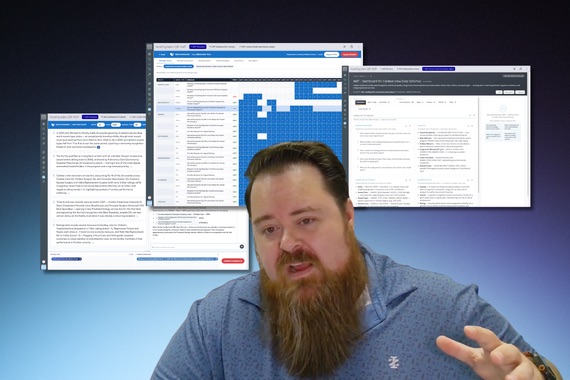
Will: Yeah, man. This is a great example. I think one of the other team members you spoke with, maybe Cassidy, stole my absolute favorite sales use case. But this one is a great, slightly abstract example. If an HR team was to come to me and ask how they can impact the business, this is where we would start. I built this about an hour before our session, and I used AI to identify what is most important to an HR department for a placeholder company called MotoCorp.
What it did was establish how things look at a high level for an HR department. As we zoom into each of the tabs, we take a more tactical approach. Inside here, we have all of our app files and code base. I'm using Claude and Codeux, and Gemini also does a phenomenal job—I often touch things up with Gemini afterward. This is VS Code, my workspace where I do the development and direct the AI to improve parts of the app. Over here, we have a preview of the app interface. I'll pause here to make sure you're comfortable with this workspace, Mark, or if you have any burning questions.
Mark: No, I think that's right on.
Will: Cool. What I like to do—and again, I'm getting into the sausage-making, so Mark, you have to pause me or cut the stream if I get too deep into the secret sauce—is think about the structure of a successful app. When I build an app that accounts love, I surface strategic oversight at a very high level to ensure we do not have blind spots. Any client I've worked with can probably repeat my mantra: I want to make sure you have no blind spots, that you are one click away from tactical oversight, and one more click away from action.
Up top, we have the viewport. The initial viewport should have everything that keeps us aware of the state of the business, like flight risk and average satisfaction. I would also include a goal or a period-over-period comparison to see if we are trending upward without any blind spots. Down here, we break apart the different areas of the business to zoom in on them individually. This is where the human-in-the-loop concept becomes very apparent—humans are not going anywhere. The AI can generate a drill-down view. Our native Domo charts look much better, but you can see where you would want to zoom in on the recruiting pipeline: open positions, candidates in the pipeline, average time to fill, and offer acceptance rate. Those are crucial metrics.
Now, let's talk about going from strategic to tactical to action, which is what it means to be agentic in nature with AI assistance. When I click here, it highlights items requiring high-level, critical attention. For example, twelve employees are flagged as high flight risk in sales and engineering. If I manage this department and want to be a superhero because of this app, I can click a button to view the specific risks, and click another to trigger action. When we collaborate with a client, we ask them what action looks like for them. Is it sending emails, sending Teams messages, scheduling calendar invites, adding items to an agenda, or assigning Domo tasks to investigate further? That represents strategic awareness, tactical drill-down, and one-click action execution. You click a button in the meeting and the action takes care of itself.
That is why I get so excited about this. Who wants to sit in five more meetings just to resolve one specific follow-up item? That is just drag and delay. We have been making videos lately about this exact topic—the friction and distance between insight and action that is simply no longer necessary. That is what we are building into these app interfaces, and our accounts are getting hooked on it. We recently showed an app to a major global shipping company, and their immediate reaction was to ask if we could build similar solutions for several of their other departments. We have been meeting with them to scope those out. I know that's a bit of a tangent, Mark, but it's exciting.
Mark: I actually like the tangents. What I want to do, Will, is I want to hear why Domo? There are plenty of people who will say, "I'll just build this in the cloud, I don't need Domo for that." Walk me through why Domo is so critical to building these safe, secure, and governed apps and agents that drive business outcomes.
Will: It is a vital question right now. A lot of companies claim they can do this, and we even have partners who work with other platforms but keep coming back to us because they want to build these solutions with Domo. The theme is always the same: governance and connectivity, which we have been building for a decade. When I started at Domo, I thought we could do a lot, and then I learned and grew under my mentor, Nick, who showed me that anything is possible in Domo. For an end-user trying to eliminate SaaS costs, break down silos, and consolidate onto a single platform, this is massive.
We have our native connectors and a low-code, non-technical way to create a solution. We also have a mid-grade approach where users can learn to build in Procode using tools like Claude and Codeux, and we can accommodate highly technical data pipeline requirements as well. It comes down to connectivity, integration, safety, and affordability. I've built apps outside of Domo, and the moment you start paying for security and the nine different services required to host an app and wire AI into it, you just watch your money drain. At Domo, you can integrate AI easily, and the governance is already built-in. If you have external users, they will only see what they are permitted to see. I just got back from Japan, and they are saying the exact same thing there: everything is in one spot, highly governed, incredibly secure, and integrating AI is so simple you could do it in your sleep.
Mark: Exactly. Anyone can quickly code a prototype, but the critical part is running these apps and agents in a governed production environment that can be audited to ensure users only access the non-sensitive information they are authorized to see. You cannot do that on a white-label coding platform.
Will: No, you can't. Or if you do, they are going to charge you a premium or charge you per cohort. For us, security features like Personalized Data Permissions (PDP) and role-based security are built-in. Any dataset a user accesses through these custom apps is automatically restricted to what is administratively permitted for them. You can't spoof it or bypass it with cookie takeovers. Since we've been doing this for so long, it's just the standard for us, even though it's a massive revelation for newcomers. It's the free bingo space.
Mark: Okay, Will, I see you've still got Claude running in the background. What other insights do you have for us?
Will: Working with global clients, one of my favorite aspects of Procode development in Domo—which I also showed to our CEO, Josh—is how easy it is to upgrade an app. If you have global teams in India, Brazil, Manila, and the US, you can easily make the app support multiple languages. It might feel like a minor feature, but when you want global alignment, language barriers are a real challenge. Building a language switcher directly into the app ensures both teams are looking at the exact same data in their preferred language.
My goal has always been to make the BI professionals and developers the heroes of the organization. Often, they are just putting out fires and servicing ad-hoc requests. We are putting capes on BI teams. When we build these solutions, we go from creating insights to creating action using the same core data. The moment we do that, we transition from subjective data reading to actively moving the business forward in a safe, governed way. You can return a week later and say, "I spoke with our Manila team. They couldn't fully utilize the app, so I added a button to switch between Tagalog and English. Now they love it and are excited to use it."
These custom app solutions in App Studio are getting non-data stakeholders excited to use data, which is what the most successful companies in the world do. The app acts as a springboard for engagement, and can even link directly to standard Domo dashboards. In my past experience, the departments that were truly thriving and moving the business were the ones with non-data data champions who were hungry to get into the platform.
Right now, there is a cohort of people who are passionate about AI, and who understand that leaning into it can fundamentally change the business. I am an example of that: I went from sales to a sales leadership role because I fell in love with SQL and used AI to teach myself. Then I became a data analyst, discovered Domo, and joined the company to build these solutions. Now, I am focused on leveraging AI to drive business forward for us and our clients.
If you find people on your team who are excited about AI—even if it isn't their core job function—lean into them. We are not fans of mindless token-maxing; AI utilization must be tethered to business impact. But when you identify those creative thinkers who are close to the problems, let them use AI to build app solutions.
Mark: One of the best hires I've ever made is a good friend of ours named Jake Heaps. Jake, if you're listening, shout out to you, brother. I asked you once, Will, who some of the most powerful users of AI at Domo were, and I think you described Jake as "one of the freakiest." Much of our marketing team's transition to an AI-first approach is because Jake helped everyone level up their usage.
Will: I couldn't agree more. He has moved the business heaps, if I may. When you sit down with someone like Jake, you realize how much further there is to go. The way he applies AI to the business is inspiring. When you believe in Domo as a company and you work alongside people like Jake Heaps, Nick Kumar, Jeremy Rogers, Cassidy, and so many others, you realize success isn't a pipe dream. When you find individuals in your company who solve problems at breakneck speed, internalize software, and liberate your organization—Jake, for example, replaced two highly expensive software systems—lift them up and let them run. Take the administrative tasks off their plates and let them focus on what they excel at, because they are moving literal mountains that would have taken entire teams two years to do just a short while ago. Cut them loose and let them run.
Mark: Exactly. When we walked on stage, Josh had Jake's walk-up song play, and we talked about the super freaks in the company—he is definitely the freakiest. We are at time, but in closing, why is Domo the platform people should be building their agentic solutions on?
Will: We are the safest and the best platform. Building your solutions inside Domo lets you reap the benefits of the entire product ecosystem, where no data source is off-limits and integration is simple. We are incredibly compatible with AI. Our platform has tens of thousands of API endpoints, allowing you to execute tasks quickly outside of Domo. We are custom-built for this exact moment.
Additionally, hosting apps inside Domo doesn't incur per-load costs like other platforms do. We charge based on the data and rows you utilize, and we don't penalize you with steep cap-based pricing models like some database competitors. There is simply no one better. When you leverage Domo, you also get access to some of the best minds in the business—our support teams, growth services, and solutions consultants—who can help you fundamentally transform your business.
Mark: I love it. Domo is the agentic solution for building apps and agents in a safe, secure, and governed way for the intelligent enterprise. We want to help you build. Reach out to me directly, check out domo.com, and let's start building together. We will see you again on Thursday at 10:30 a.m. Mountain Standard Time for another exciting session with our good friend, Elliot Leonard. Thanks, everyone.
Will: Yeah, absolutely. Thanks, Mark.
Mark: Have a good one, everybody. See you.
Will: Hey, see you.

Mark brings over 15 years of diverse marketing experience and is passionate about driving Domo’s business growth through marketing initiatives. His mission is to empower all Domo customers and prospects with the insights and tools they need to make better business decisions and achieve their goals. In his previous role as VP of Community, Partner, and Field Marketing, Mark and his teams established new and strengthened existing programs to address customer pain points and create a greater sense of community. They also executed campaigns, programs and events that showcased the value of the Domo platform. Before joining Domo, Mark spent more than 10 years working in customer relations and marketing at Adobe, and worked at Instructure as its senior director of customer marketing. He received his MBA from Utah State University and a bachelor’s degree from Brigham Young University. Outside of work, Mark enjoys spending time with his family and traveling.

Will West is the Director of AI Ecosystems at Domo, where he empowers teams by developing and refining AI tools to enhance their business outcomes. A featured keynote speaker at Domopalooza, he is a prominent voice on integrating AI as a fundamental component of modern business solutions. Will's career at Domo began as a Senior Technical Consultant, where he built custom, full-stack applications for enterprise clients. Before that, he spent over five years at Turo, growing from a Senior Account Executive to a Team Leader and Data Analyst, where he specialized in improving host profitability. An entrepreneur at heart, he also founded Extra Mile Consulting, a firm dedicated to helping small businesses develop strategies for growth and scale. With top skills in SQL, creative problem-solving, and data analysis, Will is a dynamic leader focused on driving innovation and growth.
What happens when your applications stop acting like dashboards and start operating like teammates? Welcome to the next era of enterprise software: agentic AI systems built to observe, reason, decide, and evolve in real time.
At Domo, we are building AI-powered applications that go far beyond visualization. These systems ingest operational signals from across the business, customer feedback, transcripts, workflows, support interactions, transactional systems, and enterprise data platforms, then turn that information into recommended actions, orchestrated workflows, and continuously improving user experiences. Instead of static apps and disconnected SaaS tools, organizations can now deploy intelligent operational systems that evolve alongside the business itself.
Join William West, Director of AI Ecosystems, for a live walkthrough of how modern agentic applications are being designed on the Domo App Platform using AI Services, Workflows, Code Engine, AppDB, and pro-code front-end experiences. This session will explore how AI agents can analyze incoming business context, generate recommendations, trigger downstream actions, and keep humans in the loop where governance matters most.
You will see how organizations can rapidly build bespoke AI applications that:
• Continuously evolve based on real-world feedback and operational signals
• Combine AI reasoning with governed enterprise workflows
• Orchestrate actions across data systems, APIs, and human approvals
• Replace fragmented SaaS experiences with unified intelligent applications
• Move from passive analytics to active operational execution
This is not a concept demo. This is a practical look at how enterprises are beginning to build AI-native operational software today, directly on top of governed enterprise data, without moving data into disconnected systems or rebuilding their stack from scratch.
Join us live and see what happens when your apps stop reporting on the business and start helping run it.
Domo transforms the way these companies manage business.